Quantum Hardware

Inside the Quantum Toy Factory
Why regular computers aren’t enough
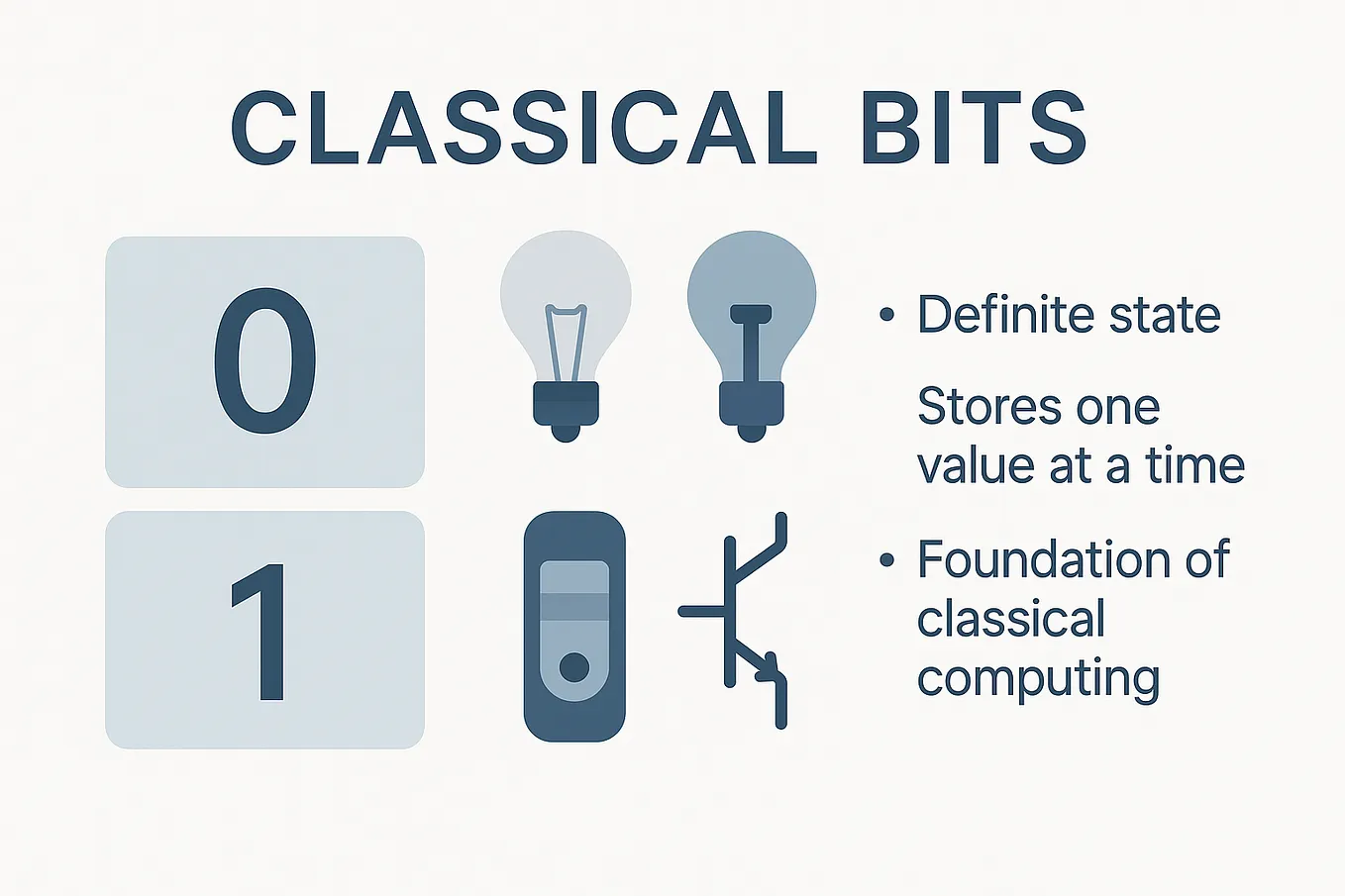
Your laptop bits are like tiny light‑switches. Great for homework, but they can’t play the super‑hard puzzles Mother Nature sets (simulating atoms, cracking monster codes). We need qubits, which can be 0 and 1 at the same time.
2. Three magical building blocks


Each gadget keeps a qubit safe and lets scientists poke it with microwaves or lasers to run gate moves.
Keeping qubits comfy
- Qubits hate heat ⇒ refrigerators colder than outer space.
- Qubits hate noise ⇒ metal shields, vacuum chambers.
- Qubits need friends ⇒ cables and optics that send ultra‑quiet pulses.
What can break?
A bump flips 0 ↔ 1 (bit flip) or smears the coin face (phase flip). Engineers fight these gremlins with error‑correction “bodyguards” (see earlier article).
Where are we today?
Super‑cold metal chips already hold hundreds of qubits, ion traps hold dozens, and photon loops keep getting better. The race is on to build the first error‑corrected “quantum Lego castle.”
Bridge: Everything above is true, but researchers zoom in with microscopes, Hamiltonians and gate fidelities. Let’s peek under the hood.

Superconducting circuits (transmons, fluxonium)
Substrate sapphire / silicon; Al‑AlOx‑Al tunnel junctions.
- Energy scales EJ ≈ 20 GHz, EC ≈ 200 MHz → anharmonicity 200 MHz.
- Control microwave XY drives, virtual Z via frame updates, fast CZ or cross‑resonance CNOT.
- Typical numbers T1 ≈ 150 µs, T2 ≈ 80 µs, 2‑qubit fidelity 99.9 %, gate time 25 ns.
- Scaling flip‑chip or 3‑D coax routing, cryo‑CMOS multiplexers.
Get Jay Pandit’s stories in your inbox
Join Medium for free to get updates from this writer.
Trapped ions (Ca⁺, Yb⁺, Ba⁺)
- Qubit hyperfine states split by GHz; laser cooling to 10 µK.
- Gate Mølmer–Sørensen XX(ϕ) or driven Raman, 10–100 µs, 99.97 % fidelity.
- Coherence seconds to minutes (magnetic‑field‑insensitive clock transitions).
- Bottleneck crystal re‑ordering and photonic interconnects for >100 qubits; modular shuttling traps (“Quantum CCD”).
Photonic qubits
- Encoding dual‑rail modes, time‑bins or polarization.
- Source spontaneous parametric down‑conversion or quantum dots.
- Gates linear optics + measurement (KLM) or fusion gates; needs massive multiplexing to beat loss.
- Advantage room‑temperature; natural for quantum networking.
Neutral‑atom tweezers
- Platform Rydberg blockade or tweezer shuttling.
- Uniform 2‑D arrays 256–1000 atoms; coherent lifetime milliseconds; Rydberg CNOT 1 µs at 99 %.
- Strength re‑configurable connectivity, potential for error‑corrected surface patches in a single array.
Spin qubits in silicon
- Qubit electron or hole spin in quantum dot; ESR or gate‑defined exchange.
- Fabrication leverages CMOS lines; metal‑oxide stack compatibility.
- Gate all‑electrical control < 50 ns; T2* ~ 120 µs with isotopic ²⁸Si.
Topological dreams
- Majorana zero‑modes in InSb/Al nanowires under high magnetic field.
- Goal topological protection ⇒ larger error threshold, simpler surface‑code patches.
- Status Microsoft reports observation of topological gap; braiding demo still pending.
Cross‑cutting metrics
- Coherence vs gate time ratio ≈ T2 / τ_gate dictates circuit depth before error‑correction.
- Connectivity graph — 2‑D grid (superconducting), all‑to‑all (ions), re‑configurable (atoms).
- Classical I/O bandwidth — cryo cables and DACs limit parallel gate count.
Takeaways
- Hardware diversity is a feature, not a bug: different qubit types may co‑exist like GPUs and CPUs.
- Error correction dominates scale: winning platform = one that multiplies physical qubits cheapest while keeping >99.9 % fidelity.
- Control electronics are half the battle: cryo‑CMOS, photonic interposers, and feed‑forward decoders matter as much as the qubits themselves.