Why Albert Collins Had a 100-Foot Guitar Cable
And how it made his live performances so unique

I was watching some clips of Rory Gallagher's live performances, impressed by how engaged he was with the audience, running across the stage like a track star, at times right into the thick of things, sometimes leaning right into the first few rows while still delivering devastatingly precise licks. I started wondering which other artists had high-energy performances like that, which eventually brought me to Albert Collins. Except Collins took it several steps further.
A young Janis Joplin may have been onto something when, at just 15, she listened to Albert Collins in the recording studio and said “Frosty” was going to be a hit. At least, that’s who Collins later attributed the prediction to. While Janis “really dug the music”, Johnny Winter was just as complimentary:
He was a great guy and a great guitarist. — Johnny Winter, 2004
Bob Hite of Canned Heat was another big fan and recalled being blown away by a specific show at the Ponderosa Club in Houston, Texas, in 1968. According to Hite, that’s when Albert started his 100-foot cable routine, but it’s more likely that was a year later. Regardless, the band were students of older blues and encouraged Collins to move out to California. Collins did, and they set him with the right people, including an agent to help boost his career. To show his appreciation, Collins later took the title for his second album in 1968, “Love Can Be Found Anywhere (Even in a Guitar),” from a lyric in Canned Heat’s “Fried Hockey Boogie,” and Hite wrote the liner notes. He also notably opened for the Grateful Dead in early August of 1969.
Get Carldexterwrites’s stories in your inbox
Join Medium for free to get updates from this writer.
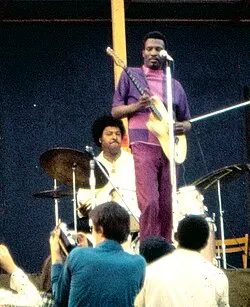
By 1969, Collins was making it a habit to hop off stage for minutes at a time, wandering through rows of people, sometimes jumping up on tables, all while never missing a beat. Perhaps that’s why later that year, he and bassist St. John purchased a 100-foot cable and put a guitar plug on each end, inspired by Big Jay McNeely, who had been doing something similar with a saxophone in the 1950s and even got arrested for disturbing the peace after leaving a San Diego venue in 1952 and honking at passing motorists.

The cable let him leave the club and play in the parking lot while the rest of the band played on stage. One account claims that, at one show, he even crossed the street, entered a store, purchased a candy bar, and came back while playing the entire time. Better documented was an incident at Milto’s in Austin, Texas. He again left the club, walked down a nearby alleyway, and ordered a pizza before returning; a delivery person later brought the pizza to the stage.
As much as Collins loved the blues, he wasn’t afraid to criticize some of its biggest clichés, like the smoky, down-and-out dive bars with a seated guitar player singing the blues. He saw younger generations in the late ’70s and 1980s moving away from the blues and thought younger people wanted more movement, more energy. So he’d hold conversations or share a beer with audience members, all while maintaining a very high level of musicianship.
This did lead to some issues at times, like at the 1978 Monterey Jazz Festival, where there was a strict 45-minute time allotment for each performance. Towards the end of Albert’s set, he walked down a 12-foot staircase and continued to jam. The band couldn’t see him but were ordered off the stage; not wanting to leave him musically stranded, they continued to play before eventually being physically forced off.
The 1980s were a huge decade for a guy who, just 20 years ago, was playing small clubs in Texas. He played Live Aid in 1985 with George Thorogood, worked on David Bowie’s Labyrinth soundtrack, and appeared with Joe Walsh in the 1986 concert Jazzvisions: Jump the Blues Away. Perhaps my personal favorite happened in December 1985: Collins, Roy Buchanan, and Lonnie Mack shared the stage at Carnegie Hall for an “American Guitar Heroes” concert and, towards the end, Collins dragged his guitar cord up the entire Carnegie Hall orchestra aisle, playing while shaking hands with patrons.
Lonnie Mack later described the experience quite vividly:
Roy was like the real psychedelic blues, and Albert was sort of the roots kinda’ blues…and I was right in between all that. So it seemed like all three were a good combination, so we put it together and did it… and it worked. — Lonnie Mack, December 1985
Collins continued recording and performing into the early 1990s, releasing Iceman in 1991, his final studio album, and still touring into 1993 when he was diagnosed with lung cancer. Sadly, Collins passed away later that year, in November 1993, at 61, but he left an incredible legacy of music.