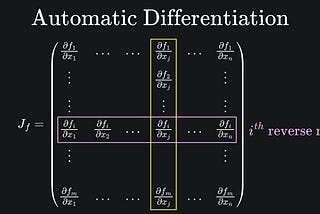
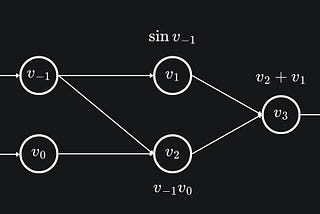
Leigh Collier·Aug 13How do you differentiate code? Automatic Differentiation (AAD) WalkthroughSo you’re presenting your new model, painstakingly trained and optimised, to your stakeholders. It’s going well and people are impressed…
Bwhiz·Apr 23Automatic Differentiation for BeginnersIf you’ve ever trained a neural network, optimized a function, or dabbled in scientific computing, you’ve probably heard the term…
InThe Thoughtful EngineerbyKobi Toueg·Apr 22Thinking in Tensors — Part 1: From Loops to Neural Networks with PyTorchHow tensors, vectorization, and gradients reshape the way we write and reason about code
InSmall Wonders DailybyDiane Foster·Feb 4I Stopped Trying to Stand Out the Hard WayChoose a smaller, smarter nicheA response icon1A response icon1
Anway Kapoor·Jan 6Inside PyTorch Autograd: Building Gradient Flow from ScratchA first principles walkthrough of computation graphs and automatic differentiation.
Philip Mocz·Oct 30, 2025Jaxion: differentiable astrophysics simulationsIn today’s blog post, we’re going behind the scenes of a new software release: Jaxion, a differentiable astrophysics code I’ve been…A response icon2A response icon2
InPython in Plain EnglishbyUsama Safdar·Oct 22, 2025JAX — The Supercharged NumPy for AI & Scientific ComputingIntroduction: Why JAX is the Secret Weapon
AmeerSaleem·Oct 12, 2025What is reverse mode automatic differentiation?Exploring the relationship between forward/reverse automatic differentiation and the Jacobian matrix.
AmeerSaleem·Oct 5, 2025What is forward-mode automatic differentiation?Explaining why the numerical and symbolic differentiation methods are insufficient for neural network gradient techniques.
Ashutosh Jena·Aug 23, 2025Taming Calculus with Magic Numbers: How Julia’s Dyad Package Makes Derivatives EasyWhat if your code could calculate exact derivatives all by itself? With dual numbers, it can.