Astropolitics: Beyond the Stars
The New Frontier of Power

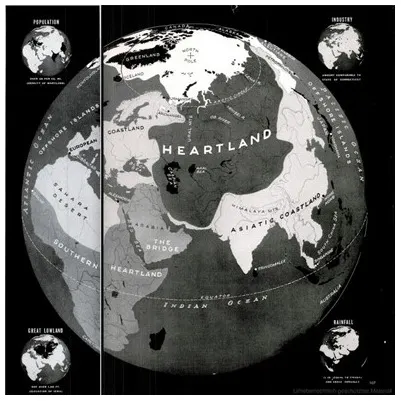
Picture a quiet lab in 2025, somewhere in California. A young scientist with tired eyes, gazes through a telescope at the Moon, a white speck glowing against the black. Her desk is littered with charts of lunar craters and asteroid orbits. “That’s where it’s all headed,” she whispers, scribbling notes about hélio-3 deposits. She’s not just dreaming, she’s mapping the next battlefield. For centuries, power played out on land, sea, and sky, Mackinder’s Heartland, Mahan’s waves, Spykman’s Rimland, Douhet’s bombers. Now, it’s lifting off into space, a frontier called astropolitics. This chapter ties those old theories to this new game, where satellites, moon bases, and asteroid mines are the stakes. It’s not science fiction, it’s the future of geopolitics, and it’s starting now. Let’s launch in and see where we’re going.
Mackinder, Mahan, and Spykman gave us the map, land’s heart, sea’s highways, the Rimland’s edge. They saw power tied to Earth’s surface, but their ideas stretch beyond. Mackinder’s control of the center hinted at holding key spots; Mahan’s sea lanes became orbits; Spykman’s coastal grip now circles the globe from above. The Cold War’s MAD locked us in a nuclear stare-down, but space cracked that ceiling open. Satellites started it, Sputnik in 1957 beeped a wake-up call, and by the ’60s, Apollo 11 planted a flag on the moon. Those moves weren’t just stunts; they were power plays, showing who could reach higher. Today’s astropolitics adapts those lessons: dominate the high ground, space, and you shape what’s below.
What’s at stake up there? Everything. Satellites are the eyes and ears, GPS guides your phone, weather sats warn of storms, spy birds watch borders. Cut those, and nations go blind, imagine a war where one side zaps the other’s satellites, crippling tanks and ships. Then there’s resources. Asteroids hold metals, platinum, gold, worth trillions, and the moon’s got hélio-3, a rare isotope that could power fusion reactors, the clean energy of tomorrow. Picture a lunar mine: robots scoop gray dust, shipping it back to fuel cities. SpaceX and Blue Origin aren’t waiting, they’re racing to mine, with NASA eyeing 2020s missions. It’s a gold rush, but with rockets, not wagons.

Key spots matter too, like the Points Lagrange, five gravity-balanced zones between Earth and the moon. Park a satellite or base there, and it sits steady, perfect for watching or striking. The U.S. Space Force, launched in 2019, aims to hold these; Russia’s rumored anti-satellite weapons, like a 2021 test that blasted a defunct orbiter, signal they’re playing too. Cut an enemy’s sats, and you’ve got the upper hand, no navigation, no comms, just chaos. Think of Mahan’s choke points flipped upward: Lagrange is the Suez of space, and whoever owns it rules the flow.
Get StratOutpost’s stories in your inbox
Join Medium for free to get updates from this writer.
The moon’s another prize. Hélio-3 could power Earth for centuries, China’s Chang’e program and NASA’s Artemis plan to dig in by the 2030s. Bases aren’t sci-fi; they’re coming, permanent outposts to mine, research, or launch deeper. The International Space Station’s winding down by 2030, and nations are splitting off, China’s Tiangong is up, Russia’s planning its own, the U.S. pushes private stations via SpaceX. Billionaires like Elon Musk and Jeff Bezos aren’t just joyriding, they’re betting big. Musk’s Starlink blankets the globe with internet; Bezos wants orbital factories. It’s a private space race, fueling a public power grab.
This isn’t peaceful exploration, it’s geopolitics gone cosmic. Resources drive it, hélio-3 could shift energy wars; asteroid metals could crash markets. Presence matters, bases at Lagrange or the moon signal dominance, like Spykman’s Rimland bases. Cutting tech is the kicker, knock out sats, and you’ve kneecapped a rival without firing a terrestrial shot. The U.S. Space Force isn’t alone, China’s got its Strategic Support Force, Russia’s testing weapons. It’s Mackinder’s control, Mahan’s lanes, Spykman’s edge, all in orbit.
Look at the players. Perseverance rover digs Mars for clues, but it’s a flag too, America’s here. China’s moon landings flex muscle; India’s joining with Chandrayaan missions. Private firms, SpaceX, Blue Origin, even Japan’s iSpace, chase profit, but nations chase power. The ISS’s end splits the pack, cooperation’s fading, competition’s rising. Hélio-3’s the long bet, fusion’s decades off, but whoever mines it first owns the future. Asteroids are closer, NASA’s Psyche mission, set for 2029, targets a metal-rich rock. It’s a race for the stars, and the prize is everything below them.
What’s the future? Control orbital, own the skies, and Earth’s yours. It’s inspiring, humanity reaching out, but curious too: will we share or fight? The Great Game’s gone galactic, and geopolitics follows.
If this excerpt was enough to pique your interest, check out this and my other works available on Amazon. Each book costs USD 3.99, or free for Kindle Unlimited subscribers. I appreciate your support.