When Rewriting Makes a Draft Worse: 7 Problems AI Editors Can Introduce


AI rewriting often arrives with a simple promise: cleaner sentences, fewer errors, and easier reading. The draft may look more polished after one pass. But cleaner wording does not guarantee a better piece of writing. A rewrite can weaken meaning, remove useful details, or replace specific language with something far more ordinary. The useful question is not whether the new version sounds polished, but whether it still does the same job as the original.
That matters most when the first draft already has a clear argument or a recognizable voice. A related point appears in this article, which discusses keeping control of existing voice and giving clear limits during editing. The same principle applies when evaluating a rewrite. An editor should not receive unlimited permission to replace every sentence that looks unusual. A good review compares what was gained with what may have disappeared.
1. Meaning Drift and Missing Details
Problem 1: The sentence means something slightly different. AI rewriting can preserve the topic while changing the actual claim. Consider the sentence, “Customers usually cancel after the second billing cycle.” A rewritten version might say, “Customers often cancel after a few months,” which sounds harmless but removes a specific time point and adds a broader claim. That difference matters if the second billing cycle is important to the argument. Check rewritten sentences by asking whether the subject, condition, timing, and level of certainty still match the original.
Problem 2: Small details disappear because they look unnecessary. A draft may say that a team tested three landing pages during a six week campaign, while a rewrite reduces this to “the team tested several versions.” The new wording is shorter, but two useful facts are gone. Details often carry the evidence that makes a sentence credible or useful. Removing them can turn reporting into vague summary. Check every paragraph for numbers, conditions, examples, exceptions, and limits that appeared in the original.
A fast comparison can focus on four questions:
- Did any number, date, condition, or exception disappear?
- Did a cautious statement become more certain?
- Did a specific action become a broad summary?
- Did the rewrite add a conclusion that the original never made?
2. Generic Vocabulary and Writing That Becomes Too Smooth
Problem 3: Precise words get replaced with generic vocabulary. A sentence that says “the customer abandoned checkout after seeing the shipping fee” may become “the customer had a negative experience during the purchasing process.” The rewrite sounds formal, but it hides what actually happened. Words including “experience,” “solution,” “approach,” and “process” can sometimes replace information instead of improving it. Specific verbs and nouns usually make editing easier to verify because the reader can see the action. Check suspicious sentences by asking whether a concrete action has been replaced with an abstract label.
Get Karen Covey’s stories in your inbox
Join Medium for free to get updates from this writer.
Problem 4: The writing becomes too smooth. Real drafts often contain useful changes in pace. A short sentence can stop the reader after a dense explanation, while an abrupt transition may signal that the argument is changing direction. Rewriting every paragraph into equally balanced sentences can remove that variation. For example, “That failed. The reason was obvious by Friday” may become “The approach ultimately failed, and the reason became apparent by the end of the week.” The second version is grammatically fine, but the first may fit the surrounding paragraph better.
These two problems often appear together because generic language is easier to arrange into predictable sentences. Read the rewritten version aloud and mark any passage that could belong to almost any article on the same topic. Then compare it with the original rather than asking whether the new sentence sounds professional. If the old version is more concrete, keep it.
3. Tone Can Change Without Any Obvious Error
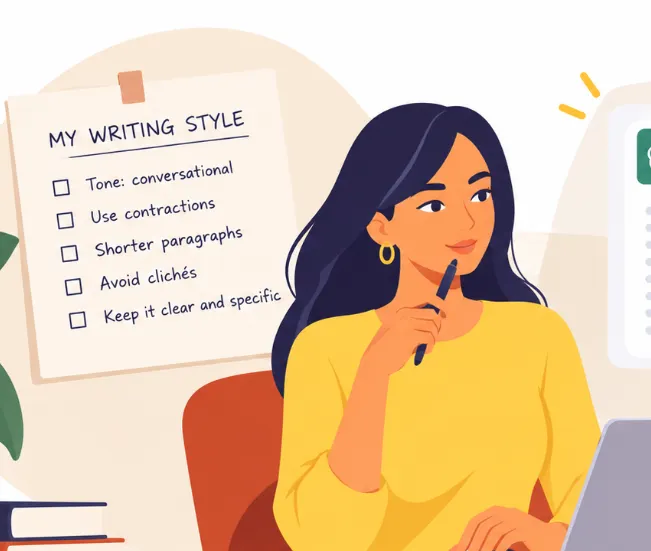
Problem 5: The rewrite changes the relationship with the reader. A practical sentence can become formal, friendly wording can become corporate, and a firm warning can become strangely polite. For example, “Do not publish the page until the prices are checked” may be rewritten as “It may be beneficial to review the pricing information before proceeding with publication.” Nothing is grammatically wrong, but the instruction has lost its force. Tone is carried by word choice, sentence length, certainty, and how directly the reader is addressed. Check important sections against a simple tone description written before editing. If the draft is meant to be direct, practical, skeptical, conversational, or restrained, the rewrite should still meet that description.
Before accepting a tone change, check:
- whether commands became suggestions;
- whether simple words became formal ones;
- whether humor or skepticism disappeared;
- whether “you” was removed where direct instruction was useful;
- whether confidence increased or decreased without a reason.
4. Repeated Structures and Corrections Nobody Asked For
Problem 6: Different paragraphs start using the same structure. An AI editor may solve several sentences in the same way even when the original draft had more variety. One paragraph begins with “The key issue is,” another with “The main problem is,” and the next with “The important point is.” The individual sentences look acceptable when reviewed separately. Across a full article, however, the pattern becomes easy to notice. Check the first sentence of every paragraph in sequence, then look at sentence length and repeated transition phrases.
Problem 7: Correct and intentional wording gets “improved.” An unusual phrase is not automatically a mistake. A writer may choose a blunt fragment, repeat one word for emphasis, use an unexpected comparison, or keep a simple phrase because a more formal version would sound wrong. For example, “The page is busy. Too busy.” may be rewritten into “The page contains an excessive amount of information,” even though the original rhythm was intentional. Check every major change to a sentence that was already clear and grammatically acceptable, and ask what specific problem the rewrite solved.
A safer editing process gives AI rewriting a narrower job. First identify what needs correction, then request changes only in those areas. Compare the result sentence by sentence instead of judging the rewritten draft as one finished block. Keep an original copy nearby so removed details and altered claims are easy to recover. Most importantly, reject changes that cannot answer the question, “What became better here?”
Rewrite does not automatically mean improvement. A stronger draft may contain a few odd sentences, sharp transitions, specific details, and phrases that another editor would have written differently. Those features are not defects when they serve the argument and fit the intended voice. The best final version is often the one that keeps useful imperfections while fixing actual problems.