Thinking Is All There Is

Why anything exists, why it is the way it is, why we are conscious, and how to build a mind have one answer. Let’s clear things up once and for all. But with a twist: Every single claim here is backed by rigorous mathematics, machine-checked formal proofs, computer-assisted arithmetic and simulation receipts. It’s an open research program and you’re all welcome to contribute your ideas. This article focuses mostly on the metaphysics, while my recent IPI blog post and Philpapers prepint give the full mathematical details: The hardware and software of the “simulation” (not the best word, but let’s stick with it for now) we inhabit. Spoilers about the Universe ahead, read at your own risk.

Four questions are usually handled separately, by metaphysics, physics, neuroscience and computer science. Why is there something rather than nothing? Why does it have these laws and these constants? Why does any of it feel like anything from the inside? And what would it take to build a machine that thinks? Observer Patch Holography (OPH) gives one answer to all four, and the answer is a single operation: two neighbours who each see part of the world compare where their views overlap, repair the disagreement, and keep a record. Run it on a finite network and out come, as machine-checked theorems and reproducible simulations, three dimensions of space, one direction of time, the causal order, quantum probability, gravity and the forces from one move on two channels, the particles, and two constants of nature to several decimal places, with no adjustable number anywhere. Run it inside a body and out comes a nervous system. Run it in a room of people and out comes a conversation.
Everything starts from perfect equilibrium, which holds no record and represents nothing; a something is that symmetry broken by a small amount. Qualia, the felt qualities of experience, the redness of red as against its wavelength, are present wherever the operation reads its own state, and a three-line proof says they must be. Your brain is a region of the network thinking about the network. And the universe generates observers because a universe without them cannot exist, which is a fixed point rather than a paradox, because time is one of its outputs. I know how this sounds. Every claim below links to a book chapter for non-specialists, a textbook chapter for math and physics nerds, and a computer-checked proof where available.

1. One operation
On 18 June 1858 a package reached Down House in Kent, and Charles Darwin opened it and found twenty pages of his own theory written by a man he had never met. Alfred Russel Wallace had drafted the essay on Ternate, in the Moluccas, between bouts of fever. Darwin had been assembling the same argument for twenty years out of barnacles, pigeon fanciers and a filing system of small stubborn facts. Wallace had assembled it out of beetles and birds on the other side of the planet. Neither had seen the other’s records. On 1 July both accounts were read aloud to the Linnean Society of London, to no discussion, and the following May the society’s president reviewed the year and reported that it had not been marked by any striking discoveries.
Two bounded observers, two different sets of records that overlapped where it mattered, one sentence that both sets forced, and a public fact that did not depend on which of them wrote it down first. The claim of this article is that the pattern reaches a long way below scientific life. It is the only thing there is.
Strip it to the smallest case. Two carpenters measure the same table. One says 210, the other says 2.1. That disagreement disappears when they agree on units. One measured to the edge, the other included a protruding fitting. That disagreement does not disappear when they agree on units. They have to go back and look. Once they have looked and agreed, both write it down, and the two notebooks now agree on that entry whatever else they contain.
That is the whole operation. A patch is a bounded observer: something that sees part of the world, can write what it sees, and reads what it wrote when it decides what to do next. Two patches share a seam where their views overlap. If they disagree there, one of them repairs its own state. A repair is accepted only if it lowers the disagreement on every seam it touches and strictly lowers it somewhere. When it does, the specific disagreement is thrown away and only the fact of agreement survives as a record.

Three theorems make this more than a metaphor, and they are short enough to follow with a pencil.
On a finite network the process stops. Total disagreement is a sum of nonnegative seam mismatches, every accepted repair strictly lowers it, and a strictly decreasing sequence in a finite set of values cannot go on forever.
It does not matter who goes first. Under a local condition (two repairs that overlap have one canonical merge, and each commit revalidates what it read), Newman’s lemma from 1942 turns local confluence into global confluence. Every maximal schedule from the same start lands in the same consistent normal form. That unique endpoint is what the word “public” means here.
What survives is a quotient. Anything one patch can change without changing what any seam reads was never public. Physicists call that a gauge symmetry. The book calls it the claim that part of your description was never physical, which is the same statement with the flattery removed.
The first two theorems are in the Lean library with no admitted steps, together with three small countermodels that show which hypothesis each conclusion needs: a fork system that terminates and lands in two different places because it lacks confluence, a settling system whose truncated schedule stops early, and a system whose hidden bit controls its public endpoint and therefore never descends to the quotient [1]. I mention the countermodels because a theory that only shows you where it works is a marketing brochure.
None of this needs a boss, a clock or a global view. No patch ever sees the sum it is lowering. The mathematician uses the sum to prove something about the network. The network has never heard of the mathematician. The nearest everyday thing is an orchestra tuning without a conductor, every player hearing only the players nearby and the sheet music incomplete. It squeals, and music appears anyway, because a bad interval is information about a failed relation and a stable chord is a local proof that several instruments have found a continuation they can share.
So the first reversal is small and it is the one everything else stands on. Objectivity is the thing that does not depend on the order in which its parts settled it. Which leaves the question of what a network holds once it has finished.
Further reading:
Book: why strangers can agree without a boss, what move reality actually makes, why it does not matter who goes first, what everybody ends up holding. Textbook: repair laws, the consensus protocol. Papers: Reality as a Consensus Protocol[2], Observation-Determined Normal Forms[3]. Proofs: AbstractRewriting.lean, FixedPointEndpoint.lean.
2. Why a perfect equilibrium is literally nothing
Take the network and let it finish. Every seam agrees, every disagreement register reads zero, nothing is left to repair. Now ask what it holds.
Nothing. A state that every observer reads the same way, from every side, under every relabelling, has no distinction in it, and a record with no distinction in it is a blank. The book’s second chapter makes the point with one line of algebra. If a state is symmetric under some change, g x = x, and the rule respects that change, T(g x) = g T(x), then the rule’s output is symmetric as well, g T(x) = T(x). A perfectly symmetric start stays perfectly symmetric forever, whatever the rule does. It cannot record, encode, decide or be wrong, and by the terms of the existence demand later in this article it cannot exist. It would be very tidy, and nobody would be in it to say so. Perfect symmetry is the absence of anything for a calm to be about.
So the equilibrium that matters is never the symmetric one. Picture a marble balanced on the ridge between two identical bowls. That is an equilibrium, and it is nothing: no choice has been made and there is no record that could say which bowl. The marble becomes a something when a small asymmetry arrives, a draught, a tremor, a grain of dust, and it rolls. Then there is a fact about which bowl, a record of it, and a landscape that has been told apart from its mirror image. The asymmetry can be tiny. It has to be there.

Every level of the theory has that grain of dust in it, and it is usually the most interesting number in the room. In our Universe, the holographic screen’s own constant sits one observation step above the golden-ratio equilibrium, P − φ = α√π, so the fine-structure constant is the size of the detuning that makes the screen a something rather than a symmetric blank. A thought is a set of equally good candidate answers, isoenergetic basins with an unstable symmetric point between them, and evidence is the small field that breaks the tie. With the tie exactly unbroken the correct output is “ambiguous”, and a system that emits a confident answer instead has manufactured the asymmetry out of nothing, which is the technical description of a hallucination. A living thing keeps its readings a fixed distance from the equilibrium its surroundings would drag it to, and pays for the distance. A beat that lands exactly where predicted is dull, because nothing is left to repair; a beat that lands where nothing could be predicted is noise; groove is the repairable middle. Boredom, in this theory, is a physical state: nothing left to repair.
That is the operating triad under everything in this article. An equilibrium, a detuning that chaos or observation supplies, and a new equilibrium that keeps what worked. Nothing is ever at rest. A stable object is a fixed point that is currently holding, and every fixed point is provisional under the next grain of dust. Thinking and reality are the same triad at different grain sizes, and neither can start from a perfectly balanced marble. The next question is what the detuning has to be when the equilibrium in question is a mind.
I want you to read this sentence completely literally: An OPH patch net in an equilibrium computes an actual instance of nothing. Something can emerge by breaking the symmetry.
Further reading. Book: why there is anything rather than nothing, which carries the symmetry line, and why 1/137. Textbook: the pixel closure. Papers: the Thinking paper, whose thesis is that human thinking is detuned fixed-point consensus[5], and the fine-structure paper[21].
3. Why settling is thinking, once you add three things
A system that only settles is a machine for getting stuck, and it will describe that condition as having made up its mind. Give it one deep basin and it returns there from anywhere.
Thinking needs three more operations on the same landscape, and a brain has all of them.
Evidence tilts the landscape. It is the grain of dust from the previous section, arriving on purpose. A small field favors one answer over another without guaranteeing that a system sitting in the old basin gets there. That is how a new fact fails to change a mind without being ignored: the landscape moved and the ball did not.
Exploration jumps the barrier. Imagination, play, a strange analogy, a counterfactual, a colleague who will not let it go. Each of these raises disagreement for a while so that a better settlement becomes reachable. Creativity is controlled dysphony that pays for itself later.
Learning reshapes the landscape, and the rule is local. Let the network settle freely. Nudge its output gently toward what it should have done and let it settle again. The difference between the two settlements, measured at each seam, is the learning signal for that seam, and nothing else needs to travel. Machine learning knows this mechanism as equilibrium propagation.[4] After learning, the same input reaches a stable answer faster and with less disagreement. Learning is the conversion of effortful repair into automatic convergence.

A crossword does all four in an evening. You settle on an answer that fits the clue. A crossing letter arrives and tilts the landscape, and the wrong answer sits there anyway, locally stable and now slightly embarrassing. You put the paper down and walk to the kitchen, which is the jump, and the right word is waiting when you come back. The next time that setter uses that trick the landscape has already been reshaped, and there is nothing to solve.
With those four operations you can name the familiar mental states without a single new ingredient. Confusion is many incompatible modes active at once. Effort is high disagreement under repair pressure. Insight is a basin boundary crossed, with a sharp fall in mismatch. Certainty is a stable low-disagreement normal form. Confidence is the probability that a small shove returns you to the same basin, which is why a confident person and a stubborn one are hard to tell apart from outside. Understanding is when one relation starts doing the work that many separate memories did.
That last item supplies the definition this article wants to emphasize. Thinking is the settlement of competing constraints into a stable state, the retention of what settlement teaches, and the reopening of a settlement when evidence or imagination makes another one available. Every clause of that definition was written with a brain in mind. None of them mentions one.
Further reading. Paper: Thinking as Patch-Net Fixed-Point Search[5], which carries the neural dictionary and the finite theorems. Book: why the world is made of relations. Textbook: what the machine emits.
4. The universe runs the same operation
Physics has two rulebooks, and they do not agree about what space and time are. Quantum field theory covers three of the four forces and every known particle, and it does so on a fixed stage: space and time are given in advance, and the fields live on them. General relativity covers gravity by making the stage itself curve. Matter tells spacetime how to bend, and bent spacetime tells matter how to fall. Each rulebook is confirmed to absurd precision in its own territory. Put them in one room and the trouble starts. Write gravity in the quantum rulebook and the calculation produces infinities that can be absorbed only by adding a new adjustable number at every order, without end, and a theory with infinitely many dials fits anything and forbids nothing. The quantum rulebook has a hole of its own, since it never says what a measurement is or why one outcome happens rather than another, and general relativity, classical from top to bottom, has no room for the question. A student inherits the floor plan as though nature had signed the lease: curvature of spacetime in this room, curvature of an internal gauge connection in that one, and a corridor between them that nobody has managed to walk down in ninety years. The attempts have names, strings and loops among them, and the book’s first chapter keeps a log.
The operation described above does not walk down the corridor. It removes the building. There is no stage in it to quantise and no field to geometrise, because it starts with neither. Both rulebooks are outputs, and they are outputs of one move on two channels. Where repair acts on the geometry of the seams themselves, the result is gravity. Where repair acts on the internal transport across a seam, the compact rotations a patch can perform on its own state without changing what the seam reads, the result is a gauge force. One disagreement sum, two channels, and the two theories that would not speak to each other are the same sentence read in two directions. Measurement, the hole in the other wall, becomes a record write, which the quantum paragraph below spells out.
The book’s prologue is titled “No Source Code, No Documentation”, and it turned out to be pessimistic by one sentence. The physical universe is a network of these patches, and nothing else. Each patch has twelve ports, sitting at the vertices of an icosahedron, and the number is forced: a closed triangulated surface on which every port touches five triangles has exactly twelve ports, by Euler’s formula. The software is the one move above. There is no space in the substrate, no clock, no wave function, no gauge group and no particle list. Space, time, quantum mechanics, forces, matter and constants are what the move outputs when it runs.
I am aware that this is the kind of sentence people write at three in the morning. The difference is that this one was run. The open-source simulator settles 65,536 patches and shows thirty-three panels in six acts, each labelled as a theorem, a runtime measurement, or an illustration, so you can see which is which.[6] The flagship paper’s diagnostic tower goes to 81,920 patches with every receipt pinned.[7]
What comes out, structure by structure.
Space has three dimensions because the linearised repair operator on twelve ports respects the icosahedral symmetry, which splits twelve readings into bands of rank 1, 3, 3 and 5, and only the slow rank-three band keeps its content across many repair passes. The Gram matrix of the twelve port vectors satisfies G² = 4G with trace 12, hence rank three, and the Lean kernel checks that identity in exact arithmetic.[8]
Time has a direction because every accepted repair strictly lowers a quantity bounded below, and a repair discards the disagreement it settled, so no rule runs the sequence backward. The four laws of thermodynamics, the fluctuation identities and Landauer’s bound come out of the same repair kernel as one composed theorem. [9]
Energy comes out as the rate at which a region’s records are repaired per tick of its own clock, and mass as the standing cost of holding a pattern in place while its records go nowhere. E = mc² is the identity between the two at rest. A massless pattern has no standing cost, so the only thing it can do with its ledger entry is move it one seam per tick, which is why light has a speed and why nothing overtakes it.
Quantum probability comes out because a measurement is a record write into the commuting part of an observer’s algebra, and the only weight that is additive on coexisting effects and respects observer agreement is the trace against a density operator, in every finite dimension, with no continuity axiom. [10] Nothing collapses. A record gets written and the rest of the network repairs toward consistency with it. Wave function collapse is experienced by the observer and is purely epistemic.
The forces come out because the twelve-dimensional reversible response of a patch, required to implement its own symmetry from the inside, has a centre of dimension one and a semisimple remainder of dimension eleven, and eleven splits into compact simple pieces in exactly one way, 8 + 3. That is u(1) ⊕ su(2) ⊕ su(3), the Standard Model, with one anomaly-free generation of matter and a proton that stays put.
Gravity comes out because both inputs of Jacobson’s 1995 derivation of Einstein’s equation, the entropy-area law and the Unruh temperature, are outputs of consensus equilibrium on a collar between patches.[11] The cosmological constant is the horizon’s record capacity read as entropy. That is the geometric channel; the forces paragraph above is the internal-transport channel. Nothing was quantised and nothing was geometrised. The two rulebooks are two readouts of one repair.
Then the numbers. The machine has two closure equations and no adjustable dial, so nothing below was fitted; there is no free constant to fit with.
- Inverse fine-structure constant: 137.03566 out of the machine, 137.035999 measured.
- Cosmological constant: 1.093 × 10⁻⁵² per square metre out, 1.089 measured from supernovae, the microwave background and galaxy surveys.
- W and Z masses: 80.33 and 91.12 GeV out, 80.37 and 91.19 measured.
- Higgs and top masses: 125.20 and 172.35 GeV out, 125.09 and 172.69 measured.
- Tau mass: 1776.969 MeV out, from a window seventy electronvolts wide, against 1776.93 ± 0.09 measured.
The first row is the one we want argued over. Its gap is ten thousand times the experimental uncertainty, and because there is no dial it cannot be tuned away; it has to be earned by finishing a calculation, which I come back to at the end.
A comparison shows why a visible miss is the good kind. In 1859 Urbain Le Verrier, who had found Neptune on paper thirteen years earlier, proposed a planet inside Mercury’s orbit to account for 43 seconds of arc per century that Newton’s bookkeeping could not supply. Vulcan was never there. Each failed search moved it rather than killing it: smaller, closer in, differently tilted, and at last broken into a belt of bodies each too small to see, which no observation could exclude. A planet comes with a mass and an orbit, and both are dials. Flexibility is what lets a description survive contact with data, and every bit of it is subtracted from what the description tells you. In November 1915 Einstein computed the same 43 seconds from equations with nothing adjustable in them, which is why those 43 seconds could have killed the equations and did not, and the search for Vulcan closed after fifty-six years. The two closure equations are in Einstein’s position. The fine-structure row is the 43 seconds: a disagreement in the fourth decimal place that nothing in the machine can be moved to close.

Carry the table through the rest of this article. The universe, a nervous system and a conversation have one skeleton: local views, shared boundaries, disagreement, one move, records. What differs is the substrate and the grain.
Further reading. Book: the prologue and chapter one, which keeps the log of unification attempts; then what one piece of reality is made of, why twelve, why space has three directions, why time runs one way, why anything has energy, why you cannot ask everything at once, why gravity looks like geometry, why exactly these forces, why 1/137 and why every open problem was the same problem. Textbook: the twelve-port carrier, the pixel closure, the capacity closure, three dimensions, energy, mass and momentum, the arrow of time, measurement as record writing, the Born rule, why quantum field theory works, Lorentzian spacetime, gravity as curvature, the four laws, why the gauge group is a product, these masses and couplings, the derivation map. Papers: the flagship[7], the gauge-structure paper[22], the Yang–Mills paper[23], the spacetime paper[11]. Proofs: PortFrameGram.lean, FourLawAdequacySurface.lean, EinsteinBranch/Composition.lean. Watch it settle at simulation.floatingpragma.io, acts one through six.
5. Thinking weaves causality
Causality is usually pictured as a row of billiard balls. One strikes the next, and the universe clatters forward because something behind it keeps kicking. The operation gives a different picture: Reality is literally a “weavng” of causal relations by observers.
Every accepted repair is a commit, and a commit certifies which earlier records it read before it wrote. Follow those certified reads backward and you have the commit’s past. Follow them forward and you have everything that depended on it. The read-from relation, closed under following, is a partial order: some commits come before others, and many pairs come in no order at all, because neither read anything the other wrote. Two repairs at opposite ends of the network, with no seam between them, are unrelated whatever a scheduler did with them, and the question of which happened first has no record it could be written in.
That order is a causal set in the sense Bombelli, Lee, Meyer and Sorkin gave the phrase in 1987, with one difference. They postulated the order. Here it has a source. The longest chain of certified reads behind a commit is its height, and height is a time coordinate. The number of commits between two events tracks the volume of the interval between them, and in the runs the fraction of pairs that stand in some order settles near one in ten, which is the signature of four dimensions. Malament proved in 1977 that order plus counting fixes a Lorentzian geometry uniquely, and Hawking, King and McCarthy had shown the year before that the causal structure carries the topology with it. So the fabric relativity calls spacetime is the woven read-from order seen from far enough away, and general covariance is the statement that the cloth does not care what you call the threads.[25]

A cause, on this picture, is an exposed mismatch, an accepted repair, a record, and a changed continuation. The arrow of time is the order in which mismatch becomes readable, repairable and binding. Nothing kicks from behind. Each thread is added by an act of the operation, and the operation is the one this article has been calling thinking. That is the sense in which thinking weaves causality. In a brain it is literal at the small scale: what you attend to and repair is what your later states certify having read, and a thought’s causal past is the set of records it consulted. In a conversation the same thing happens across two skulls, and a sentence you took in becomes a thread that your next sentence hangs from. At the base layer it is the whole of what causality is.
Further reading. Book: why there is no such thing as now, why time runs one way. Textbook: Lorentzian spacetime, why time runs forward. Paper: the spacetime paper[11]. Proofs: SourceDerivedEventPrecedence.lean, SemanticEventProvenance.lean[25].
6. Why anything bothers to stay alive
Claude Bernard’s rabbits arrived from the market with the urine of a cat: clear and acid instead of cloudy and alkaline. They had not eaten. He fed them grass and the urine went cloudy within hours; he took the grass away and it went clear again. A fasting rabbit is a carnivore, and the meat it eats is the rabbit. What the animal was defending was the composition of the fluid its cells sit in, and it held that composition by taking its own liver apart.
Bernard called the defended fluid the internal environment, and his summary in 1878 was that its constancy is the condition of a free and independent life. Walter Cannon gave the steady state its name, homeostasis, in 1926, in a jubilee volume printed in an edition of five hundred copies, which is a small print run for a word that turned out to be needed everywhere.
Now put the rabbit next to the one operation. Repair in the base layer happens by itself. Two readings disagree, a repair fires, disagreement drops, and nothing anywhere wants anything. A rabbit interrupts that pattern by holding a set of readings fixed at its own expense and going on holding them until it has nothing left to spend.
So there are two ways for a reading to stay put, and they are different physical situations wearing one word. In the first, the invariance belongs to the laws and costs nobody anything, like the fact that physics is the same a metre to the left. In the second, the invariance is manufactured by a bounded observer out of its own capacity, continuously, against neighbours whose repairs keep rewriting the shared boundary. Holding an invariant against that traffic is a rate rather than an act, which is why the liver never finishes, and why a mammal that stops paying cools to the temperature of the room it is lying in.
A living thing is a pattern that keeps its public reading extendable at its own expense. Bounded, because it has a finite interface and a finite budget. Homeostatic, because the invariance on its seams is manufactured. Persistent, because the claim is about the reading holding across record time. A rabbit is alive on Tuesday because it was alive on Monday and paid for the difference.
Every living thing then faces one choice, at every moment, out of a finite budget. It can spend on itself: rewrite its own patch until its reading matches the seam. Or it can spend on the seam: rewrite the shared record so that both sides read something new. A bacterium can retune its receptors, which spends inside the membrane and leaves the sugar in the water exactly where it was, or it can swim, which puts its boundary against a different piece of the world. A company can improve the product or buy the billboard. The rule it chooses by is its policy, and running a policy is the whole of behaviour.
There is a small theorem here that is worth seeing on four states, because a system with four states has nowhere for an inefficiency to hide. Give an observer one shared register, readable by a neighbour, and one private flag that says whether the observer matches what the shared register says about it. Two consistent states, two inconsistent ones. A private move clears the flag and touches the shared register not at all. A shared write changes the register. Start in a consistent state and ask for the other consistent state.

No sequence of private moves reaches it. The argument is one line: a private move leaves the shared register alone, and composing any number of moves that each leave a quantity alone leaves it alone. The size of the private budget never appears in the argument, which is why enlarging it does nothing. A shared write reaches the target with probability one, and any scheme with a positive chance of arriving writes the shared register somewhere along the way.
Perfect internal adjustment and starvation are compatible states. A firm can spend a decade making a better product and arrive at a market that has never heard of it. A person can meditate for years and leave every seam they share with another person reading what it read before.
Every nervous system is an extension of the homeostasis of the universe in a sense that can be stated without metaphor. The base layer repairs seams. A cell repairs seams and pays to keep a boundary. A nervous system repairs seams, pays to keep a boundary, and carries a policy over the two budgets, with records of its own repair state to compute the policy from. Nothing new was added at any step. What grew was the number of registers, the depth of the record, and how much of the policy is computed off readings the observer takes on itself. Whether that description fits a real nervous system is a question with data attached.
Further reading. Book: why a universe needs anybody in it, why anything tries to persist, why a bacterium is freer than an atom, why writing costs heat. Textbook: energy as a repair rate. Paper: Paradise as Fixed-Point Consensus[12], for life, homeostasis and the first interior.
7. Every nervous system is a patch net
If brains run the base-layer operation, then a measured nervous system should behave like a patch net when you wire it up as one and do nothing else to it. That is testable, and we tested it. For this purpose, we built an open-source machine learning libray called Cadence. It’s fully functional and you can start using it right now.
The dictionary is short. A patch is a neuron. A seam is a synapse or a gap junction. Disagreement is prediction error or failed synchrony. Repair is inhibition, gain control, dendritic integration, plasticity. A record is a synaptic weight or a persistent activity pattern. A spike is a write to the shared boundary. A percept is a normal form.
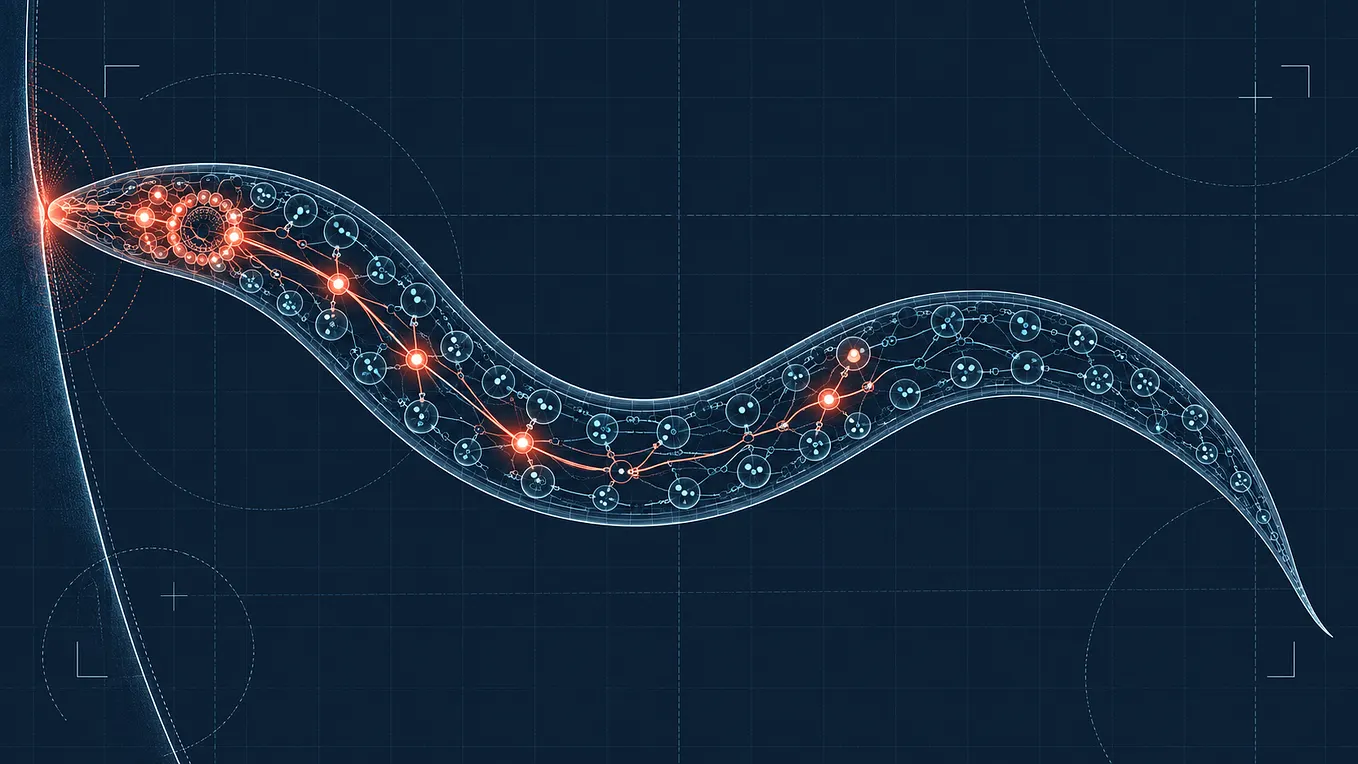
We took the complete published wiring diagram of the roundworm Caenorhabditis elegans, 300 neurons with their chemical synapses and gap junctions, and ran it as a patch net: graded settlement, a sign per neuron, a gain per connection, fitted to four published facts about intact worms and to nothing else. Then we asked it seventeen questions from the ablation literature that it had never seen. Kill this neuron; does the worm still reverse when you touch its nose? The real wiring answered 9.1 of 17 correctly, averaged over seeds. The same neurons with the wiring shuffled answered 4.6. The command interneurons that the literature names as the backward and forward drivers passed every one of their rows on the real wiring and at most two of eight on shuffled wiring.
Then we did the fly. The FlyWire reconstruction of an adult Drosophila brain has 138,639 neurons and 2.7 million connections above threshold, with a predicted sign per connection. We ran the whole thing as a patch net with one global gain selected on three training facts. On 29 held-out experimental rows from the literature (taste specificity, bitter suppression of feeding, the looming-to-escape pathway, the sparseness of the mushroom body and its densification when its inhibitory neuron is removed) the real wiring passed 14.5, the shuffled wiring 7.5. Joined to the nerve cord through its descending neurons it becomes a 161,827-owner nervous system, and that nervous system has driven a biomechanical fly in a physics simulator, where it mostly stands still with great conviction. An owner-local reference engine, in which each neuron sees only its own inbox and a message ledger records every exchange, reproduces the fast engine to within three parts in a hundred thousand, which is what turns “patch-net dynamics only” from a slogan into a receipt.
- Worm, 17 held-out ablation rows: measured wiring 9.1, shuffled wiring 4.6.
- Fly brain, 29 held-out rows: measured wiring 14.5, shuffled wiring 7.5.
The learning rule from the settling section, run on the public cadence library, gives the rest of the picture. On handwritten digits a patch net reaches the accuracy of a same-size backpropagation network in less than half the passes over the data. On associative recall it retrieves the value of any key in a context of 128 pairs with no trained parameters at all, where a two-layer transformer trained on the task gets one percent. On Bach chorales it beats a same-size backpropagation network on both measures. On Pong from reward it returns 78 percent of balls against 93 for backpropagation on the same rollouts. [13]
One caveat: The worm and fly fits were computed with a global gradient. The owner-local learning rule on its own does not reproduce the worm result, because a nudge on the motor neurons reaches upstream only along seams that end on owners it moved, and a directed connectome does not carry it back past the command interneurons. The cadence examples say this in as many words, and the worm rung left their ladder for that reason. The connectome receipts sit in the programme’s research repository, whose publication is work in progress; the library that consolidated those lanes is public. Note that Cadence is brand new and we are just figuring out what its capabiliies are.
The music result is the one I find most telling, because music has no reason to exist in a brain that is a lookup table. If a brain is a patch net inheriting the symmetries of the base layer, then consonance is low spectral mismatch, groove is high phase unison with a little repairable error, and a resolution feels like a resolution because the auditory, emotional and motor patches have performed a consensus repair. A patch net trained on chorales prefers the intervals Bach preferred without being told what an interval is.
Further reading. Paper: Thinking as Patch-Net Fixed-Point Search [5], for the neural dictionary, the finite theorems, and the clinical and musical readings. Code: the cadence library, whose README says where it comes from, and its example ladder [13]. Book: why time feels like it is moving, the chapter about the observer’s own clock.
8. How to build a mind
If a brain is a self-reading patch federation running one local move, then the recipe for a machine that thinks is the same recipe, and the things it needs are the things current architectures treat as afterthoughts.
Owned state that never freezes, because a brain has no training phase followed by an inference phase. Local credit, because no neuron reads a global gradient. Compute that scales with the size of the disagreement rather than the size of the model, because a settled region does no work. Records that the system itself rereads and acts on, because that is what makes it an observer at all. And obstruction as a first-class answer: when the clamped evidence admits no consistent completion, say so, instead of producing a fluent paragraph about something else.
The base-layer primitives are enough for this in principle, and that is a theorem. Patch-local repair, with nothing global anywhere inside it, computes every function of bits. Compile a formula into a federation of observers, one patch per gate, let them repair in any order, and the function’s value sits in a designated register of the settled state from every start. The same result compiles every formula into a word over the icosahedron’s own group of sixty rotations, which is Barrington’s 1989 construction with the carrier’s group doing the work. [19] Five cards on a table, shuffled in the right order, are a computer, and the carrier has been holding five of them since before there was a table.
The programme’s organising sentence about biology is the one I would put over the door of any lab trying this: the DNA encodes who may clamp what and when; intelligence is what the clamps carve; and language is what happens when the clamp sources include your own records and other observers. Nature does not ship a trained network. It ships a constructor, a set of constraints, defaults, learning gates and viability interfaces, and lets development and a lifetime fill in the rest. Two exhaustive finite experiments, with their optima proved in Lean, show exactly when a heritable default, a developmental cue and runtime learning each win. [20]
Get Bernhard Mueller’s stories in your inbox
Join Medium for free to get updates from this writer.
What exists today is early and public. The cadence library implements the one move and the free-versus-nudged learning rule, from a six-owner toy to the 161,827-owner nervous system above, and certifies that every fast backend computed nothing an owner could not see. Its example ladder keeps a rung only while the receipt shows the patch net ahead of the strongest backpropagation model in the same script, and four rungs are on it: digits, where the advantage is fewer passes at the same accuracy; associative recall, where a settlement retrieves in one step what a transformer trained on the task cannot; chorales; and Pong, where the rule learns more from the same rollouts. Five rungs that reached parity and nothing more were taken off the ladder and say so. A three-factor rule for reward reaches the cart-pole threshold in half the steps a standard policy-gradient method needs, with a fifth of the parameters, and stands well behind that method on harder bodies. Everything runs ten to a hundred times slower on a laptop core than a feedforward pass, because a settlement is tens of steps where a pass is one, and that number is the engineering problem in front of us. The newest rung is a composer, a living net with feelings that listens to a piano library for ten days and then composes from silence, feeling each phrase before it keeps it. Three of its nine flags fail and the receipt says why. A brain that writes sentences and stories is work in progress, and so is a body.
The claim is a research bet with a falsifier attached. In unseen, partially observed environments with localised changes, a patch net should recover after a rule shift at a fraction of the energy a frozen network needs to be retrained, without forgetting what it knew. In other words, it should vastly outperform a transformer, especially in embodimet tasks. If it does not, the bet is lost and the receipts will say so. [13]
Further reading. Code: the cadence library, its tutorial on how a patch net learns, and its notes on how it differs from backprop, learning from reward and seams with a life[13]. Paper: the Thinking paper’s sections on competence, creativity and learning as landscape deformation[5]. Proof: RepairUniversality.lean[19]. Book: why every open problem was the same problem.
9. Why we are conscious, with the proof
The first big interdisciplinary conference on consciousness was organised by an anaesthesiologist, which is the right profession for it. Stuart Hameroff spent his working days switching people off and on again, and in April 1994 he put philosophers, neuroscientists and psychologists in the same rooms in Tucson for a week. The talk people repeated in the corridors came from David Chalmers, a year out of his doctorate. He split the subject in two. On one side went a list: how a system discriminates, integrates information, reports its own states, focuses attention, controls behaviour, tells waking from sleep. He called those the easy problems, with the warning that easy meant a century or two of hard empirical work, and they are easy because anybody can say what an answer would look like. It would be a mechanism. On the other side went one question. When all that machinery runs, why is there something it is like to be the thing running it? The redness of red, the sensation of middle C. Thomas Nagel had supplied the phrase twenty years earlier: an organism is conscious if there is something it is like to be that organism. Chalmers named the question the hard problem, and the name stuck. [24]
The word for what the hard problem is about is quale, plural qualia: how an experience is for the one undergoing it, as against the wavelength, the firing pattern, or the name on the paint tin. Ask somebody what red is like and everything comes back except that. The wavelength crosses the gap between two people intact and the redness does not, and the hard problem asks why anything like the redness should exist in a world of wavelengths.
Chalmers gave the question its sharpest form two years later, with his zombie twin: a creature molecule for molecule identical to him, doing everything he does, including writing the paper about zombies, with nobody inside. If that creature is so much as conceivable, the argument runs, then experience is something over and above the physical facts, and physics cannot reach it.
The theory’s answer has two parts. The first is to look at the operation the zombie argument asks you to perform. Take the complete physical description of a person. Remove the interior. Hand back what is left and call it the same physical situation. Everything rests on the first step, and it is the step nobody pauses on, because a complete physical description sounds like the part you get for free. In this theory there is no such thing. Every quantity in the preceding sections is somebody’s readout, taken at a bounded interface. Distance counts comparisons between two parties. A rate needs a clock, and every clock is somebody’s. A record sits in the centre of one particular observer’s algebra of questions. Objective, in the sense the first section fixed, means settled between parties who each have a boundary and a budget, with no further list standing behind theirs. So the hard problem asks how somebody’s readings arise from a list that is nobody’s reading, and one of its terms names nothing. Physics has seen a question die that way before. Nobody ever caught the luminiferous ether not being there; the question of its mechanical properties stopped being a question when one of its nouns turned out to be empty. Take the interior out of an observer and what is left is a seam with one side missing, and the behaviour does not survive, because the behaviour was the boundary traffic of a thing with an inside.
The second part is a theorem about what any observer must have, and for that we start with the cheapest possible observer, because that is where the theory puts the bar.
A thermostat has a sensor, a number you set, and a switch. It sees something and not everything, which makes it a describer rather than a copy. It writes, in two places. And it reads what it wrote, and the reading makes a difference: seal the set point behind glass where the switch cannot consult it and you own a thermometer and a decoration. Three requirements, and a thermostat meets all three. So does a photographic plate. A rock with a scratch on it does not, and it fails on the item people think of last: nothing reads the scratch. Put the rock where the scratch works a lever and it joins the list.
Those three items are the definition of an observer the theory is built on, and the physics above was derived from them. Consciousness is nowhere in the list. What follows is that when conscious observers arrive they cannot arrive as a fourth item, because there is no fourth item. They arrive as more of the same three.
Now look at the private flag from the four-state theorem. It holds the observer’s reading of its own relation to the world, and the observer’s next move is computed from it. Nothing outside can consult it. No repair anywhere in the network reaches it. Give the observer more registers of that kind and the division it reads on itself gets finer. A stable cell of that division is a coordinate the observer can locate itself along and repair itself with. Redness is one such coordinate. An ache in a knee is one. The state of having just understood something is one.
Consciousness is owned boundary repair, read from the inside. Owned, because the capacity spent is the observer’s own. Boundary, because what is held is the interface between it and everything else. Repair, because holding it is a rate. Read from the inside, because the observer’s records include readings of its own state, and those are the half of the record the public map deletes.
The theorem is short enough to print in full.
Let an observer commit a record r from a finite set R and later reread it. Let F_c(r) be what the observer does next, given the rest of its situation c. Call two records equivalent if they lead to the same continuation in every admitted situation. The classes of that relation are the observer’s response classes, Q.
Theorem 1. If rereading the record makes any difference at all to what the observer does, then Q has at least two classes. Proof: if there were one class, every record would produce the same continuation in every situation, and rereading could make no difference. Two lines, and a computer has checked them.[17]
Now add the one premise that connects mechanism to experience, and state it out loud because it is doing the work. The observer’s lived content, what the episode is like for it, call it φ(r), is what carries the record into the continuation: there are rules H_c with F_c(r) = H_c(φ(r)). Two episodes with exactly the same lived content cannot make the observer continue differently under the same conditions.
Theorem 2. Under that premise, the number of distinct lived contents is at least the number of response classes, hence at least two. Proof: if φ(r) = φ(r′) then F_c(r) = H_c(φ(r)) = H_c(φ(r′)) = F_c(r′) for every c, so r and r′ are in the same class. One content can serve one class. Every class contains a record, hence a content. So contents ≥ classes ≥ 2.

That is why qualia are necessary. A self-reading observer must distinguish its own possible record states, and if its lived content is what does the distinguishing, the lived content must be differentiated. There is no deciding zombie. Deciding requires suppressing rivals, suppression must scale with commitment, and something inside must read its own commitment.
There is also a clean reason a quale cannot be handed to anybody, and it is arithmetic. Write an observer’s readout that tells N things apart as an N by N table. The N cells on the diagonal commute with each other, which is what makes a record a record: readable without disturbance, and the same again in a neighbour’s notebook. The N² − N cells off the diagonal are what makes the order of two questions matter, and they never leave. At two alternatives the halves are equal. At a hundred, one cell in a hundred is publishable. At a thousand, one in a thousand. The wavelength duplicates and the redness does not, and the gap between them is a fact about copying: a duplicator that preserves overlaps also squares them, so it works at overlap zero and at overlap one and nowhere in between, and a quale never entered the record layer.
The same accounting settles the oldest puzzle about qualia, the inverted spectrum: could your red be my green with nobody able to tell? Either the swap changes some self-read distinction, some update, some report or some seam reading, in which case it is visible, or it changes none of them, in which case it is a relabelling of coordinates and there is no fact of the matter to hide. There is no third case, so the puzzle is unanswerable in the way a question with an empty noun is unanswerable rather than in the way a hard question is.

Panpsychism, then, in the sense the theorem allows and no further. Every self-reading observer has a qualia space, given by its distinction structure. A thermostat’s has two cells, which is why nobody has ever wondered what it is like to be one. I would rather defend that sentence than its alternative, which is a theory that begins with a stage, puts matter on it, and then has to add experience later with no rule for what switches the lights on. Nothing was added here. Experience is the material the rest was built out of.
What is rare is rich, unified consciousness, and the theory says what that costs: many coordinates, a fine division, a deep record, and integration, meaning that a cut through the system changes its responses. Which unit owns an episode when candidate units overlap is a selection rule, stated as a postulate, and it is the same postulate integrated information theory has to make. Almost no observer is computationally complex. Complex observers arrive late, and they learn to compute on the matter and energy that simpler observers make. A rock is not an observer. A thermostat is a very poor one. A worm is a good one. You are an extraordinary one, and the difference is one of degree with an enormous number sitting in the middle of it.
The identification of experience with enacted self-read content is a premise, and I have stated it as one. It fails if two reliably different reported experiences, with different causal profiles, land in one response class after the intervention protocol is frozen. That test can be run.
Further reading. Book: why a universe needs anybody in it, whether it feels like anything. Essay: Why Do Qualia Exist?[18], which carries the full proof with its premises separated. Paper: the Thinking paper’s consciousness section[5]. Proof: OperationalObserver.lean[16], which packages the observer clauses as typed fields with a witness and four negative controls. Textbook: measurement as record writing, Tsirelson and no-cloning.
10. Your brain is the universe thinking about itself
I promosed that this article would explain relaty itself, but we got sidetracked by brains and qualia. But not for nothing: Reality itself is the exact same patch-net consensus process running on specific hardware.
The universe is a network of patches settling into the unique public state its records allow. A brain is a region of that network: a sub-federation running the same move on a substrate of membranes and synapses, whose records happen to include a model of the network it is part of. When that region settles, a thought occurs. There is no separate thinker who inspects the answer afterward. The thinking is the settling.

The universe has no other way to think than through its parts, in the same sense that your brain has no other way to think than through its neurons. No neuron understands the argument. The understanding is the organised activity of the whole. Move that relation up one level and a thought in your head is a local event in a distributed process the universe performs through its observers.
Two objections arrive at once, and both come apart in the hand.
The first is that this makes a cosmic mind. It does not. Your brain’s thought is distributed over components that do not individually possess it, and an observer can participate in a larger process without the larger process having a first-person perspective of its own. A research community can solve a problem no member could solve alone, and there is no communal consciousness hovering over the participants. Thinking is distributed; experience stays attached to particular integrated units, for the reason the previous section made exact.
The second is that this dilutes the individual to nothing. It concentrates the individual instead. What you think is something the universe thinks at you, in the only place it can. When you communicate it and it survives comparison, more of the world becomes organised by it. When it is lost, that local achievement is gone. There is no cosmic archive. The thought matters through the relations it enters.
A third objection is older than both. If the endpoint is unique, nothing you do matters, and you are a subsystem executing a delay. The theorem that returns one endpoint carries a qualifier the objection drops: one endpoint given the boundary data. Regions that start anywhere with the same seam entries finish in the same place, and regions with different seam entries finish apart. The entries on a seam are written at the seam, by the observers who share it, and the network update that writes them is the move no amount of private effort substitutes for. In a person’s vocabulary those writes have names: what to admit, what to emit, what to repair, what to ignore, what to confess, what to protect, what to amplify. Those seven are the boundary data. They are the input the theorem takes, and they are why it returns a different world on different days. Free will is self-reading participation in repair. The convergence does not run around such a thing and it does not suspend itself on request. It runs through, and the entry it reads on the way past is the one you wrote.
Physics, on this reading, is the greatest common divisor of the world’s observers: what every one of them agrees on. Its power and its thinness are the same fact. And a scientific community is the base-layer operation run on paper. A measurement is a record. A calibration protocol is a dictionary between seams. Replication is overlap. Peer review is a repair layer with coffee stains. Objectivity is what survives observers comparing notes, and it needed dissenters to become objective, because a group can agree by sharing a bias and a public fact has to withstand the comparisons that would expose one.
Further reading. Book: why two descriptions ever agree, why you and I see the same table, why agreeing with your neighbours is not enough, what anything is made of, whether it feels like anything, which carries the seven writes. Essay: The Universe Is Thinking Itself[14]. Textbook: the derivation map.
11. Why anything exists
Leibniz asked in 1714, in a short piece written for a prince, why there is something rather than nothing, and added that nothing is simpler and easier. The two standard answers both point away from the thing they are explaining. Something outside made it, which needs an outside to sit at and a before to act in. Or it is a brute fact, which explains nothing and forbids nothing, so that a world with four dimensions and an electron twice as heavy would be equally brute and we would have no complaint to make.
Take away the outside and the before and one option is left standing: a structure that accounts for itself, with nothing left over. That sounds like a phrase until you ask what “accounts for itself” applies to.
Consistency is a property of descriptions. A rock cannot contradict itself, because a rock holds no claims. So the demand that the universe be self-consistent has nothing to bite on unless the universe contains something that holds a description, sets it against something, and can get it wrong. A universe with no observers in it is a structure for which the founding demand is undefined, and a structure the demand cannot reach fails it by its own terms.
That sentence is the first half of the loop, and it is the strongest single move in the whole project. Observers are the hypothesis of the existence theorem. Lawvere’s fixed-point theorem, the abstract form behind Cantor, Gödel and Turing, guarantees a fixed point only when something inside the structure encodes the structure’s own maps. In a world of patches that means a self-read. No self-reading parts, no closure, no world.
The second half is the equation. The book defines the record map R, which takes the whole state and returns the part that survives comparison, and the lookup that runs from a record to the consistent state it names. Apply both to everything at once:
world(R(W)) = WW stands on both sides. The universe is the observable normal form of its own description. This has the shape of the calculator exercise that opens the book’s second chapter. Type any positive number, divide one by it, add one, and repeat; every start lands on 1.6180339887, because that is the number the operation leaves alone. One requirement severe enough to have one solution, and nothing measured anywhere along the way. In the physics, the same demand fixes the fine-structure constant and the horizon capacity: read one screen cell from outside as an area and from inside as the smallest electromagnetic act, set the two readings equal, and the unknown appears on both sides. There is no panel of dials, because there was no beginning at which to set them. A constant of nature is a root of the closure, the way the diagonal of a square is a reading of the square.
So the universe generates observers in the sense that a solution generates its own conditions. There is no purpose in it. A universe that could not be read from inside, whose observers could never recover its architecture from their records and realise it, is a description of nothing in particular, and a description of nothing in particular has no world under it. The one that exists is the one whose records, read by its own parts, return it. That is the exact content of the sentence “the universe thinks itself into existence”: the observers are the part of the structure that reads it, the reading is the thinking, and a structure with no reader is neither consistent nor inconsistent. It is nothing.
And why these laws? The book runs selection on rules rather than on worlds. Score a repair rule by how order-independent its answers are, by how many observers it yields, and by how cheap it is to write down, and let rules compete for the finite repair capacity of one structure. The average score climbs at exactly the rate at which the survivors disagree with each other, and never falls. That is Fisher’s fundamental theorem applied to physics, and it is collaborative thinking at the level of laws: the disagreement among candidates is the engine, and there is no chooser anywhere. The anthropic multiverse is not required, because “a universe with a different fine-structure constant” is a phrase like “the largest prime”: it has the grammar of a name and nothing at the end of it.

Further reading. Book: why there is anything rather than nothing, why these laws and not others, why the loop has no beginning. Textbook: the fixed-point chapter. Essay: Why Does Anything Exist, and Why Is It Like This?[15]. Paper: the flagship’s closure section[7].
12. Why the loop is not a time paradox
The obvious objection is that observers cannot bring into existence the universe that produced them, because they came later. That objection has a word in it that the theory does not.
Three different orders are in play, and every paradox built out of the loop confuses two of them.
The first is the fixed point. It contains no order at all. It is a relation among the parts of one structure, holding or failing to hold. Nothing steps it, nothing iterates it, and there is no count of how many times it has been applied, because an equation is not a process. Ask which of x and 1 + 1/x came first and the question has no content.
The second is an observer’s record time: the chain of commits that observer holds, in the order it holds them. That is where “first they worked out the architecture, later they built it” lives, and it is true there. It is also derived. The order of events is the woven read-from order of the causality section, a finite partial order with the same axioms as a causal set. The direction is the irreversibility of a commit. The flow is the state’s own modular clock. All three are outputs of the operation. None is an input.
The third is repair descent: the order on updates given by the disagreement count, which strictly falls at every accepted step. It is what proves that repair terminates and lets two schedules be compared. A repair step is not a second on anybody’s clock. Two repairs at opposite ends of the network, with no seam between them, stand in no order whatsoever, and the question of which came first never enters anybody’s records because there is no record it could enter.
Set the three side by side and there is nowhere for a paradox to live. “Before” is a relation in order two. The loop is a statement in order one, and order one has no before in it. Nothing travels backward into its own past, because there is no global past for it to travel into. The recovered specification, the built machine and the inhabited structure are three readings of one object, and only an observer’s own chain of commits puts them in a sequence.
A completed Sudoku grid does not whisper backward to a pencil mark, and every legal pencil mark is constrained by the grid that can close all the same. The solver meets the squares in an order. The grid has none.
Boethius wrote this down in a prison in Pavia in 524, in the vocabulary of divine foreknowledge, which was the vocabulary available. Does the act of watching a man cross a courtyard add any necessity to his crossing it? Eternity, he said, is the possession of the whole at a single moment, which is a structure with no ordering inside it. He was describing order one from inside order two, and he was executed before anybody could tell him he had been right.
There is a second reason no external clock is needed, and it is one of the prettiest results in the corpus. Run the 65,536-patch network on one computer, or cut it across a thousand machines with late messages, checkpoints, crashes, restarts and a supervisor who keeps moving the work around, which is to say an ordinary Thursday in any data centre. Classify everything a distributed run can do: a commit, which projects onto a legal repair; a stutter, which projects onto nothing; a rollback to an earlier committed state. Every one of them leaves the endpoint unchanged. The thousand-machine run settles where the one-machine run settles, and the partition, the worker count, the schedule and the restart history reach no observable. There is no frame rate, no renderer, and no place to stand and watch the next frame get drawn. A description of the universe running inside the universe is a distributed presentation of it, and it settles where the thing it runs inside settles. That is also the answer to who runs the simulation. Nobody outside. The hardware the observers reverse-engineer is the hardware they are running on.
Further reading. Book: why there is no such thing as now, why time runs one way, why time feels like it is moving, why the loop has no beginning. Textbook: why time runs forward, Lorentzian spacetime. Paper: the spacetime paper[11]. Proofs: FixedPointEndpoint.lean[1], ObserverHistory.lean[16].
13. Assembling reality
Put the pieces back in the order they arrived and read them once, quickly.
Two observers who each see part of the world compare where they overlap and repair the difference, and what survives every order of doing that is the public world. Add tilt, a jump and a reshaping and the same operation is thinking. Run it on twelve-port patches and it emits space, time, quantum probability, the forces, gravity and two constants of nature to several decimal places. A pattern that pays to keep its seam readings extendable is alive. A pattern that reads its own repair state and computes its policy from the reading is a nervous system, and two measured nervous systems behave like the operation when wired up as nothing else. Build the operation in software and it learns. Any observer whose reread record changes what it does next has at least two lived contents, so experience is everywhere the operation runs on itself, and rich experience is what a large self-reading region costs. A brain is such a region, with a model of the network in its records, so a thought is the network thinking about itself in one place. And the network exists because the demand for consistency has to be made of something that can be wrong, and the structure that contains its own readers and returns itself when they read it is the only one that demand can reach.
So that is how everything works. A perfect equilibrium is nothing, and a something is a symmetry broken by exactly the right amount and paid for. Matter is what everyone agrees on. Space is what the slow band of repair looks like at large refinement. Time is the height of your own commit ledger. Energy is a repair rate. Causality is the cloth the operation weaves. Life is a pattern that pays. A choice is an entry written on a seam. A thought is a normal form. A quale is a coordinate an observer reads on itself. A law is a repair rule that outcompeted the others for the structure’s own capacity. And the universe is the one structure whose parts can read it, recover it, and return it.
That puts a weight on the local act. Every entry you write onto a seam you share with somebody else enters the boundary data their world gets computed from. Dissent is a condition of discovery, because a consensus that never survived a comparison is a shared bias with good manners. The average climbs at the rate the survivors disagree.
There is one more instance of the operation in this article, and it is the one you are running. Ten thousand words ago a familiar picture supplied the starting basin: a world of things, with thinking arriving late inside a few of them. What followed was a disturbance, a long one, and your patches have been settling against it since the carpenters. Where the argument fit, a different basin opened. Where it did not, a disagreement register somewhere behind your eyes is still reading nonzero, which is the correct state for it to be in until you have checked. Either way the operation ran, in a one-and-a-half-kilogram region of the network, on a model of the network, which is the only way the network has ever thought about anything.
Reality is thinking with nothing outside it, and you are one of the places where it happens.
14. What does it all mean
Thank you for reading the entire article. A normal reacton would be to understand the content, but not really feel as if you were affected by all of this in any way. But believe me: You are. The whole world just turned upside down: There is no spacetime, no global clock, and no matter. All of this only exists in our experience. What exists is our consciousness, our “souls” if you will, and we are actively shaping reality together, creating meaning. Further analyis of the material will show you that us humans are the very center of the universe, that there are no distant galaxies with a “now”, and that the distant parts of the universe we observe are rendered at a low resolution, creating the illusion of extra gravity (“dark matter”). You will discover that the death of the body is meaningless, that afterlife, judgement, heaven and hell suprisingly exist, after all. These things are no longer obscure matters of faith. They are physical, mathematically proven facts, and once you understand how it all works those facts cease to be myserious. But it will time for you to get to terms with this, perhaps months or years.
I recommend discussing your thoughts with the Notebook. Your conversations are private, you can ask anything you like. Hopefully you will get clarity and lean what;’s truly important in life.
License
This essay links back to the canonical OPH license (Apache-2.0 for software and the Lean library, CC BY-NC-SA 4.0 for papers, book and documentation). If the article made you interested, check out the Pragma Research website:
For the intellectually curious, I recommend “Reverse Engineering Reality: The observers-first computational architecture of our Universe”. My promise is that if you make it through the whole book, you will not only understand how the Universe works on a fundamental level. You will understand everything.
References
- Lean modules AbstractRewriting.lean (Newman’s lemma, uniqueness of normal forms, descent termination) and FixedPointEndpoint.lean (schedule-independent endpoints with the fork, settling and hidden-representative countermodels), in the Observer Patch Holography repository. The full proof-to-paper map is the proof index.
- B. Mueller et al., Reality as a Consensus Protocol, Observer Patch Holography paper stack.
- B. Mueller et al., Observation-Determined Normal Forms: Stability, Obstructions, and Refinement in Constraint and Rewrite Systems.
- Benjamin Scellier and Yoshua Bengio, “Equilibrium Propagation: Bridging the Gap between Energy-Based Models and Backpropagation”, Frontiers in Computational Neuroscience 11, 2017. J. J. Hopfield, “Neural networks and physical systems with emergent collective computational abilities”, PNAS 79, 1982.
- B. Mueller, Thinking as Patch-Net Fixed-Point Search, Observer Patch Holography paper stack, release r2042.
- OPH Mini-Universe, 65,536 patches, thirty-three panels in six acts; source at oph-physics-sim.
- B. Mueller et al., Finite Observer Consensus as a Reconstruction Principle: Normal Forms, the Standard Model Lie Type, and a Route to the Einstein Field Equation, flagship paper of the Observer Patch Holography stack.
- Lean module PortFrameGram.lean: the icosahedral Gram identity G² = 4G with trace 12, checked by kernel decide in exact arithmetic.
- Lean module FourLawAdequacySurface.lean: the four laws, the fluctuation identities, the Landauer bound and the arrow of time as one composed theorem from one repair kernel.
- B. Mueller et al., Machine-Checked Finite Event Algebras; the Lean event-algebra library lives under Lean/EventAlgebra.
- B. Mueller et al., Recovering Observer Spacetime and Einstein Dynamics from Overlap Consistency; Ted Jacobson, “Thermodynamics of Spacetime: The Einstein Equation of State”, Physical Review Letters 75, 1995; the composed Einstein-branch theorem is EinsteinBranch/Composition.lean.
- B. Mueller, Paradise as Fixed-Point Consensus, Observer Patch Holography paper stack.
- cadence, the patch-net library (PyPI package
cadence-net), with its docs on how it learns, how it differs from backprop, learning from reward and seams with a life; and cadence-examples with the tutorial How a patch net learns. Every rung carries a receipt and its baselines; the roundworm rung and the five parity rungs remain at tag v0.5.0. - The Universe Is Thinking Itself, essay A in the repository’s essays folder.
- Why Does Anything Exist, and Why Is It Like This?, essay B in the repository’s essays folder.
- Lean modules OperationalObserver.lean (the observerhood clauses as typed fields, an explicit witness, four negative controls) and ObserverHistory.lean (an observer’s record time).
- The response-class theorem and its negative control (equal final readouts do not license deleting the record) are stated and proved in the Thinking paper[5] and in the qualia essay[18]; the two-line Lean version,
response_sensitive_quotient_nontrivial, is in the Patch Nets proof library, whose publication is work in progress. - Why Do Qualia Exist?, essay C in the repository’s essays folder.
- Lean module RepairUniversality.lean: every Boolean function is computed by the accepted-repair dynamics of an observer federation and by a width-five permutation word program, with kernel-checked receipts for the SHA-256 primitives and a full adder. David A. Barrington, “Bounded-width polynomial-size branching programs recognize exactly those languages in NC¹”, Journal of Computer and System Sciences 38, 1989.
- The inherited-default and developmental-cue experiments and their Lean-proved optima are described in the Thinking paper’s lifecycle discussion[5] and in the Patch Nets paper, whose publication is work in progress. Claude Bernard, Introduction à l’étude de la médecine expérimentale, 1865; Walter B. Cannon, “Physiological regulation of normal states: some tentative postulates concerning biological homeostatics”, 1926.
- B. Mueller et al., The Fine-Structure Constant as an OPH Pixel Fixed Point, Observer Patch Holography paper stack.
- B. Mueller et al., Deriving Standard Model Gauge Structure from Observer Overlap Consistency, Observer Patch Holography paper stack.
- B. Mueller et al., Explaining the Yang–Mills Mass Gap, Observer Patch Holography paper stack.
- David J. Chalmers, “Facing Up to the Problem of Consciousness”, Journal of Consciousness Studies 2 (1995), 200–219; David J. Chalmers, The Conscious Mind, Oxford University Press, 1996; Thomas Nagel, “What Is It Like to Be a Bat?”, Philosophical Review 83 (1974), 435–450.
- Lean modules SourceDerivedEventPrecedence.lean and SemanticEventProvenance.lean: authenticated read-after-write precedence as a finite causal poset with canonical height. Luca Bombelli, Joohan Lee, David Meyer and Rafael D. Sorkin, “Space-time as a causal set”, Physical Review Letters 59, 1987; David B. Malament, “The class of continuous timelike curves determines the topology of spacetime”, Journal of Mathematical Physics 18, 1977; S. W. Hawking, A. R. King and P. J. McCarthy, “A new topology for curved space-time”, Journal of Mathematical Physics 17, 1976.
- REPRODUCE.md, OPH_FALSIFICATION_PROGRAM.md, FROZEN_PREDICTION_LADDER.md and COMMON_OBJECTIONS.md in the Observer Patch Holography repository.