new

Get trending papers in your email inbox!

Subscribe

Trending Papers

byAK and the research community

Trending Papers
Submitted by
janchorowski

BDH-CQ: In-Context Learning with Recurrent Latent Reasoning

A 150M-parameter reasoning model using recurrent latent reasoning and in-context learning achieves a new cost-accuracy frontier on ARC-AGI-1.

pathwaycom Pathway · Aug 10, 2026
Submitted by
andy-yang

FreeToken: Efficient Edge-Native MoE Serving with Bandwidth-Adaptive Execution

FreeToken is an edge-native Mixture-of-Experts serving system that dynamically maps computation and model state onto heterogeneous local hardware to run large open-weight models on personal machines.

TradingAgents: Multi-Agents LLM Financial Trading Framework

A multi-agent framework using large language models for stock trading simulates real-world trading firms, improving performance metrics like cumulative returns and Sharpe ratio.

  • 4 authors
· Dec 28, 2024
Submitted by
oriuta

Apodex 1.1: Scaling Agentic Intelligence for Complex Work

Apodex 1.1 improves sustained, verifiable progress on complex real-world tasks by scaling executable environments and training agents to coordinate long-horizon work with state maintenance and recovery.

apodex Apodex · Aug 24, 2026
Submitted by
milkkarten

Prime Agent: A Self-Improving RLM Harness

Prime Agent is an open-source harness that uses recursive subagents, persistent computation, and agent-to-agent coordination to extend language models' long-horizon capabilities across coding and reasoning tasks.

PrimeIntellect Prime Intellect · Aug 24, 2026
Submitted by
JUNJIE99

WeMM-Embedding: WeChat Multi-Modal Embedding Technical Report

WeMM-Embedding is a family of universal multimodal embedding models that align text, images, videos, and interleaved inputs in a shared space, achieving state-of-the-art retrieval and recommendation performance across public benchmarks and large-scale WeChat applications.

tencent Tencent · Aug 25, 2026
Submitted by
akhaliq

OpenDevin: An Open Platform for AI Software Developers as Generalist Agents

OpenDevin is a platform for developing AI agents that interact with the world by writing code, using command lines, and browsing the web, with support for multiple agents and evaluation benchmarks.

  • 24 authors
· Jul 23, 2024
Submitted by
akhaliq

FunAudioLLM: Voice Understanding and Generation Foundation Models for Natural Interaction Between Humans and LLMs

FunAudioLLM enhances voice interactions by integrating SenseVoice for multilingual speech recognition, emotion detection, and audio event detection with CosyVoice for natural speech generation across languages, timbres, and styles.

  • 1 authors
· Jul 4, 2024
Submitted by
akhaliq

Very Large-Scale Multi-Agent Simulation in AgentScope

Enhancements to the AgentScope platform improve scalability, efficiency, and ease of use for large-scale multi-agent simulations through distributed mechanisms, flexible environments, and user-friendly tools.

  • 8 authors
· Jul 25, 2024
Submitted by
taesiri

AgentScope 1.0: A Developer-Centric Framework for Building Agentic Applications

AgentScope enhances agentic applications by providing flexible tool-based interactions, unified interfaces, and advanced infrastructure based on the ReAct paradigm, supporting efficient and safe development and deployment.

  • 23 authors
· Aug 22, 2025
Submitted by
akhaliq

3D Gaussian Splatting for Real-Time Radiance Field Rendering

A method using 3D Gaussians for scene representation and optimized rendering allows high-quality, real-time novel-view synthesis at 1080p resolution.

  • 4 authors
· Aug 8, 2023
Submitted by
zhifeixie

VoiceMem: Streaming Dual-Brain Memory for Real-Time Interaction

VoiceMem introduces a dual-brain streaming memory architecture for speech language models that improves retrieval accuracy, emotional personalization, and real-time efficiency.

Submitted by
akhaliq

Efficient Memory Management for Large Language Model Serving with PagedAttention

PagedAttention algorithm and vLLM system enhance the throughput of large language models by efficiently managing memory and reducing waste in the key-value cache.

  • 9 authors
· Sep 12, 2023
Submitted by
taesiri

MinerU2.5: A Decoupled Vision-Language Model for Efficient High-Resolution Document Parsing

MinerU2.5, a 1.2B-parameter document parsing vision-language model, achieves state-of-the-art recognition accuracy with computational efficiency through a coarse-to-fine parsing strategy.

  • 61 authors
· Sep 26, 2025
Submitted by
krahets

4DAnyone: Create Anyone in 4D from a Casual Monocular Video

4DAnyone reconstructs 4D humans from monocular video by generating multiview-consistent videos and lifting them into 4D Gaussian Splatting, using reference and target context designs to overcome scaling bottlenecks.

Robbyant-Research Robbyant Research · Aug 20, 2026
Submitted by
akhaliq

Mem0: Building Production-Ready AI Agents with Scalable Long-Term Memory

Mem0, a memory-centric architecture with graph-based memory, enhances long-term conversational coherence in LLMs by efficiently extracting, consolidating, and retrieving information, outperforming existing memory systems in terms of accuracy and computational efficiency.

  • 5 authors
· Apr 28, 2025

AI-Trader: Benchmarking Autonomous Agents in Real-Time Financial Markets

AI-Trader presents the first fully automated live benchmark for evaluating large language models in financial decision-making across multiple markets with autonomous information processing.

  • 6 authors
· Dec 1, 2025
Submitted by
RuofengYang

ARIS: Autonomous Research via Adversarial Multi-Agent Collaboration

ARIS is an open-source research harness that uses cross-model adversarial collaboration to ensure reliable long-term research outcomes through coordinated execution, orchestration, and assurance layers.

Submitted by
Zonghao2025

Securing the AI Agent: A Unified Framework for Multi-Layer Agent Red Teaming

AI-Infra-Guard is an open-source framework that addresses AI infrastructure security through layered detection paradigms spanning infrastructure, protocol, agent behavior, and model layers.

tencent Tencent · Jun 30, 2026
Submitted by
jasonrqh

COLLEAGUE.SKILL: Automated AI Skill Generation via Expert Knowledge Distillation

Person-grounded AI skills are automatically distilled from heterogeneous traces into inspectable, correctable packages that capture both capabilities and behavioral patterns.

ShanghaiAiLab shanghai ailab · May 29, 2026
Submitted by
VictorKai1996NUS

StateM: Reaching 95.3% Raw Accuracy, or a \$15 Frontier Run, on Terminal-Bench 2.1 via Harness Scaling

StateM is a runtime system that improves long-horizon agent execution through durable states, recoverable runbooks, and enforceable procedural controls without altering model weights.

  • 4 authors
· Aug 15, 2026
Submitted by
Paranioar

SenseNova-U1: Unifying Multimodal Understanding and Generation with NEO-unify Architecture

Unified vision-language models treat understanding and generation as integrated processes rather than separate tasks, demonstrating strong performance across multiple multimodal capabilities including image synthesis and action reasoning.

sensenova SenseNova · May 12, 2026
Submitted by
taesiri

Unlimited OCR Works

Unlimited OCR introduces Reference Sliding Window Attention to eliminate growing memory consumption during long-sequence OCR tasks, enabling efficient transcription of multiple pages in a single forward pass.

baidu BAIDU · Jun 22, 2026

OmniFlatten: An End-to-end GPT Model for Seamless Voice Conversation

A novel GPT-based model, OmniFlatten, enables real-time natural full-duplex spoken dialogue through a multi-stage post-training technique that integrates speech and text without altering the original model's architecture.

  • 9 authors
· Oct 23, 2024
Submitted by
greeky

JIT-Agent: Scaling Harness Intelligence via Just-in-Time Harness Evolution

JIT-Agent is a trainable model that synthesizes adaptive agent harnesses for off-the-shelf LLMs, improving performance across diverse models and tasks.

Submitted by
ChengCui

PaddleOCR-VL-1.6: Expanding the Frontier of Document Parsing with Under-Optimized Region Refinement and Progressive Post-Training

PaddleOCR-VL-1.6 enhances document parsing performance through targeted data optimization and progressive post-training techniques, achieving state-of-the-art results on OmniDocBench v1.6.

PaddlePaddle PaddlePaddle · Jun 2, 2026
Submitted by
unilm

VibeVoice Technical Report

VibeVoice synthesizes long-form multi-speaker speech using next-token diffusion and a highly efficient continuous speech tokenizer, achieving superior performance and fidelity.

MicrosoftResearch Microsoft Research · Aug 26, 2025
Submitted by
taesiri

LLM-as-a-Verifier: A General-Purpose Verification Framework

LLM-as-a-Verifier introduces a probabilistic verification framework that scales across multiple dimensions to improve solution correctness assessment and agent performance across various benchmarks.

  • 9 authors
· Jul 6, 2026
Submitted by
happinessqq

StreamPI: Streaming Multimodal Temporal Modeling for Vision-Language-Action Models

StreamPI enhances single-frame vision-language-action models with streaming temporal reasoning via instruction-anchored attention and randomized interval training, improving robot manipulation without extra parameters.

  • 10 authors
· Aug 26, 2026

HuggingFace's Transformers: State-of-the-art Natural Language Processing

Transformers library provides state-of-the-art Transformer architectures and pretrained models for natural language processing tasks with a unified API and emphasis on extensibility and robust deployment.

huggingface Hugging Face · Oct 9, 2019

Kronos: A Foundation Model for the Language of Financial Markets

Kronos, a specialized pre-training framework for financial K-line data, outperforms existing models in forecasting and synthetic data generation through a unique tokenizer and autoregressive pre-training on a large dataset.

  • 7 authors
· Aug 2, 2025
Submitted by
jometeorie

UrbanGround: From Local Perception to Spatial Agency in a Real-Scale City

UrbanGround evaluates whether multimodal language model agents can sustain reliable navigation and spatial reasoning in a realistic 3D city replica, revealing that local perceptual skills fail to compose into extended goal-directed behavior.

Continuous Audio Language Models

Audio Language Models (ALM) have emerged as the dominant paradigm for speech and music generation by representing audio as sequences of discrete tokens. Yet, unlike text tokens, which are invertible, audio tokens are extracted from lossy codecs with a limited bitrate. As a consequence, increasing audio quality requires generating more tokens, which imposes a trade-off between fidelity and computational cost. We address this issue by studying Continuous Audio Language Models (CALM). These models instantiate a large Transformer backbone that produces a contextual embedding at every timestep. This sequential information then conditions an MLP that generates the next continuous frame of an audio VAE through consistency modeling. By avoiding lossy compression, CALM achieves higher quality at lower computational cost than their discrete counterpart. Experiments on speech and music demonstrate improved efficiency and fidelity over state-of-the-art discrete audio language models, facilitating lightweight, high-quality audio generation. Samples are available at https://continuous-audio-language-models.github.io

  • 5 authors
· Sep 8, 2025
Submitted by
andito

SmolDocling: An ultra-compact vision-language model for end-to-end multi-modal document conversion

SmolDocling is a compact vision-language model that performs end-to-end document conversion with robust performance across various document types using 256M parameters and a new markup format.

ibm-granite IBM Granite · Mar 14, 2025
Submitted by
HomieZ

Zero-WAM: In-Context World-Action Modeling from Human Videos for Open-Ended Task Generalization

Zero-WAM enables robotic manipulation of unseen tasks by conditioning a causal video-action model on in-context human video guidance, supported by an automatically generated dataset and a future-chunk prediction objective.

Robbyant-Research Robbyant Research · Aug 26, 2026
Submitted by
lyhisme

Annotations as Rollouts: Efficient and Scalable Reinforcement Learning for Video MLLMs

OraRL improves reinforcement learning post-training for video multimodal language models by integrating oracle rollouts with decoupled advantage estimation and sign-balanced pruning, achieving higher sample efficiency and scalability without chain-of-thought generation.

  • 7 authors
· Aug 20, 2026
Submitted by
taesiri

PhiZero: A World Model Built Around Physical Language

PhiZero learns a discrete physical-language representation from videos to explicitly reason about world dynamics before rendering future frames, improving coherence and enabling interactive simulation.

Submitted by
Xin64

Zetta ζ: An Efficient Closed-Loop Embodied Harness for Self-Evolving Physical Intelligence

Zetta is a closed-loop embodied harness that evolves runtime critics and recovery skills online to govern physical execution at action frequency, achieving high success on robot benchmarks with faster inference and scaling self-exploration.

  • 15 authors
· Aug 17, 2026
Submitted by
LoYoT

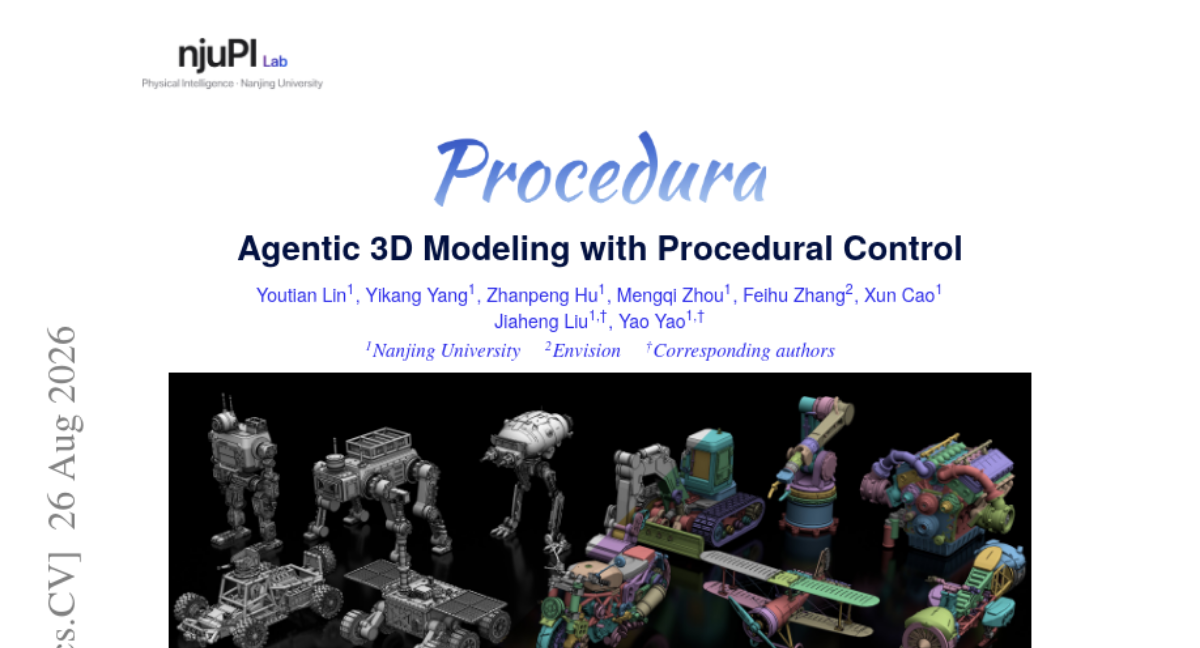
Procedura: Agentic 3D Modeling with Procedural Control

Procedura is a 3D modeling agent that generates editable, part-structured procedural assemblies with sharp geometry and validated articulation from text prompts.

  • 8 authors
· Aug 26, 2026
Submitted by
seashell11

LongHorizon-Harness: Advancing Long-Horizon Agents for Real-World Tasks

LongHorizon-Harness improves long-horizon agent performance by explicitly tracking verified task states outside context via a manage-execute-audit loop.

alibabagroup alibaba · Aug 3, 2026
Submitted by
WeiChow

On-Policy Self-Distillation in Diffusion Models

DiffusionOPSD uses on-policy self-distillation to turn image-level rewards into explicit intermediate targets for diffusion models, improving alignment efficiency and enabling separate analysis of target construction and policy fitting.

ByteDance-Seed ByteDance Seed · Aug 25, 2026
Submitted by
PY007

Faster Video Diffusion with Trainable Sparse Attention

Trainable sparse attention (VSA) reduces computational cost in video diffusion transformers with minimal impact on performance, enabling efficient scaling of the models.

  • 8 authors
· May 19, 2025
Submitted by
andito

SmolVLA: A Vision-Language-Action Model for Affordable and Efficient Robotics

SmolVLA is a compact, efficient vision-language-action model that achieves competitive performance at reduced computational costs and can be deployed on consumer-grade hardware.

  • 14 authors
· Jun 2, 2025

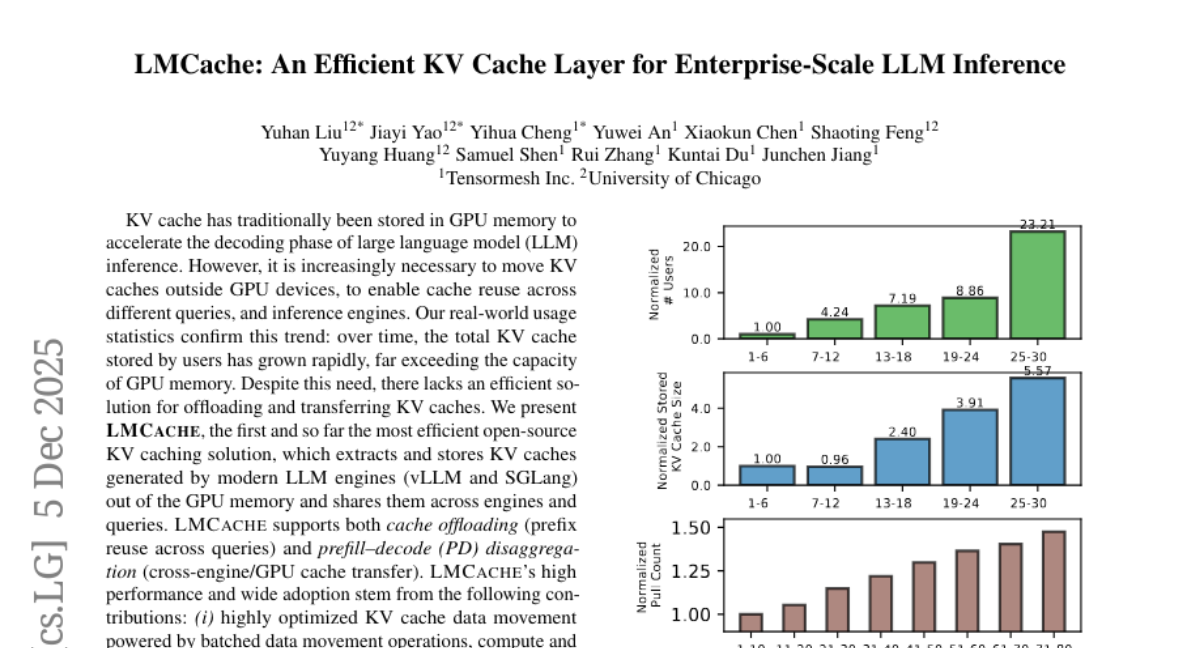
LMCache: An Efficient KV Cache Layer for Enterprise-Scale LLM Inference

LMCACHE enables efficient KV cache management for large language models by storing caches outside GPU memory, supporting cache reuse across queries and inference engines while achieving significant throughput improvements.

  • 11 authors
· Oct 8, 2025
Submitted by
talor-abr

SPEED-Bench: A Unified and Diverse Benchmark for Speculative Decoding

Speculative Decoding evaluation requires diverse workloads to accurately measure performance, which existing benchmarks lack, prompting the introduction of SPEED-Bench for standardized assessment across semantic domains and serving regimes.

nvidia NVIDIA · Feb 10, 2026

IndexTTS: An Industrial-Level Controllable and Efficient Zero-Shot Text-To-Speech System

IndexTTS, an enhanced text-to-speech system combining XTTS and Tortoise models, offers improved naturalness, enhanced voice cloning, and controllable usage through hybrid character-pinyin modeling and optimized vector quantization.

  • 5 authors
· Feb 8, 2025
Submitted by
eric-xiang

Graph Engineering in the Era of LLM Agents: From Individual Intelligence to System Intelligence

Graph Engineering organizes multi-agent LLM systems through dynamic graph structures to coordinate specialized agents and manage complex, evolving tasks.

  • 35 authors
· Aug 21, 2026
Submitted by
taesiri

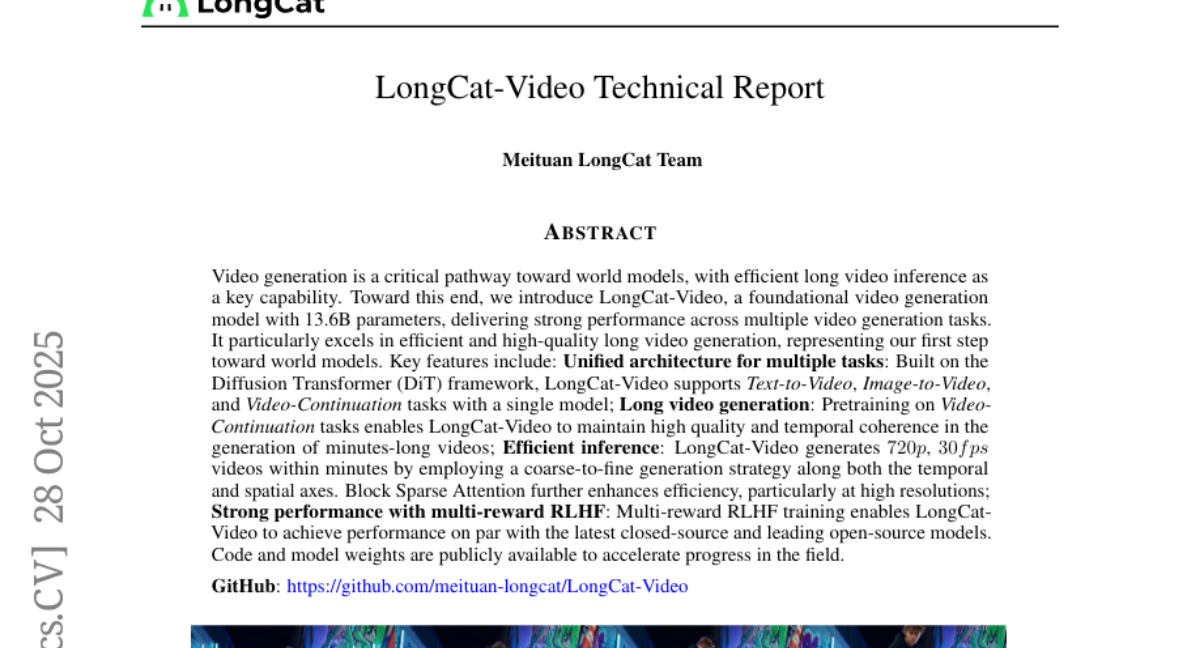
LongCat-Video Technical Report

LongCat-Video, a 13.6B parameter video generation model based on the Diffusion Transformer framework, excels in efficient and high-quality long video generation across multiple tasks using unified architecture, coarse-to-fine generation, and block sparse attention.

meituan-longcat LongCat · Oct 25, 2025
Submitted by
taesiri

SkillOpt: Executive Strategy for Self-Evolving Agent Skills

SkillOpt introduces a systematic text-space optimizer for agent skills that trains skills as external agent state with stable updates and zero deployment inference overhead, achieving superior performance across multiple benchmarks and execution environments.

MicrosoftResearch Microsoft Research · May 22, 2026

AutoDev: Automated AI-Driven Development

AutoDev is an AI-driven software development framework that automates complex engineering tasks within a secure Docker environment, achieving high performance in code and test generation.

  • 5 authors
· Mar 13, 2024