Learning to swim towards seniority

I use this analogy quite a lot, so I thought I should probably write it down.
A few years ago, I did my first triathlon (YES YES I have mentioned this in other blogs)
I thought I was a pretty good swimmer, I swam loads as a kid. Now I am privilidged to live near the sea and bob around in it occasionally. Before the triathlon I swam out to some buoys and back and thought, yep, yep, Tash, you got this.
Turns out….
I
DID
NOTTTTTT
GOT THIS (Well I did, I did finish)
The sea swim was terrifying, like nothing I have experienced
TE-RR-IFYING, people, terrifying
I was super slow, people were thrashing around me, my nose plug fell off, my goggles kicked sideways and I genuinely remember being in the middle of the sea at one point thinking, this is it. I am going to die here.
Spoiler. I did not die.
I got out, did the cycle, the run and everything was fine (ish). But I had realised, quite literally, that I was out of my depth…. I thought I could swim, what I could actually do was my own weird little side stroke and a version of front crawl where I didn’t breathe properly, well breathe. Fine for bobbing around, 100000% useless in a triathlon.
So I started learning to swim properly, and the more I learned, the more I realised how much I didn’t know.

Armbands, lidos and the unknown unknowns
YES heres the Linkedin lover injection…. lets compare this to work, and I do do this a lot, and it helps me, so go with it…. I think design, facilitation, service design, UCD, and probably a lot careers, work a bit like this.
At the beginning, you’re in the paddling pool with your armbands on. You’re learning some tools, trying things out, mapping a bit, throwing out post-its like they are free. The pool sides are close enough to grab and it feels safe. You don’t know what you don’t know yet.
Then you move into the lido. NICEEEE. You’re swimming lengths, getting stronger, you’ve learned a few strokes. And you can see the sea from where you are swimming and start thinking, dudes…. that doesn’t look so hard.
I think this is the point in your career where it can be very easy to think, I know the tools, I’m doing the work. Why can’t I be senior? Why can’t I lead this?
Why…. Because the lido and the sea are very different places.

Then you get in the sea
The sea is ambiguous, Poseidon is pissed at you and its deep, unfathomable and wait it doesn't even stop at the horizon… wheres the sides???
There are currents you didn’t expect, waves hit you in the face just as you try to breathe, the weather changes and you can’t work out whether you’re moving forwards or backwards due to the tide
All the things you learned in the lido still matter, but now you have to understand when and how to use them. This is the bit where the tools aren’t enough.
It’s understanding context, and this is where mindset starts to matter more than the tools and methods.
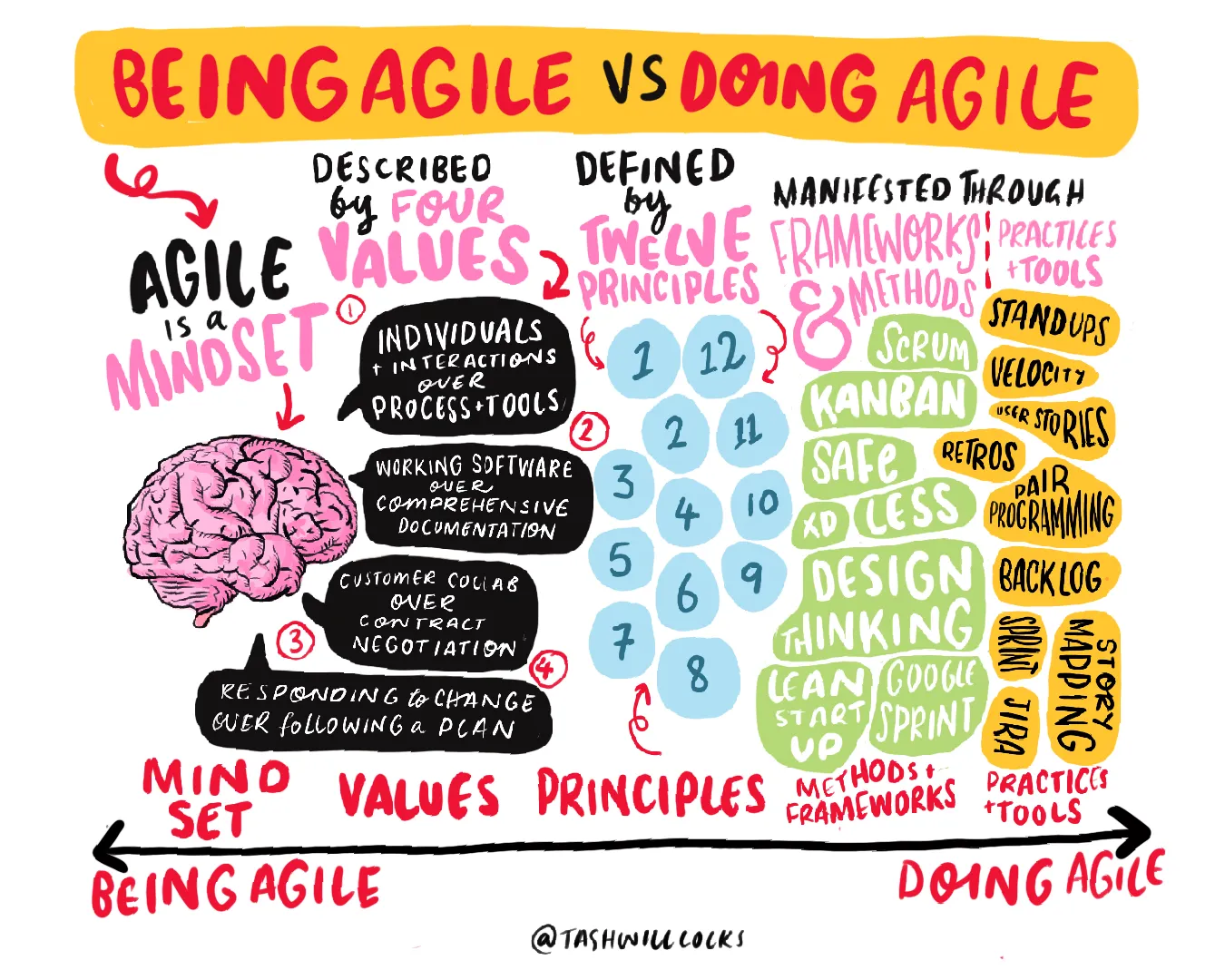
Let's slide in my fave, the agile onion… which maps over most things IMO. On the outside you have the things you do… the tools, practices, methods and processes, your swimming strokes, they’re useful, and you need to learn them.
But move further into the onion and you get to the principles and values underneath them, eventually you get to mindset. MINNNNNNDSET…. That’s the bit that helps you work out what to do when the conditions change and your lovely, practised stroke suddenly isn’t working. (Oh and boy they did not work my friends)
Get Tash Willcocks’s stories in your inbox
Join Medium for free to get updates from this writer.
The sea (we all know I am not really talking about the sea here anymore… yes?) doesn’t care that you know the tools, you have to be able to adapt, respond, make decisions and understand the conditions you’re in.
And sometimes get knocked on your arse just trying to get in.

Sometimes you’re not ready for the sea
I was talking about this with my mentee /friend recently and the conversation sparked another really important part to the metaphor for me. Sometimes you need to recognise that today isn’t the day to swim out further.
Being out of your depth affects other people too, if you get into trouble, somebody has to stop what they’re doing and come and get you. Sometimes, if you panic, you can pull them under with you.
Knowing your limits is part of becoming more experienced.
It might mean staying in the lido a little longer, swimming closer to shore, going out with somebody more experienced and/or building strength before going further. I see people racing for promotions, which then burn them out… its OK to take the time it takes… because none of the things mentioned mean you can’t swim.
They mean you’re learning to swim in different conditions.
The Cynefin framework, from Dave Snowden, is useful here, it helps us make sense of the situation we’re in, recognising that different contexts need different responses. What works in something predictable might fall apart completely when things become complex or uncertain.
Another metaphor I use is cooking, I like what Mr Snowden has added there… he talks about complex, unpredictable environments, and that we need adaptive experts (chefs) rather than people blindly following rigid frameworks (recipes)… We need more chefs, not recipies

WAIT… we may need a bigger boat!
OK I just wanted the jaws reference, we may simply need a boat, but equally look out for sharks, most people support you, but there are a few sharks out there ready to bite. For another blog, but it takes a team to navigate a shark…. back to the boat
People swim the Channel, but they don’t really do it alone.
There’s a support boat alongside them, a team of people are watching the conditions, helping them navigate, feeding them and ready to step in when needed. You can be an incredibly strong swimmer and still need the boat.
I think we sometimes mistake progression for needing less support. I 100% did…. still do occasionally, the further out you go, the less you should need other people.
I’m increasingly convinced it’s the opposite…. only this week I cracked the ‘can I get some help’ glass… AND WOW it helped me get back on track
As the water gets deeper, the conditions rougher and the work more complex, knowing when you need the boat becomes part of the skill.
I’m still learning front crawl, I’m much better than I was. I’m still working on my breathing, and every time I get into the sea, I learn something slightly different. But I have videos to watch, swim buddy's and occasionally a coach to help
Is this the point? I think it is… yes we are reaching metaphor crescendo…. getting better isn’t reaching the moment where you’re finally ready for every sea, it’s about learning to understand the water you’re in.
Further reading watching
Critical thinking… or fast decisions, expensive consequences
I have written about this before…. but slightly different stance
Start, suck, stick at it…. swimming into the unknown (unknowns)
Getting comfortable with being uncomfortable….. (Spoiler: you don’t)
https://www.youtube.com/watch?v=QRbDJEvuEz4
KNOWN KNOWNS and KNOWN UNKNOWNS — Swans and Elephants
Rumsfeld’s Logic of Known Knowns, Known Unknowns and Unknown Unknowns
https://medium.com/paul-austin-murphys-essays-on-philosophy/rumsfelds-logic-of-known-knowns-known-unknowns-and-unknown-unknowns-f506db31ac74
Unknown Knowns
https://issues.org/known-unknowns-uncomfortable-knowledge-sarewitz/