

I think most of us can agree that U.S. politics has gotten... a little weird. One day, the president is making headlines for saying something that leaves the internet collectively scratching its head, and the next, he’s trying to ban three media outlets from covering the White House, only for a federal judge to step in and overturn the move. You really couldn’t make this stuff up if you tried.

It got me wondering, though, when did American politics become like this? Because surely it wasn’t always like this, right? So naturally, I did what I do best. I put on my glasses, sat down in front of my laptop, and started digging through the internet until I could satisfy that very specific itch in my brain. This time, that itch was finding photos from the past that captured American politics at some of its most fascinating, dramatic, and genuinely unforgettable moments, and find them I did, my fellow readers.
Of course, no era of American politics was perfect, and these photos don’t tell the whole story. They simply capture a side of political life that feels a little more personal, theatrical, and human than what we’re used to today.
Here are 26 photos from the past that capture the grandeur, civic participation, press accountability, political relationships, fun, and seemingly human moments that once defined American politics.
1. In February 1962, Jacqueline Kennedy invited television cameras inside the recently renovated White House for A Tour of the White House with Mrs. John F. Kennedy. The special aired on CBS and NBC on Valentine’s Day, with ABC airing it four days later, and it became the first televised White House tour led by a first lady. Jackie walked viewers through the rooms, talked about the restoration, and showed off the history and furnishings she had worked to bring back.

2. This photo was taken while CBS News correspondent Charles Collingwood interviewed Jackie Kennedy in the East Room. It’s the largest room in the White House’s historic Executive Residence, and it has long been used for presidential ceremonies, press conferences, and receptions.

3. On August 28, 1963, an estimated 250,000 people gathered in Washington, D.C., for the March on Washington for Jobs and Freedom, making their demands for civil and economic rights impossible to ignore. This is the kind of political photo I wanted in this list because there isn't a president in sight. It was more about politics and not politicians—hundreds of thousands of ordinary Americans showing up, carrying signs, standing together, and making it very clear what they wanted their government to hear.

4. In March 1933, Eleanor Roosevelt held her first press conference exclusively for women reporters, with about 35 journalists attending. It was the first of 348 women-only press conferences she would hold during her time as first lady, giving women journalists regular access to the White House at a time when they were still a small minority in the profession. They were there to do a job, ask questions, and help keep the public informed, and Eleanor Roosevelt had created a regular space for them to do exactly that.

5. And just a few hours later, its leaders went to the White House to meet with President John F. Kennedy and Vice President Lyndon B. Johnson. The group included Martin Luther King Jr., John Lewis, A. Philip Randolph, Whitney Young, Roy Wilkins, Rabbi Joachim Prinz, and other civil rights and labor leaders. The March on Washington brought hundreds of thousands of people into the streets, and its leaders then took those demands directly into the Oval Office to discuss the civil rights legislation moving through Congress. This photograph really shows what an active democracy used look like.

6. This photo was taken in December 1961, with President John F. Kennedy and First Lady Jacqueline Kennedy posing beside the official White House Christmas tree in the Blue Room. That year, Jackie started the tradition of giving the official tree a specific theme, choosing “The Nutcracker Suite” and decorating it with tiny toys, birds, angels, candy canes, gingerbread cookies, and other ornaments inspired by the ballet. The whole thing feels less like a presidential photo op and more like something straight out of a ridiculously glamorous Christmas movie, and I am here for it.

7. There’s this photograph of Richard Nixon and his family posing in front of the Christmas tree in the Blue Room on Christmas Eve.

8. And here are Ronald and Nancy Reagan decorating the White House Christmas tree on Christmas Eve in 1983.

9. Yes, this is Vice President Harry S. Truman playing the piano while actress Lauren Bacall sits on top of it. The two were at the National Press Club Canteen to entertain servicemen, and somehow this is the photo that came out of it. I don't know what I expected to find while digging through old political photographs, but it definitely wasn't this.

10. On March 3, 1913, more than 5,000 women marched down Pennsylvania Avenue in Washington, D.C., demanding the right to vote. The procession included nine bands, four mounted brigades, more than 20 floats, and women organized into groups representing different occupations and states—nurses, lawyers, teachers, actresses, librarians, college women, and more. Women in long white dresses are marching in perfectly organized groups, banners are everywhere, horses are moving down Pennsylvania Avenue, and the U.S. Capitol is sitting in the background.

11. Bill Clinton was in the middle of his 1992 presidential campaign when he showed up on The Arsenio Hall Show and did something you don't exactly expect from someone trying to become president: he picked up a saxophone and played Elvis Presley's “Heartbreak Hotel.” He was wearing a dark suit and sunglasses, and the audience absolutely loved it. The appearance, which aired on June 3, 1992, became one of the most memorable moments of Clinton’s campaign and showed how political candidates could step outside traditional speeches and news interviews and connect with people through entertainment and pop culture.

12. Franklin D. Roosevelt is surrounded by reporters during his first press conference as president, with Presidential Secretary Marvin McIntyre standing directly behind him. Just look at all those journalists packed around him, wow. Seeing a president surrounded by reporters like this, with microphones and notepads everywhere, really makes you appreciate just how different the visual language of political journalism used to be.

13. President Franklin D. Roosevelt and British Prime Minister Winston Churchill met at the White House in December 1941, just weeks after the United States entered World War II. On December 23, the two held a joint press conference in the Oval Office, and this photo captures that very old-school image of two major political leaders sitting down together to talk through a world-changing moment.

14. On July 28, 1917, around 10,000 Black men, women, and children marched silently down New York City’s Fifth Avenue in protest of racial violence and the East St. Louis riots. Organized by the NAACP with church and community leaders, the marchers carried banners calling for justice and equal rights, with children and women dressed in white and men in dark suits following behind them. The only sound throughout the procession was the beat of muffled drums. This is another one that shows how political demonstrations could become enormous public spectacles and still have this incredible sense of order to them.

15. This was the first televised presidential debate, held on September 26, 1960, with Democratic nominee John F. Kennedy and Republican nominee Richard Nixon facing each other on live television. I love this one because it captures a completely different side of political life: two presidential candidates standing across from each other and making their case in front of the country. No giant rally, no elaborate backdrop, just Kennedy, Nixon, and a television audience watching them debate.

16. There are plenty of photographs of presidents meeting with members of Congress around conference tables, in the Oval Office, or at formal White House ceremonies. Then there’s this: President George H.W. Bush hosting members of Congress and their families at a White House barbecue in 1992, with First Lady Barbara Bush. They're just hanging out at the White House, eating barbecue and socializing with people they normally spent their days fighting with on Capitol Hill.

17. On November 20, 2007, President George W. Bush took part in the annual White House Thanksgiving turkey pardon, where he officially spared a turkey named May from becoming someone’s dinner. Yes, there he is, standing in front of a room full of reporters and photographers, giving a turkey the full presidential treatment. Presidents had been receiving Thanksgiving turkeys for decades, and John F. Kennedy famously gave one a reprieve in 1963. Ronald Reagan later incorporated the word “pardon” into the ceremony, but it was George H.W. Bush who turned the turkey pardon into the annual presidential tradition we know today, beginning in 1989.

18. John F. Kennedy’s inauguration on January 20, 1961, drew an enormous crowd to Washington, D.C., with people bundled up against the cold and packed across the National Mall to watch him take the oath of office. The sheer number of people stretching across the Mall is incredible, and this is exactly the kind of political spectacle I was hoping to find for this list. It also feels very different from today, when a president, ahem ahem, can claim the seats at a rally are completely full only for the camera to pan over and reveal plenty of empty ones.

19. Dwight D. Eisenhower and First Lady Mamie Eisenhower are pictured riding through the inaugural parade during Eisenhower’s second inauguration in 1957, with crowds lining the streets to watch the presidential motorcade pass by. Even a parade somehow had this sense of occasion to it, and I’m sorry, but they really knew how to make an entrance.

20. I knew presidents had their hobbies, but I was not prepared to find Richard Nixon casually bowling in a dress shirt and tie while surrounded by bowling champions. Nixon was a serious bowler, and he eventually had a private one-lane bowling alley installed under the White House’s North Portico in 1969. This particular photograph, however, was taken at the Executive Office Building lanes in 1971, when Nixon bowled alongside winners of the 7th World Bowling Congress.

21. There was a time when presidential candidates would go on something called whistle-stop tours, traveling across the country by train and stopping in towns along the way to speak to crowds gathered at train stations. In 1952, Richard Nixon stopped in Athens, Ohio, during a whistle-stop campaign tour supporting Dwight D. Eisenhower, where he spoke to a crowd that included a large group of Ohio University students.

22. Then, in 1976, Jimmy Carter kicked off his own whistle-stop tour at New York’s Penn Station, heading through Pennsylvania and New Jersey. There are politicians everywhere, people crowding around Carter, cameras going off, and an entire political event happening right in the middle of a train station.

23. And finally, here’s John F. Kennedy during his 1960 campaign, reaching down from a special train to shake the hand of a well-wisher shortly after boarding for a whistle-stop tour of California. By the 1960s, whistle-stop campaigning was already starting to fade as presidential campaigns increasingly relied on airplanes, cars, television, and other forms of mass media to reach voters. So this photo feels like a pretty perfect example of that old campaign tradition near the end of its heyday.

24. On February 10, 2009, President Barack Obama held an economic recovery town hall at the Harborside Event Center in Fort Myers, Florida, where he took questions from people in the audience. Henrietta Hughes was called on and told him that she and her son had lost their home and were living out of a small vehicle. Obama then stepped down from the stage and crossed the barrier to speak with her, a moment that was captured by photographers. This is what a president actually looking concerned about what ordinary people were going through looked like.

25. President Ronald Reagan and House Speaker Tip O’Neill were on opposite sides of the political aisle and fought plenty of battles over taxes, spending, and the direction of the country. Behind all of that, the two men genuinely liked each other and developed a real friendship. They famously joked that they could fight about politics during the day and be friends after 6 p.m. Reagan even publicly referred to O’Neill as his friend at the speaker’s retirement celebration in 1986. I don’t think we get to see much of that in today’s politics.

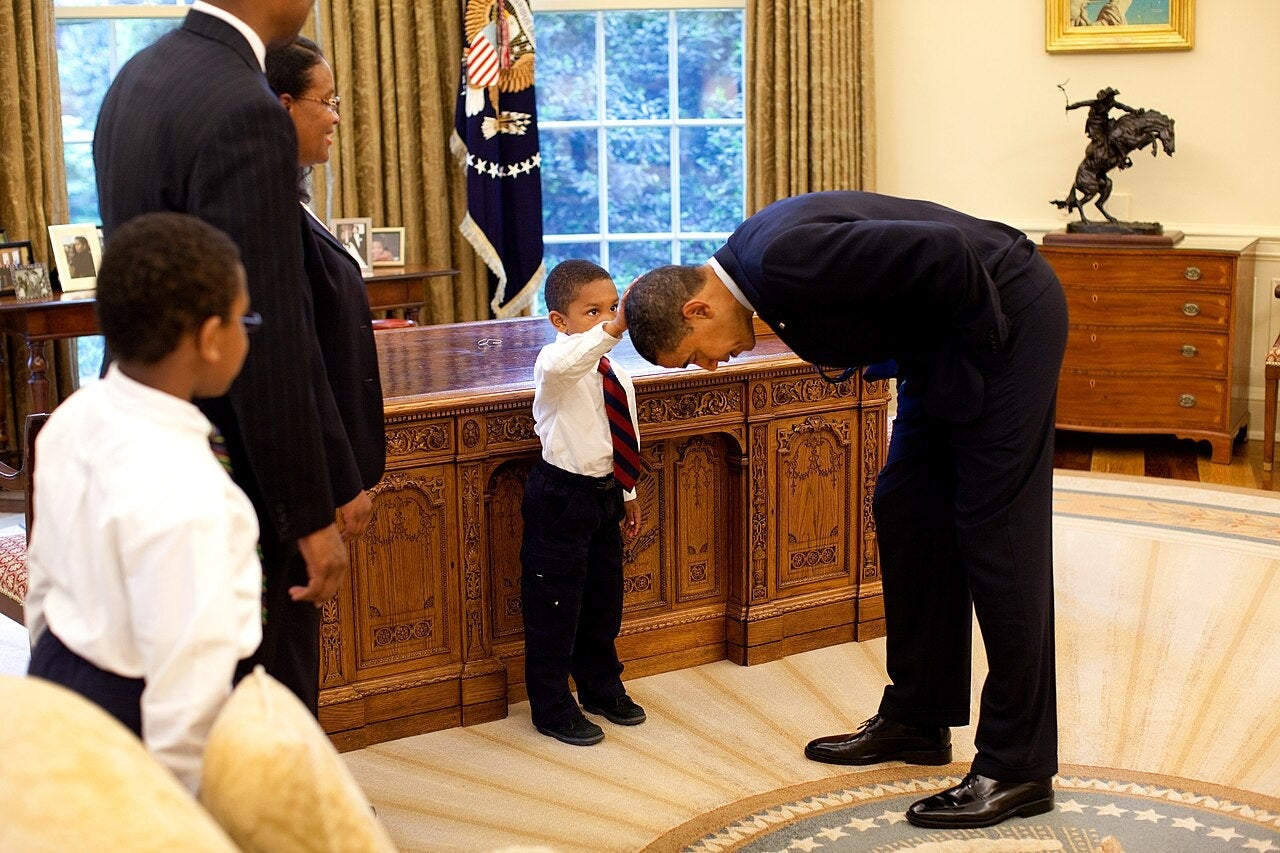
26. And finally, on May 8, 2009, five-year-old Jacob Philadelphia visited the Oval Office with his family when he asked President Barack Obama, “Is your hair like mine?” Obama bent down and invited him to touch his hair, and White House photographer Pete Souza captured the moment. The photograph became one of the most recognizable images of Obama’s presidency, and a framed copy was displayed in the White House.
Comments