

I spend more on food and treats for my pugalier Rocky than I do on my children, and I used to think that meant I was doing everything right. Premium chews, “all-natural” jerky, grain-free biscuits and fortified dental chews. Lots of special treats for my special boy.

Americans spend almost $70 billion on pet food a year, and I’ve been doing my part. But veterinarians say some of the most popular products are leading to emergency surgeries, tooth problems and organ damage.

Dr. Stephanie Liff, a New York City-based veterinarian and practice owner, sees the damage firsthand, noting that “26% percent of dogs will suffer from fractured teeth, usually from chewing on hard things.” The products responsible are ones most owners would consider safe, such as bully sticks, yak chews, antlers and smoked bones.

“Any treat that is not soft enough for you to make a dent with your nail is technically too hard and could break a tooth,” she said. Liff recently had to surgically remove a Himalayan yak chew from a dog’s stomach. Another of her patients, a labradoodle, cracked both of its large back molars on a hard chew so forcefully the owner heard it across the room. Repairing the damage cost the owner over $2,000.

Even experienced breeders get caught out. Katherine Bailee comes from a family that has bred European dobermans for two generations. Early in her career, she gave her Doberman, Ares, a smoked marrow bone she’d picked up at the store. “Within 20 minutes, the bone splintered into shards as sharp as glass,” she recalled. “One large shard became wedged horizontally across the roof of his mouth, while smaller pieces were swallowed.”

Ares survived, but they spent 48 hours watching for signs of a perforated bowel before vets cleared him. Bailee had no idea that smoking strips a bone of its flexibility, making it brittle and prone to shattering. She now calls products like these “a literal internal hazard.”

“When you have a breed prone to bloat and sensitive GI tracts,” she said, “the good dog owner aisle at the grocery store is the most dangerous place in the building.” Rawhide is just as dangerous, though for different reasons. It looks like a dried meat product, but is a byproduct of the leather industry, processed with chemicals to preserve its shape. Once chewed, it softens enough to be swallowed in chunks, then swells in the stomach or intestines, potentially causing a life-threatening blockage.

That’s what happened to Caleb Johnstone’s golden retriever, Killua, who swallowed a large chunk of a knotted rawhide bone. “The piece grew inside his stomach like a sponge and caused a serious intestinal blockage,” Johnstone said. Killua needed emergency surgery. “I thought it was dried meat. It’s closer to chewing on a leather shoe. I wish I had known that the cleaning process for these bones involves bleach and hydrogen peroxide.”
“I perform gastrointestinal surgeries every few weeks that are completely avoidable,” said Dr. Ezra Ameis, a veterinarian and owner of Paw Priority veterinary clinic. He’s removed rawhide, cooked bones and hard dental chews from dogs’ stomachs, throats and palates. “Don’t give your dog anything as hard as their teeth,” Ameis cautioned. “It can break them.”

Those injuries and blockages are at least visible. A dog chokes, breaks a tooth or stops eating. What concerns Georgia-based veterinarian Dr. Jordyn Zoul are the treats that do damage no one can see. “A middle-aged dog presented for sudden lethargy, not eating and vomiting,” said Zoul, who practices at Seaside Veterinary Hospital in St. Simons Island, Georgia. “His blood work showed acute kidney injury. The only explanation we could find was his owner had recently purchased some jerky treats.”

The condition is called Fanconi-like syndrome, a rare kidney disease that damages the kidneys’ ability to filter nutrients. Ameis has seen the same. “Some recover once the treats are stopped, but others are left with permanent kidney damage,” he said. “I tell people to avoid jerky treats altogether. Dogs don’t know what they’re missing.”

Zoul observed the same invisible damage playing out in the food bowl itself. Many owners feeding their dogs grain-free diets have no idea the choice carries its own serious risks. “We have overwhelming research now that grain-free diets can lead to heart disease in dogs,” Zoul said. “Dog food companies learned that ‘grain-free’ played well with consumers who assumed dogs were carnivores. This is actually a myth,” Zoul added. “Dogs are omnivores, not obligate carnivores like cats. They need animal protein but also nutrients from plants and starches.”

She diagnosed a 2-year-old Rottweiler with dilated cardiomyopathy, a condition where the heart becomes enlarged and weakened. “We found it incidentally while listening to the heart during an exam. He’d been eating a grain-free diet his whole life just because the owner didn’t know any better.” Chest X-rays confirmed heart enlargement. After switching to a grain-inclusive diet, the dog recovered completely. “Within the year, he was a normal dog. His heart had recovered,” Zoul said.

Beyond the contents, the labels themselves are a separate problem. All three vets flagged xylitol as the ingredient that scares them most. It’s an artificial sweetener found in some peanut butter and yogurt-based treats. “Xylitol is the most dangerous,” Ameis said. “Even tiny amounts can cause life-threatening low blood sugar and liver failure in dogs.” Ameis also warned owners to check labels for BHA, BHT and excessive salt.
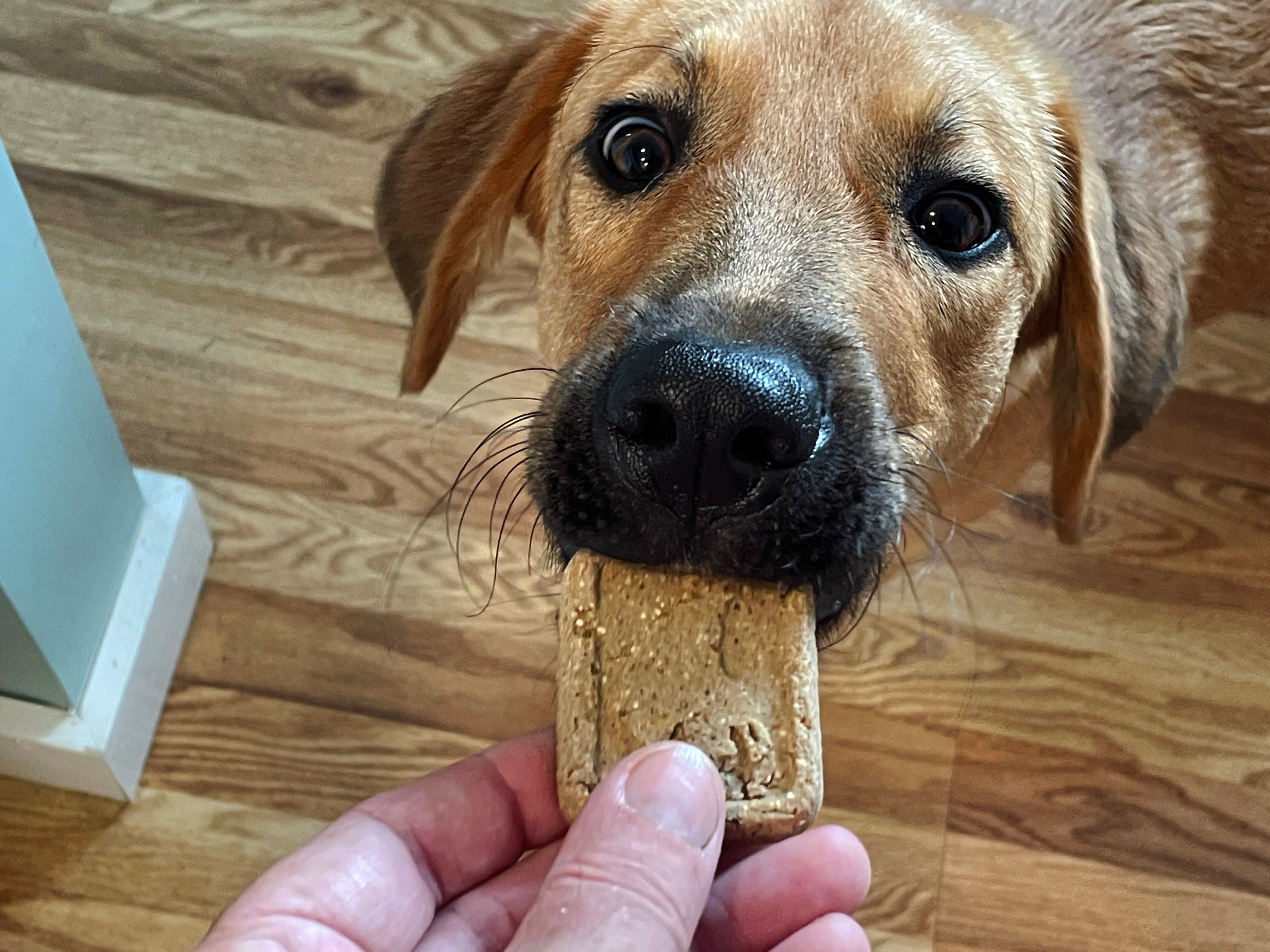
Liff is equally skeptical of the language on the packaging itself. “The word ‘natural’ is mostly used in marketing,” she said. “It’s not synonymous with being better, safer, or digestible for your pooch.” Ameis puts it simply: “If you can’t easily identify what’s in it, it’s probably not a great choice.”

The vets I spoke with keep things simple with their own dogs. Liff gives her dogs softer, single-ingredient treats while Ameis feeds his dogs blueberries, carrot slices and small pieces of lean meat. Zoul’s rule is to keep treats under 10% of a dog’s daily calories and supervise every chewing session. They all returned to the test Liff described at the start: if you can’t dent it with your fingernail, don’t give it to your dog.

I’ve since overhauled Rocky’s treat drawer. The smoked bones are gone. So is the jerky he would always go mad for. Now, he gets softer chews and carrot sticks, which we share. Anything with an ingredient list that requires a chemistry degree to decipher is also gone. It’s the least I can do for my favorite child.

This article origially appeared on HuffPost.
Comments