A major new history of Saudi Arabia, from its eighteenth-century origins to the present day
Saudi Arabia is one of the wealthiest countries in the world, a major player on the international stage and the site of Islam’s two holiest cities. It is also one of the world’s only absolute monarchies. How did Saudi Arabia get to where it is today?
In this comprehensive account, David Commins narrates the full history of Saudi Arabia from oasis emirate to present-day attempts to leap to a post-petroleum economy. Moving through the ages, Commins traces how the Saud dynasty’s reliance on sectarianism, foreign expertise, and petroleum to stabilize power has unintentionally spawned secular and religious movements seeking accountability and justice. He incorporates the experiences of activists, women, religious minorities, Bedouin, and expatriate workers as the country transformed from subsistence agrarian life to urban consumer society.
This is a perceptive portrait of Saudi Arabia’s complex and evolving story―and a country that is all too easily misunderstood.
This was a good book and especially the chapters dealing with the founding of Saudi Arabia, tribal culture, and relationships with the Ottoman Empire, the British, and other regional powers. In chapters discussing the current era, there was a degree of editorializing.
Dr. David Commins, Professor of History, tries to find a modern compare and contrast to take the reader back into the modern history of the Kingdom of Saud.
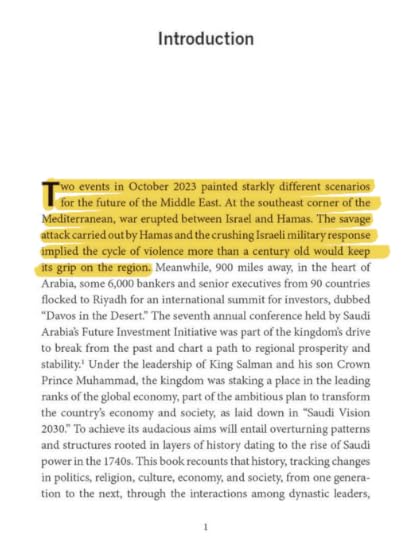
"Savage attack carried out by Hamas" gives the reader a terribly simple framework for the 2023 conflict and the 77 years of occupation that preceded it. For a professor of history, this is inexcusable.
We have a duty to future generations to be accurate in our retelling of history. The creation of the state of Israel, history relates, was bankrolled by English and American eschatologists who thought that returning the diaspora of Jewish people to Palestine would hasten the end of the world. A land without people for a people without a land. This colonizer rallying cry was not hampered when traumatized people got there and found people already living there. Putting it simply in historical terms, the state of Israel is the modern-day Filles du Roi, and we are all watching it happen.
We are only three generations removed from the Nakbah and have an obligation to make sure our children don't grow up believing that the extermination of the indigenous people of Palestine is due to an irreconcilable cycle of violence that is meant to be lifted by the Arab World. Because with this verbiage, that is exactly what Dr. Commins is proposing. The conflict cycle could be lifted if the economic superpower a stone's throw away would just take these indigenous people from their home. There! Settled! No more problem. The Arab world will absorb these people, a people I'm sure Commins needs no reminding, were not of voting age when Hamas was elected. 47% of Palestinians weren’t even born when the election happened. Once more, 75.9% of current Palestinians (data from NPR, as of 2022) were not even old enough to have voted in that election.
To illustrate this point of how we need to clean up our language, perhaps a bit of comedy could be used to make my point.
Dr. David Commins uses an occupied region as a jumping in point to illustrate the disparity in wealth separated by only 1014 km. While he may have thought it was a throwaway line, it left a bad taste in my mouth due to it being a literal feast and famine dichotomy. How apropos, Commins.
Beyond his boot licking and heavy op-ed hand, Commins's expertise on Wahhabism and the House of Saud found this history a fine overview of the Kingdom's place in the region and in global affairs. Commins insight on the Wahhabist editorializing of the Quran was something I didn't know and really interests me to see how deep those edits go. I also particularly enjoyed the parts of women finding their place in things like film making.
I am struck by how little many expatriates in Saudi Arabia or the Gulf know about the history of the region in which they live. Many are unaware that it was a political and economic backwater until the oil era began just before the Second World War. Some are even surprised that, before the 1930s, there had only once been a powerful state covering most of the Arabian peninsula – and that was well over a millennium before. Cairo, Damascus, Jerusalem, Aleppo, Baghdad, and Mosul were the great cities of the eastern Arab world, all located to the north or west of the peninsula. Mecca and Medina were merely pilgrimage centres, while most of the ports dotted around the peninsula were of only local significance. Few people outside Arabia knew of Riyadh. The arid Arabian subcontinent was one of the poorest and most desolate places on earth.
In 1932, the year in which Saudi Arabia was officially created, the kingdom had a diverse, albeit exclusively Muslim, population. Najd in the centre of the peninsula was the home of the fierce warriors who followed the puritanical and intolerant Wahhabi version of the faith. It pronounced that Muslims who were not Wahhabis were infidels. To the east, in the region where the Kingdom’s oil wealth would begin to appear in 1938, at least half the population was Twelver Shi’i. To the west, in the Hijaz, the population of the towns was predominantly Sunni but not Wahhabi. It was also cosmopolitan. This reflected the legacy of 13 centuries of pilgrimage from all over the Muslim world. To the south, near the Yemeni border, there was a substantial Ismaili community. Outside towns and oases, everywhere was tribal. The tribes followed codes of honour that acknowledged pillage as having its proper place in ordinary life, and saw the deterrent of the blood feud as the most effective way to maintain order. The new kingdom was one of the last bastions of officially tolerated slavery.