Jump to ratings and reviews
Rate this book

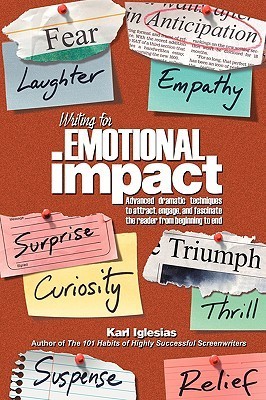
Writing for Emotional Impact: Advanced Dramatic Techniques to Attract, Engage, and Fascinate the Reader from Beginning to End

Rate this book
There are three kinds of feelings when reading a story – boredom, interest, and WOW! To become a successful writer you must create the WOW! Feeling on as many pages as possible, and this requires writing that engages the reader emotionally. In his best-selling 101 Habits of Highly Successful Screenwriters, screenwriter Karl Iglesias explored the working habits of A-list Hollywood scribes. Now, he breaks new ground by focusing on the psychology of the reader. Based on his acclaimed classes at UCLA Extension, Writing for Emotional Impact goes beyond the basics and argues that Hollywood is in the emotion-delivery business, selling emotional experiences packaged in movies and TV shows. Karl not only encourages you to deliver emotional impact on as many pages as possible, he shows you how, offering you hundreds of dramatic techniques to take your writing to the professional level.

238 pages, Paperback

First published September 1, 2005

248 people are currently reading
1643 people want to read

About the author

Karl Iglesias

7 books23 followers

Ratings & Reviews

What do you think?
Rate this book

Friends & Following

Create a free account to discover what your friends think of this book!

Community Reviews

5 stars
345 (49%)
4 stars
233 (33%)
3 stars
94 (13%)
2 stars
19 (2%)
1 star
8 (1%)
Displaying 1 - 30 of 84 reviews
Profile Image for K.A. Merikan.
Author 129 books3,005 followers
April 3, 2018
I'm still reading it, but I'm already giving it 5* because it's just so great. To the point, well written and full of concrete advice and analysis.
I see my books very much like movies, so this is just what I needed.

ETA: Very useful, inspiring, made me rethink some writing theory
Profile Image for Bayard West.
Author 2 books16 followers
February 19, 2014
If I were stranded on a desert island with a typewriter and paper, this is the book I'd want to help me in my writing. This book is for screenwriting, but I found most of it applied to writing novels as well.

Iglesias takes the challenge of making you a better writer head on. He starts out with that promise and delivers. His intent is to help you write scene by scene, paragraph by paragraph in such a way that no one could set your book down. He shows you how to ensure the reader cares about your characters and feels the character's emotions. He also points out how to make sure the reader has a takeaway that will make them talk about your story to other people.

He shows how to build tension, write snappy dialog, and deliver emotional scenes. He does this by examining movies like case studies, and does it in a way that really hooks you. There are other books that examine movie plots and dialog, but this book is an order of magnitude better than the rest.

This is the most influential book on writing I can think of. I re-wrote my manuscript after reading this book. If you get mired down in chapter one, skip it, but this book is a must read.

For any writer out there, I RECOMMEND THIS BOOK ABOVE ALL OTHERS on the subject of writing.

Do I know the Author? No. Did I get the book for free? No. Is this an impartial review? Yes. This book will full on make you a better writer, and I look forward to world filled with more intriguing, engrossing books!
Profile Image for Emily.
Author 27 books213 followers
Read
March 7, 2025
So informative and helpful!
Profile Image for Charly Troff (JustaReadingMama).
1,642 reviews30 followers
July 4, 2021
While this book isn't without it's flaws, it's so useful it's now one of my favorite writing craft books.

He has a lot of lists, which is nice for readability but also got repetitive (he uses many of the same bullet points in multiple sections) and at times the points were obvious enough that they didn't need a paragraph of explanation.

There is so much important information in the book though! I found the sections on tension and suspense really useful and the section on scenes. It's one that I will go back to again and again for reference and to learn more (there's so much, there's no way to get it all in one read).

High recommend to any writer.
Profile Image for Rebecca.
Author 16 books57 followers
May 6, 2016
There's some solid advice for writers. Much of it wasn't necessarily new, but presented in new ways. I particularly enjoyed the piece about subtext. The author's explanation and examples really showed me how subtext can make the difference between good and great dialogue.
Profile Image for Claudia Torkan.
Author 2 books111 followers
October 7, 2023
"Find what gave you emotion, what the action was that gave you excitement, then write it down, making it clear so that the reader can see it too."
- E. Hemingway

4.5*

Ešte aj dnes je veľa ľudí, ktorí si myslia, že napísať "bestseller" je hračka. Čo môže byť predsa náročné na skladaní slov do viet a tie do komplexného príbehu? Nič ťažké, to predsa dá každý, veď ich život je jeden úžasný, chodiaci príbeh, ktorý by sa predával na mraky!
Dovoľte mi nesúhlasiť. Alebo aspoň nie tak úplne.

Každé dielo by malo mať svoju štruktúru. Poznáme úvod, jadro, záver, plus delenie týchto jednotlivých častí. Aby sme zaujali čitateľa, potrebujeme vytvoriť catchy úvod, aby našu knihu nechcel pustiť z rúk. Samozrejme, musíme udržať jeho pozornosť do prvých zápletiek a, v ideálnom prípade, až do konca. Ako sa ale vyhnúť hluchým miestam? Ako napísať príbeh, ktorý by si ľudia zamilovali a prečítali aj na posedenie?
Konečne sa dostávame k obsahu tejto knihy.

Writing for emotional impact je kniha určená primárne scenáristom, aby svojimi scenármi zaujali široké publikum. Našťastie, veľa z nej môžu vyťažiť aj spisovatelia, pretože sa v nej rozoberá aj samotný koncept diela, téma, postavy či rôzne zápletky.

Na trhu je veľa kníh, ktoré sa snažia predať autorom svoje "know how", ale je len málo takých, v ktorých nenájdete zbytočné omáčky a frázy, ktoré všetci poznáme. Pri čítaní tohto som ale konečne mala pocit, že niekto prišiel s "návodom" ako na to, doslova aj pre debila. čo v živote nečítal a nepísal.
Autor sa opiera o základné fakty, využíva v knihe ukážky zo známych filmov ako je Pulp fiction, Mlčanie jahniat či podobné kultovky. Kladie autorom otázky o ich dielach, núti ich zamyslieť sa nad jednotlivými časťami rukopisu a hlavne... snaží sa ukázať, že nezáleží na tom, koľko draftov rukopis bude mať, dôležité je, aby to rozcítilo a zaujímalo samotného autora.
"Plot is more than a pattern of events, it is the ordering of emotions."

Osobne som veľmi rada za kapitoly, v ktorých autor priblížil stávky a možné vyvrcholenia, pretože som sa vďaka tomu lepšie zamyslela nad vlastnými rukopismi, a pri niektorých som dokonca prišla s novými nápadmi, pretože nie je nič, čomu sa chce autor vyvarovať väčšmi než slabej či neexistujúcej zápletke.
Profile Image for Lucas Miller.
38 reviews
March 5, 2022
Good as far as advice on the craftsmanship of screenwriting goes. Very interesting to learn what readers and execs look for when prompted with spec scripts. The author clearly has a knowledge for the industry and truly has some great tips.

I was a little turned off by the fact that he mostly only mentioned male writers at the end of each chapter for who to check out despite referencing several female written stories throughout the book. He uses Thelma & Louise and When Harry Met Sally (both written by women) constantly but then doesn’t give the writers individual shoutouts like William Goldman and Paddy Chayefsky. This book was written 20 years ago almost, so some will say women weren’t given the same opportunities, which is true, but there were still masterful storytellers who made movies and are worthy of mentioning individually: Jane Campion, Emma Thompson, Callie Khouri, Lisa Cholodenko, Nora Ephron, Nancy Meyers, and Fran Walsh, just to name a few. Their exclusion, whether purposeful or ignorant, made me pigeonhole the writer as being just another straight guy whose taste starts with The Godfather and ends with Breaking Bad.
Profile Image for Kevin.
266 reviews
February 19, 2020
Lists of (mostly dialogue) techniques with examples of use.

I guess I was hoping for more structural advice about psychological triggers, but the book isn't that deep.
Profile Image for علی عموکاظمی.
127 reviews7 followers
October 31, 2023
سه تا از فصلهای کتاب که درباره‌ی ایده، درون‌مایه و شخصیت پردازی بود، خیلی برای من مفید بود. بقیه‌ی بخش‌های کتاب یا چیز جدیدی برایم نداشت یا خیلی نویسنده روده درازی کرده بود. در کل خواندنش را به فیلمنامه‌نویسان توصیه می‌کنم
Profile Image for Mad Hapa.
271 reviews5 followers
July 11, 2024
The best book about screenwriting I've read — out of at least a dozen.
Profile Image for James Cardona.
Author 13 books54 followers
January 13, 2015
I would give this book 3 stars but am adding an additional star mainly because I am not the target audience and then am giving some benefit of the doubt.
I am a fiction writer and this book is aimed at screenplay writers but I thought I'd give it a whirl.
The book promises to not talk about basics and only more advanced topics. What I found was that most of the lessons seemed very obvious to me, so I am wondering what about them is not basic. There are a few gems mixed in, however, and I particularly liked the chapter on dialog.
The biggest problem with the book is the endless repetitive lists that are used as "examples". Occasionally, there is a well thought out and thoroughly presented example, but those are the exception. In general a statement is made then a reference is given to a character or scene in a movie with little or no explanation to the specifics of why or how it works. For example, create a bittersweet ending like Thelma and Louise, talk to the camera like Ferris Bueller, the leitmotif of Chinatown.
I guess the assumption is that the reader has seen and studied these endless lists of movies and can identify the scenes in them. Even if that were true, I would still have liked to see a more detailed explanation on exactly how the technique is employed and why it works.
Since reading the book, I have watched a few movies and interestingly I find myself deconstructing scenes and seeing why and how some of the things were done. That was neat. But as far as my fiction writing, I think the book was of little help to me.
Profile Image for Cloak88.
1,040 reviews19 followers
September 18, 2021
Useful but limited, Don't bother with the audiobook!

I'm going to be the outlier in this sea of high ratings, because the audiobook just SUCKS!!!
In simple terms this isn't actually an audiobook let alone an audiobook of the text-based book it pertains to be. Because these are the badly formatted, meandering and rambling recordings of the lectures that were supposed to be, only the ISPIRATION for the actual book!

So what we have here is a a bunch of lectures that, while interesting in their subject and undoubtedly are of some use to some people. They are however unstructured and without much cohesion from lecture to lecture, jumping form random topic to random topic while Iglesias endlessly spouts praise for the movies he likes.

As for the content itself. well it is a bit underwhelming. Most of it is basic advise to the point of: learn from the masters and Practice, Practice, Practice....... Yeah shocking! No one has ever though of those pieces of advice. Add to that that all of this advice is tailored to the narrow field of Hollywood Script Writing. If you write anything ells, about half of this book would be useless to you

So...... Overall you've got a non-book, badly "written" with useful information to only a narrow field, and a narrator who rambles on and on. And then in the end, he doesn't add all that much that other books haven't done better. Not a good showing

Ps.
Author please stop referring to everything to do with writing as 'The Craft' it sound incredible pretentious.
Profile Image for Suzanne.
305 reviews20 followers
December 8, 2011
Although this book is aimed at screenwriters, most of the advice also applies to novelists. I read this while working on a first draft and can see that it will be very useful later during editing. At only 110 pages, screenplays have to be tight. Every scene has to count, each line of dialogue must be informative, and reader suspense/curiosity should be maximized. All this is definitely applicable to producing an engaging and well-paced novel.

In explaining how these things are accomplished in successful scripts, some chapters have a bit of a laundry list feeling to them. Again, probably more useful in editing if you're brainstorming ways to make your characters more sympathetic, for example. I enjoyed the wrap-up sections, however. He dissects sections of scripts and shows how the screenwriter has manipulated us at every turn. (Obviously this means there are a lot of movie spoilers in here, though if you're a movie buff at all, you've probably seen them anyway.)

Where it fell flat for me, ironically, is in the author's tone. I felt no emotional connection. Although I have moved away from the inspirational self-help "anybody can write!" sorts of writing books that I used to love, I still like for the author to be encouraging and make me feel as though I'm being mentored. With this book, it's more like, "Try not to suck." So, don't go looking for that kind of inspiration here. I suppose Hollywood isn't meant for the thin-skinned that need coddling anyway.
Profile Image for JalapenoSoup.
308 reviews4 followers
July 8, 2022
Enjoyed it so much I purchased a physical copy as well.

Obviously as a reader I want to "feel things" and as a writer, that's my goal too. What's the point of a story if you aren't affected by it in some way? Includes lot of practical tips and both advanced and introductory advice and techniques.

---

If you liked this! And want more! I HIGHLY recommend the Film Courage podcast. It's FREE! They have stuff on YouTube, and Spotify, and probably other platforms I don't know about. Tons of expert advice from people who have made their careers in the story industry. I can't praise it enough.

Ironically, I'd recommend Film Courage over the Bulletproof Screenwriting podcast, because, while similar in concept, the Film Courage interviewer allows her guests to speak in full without interrupting them. Alex Ferrari has interesting guests, but I stress out listening to them fight to get a word in edgewise sometimes. Maybe that's just me. I stress out easily.

There is an interview between Bulletproof Screenwriting's Alex Ferrari and Karl Iglesias at the end of the audio, and I enjoyed it a lot less than the rest of the production. But again, this may be a matter of personal taste.

---

Overall, I'd probably recommend the physical copy over the audio version, as the audio quality varies and certain concepts seemed to require, or at least be improved by, visual accompaniment.
Profile Image for Veronica Sicoe.
Author 4 books47 followers
October 19, 2012
Our job is to seduce the reader, keep him hanging and longing for more, and then reward him beyond expectation. Our biggest promise to him when we create a story, is that it will be an unforgettable and unmitigated experience. Only when we accomplish that, are we accomplished as writers.

"Writing For Emotional Impact" is bristling with incredibly useful and superbly explained advice, that will change the way you see the impact great fiction has on readers. It's almost as if Karl Iglesias reveals how some of the greatest magic tricks work -- and once you realize how it's done, and with a bit of practice, you can achieve mastery of emotional impact that feels like magic.

An absolute must read for screenwriters and novelists alike!
Profile Image for Maria Wallingford.
Author 2 books21 followers
May 31, 2020
Possibly the most indispensable book in a large collection. If you have any desire to understand the relationship between writer and reader/viewer and the industry know-how that makes that relationship a strong and fruitful one, then get Karl Iglesias Writing for Emotional Impact.

He's pretty bold about the journey you'll go on - expect to have the veil stripped from your eyes as far as ever just enjoying a good film or book without fully appreciating how and why you've enjoyed it. It goes deep. It answers questions such as, why do we like characters? why do we root for them solving their problems? And it provides long lists of examples and evidence throughout.

If you only buy one book on your own quest to understand how stories work on an emotional level, buy this one.
Profile Image for Voss Foster.
Author 40 books19 followers
Read
August 29, 2019
DNF - For me, the issue is that I'm not a screenwriter. The techniques in the book are certainly workable for an author of novels as well, but to get to them, you have to swim through scads of screenwriting anecdotes and terminology and maxims which it's assumed you know and understand already.

If you're a screenwriter, absolutely check this out. If you're hoping to borrow techniques to write your novels...your mileage may vary.
Profile Image for Anyta Sunday.
Author 111 books2,733 followers
January 9, 2015
Re-read a few chapters of this today. Yes, it's designed for screen-writing, but so much of what makes for dramatic scenes can apply to novel writing too!

I loved this tip for learning how to Show (not tell) emotion, and I'm going to try it: Watch silent movies. How do the scenes work to portray the emotion without ever stating it outright?
Mimic in own writing.

Profile Image for Kali Srikanth.
67 reviews71 followers
March 30, 2013
“I hear and I forget; I see and I remember; I do and I understand".

Posed as advanced book on writing it's surely Powerful, Inspiring and immensely helpful. But its worth is more proved only when the techniques and tools prescribed in it are put to use in our own scripts.

4/5. Detailed review to follow.
Profile Image for K.C..
Author 1 book1 follower
May 16, 2017
Good, solid advice.

My editor assigned me this book when my first and second drafts were flat. Using some of these tips dramatically improved drafts 3 and 4, and isn't that the true measure of a how-to book on writing?
61 reviews
January 2, 2018
There's a reason this book is so highly reviewed. While it doesn't cover things like structure, it goes into depth on more advanced topics and techniques that can add more impact to characters/scenes/plots/etc. It'll be a great reference going forward.
Profile Image for Kyndall.
285 reviews18 followers
December 22, 2018
This was recommended to me by a friend. If you’ve read very many other craft books, this one has nothing new. I found it very simple, especially if you’re a novelist reading it. Most of it is already things you’ve heard, or read about.

There are better craft books out there!
Profile Image for Monika Ciblyte.
2 reviews7 followers
April 23, 2021
Best book on screenplay writing. Must read, must learn and must practice. Karl Iglesias explains everything simply straightforward, clearly and warmly. No lies, no nonsense, saves your time and motivates to write.
1 review
November 27, 2022
Fantastic! Fantastic! Magnificent book!

Ah, I'm not a screenwriter but a fiction writer and this book has helped me in many ways than one. I initially bought it on Kindle but now I'm off to get the hard copy to re-read and underline.
Profile Image for Sue Lilley.
Author 6 books261 followers
February 23, 2017
Excellent guide for fiction authors as well as screenwriters.
Profile Image for Cynthia.
Author 8 books105 followers
February 24, 2020
As I write a new manuscript, I'm reading this again!
6 reviews
September 26, 2021
Great for honing the craft of writing but very advanced! Highly recommended if you've read a lot of books on writing/structure already!
154 reviews1 follower
April 12, 2023
Keep your reader engaged. So admonishes Karl Iglesias in this book derived from a course he runs. To which, I say this: I have some silica gel packs that are jealous as to how dry the writing is within these pages. A mere 20 minutes' reading was pretty much assured to put me to sleep.

Iglesias also claims that this is the only book on writing that addresses how to address readers emotions; all the others rake over the same well-trod path of structure. To which: poppycock! Pretty much every book on writing, whether for screen or novel, addresses reader emotional engagement. Indeed, most do a much better job of it.

The problems with this book are too many to address.

A prime example would be the proposition that all people feel the same range of emotions, in the same way. Anyone who understands anything about emotions – and we could reasonably expect someone teaching on the subject of eliciting emotion to be amongst that cohort – knows that emotions are entirely individual. Emotional concepts may be common within cultures, but every instance of emotion is distinct, because emotions derive from the intersection of current situation and one's life-experience context. As such, to play to emotions, even within the vague categorisation of what might be elicitable within a known audience, depends entirely on that audience's cultural sensibilities.

Then, there is the section on naming a script. Iglesias makes an absurd claim that specific titles elicit certain questions in the reader. I can attest that not a single example provided – and all were films of good repute – raised the questsion he suggested. And in those cases where there was an association, it derived from either a memory of the poster artwork that accompanied the release of said film, or from a memory of the film's storyline.

And therein, perhaps, the underlying error in the entire book: Iglesias completely ignores that emotional impact derives from the context the audience brings to the table. The author can only elicit emotion if they can create resonance with that other context, about which they cannot know; only make generalised assumptions.

All that said, there are a few hints at structuring techniques that, if worked over and mapped to something visual, rather than Iglesias' parched prose, might be useful. If those could be extracted before one falls asleep. Again.
Profile Image for Laura Mikkelsen.
Author 1 book9 followers
March 14, 2022
Hvis du gerne vil skrive, uanset i hvilket henseende, og du kun må læse en bog om det, så vil jeg anbefale denne. Der findes utallige bøger om de forskellige aspekter af skrivning, og man skulle tro, at en bog specifikt om at skrive manuskripter ikke ville løbe med titlen som den bedste. men det gør den nu alligevel, fordi den taler ind i alle former for skrivning – manuskripter, skønlitteratur, men også faglig eller sågar hverdagens formidling. På mystisk vis formår Karl Iglesias nemlig at koge alle disse ting ned til en simpel pointe: Det handler om følelsesmæssig indflydelse.

Jeg er på en gang forbløffet og imponeret over, at det er så simpelt – uanset om du skal overbevise nogle i en mail eller skrive den næste bestseller. Men forfatteren formår igennem bogen at vise, at alle skriveråd og områder inden for dem faktisk kan koge ned til det. Han gennemgår helt konkrete tips til alt fra dialog til plotstruktur, og selvom den favner så bredt og bliver et genialt opslagsværk til senere brug, vil det hele kunne udledes af hovedpointen. Derfor blev det for mig nogle gange eksemplificeret eller gentaget lige rigeligt. Der er talrige eksempler fra filmmanuskripter, hvor man ser det omtalte i action – men for mig, som ikke har set en eneste af filmen, var det lidt af en forstyrrelse af læseflowet. Jeg beskylder altså dem for, at det har taget mig over et halvt år at komme gennem den ellers givende bog.

Opsummeret er denne bog altså et oplagt opslagsværk, som tillader plads til, at man selv kan vælge, hvilket middel, man vil bruge til at opnå det altid samme mål: at påvirke andres følelser.

“I can’t tell you how to write. No one can. But I’m a strong believer in tools, not rules.”
Displaying 1 - 30 of 84 reviews

Can't find what you're looking for?

Get help and learn more about the design.