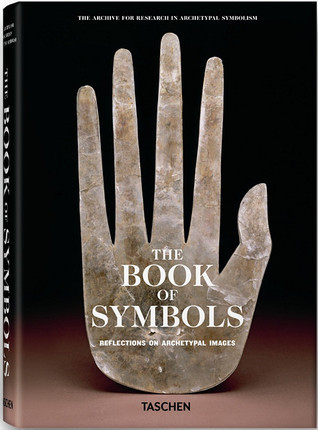
An exploration of symbols and their meanings throughout history.
The Book of Symbols combines original and incisive essays about particular symbols with representative images from all parts of the world and all eras of history. The highly readable texts and over 800 beautiful full-color images come together in a unique way to convey hidden dimensions of meaning. Each of the ca. 350 essays examines a given symbol’s psychic background, and how it evokes psychic processes and dynamics. Etymological roots, the play of opposites, paradox and shadow, the ways in which diverse cultures have engaged a symbolic image—all these factors are taken into consideration.
Authored by writers from the fields of psychology, religion, art, literature, and comparative myth, the essays flow into each other in ways that mirror the psyche’s unexpected convergences. There are no pat definitions of the kind that tend to collapse a symbol; a still vital symbol remains partially unknown, compels our attention and unfolds in new meanings and manifestations over time. Rather than merely categorize, The Book of Symbols illuminates how to move from the visual experience of a symbolic image in art, religion, life, or dreams to directly experiencing its personal and psychological resonance.
The Book of Symbols sets new standards for thoughtful exploration of symbols and their meanings, and will appeal to a wide range of readers: artists, designers, dreamers and dream interpreters, psychotherapists, self-helpers, gamers, comic book readers, religious and spiritual searchers, writers, students, and anyone curious about the power of archetypal images.
This isn't the kind of book you just dive into on page one, and plow through in a sequential manner. It is, though, a supurb reference book of all things Jungian, Freudian, archtypal, tantric, and post-modern. For those of you who appreciate and respect the power of the symbols that surround us in our daily lives, this is the tome for you. Drawing from a variety of traditions, it is nearly exhaustive in scope, yet oddly refreshing in its occasional irreverence towards its own chosen subject matter.
This is a book that examines how our environment interacts with our psyche and how we make sense of the world. It starts with the most fundamental and ancient symbols like the Universal egg and expands further towards modernity passing through the symbolism of the plant world, the animal kingdom, and ultimately, our own artificial creations. It's a fascinating collection of illustrated essays that would be of interest to anybody. It's beautifully designed, incredibly well researched and a pleasure to read.
So I haven't actually read the book cover to cover, but I have used it as a reference book a number of times, and have absolutely loved this book. It's a great reference for philosophy, literature, art, art history, mythology, etc.
One of my professors recommended this book. So I bought a copy. It was about $20 on Amazon, and let me tell you, after getting this book, I can't believe it was only $20. It's a beautiful, hardback book. It has tabs that make it easy to navigate through the different categories of entries. It has lots of pictures and of course a ton of info. Just for a small sampling, for my first assignment using this book, I looked up several colors [red, black, etc], astrological/astronomical signs [sun, moon, stars, etc] and alchemy symbols. It's been interesting to just pick a random topic and read about it.
This is a cool just-for-fun book, as well as an awesome reference book.
I'm not gonna say there is nothing interesting in the book, but the vast majority seems very superficial. You can find most of it in a short google search or by thinking yourself for two minutes. Also, if your looking for some reflection on the triangle for example, you'll have a hard time finding it. However, you will find two pages dedicated to a bicycle! A bicycle! In a book on archetypes?!
Definitely not a "reading" book. More like a "sit and peruse" book. Phenomenal reference book on the archetypal and historical symbolism of a huge variety of objects that, while seemingly mundane, reach deep into the origin myths and the deep spiritual aspects of human psychology and symbolic meaning. I originally picked this up as a christmas present for a friend and never mailed it, as I simply found it too fascinating to give up. Guess I just have to get another copy for this christmas. Just open it up to any page and start reading. Furthermore, the visual illustrations for the enormous volume of entries is as varied and profoundly researched as the information itself–a huge collection of regional, historical and contemporary examples of these symbols make this book a must have for anyone interested in Jungian concepts of collective symbolism, as well as anyone working in the visual arts. Taschen produces another fantastic work–this is what books are for.
I chipped away at this tome for fourteen months and finally finished today. If you wish to delve into the symbolism of the fourteen months, the beginning of such a reading endeavor, the text itself, what it means to finish a text, etc., etc., I would recommend this book to you.
Be warned, however: If you were one of those students who thought that your English teacher read too deeply into symbols, you will be beside yourself with this one. Furthermore, one is left wondering why symbolic meaning matters at all given the fact that the authors go to great lengths to illustrate that every symbol symbolizes the very opposite of the thing it symbolizes.
Quite the piece of scholarship, I will say that. Only for the most enthusiastic Jungian disciple.
This book is super surface level, it acts as a basic introduction to symbology. I understand the rose is a symbol of love and that an egg is a symbol of creation, this book didn't go into more detail about the symbology throughout history, cultures, religion etc. Thankfully I took it out of the library instead of buying it and returned it the next day.
Semplicemente perfetto, una vera mappa per meglio comprendere quanto l'inconscio cerca di comunicarci. Apparato iconografico magnifico, curato nell'edizione, e faccenda che ha il suo peso il costo è di soli 30 euro. La pubblicazione la si deve anche al sito http://aras.org The Archive for Research in Archetypal Simbolism. Sito bellissimo, unico problema il costo annuale di 100$ per poter consultare il suo ricchissimo archivio di immagini e schede di commento ai simboli. E poi è only English...
Gli ho comprato anche il leggio apposta. Così é pronto per la consultazione mattutina (mia e del marito). Stanotte nel sogno vi era una leonessa, nel libro trovo: Leone come oro, sole e regalità p. 268 femmina, come cacciatrice e madre, p. 268 leoni come Oriente e Occidente, p. 54-55 simbolo alchemico del, p. 270 ricchissimo ampliamento di senso, di che nutrirsi bene.
Lo tengo y lo vengo leyendo hace un año, pero se merecía una pequeña reseña.
Es un libro que recorre la mayoría de los arquetipos reconocibles, desde colores, animales, objetos mitológicos y nos da una amplia significación de cada uno de ellos, abordándolo desde diferentes miradas, culturas, épocas. Es muy completo, MUY.
Es un libro hermoso, que más puedo decir.
No lo terminé claramente, porque es enorme pero vuelvo a él siempre que necesito alguna referencia de algo, se convirtió en mi biblia, en mi manual de consulta de cabecera.
While this book is rich in images, symbols, art and their significance, it also lacks some elementary parts in the world of symbols, rendering it practically useless in some fields. Numbers, fruits, animals and holidays are lacking in their coverage, references that are often made in literature. It is a fun book to delve into and find interesting new facts about symbols, but functionally, it is more like a coffee table book, and less like an encyclopedia or dictionary that has practical use.
So how do I explain that a fictional crown prince with magic tattoos made me crave a deeper understanding of archetypal meaning and led me to this book?😭
Regardless, I’m here and I’m thriving. I’ve always been drawn to the hidden meanings behind dreams, symbols, rituals, dreams etc and this book felt like a natural extension of that curiosity.
This isn’t a book you read cover to cover, but it’s the perfect reference text. I went down a rabbit hole with it, and had so much fun with it. I enjoyed learning the basic origins and meanings of symbols and cultures around the world, though I do wish it dug deeper into both for a more rewarding learning experience. This was pretty unsatisfying in that sense, but it was a great starting point. I also understand why it is as concise as it is, as it covers a wide range of symbols and images.
Haven't read the book cover to cover, but I have used it as a reference book many times in my studies of psychoanalysis, philosophy, literature and mythology. Beautiful. Absolute perfection to me. One of my favourite books of all time.
A perfectly gorgeous book that discusses and illustrates the symbolic meaning of a host of concepts from the egg to "ancestor," the final entry. In between, the book covers creation and cosmos, the plant world, the animal world, the human world, and finally the spirit world. This is your go-to source for all things symbolic. Useful for both readers and writers, and of course Jungians on holiday.
This is not really a book you sit and read but rather an intense resource to refer back to. It’s absolutely gorgeous and I plan on buying a copy. Very comprehensive.
I haven't read the entire book yet. It's 790 pages, and intended as a reference work. What I have read is impressive, illustrated with the quality of artwork one might find in a comprehensive art history course. This is a book on symbols, and edited from a Jungian perspective, published by the Archive for Research in Archetypal Symbolism (aras.org). The text is revealing and yet open-ended enough to make it a remarkably valuable resource, not as a dream interpretation book, but one that offers hints as to what one might have meant when one dreamed or imagined that. I can still think of symbols I wish were included, but this is a book I know I'll turn to again and again for that extra nudge of insight. The book is hardbound, with five ribbon markers as well as thumb-indentations at major sections. It's divided into five main sections: Creation & Cosmos, Plant World, Animal World, Human World, and Spirit World.
Een bijzonder mooi uitgevoerd boek - je verwacht niets anders van Taschen. Meer een blader dan een leesboek, ook gebruikelijk bij deze uitgeverij. Wat ik waardeer aan dit boek, is dat het team "beeld" als uitgangspunt heeft genomen, en niet het "symbool". Er is daardoor ook ruimte voor wat je in eerste instantie niet als een symbool zou zien, zoals "auto". De indeling in grote delen en hoofdstukken is prettig, de gevonden afbeeldingen spreken aan. Ze putten zowel uit archaïsche bronnen als moderne kunst. De meeste beelden krijgen twee pagina's, maar er is ook ruimte voor verdieping bij centrale, menselijke beelden.
Ik gebruik het werk als referentie, bijvoorbeeld bij het lezen van tekeningen, (Tarot)kaarten en ter inspiratie bij beeldvorming in groepen.
I have had this on my to read shelf for quite a few years (Since 2017). I could not muster up the effort to buy the book nor pop down to my library as it was only available as a reference material.
I finally got down to doing it and wow it was a tome of a book. The book is split into various sections like human body, nature, animals, the earth and more and each section is divided by an indented portion so u can easily flip to it. Each item has a 1 - 2 page essay on one of the art work featured and I am glad I did not purchase this as it was not what I wanted.
I think it is interesting as it shows art and photos from different cultures and let's the reader think about what the symbol means to them.
Best ever encyclopedia of animals, patterns, things, places, plants and flowers, mythological creatures, landscapes and more, with very interesting text alongside each one exploring their symbolic meanings. It covers the cosmos, the natural world, the human body and just pretty much anything you could ever hope for; it's fantastic to dip in and out of and the editing is brilliant with a really beautiful selection of images. I've found it helpful in designing tattoos and writing essays, understanding different levels of symbolism and just feeding my own interest. So yeah, basically, I love it! A very worthwhile investment that won't run dry.
Good for quick reference and inspiration, especially since it has information about different interpretation in different cultures (sometimes I just flip through when I need certain subject matters to work on). But you'll need to find more on your own if you're expecting some in-depth information.
There needs to be more books like these! Makes research life so much easier.
I've studied this book and explored it and leaped back and forth around it. It's a reference book that's helped me make sense of dreams and ideas and encounters with images in my psyche. It's one of the most helpful books I turn to as I try to understand myself and my world.
The author of this book - The Archive for Research in Archetypal Symbolism - is a collective working in the spirit of C.G. Jung's legacy. It grew out of the Bollingen Foundation in New York. The Foundation was the recipient of a visual archive that sedimented from the long series of Eranos conferences, initiated by Olga Froebe Kapteyn on the Swiss shores of Lago Maggiore. Jungians approach symbols as dynamic and polysemic cultural entities. In her introduction editor Kathleen Martin writes: "A symbol mysteriously unites disparities. Thus, the reader will find that we have avoided pat definitions and equations since these tend to constrain a symbol. A still vital symbol remains partially unknown, compels our attention and unfolds in new meanings and manifestations over time." Symbols offer an invitation to develop a relationship of curiosity with them. They are sources of contemplation and individuation. James Hillman said that "the gift of an image is that it affords a place to watch your soul". The task is not to understand the image. Hermeneutics kill the image. It's about observing and understanding our position with respect to archetypal images - whether culturally transmitted or emerging from our own minds. That is the only thing we can do that is genuinely therapeutic. The reason for the four stars rather than five is that there never seems to be enough in this kind of book. The store of images is potentially endless. And I agree, it's odd that the bicycle is included but the anus is not.
DNF. As someone who loves symbols in art and literature, I picked this book up as an impulse buy, hoping to glean more general knowledge on the images and hidden meanings that I might encounter or might have already encountered in art and reading. The book, however, leaves much to be desired. While the images are interesting and relevant (almost a little lesson in and of themselves) and while I felt this was a well-rounded global acknowledgment of symbols (and not just what white Europeans thought), it was a combined effort of several contributors. Therefore some entries were really interesting where others were poetic, waxing and waning on nothing in particular. Sadly, in the end, I've decided to abandon it. I just don't ever want to read it. It's a book that looks impressive on your coffee table but belongs in the bin in the bathroom where people are forced to read it when they are bored and that desperate for reading material.
What do the shell, a house and an earring have in common? Well according to this male author, a woman’s vulva. The concept of this book is such a great one, as is the plentiful color artworks and ancient objects found throughout the 800+ pages. The writing here is where this book really falls flat. For a book this length you would think they would try and fit as much interesting content as possible. Every single symbol is presented as if the average adult living in this world has never seen it before. Do we really need the most pretentious paragraph ever describing what a puddle is? The entry for the broom truly made me laugh out loud. I’m giving a bonus star just for the many moments this book was so ridiculous that I just had to chuckle and wonder how much better this could have been if it had been written by someone else (ahem, a woman).