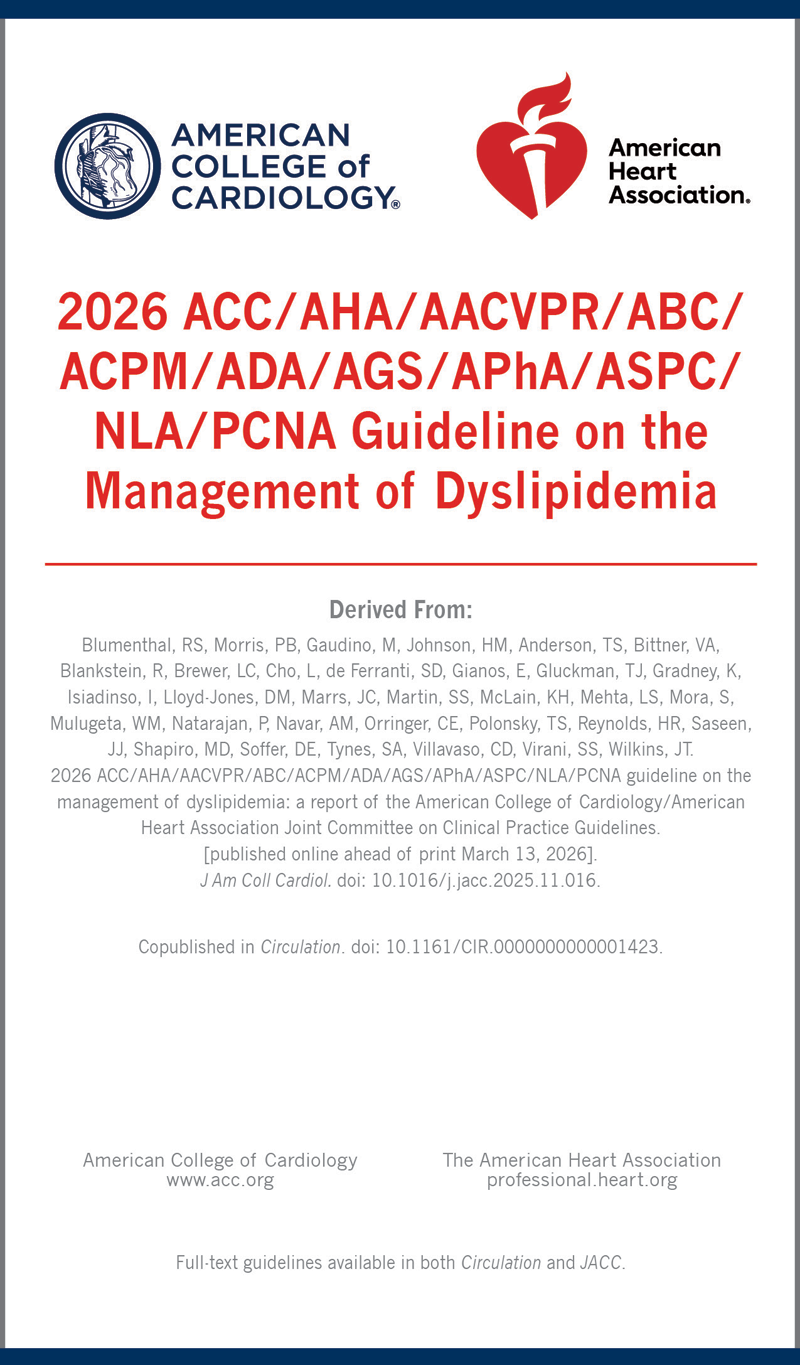
Management of Dyslipidemia
American College of Cardiology, American Heart AssociationPublished: March 13, 2026
- Introduction
- Top Take-Home Messages
- Definitions and Classifications
- Evaluation and Diagnosis
- Management
- Complications of Management
- Tables
- ASCVD Risk Related to Lp(a) Concentrations
- Characteristics of Common Lipid-Lowering Medications to Treat Dyslipidemia
- High-, Moderate-, and Low-Intensity Statin Therapy
- Pharmacokinetic Properties of Statin Medications
- Common Medications That May Interact With Statins
- Considerations for Referral to a Lipid Specialist
- Checklist for Individualized Benefit-Risk Discussion
- Salient Features of the American Heart Association PREVENTTM* Equations
- Crosswalk Between 10-Year Risk ASCVD Estimates From PCE and PREVENT-ASCVD Equations
- Risk-Enhancers
- Reproductive Risk Markers Associated With ASCVD Events
- Liposorber® (LA-15 System) FDA-Approved Indications for Lipoprotein Apheresis
- Physiological and Secondary Causes of Hypercholesterolemia Due to LDL-C
- Diabetes-Specific Risk Enhancers That Are Independent of Other Risk Factors in Diabetes
- Normal and Elevated Lipid Values in Childhood
- Lipid-Lowering Agents in Childhood and Adolescents (eg, <Age 18 Years)
- Lipid-Lowering Therapies During Pregnancy and Lactation
- Antiretroviral Therapy and Statin Drug Interactions - Protease Inhibitors
- Antiretroviral Therapy and Statin Drug Interactions - NNRTIs
- Antiretroviral Therapy and Statin Drug Interactions - NRTIs
- Antiretroviral Therapy and Statin Drug Interactions - Integrase Strand Transfer Inhibitors
- Physiological and Secondary Causes of Hypertriglyceridemia
- Patients or Characteristics Associated With Increased Risk for Statin-Attributed Muscle Symptoms
- Safety Considerations for LDL-C–Lowering Medications
- Safety Considerations for Triglyceride-Lowering Medications
- Clinical Recommendations on Management of DDI With Statins and Cardiovascular Medications
- Figures and Algorithms
- Lipoprotein Goals for ASCVD Risk Reduction
- Health Behavior Interventions in Patients With Hypertriglyceridemia
- Rationale for New 10-Year Risk Thresholds in Lipid-Lowering Therapy Using PREVENT-ASCVD
- Logic for Defining the Absolute Estimated 10-Year ASCVD Risk for Consideration of LLT at ≥3% in Primary Prevention
- CPR Framework for Risk Evaluation
- Primary Prevention in Adults 30 to 79 Years Without ASCVD
- Evaluation and Management of Severe Hypercholesterolemia
- Evaluation and Management of HoFH
- Adults With Diabetes and Without ASCVD
- Clinical ASCVD: Criteria for Defining “At Very High Risk” in Adults
- Secondary ASCVD Prevention for Adults at Very High Risk
- Secondary ASCVD Prevention for Adults at Not Very High Risk
- Managing Adults With Subclinical Atherosclerosis
- Managing Adults With Hypertriglyceridemia
- Adults With ASCVD and Hypertriglyceridemia
- Adults With Hypertriglyceridemia but (cont'd) Without ASCVD or Diabetes
- Managing Adults With Triglycerides ≥500 mg/dL
- Adults With Statin-Attributed Muscle Symptoms
Also Found In


You rely on Guideline Central for transparency
Guideline Central and select third party use “cookies” on this website to enhance the user experience.
This technology helps us gather statistical and analytical information to optimize the relevant content for you.
The user also has the option to opt-out which may have an effect on the browsing experience.