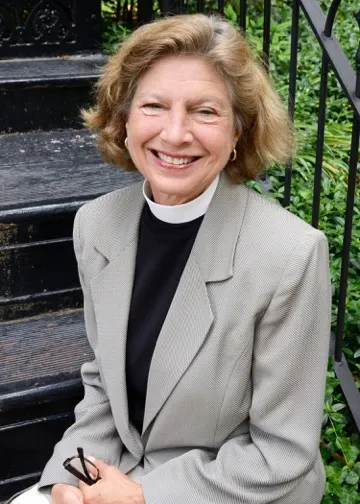
Question Session

with Rev. Cynthia Dopp, Deacon
Originally published February 16, 2018 in the Winged Lion Review

What is a deacon? Is this something new?
The word deacon comes from the Greek root diakonia. Diakonia means service to the needy. During the ordination service of a deacon, the Bishop states that the diakonia is a “special ministry of servanthood directly under your bishop. In the name of Jesus Christ, you are to serve all people, particularly the poor, the weak, the sick, and the lonely.”
Deacons have been around since the very early church (in fact, before there were priests). Acts 6 is considered to be the biblical foundation of deacons: “and the twelve [disciples] called together the whole community of disciples and said, “It is not right that we should neglect the word of God in order to wait on tables. Therefore, friends, select from among yourselves seven men of good standing, full of the Spirit and of wisdom, whom we may appoint to this task, while we for our part will devote ourselves to prayer and to serving the word.” (Acts 6:1–3)
The order continued until about the 5th century. As priests became more numerous, the order of deacons essentially died off. However, deacons returned to the church by the 20th century. The Episcopal Church renewed the order of deacons in 1970, and for the first time, allowed women to be ordained as deacons. (There were deaconesses before, but the office of deaconess was abolished by canon.)
Today, there are two kinds of deacons: transitional, and what some call vocational.
Transitional: All priests are required to be transitional deacons for six months prior to ordination to the priesthood. This is a time of preparation for the priesthood and the transitional deacon’s functions are essentially the same as a priest, with the exception of presiding at the Eucharist. It is an internship of sorts.
Get The Winged Lion Review’s stories in your inbox
Join Medium for free to get updates from this writer.
Vocational: I am a “vocational” deacon, meaning that I am permanently ordained to the diaconate. My role is different from a priest or a transitional deacon.
So what is my role? There are three major components involved with the deacon’s role:
- Liturgical: It is the deacon’s role during worship to: Proclaim the Gospel, Invite the confession, set the table (and serve the cup), and dismiss the congregation to go out in the world to serve others.
- Outreach/Serving the needy: Deacons serve as bridges between the world and the church. We bring the needs of the world to the attention of the church and encourage the church community to respond to the needs of the world. Outreach and social justice advocacy are two common areas of ministry for the deacon.
- Collaboration: Bishop Mariann Budde has asked deacons to develop collaborative relationships with other Episcopal parishes in our regional area of the diocese. (Our regional area is Capitol Hill) Partnering with other church communities strengthens the Church’s ability to engage in ministry. It will be my task to collaborate with other Capitol Hill parishes in order to create strong relationships.These relationships will more effectively serve the needs of the community.
How does one get to be a deacon?
I was ordained on September 30, 2017, along with four other deacon candidates. We were the first official group of deacons to be ordained in the Washington diocese, having started discernment in November 2014. (Yes, it took nearly three years to become ordained.) There is a diaconate discernment and formation process in many Episcopal dioceses. However, the diocese of Washington has not ordained vocational deacons until now. (There was a small pilot program about six years ago where four deacons were trained and ordained but it was only a trial program that was not continued.)
The formation process involves initial discernment with a priest from the person’s home church, moving on next to work for six sessions with a discernment committee comprised of parishioners. Following approval by the discernment committee and the church’s vestry, the Bishop decides who may move forward from there. At that point, official “deacon school” starts — an 18-month process of monthly classes where various aspects of the diaconate are taught through lectures, discussions, reading, and writing assignments. During the last year, the deacon candidate also engages in two six-month internships: first with a social service agency and then with a church in the diocese as a deacon intern. I interned at Bethesda Cares, an organization that fights homelessness in Montgomery County. I then spent six months at St. Stephen and the Incarnation, observing and learning as much as I could about the deacon’s role at that parish, which has had a deacon for five years.
Why do you wear your sash at a diagonal?
The deacon stole goes diagonally from the left shoulder to the right side at the hip, in contrast to priests, who wear their stoles around their necks like a yoke. I have heard different reasons for the diagonal stole, other than distinguishing deacons from priests. The deacon’s diagonal stole is tied with a loop to have the effect of the towel that Jesus tied around himself and is thought to represent the towel that Jesus used to wash the disciples’ feet.”Then he poured water into a basin and began to wash the disciples’ feet and to wipe them with the towel that was tied around him.” (John 13:5) Some of my deacon colleagues also commented that the stole is attached in order to keep the deacon’s hands free to serve.
Who are some of the famous deacons of history? Any saints?
Acts 6 names the first seven deacons in scripture, beginning with Stephen. “They chose Stephen, a man full of faith and the Holy Spirit, together with Philip, Prochorus, Nicanor, Timon, Parmenas, and Nicholaus” (Acts 6:5). St. Stephen, the first Christian martyr, is viewed as the patron of deacons. According to the Association for Episcopal Deacons, there are currently approximately 3,000 deacons in the U.S.
Do you root for the Wake Forest Demon Deacons?
I certainly can’t root for deacons who are demons! No, I root for the Williams College Purple Cows.
Seriously, please tell us a bit about you and how you came to St. Mark’s.
The Bishop assigned me to St. Mark’s, which I knew very little about but have been very pleased so far! I attended St. Columba’s Church in Northwest D.C. for 27 years, participating in a variety of ministries including Lay Eucharistic Ministry, Healing, Reading, Adult Education, and Stephen Ministry training and leadership. I also served on Senior Ministries and Pastoral Care committees and as a diocesan lay delegate. My experiences at St. Columba’s led to my interest in attending seminary. I was not thinking about ordained ministry at that point, but just wanted the theological education. In 2004, I started to take a few courses at Wesley Seminary. This quickly led to my enrollment in Wesley’s Master of Divinity program, graduating in 2011. Currently, I am working towards a Doctor of Ministry degree, with a focus on chaplaincy. While I have taken a break from studies this past year and a half in order to focus on deacon school, I hope to complete my degree within the next few years.
My seminary studies led me to want to be a chaplain, and I have worked as a hospital chaplain since 2010. Currently, I work part time as a chaplain at George Washington University Hospital, where I have focused on palliative care patients and their families for the past five years. In addition, I work as a chaplain for an outpatient palliative care clinic run by George Washington Institute for Spirituality and Health.
Prior to seminary and chaplaincy, I spent 15 years at home with my three children. It was at this time that I became very involved with St. Columba’s. Before having children, I worked as a health care management consultant, working on financial and strategic planning efforts with D.C.-area hospitals. It is interesting to me that I continue to work in the hospital setting, albeit from a different perspective!
My husband, Michael, and I live in Bethesda and are now officially “empty nesters.” James (30) lives in China; Carolyn (28) lives in New York; and Peter (24) lives in Denver. We have a neurotic but loving dog, Benny, who my husband greets effusively before acknowledging me when he comes home from work. We met in graduate school and have been married for 31 years. I am a compulsive knitter, which you probably have already noticed because I bring my knitting with me everywhere.
How do you see your role or mission here? What would you like to accomplish during your time here?
My role is to serve liturgically, engage myself and others in ministry, and assist Rector Michele Morgan in any ways that are helpful. I am excited to be at St. Mark’s because of your amazing outreach ministry work and I hope to contribute to and encourage outreach. I have a special interest in health care ministry, both from my chaplaincy and pastoral care work, and my prior career in health care consulting. I would love to explore the possibilities of developing a health-care ministry, perhaps for those in need in the St. Mark’s neighborhood and also for parishioners. I also am interested in working with older adults, having spent nine years on the Board of Seabury Resources for Aging, which is the diocesan-supported organization that supports and advocates for seniors.
In all honesty, I am open to all kinds of ministry possibilities and I look forward to seeing what lies ahead at St. Mark’s. I am confident that working with all of you will open up a multitude of opportunities for ministry. There are many active parishioners who I look forward to working with in my role as your deacon. I am happy to be assigned to St. Mark’s. People have been very friendly and welcoming and that is a blessing. Thank you!