
 Meet Maggie, PCMag's
Roku's first OLED TV addresses the category's biggest hurdle: sky-high pricing. The Roku Pro Series OLED brings accurate colors, an ultra-slim profile, and precise pixel-level contrast down to just $1,199.99 for the 65-inch model I tested. The catch? It’s noticeably dim compared with budget-priced mini-LEDs like the Hisense U6SF Pro ($649 for 65 inches) and midrange OLEDs like the LG Evo C6 ($2,699.99 for 65 inches), meaning shadow-heavy content looks best in a fully darkened room. The U6SF Pro and the Evo C6 remain our Editors' Choice winners in their respective categories, but Roku beats them both on speed. Registering under nine milliseconds of latency with a 4K60 signal, it earns our PCMag Lab Award for lowest input lag, a title previously held by the Samsung S95H ($3,399.99 for 65 inches), making it a terrific choice for high-speed gaming.
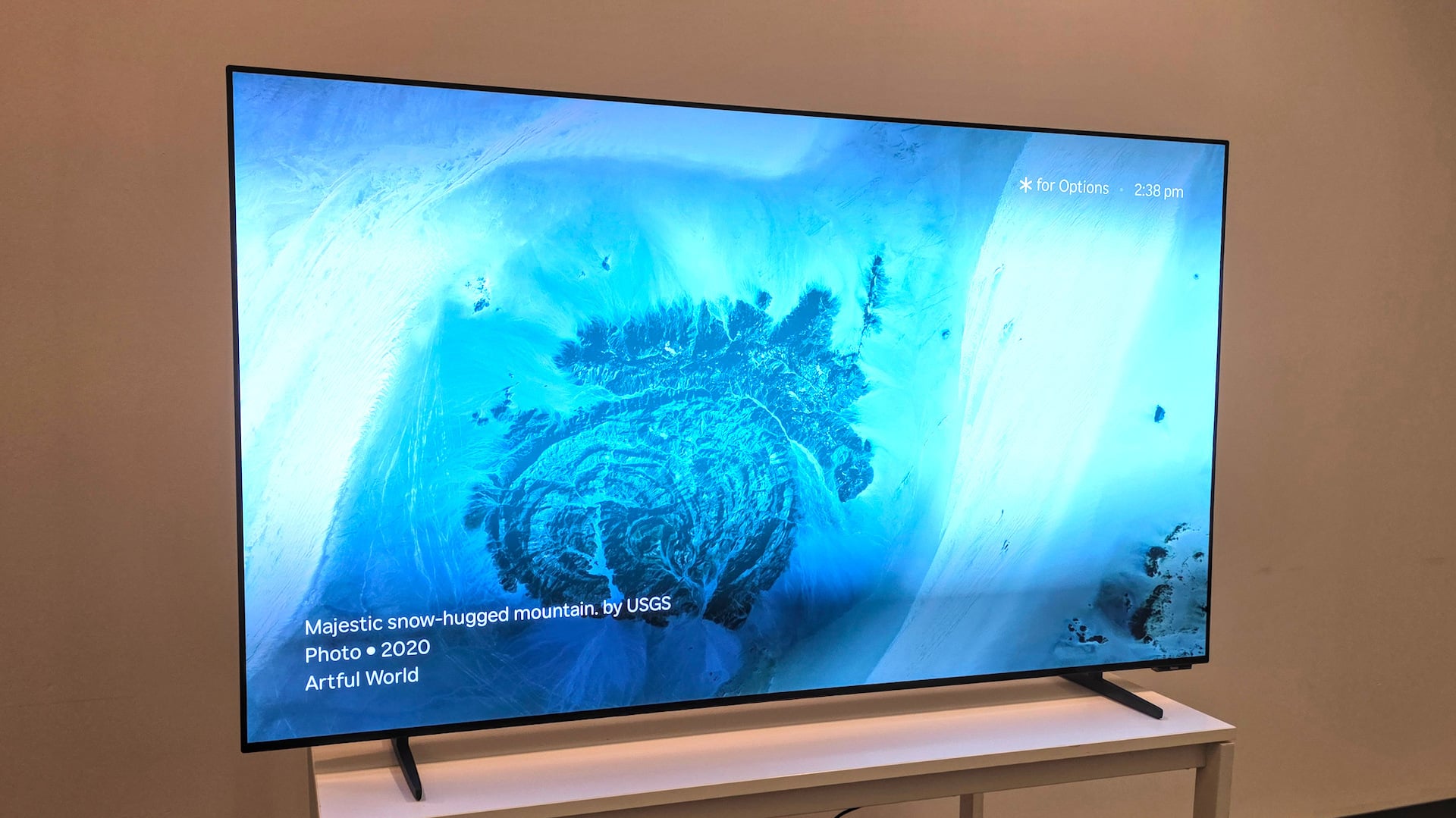
The Roku Pro Series OLED TV is a single bezel-free surface framed by only a narrow black band around the active picture. The edge of the panel is covered with gray metal that wraps around the entire back of the screen. The top third of the back of the TV consists only of the OLED panel and its metal frame, which combined are a fraction of an inch thick. Occupying the lower two-thirds of the back is a 1.4-inch-deep black plastic casing that houses the TV’s electronics and connections. It stands on two flat, skinny metal legs near the sides of the screen, unless you mount it on the wall.
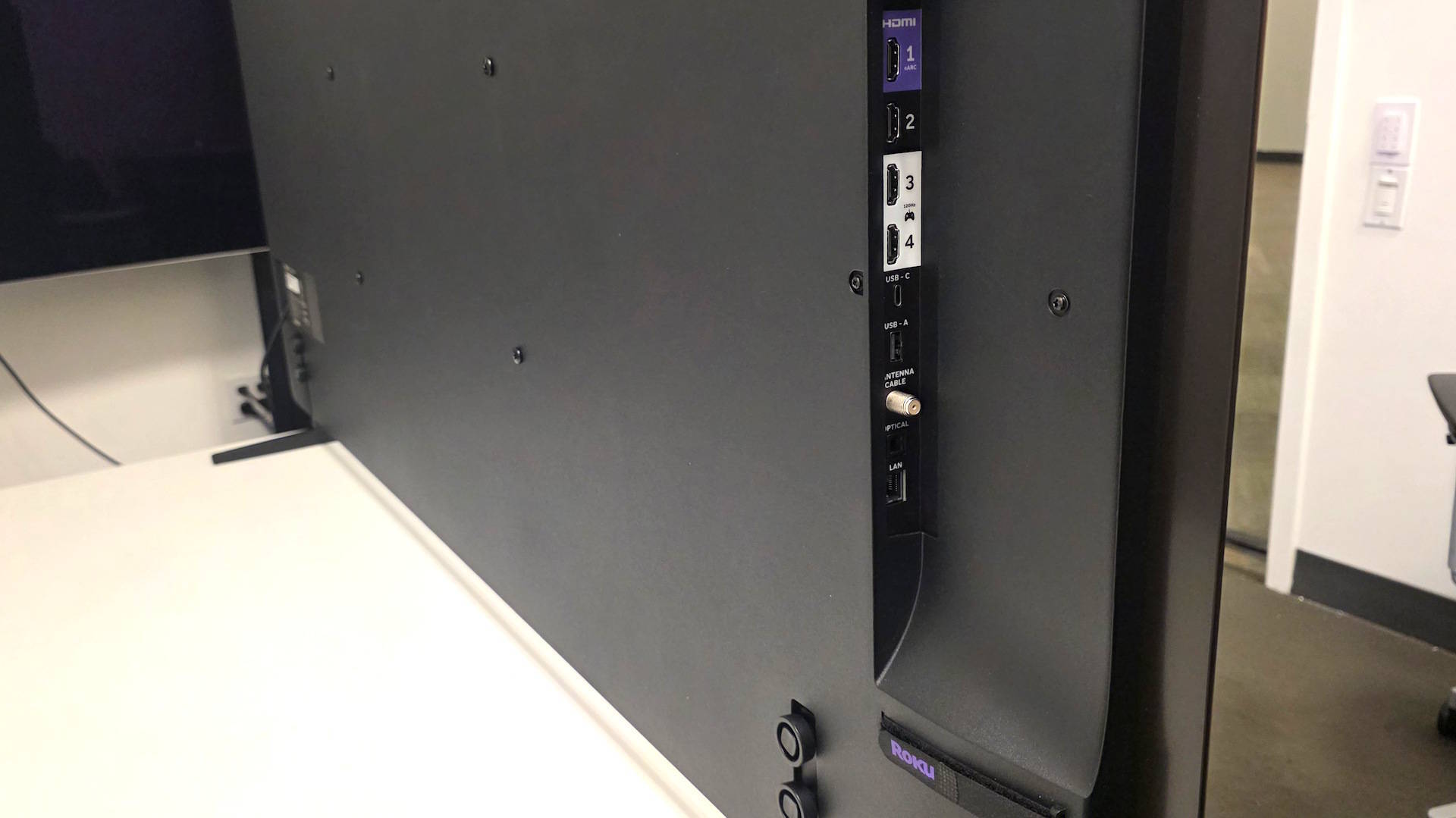
Besides the power cable connector on the right side, all of the Pro Series OLED’s ports are on the left side of the back of the TV, facing left. They include four HDMI ports (two 4K120, one eARC), a USB-A port, a USB-C port, an optical audio output, an Ethernet port, and an RF antenna/cable connector. In a very basic but nice touch, a strip of Velcro sits mounted just below these ports, letting you bundle all the cables together to keep them untangled.
Powered by two AA batteries, the included voice remote has Roku's standard candy bar shape, with its distinctive purple plus-shaped navigation pad near the top and a matching fabric Roku tag near the bottom. A volume rocker and mute button sit on the right edge, and dedicated service buttons near the bottom provide quick access to Amazon Prime Video, Disney+, Netflix, and YouTube. It also has a pinhole microphone near the top for using Roku’s voice features.
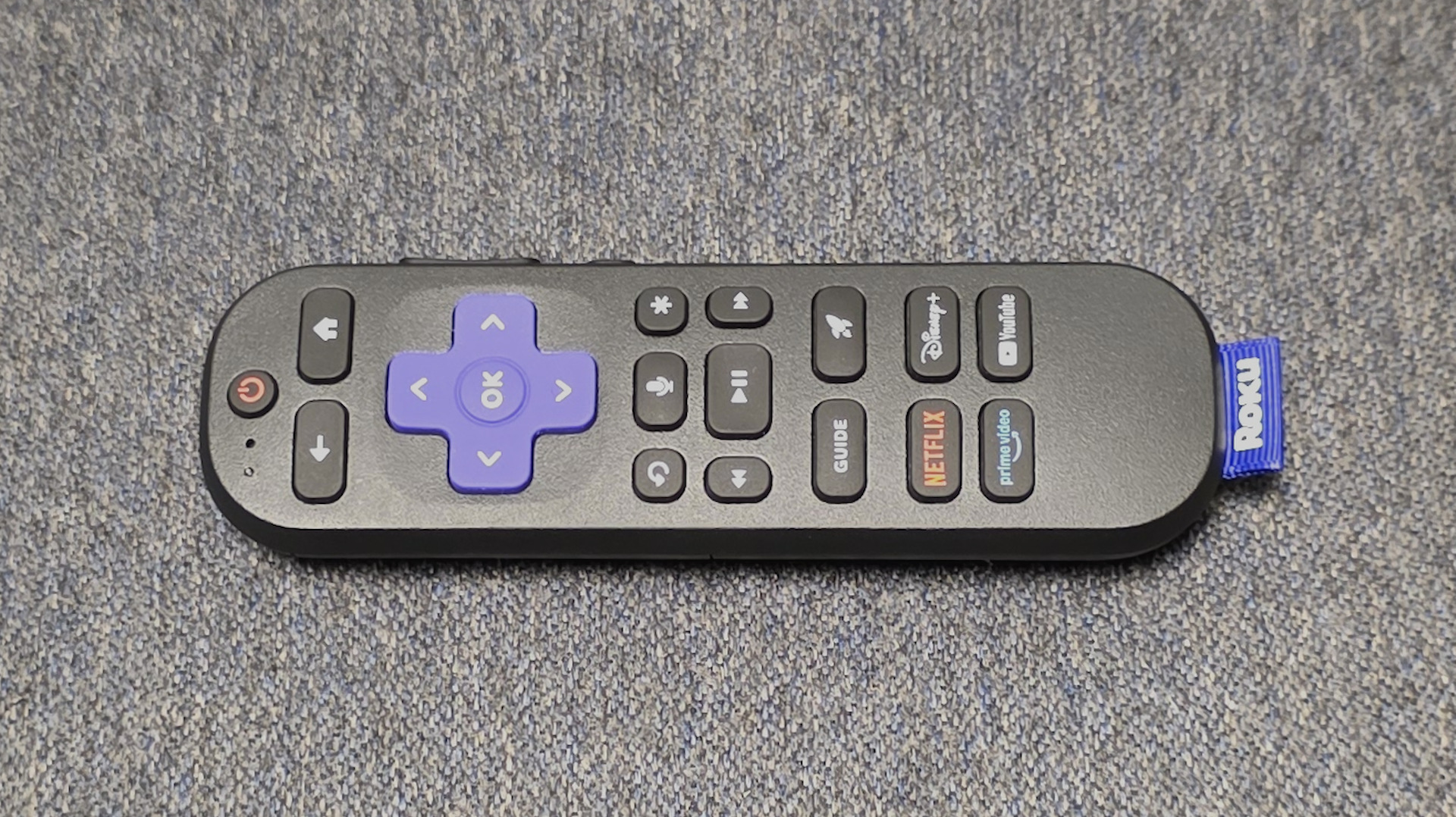
The remote is a slightly enhanced version of the standard Roku Voice Remote, featuring backlit buttons and a finder function that chirps when you press a button on the back of the TV. It doesn’t have the hands-free voice functionality or built-in rechargeable battery of Roku's $29.99 Voice Remote Pro. It's a bit disappointing because the mini-LED Roku Pro Series TV ($1,199 for 65 inches) comes with the Voice Remote Pro.
Similar Products


Vizio Mini LED Quantum 4K Smart TV

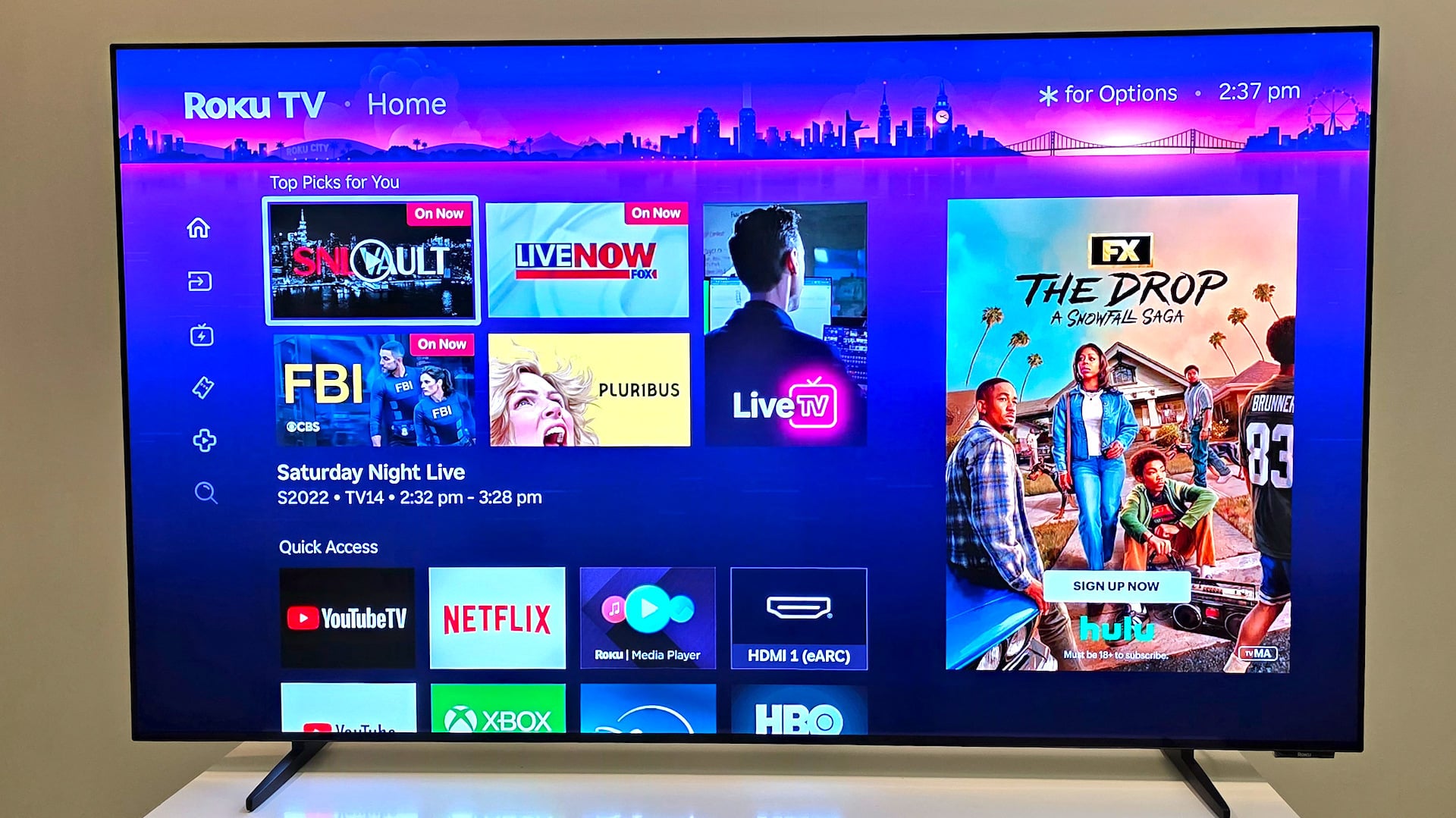
Roku is in the Pro Series’ name, so naturally, it uses the company's smart TV platform. Roku OS is focused on streaming media above any other feature, with a simple interface built around large, friendly tiles and relatively few ads or algorithm-driven suggestions. Even after a recent update that adds more content recommendations than before (much to my chagrin), it’s still one of the least cluttered TV menu systems available, which is why I often recommend Roku TVs and media streamers to less tech-savvy users. Nearly all major streaming services are supported on Roku, with the exception of Twitch, and the platform supports Apple AirPlay for streaming content from your iPhone, iPad, or Mac.
You can control the Pro Series OLED with your voice by speaking into the remote, though this is also very media-centric, with few extra tricks. Roku’s voice feature lets you search for media, control the TV itself, and supports a handful of first-party smart home devices. It’s not a full AI assistant that can answer general questions like Fire TV with Alexa or Google TV with Gemini, and it isn’t really designed to serve as a comprehensive whole-home smart hub, either.
The Roku Pro Series OLED has a 120Hz refresh rate with VRR and AMD FreeSync Premium, and supports high dynamic range (HDR) content in Dolby Vision, HDR10, HDR10+, and hybrid log gamma (HLG). It has Wi-Fi 5 and an ATSC 1.0 tuner.
I tested the Pro Series OLED using my standard gear, including a Klein K-10A colorimeter, a Murideo SIX-G signal generator, and Portrait Displays’ Calman software.
Light output is one of the biggest weaknesses for OLED TVs, though midrange and high-end models have gotten brighter over the last few years. In HDR Dark mode with an HDR10 signal, I measured peak brightness of 138 nits for a full-screen white field, 496 nits for an 18% white field, and 639 nits for a 10% white field. I’ll point out that HDR Dark mode isn’t actually “dark,” and that the TV’s HDR Bright mode showed similar numbers. HDR Dark on the Pro Series OLED is like the Movie or Cinema modes of most other TVs, using the warmest white balance to produce the most accurate colors. HDR Bright is similar to the Vivid mode on other TVs, setting a cooler white balance that makes the picture visually appear brighter, but also skews colors heavily.
Ideally, a TV should be able to deliver at least 1,000 nits to really do HDR content justice, though low-end OLEDs and even cheap LED TVs often fall short. The LG Evo C6 is more than twice as bright as the Roku (274 nits full-screen, 1,015 nits 18%, 1,552 nits 10%), but it’s also more than twice the price. The mini-LED Roku Pro Series outshines all of these other TVs (833 nits full-screen, 1,621 nits 18%), but the trade-off is light bloom that can cause haze along high-contrast edges. Because OLED TVs control light output at the pixel level, they’re completely free of light bloom, and that precision is one of the big advantages of the Pro Series OLED.
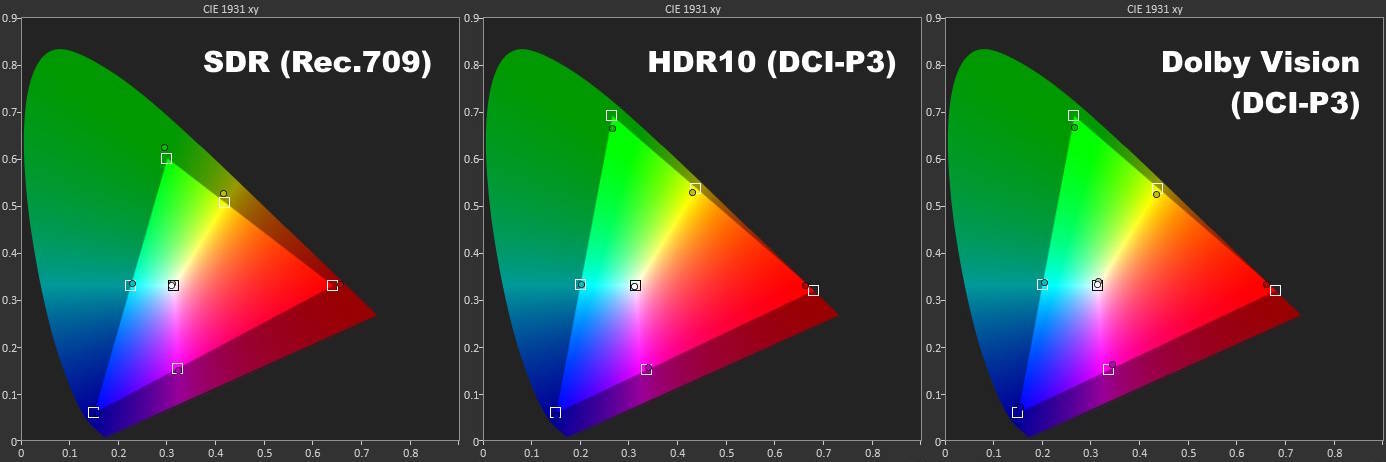
Color performance on the Pro Series OLED is excellent, even if the TV doesn’t aspire to show the widest range of hues. The above charts show the Pro Series’ color measurements in Movie mode with an SDR signal compared against Rec.709 broadcast standards, and in HDR Dark mode with an HDR10 signal and Dolby Vision Dark with a Dolby Vision signal, both compared against the DCI-P3 digital cinema color space. Whites are more or less spot-on with all three signals, and no colors show any significant tint. Greens and reds fall a bit short of DCI-P3 in HDR, but they come quite close. The LG Evo C6, for comparison, fully covers the color space and is similarly accurate, though its magentas in HDR10 are a bit warmer than ideal.
BBC’s Planet Earth II looks gorgeous on the Pro Series OLED, thanks to its vibrant, accurate colors. The greens and blues of plant life and water look lifelike, with plenty of variation. Earth tones in trees, fur, and dirt also look very natural, and all of these colors stay consistently saturated even when viewing the TV off-angle, even fully from the sides.
The OLED panel’s strong contrast and pixel-level light control are showcased nicely in the party scenes of The Great Gatsby. While the TV doesn’t have very high peak brightness, it makes good use of its dynamic range, so black suits look very dark and white shirts and lights appear comparatively bright. As to be expected from an OLED, there isn’t a hint of light bloom along high-contrast edges. Skin tones also look natural, and orange dresses stand out nicely.
Most shots in the demonstration footage on the Spears & Munsil Ultra HD benchmark disc look very good on the Pro Series OLED, again thanks to its color accuracy and per-pixel luminance control. Wide, sunny landscape shots are comfortably bright, with plenty of vivid, natural hues. Especially snowy shots test the panel’s capabilities, though. When the frame is filled with white skies and snow, the picture can look dim compared with other shots, though highlight details like wisps of clouds and falling snowflakes against all that white can be readily seen.
Shadow details, like the textures of tree bark and animal fur in the shade, or the cuts and contours of black suit jackets, stay intact when watching in a dark room. When the TV has to fight with overhead lighting, those details can become muddy. This is where a brighter OLED like the LG EVO C6, or even a mini-LED TV like the Hisense U6SF Pro, has an advantage. It isn’t a problem of glare, strictly speaking, and bright scenes can be easily seen in a well-lit room, but dark and moody shots quickly get overpowered by room lighting.
For gaming, the Pro Series OLED features a 120Hz refresh rate, supports variable refresh rate (VRR), and has AMD FreeSync Premium. It’s also the most responsive TV I’ve tested yet in terms of input lag.
Using a Leo Bodnar 4K video signal lag tester, I measured latencies of 8.8 milliseconds with a 4K60 signal and 4.8ms with a 1080p120 signal. That’s just 0.2ms slower than the Hisense U65SF Pro at 1080p120, but it’s 0.4ms faster than both the Hisense and the Samsung S95H at 4K60 (both 9.2ms). In fact, this is the first time I’ve recorded a 4K60 input lag below 9ms. That makes the Pro Series OLED our new PCMag Lab Award winner for lowest input lag, taking the mantle from the S95H.
Final Thoughts
 (Credit: Will Greenwald)
Roku 65-Inch Pro Series OLED TV
- 5.0 - Exemplary: Near perfection, ground-breaking
- 4.5 - Outstanding: Best in class, acts as a benchmark for measuring competitors
- 4.0 - Excellent: A performance, feature, or value leader in its class, with few shortfalls
- 3.5 - Good: Does what the product should do, and does so better than many competitors
- 3.0 - Average: Does what the product should do, and sits in the middle of the pack
- 2.5 - Fair: We have some reservations, buy with caution
- 2.0 - Subpar: We do not recommend, buy with extreme caution
- 1.5 - Poor: Do not buy this product
- 1.0 - Dismal: Don't even think about buying this product
Read Our Editorial Mission Statement and Testing Methodologies.
The Roku Pro Series OLED TV successfully democratizes OLED picture quality, bringing stunning color accuracy, infinite contrast, and record-breaking input lag to an affordable $1,199.99 for a 65-inch model. That said, its low peak brightness means shadow details struggle against ambient light, making it less ideal for bright living rooms compared with higher-end OLEDs like the LG Evo C6 or budget-priced mini-LEDs like the Hisense U6SF Pro. Even so, the Roku Pro's record-breaking input lag and rich, bloom-free picture make it a stellar value for gamers and dark-room movie enthusiasts looking to get into OLED without breaking the bank.
STILL ON THE FENCE?
About Our Expert
I’m PCMag’s home theater and AR/VR expert, and your go-to source of information and recommendations for game consoles and accessories, smart displays, smart glasses, smart speakers, soundbars, TVs, and VR headsets. I’m an ISF-certified TV calibrator and THX-certified home theater technician, I've served as a CES Innovation Awards judge, and while Bandai hasn’t officially certified me, I’m also proficient at building Gundam plastic models up to MG-class. I also enjoy genre fiction writing, and my urban fantasy novel, Alex Norton, Paranormal Technical Support, is currently available on Amazon.
- The Best Ereaders for 2026
- Up Close With Amazon's New Kindles: Sleek Aluminum, Flat Bezels, and Page-Turn Buttons Are Back
- Meta VR Glasses vs. Apple Vision Pro: Can $1,300 Glasses Dethrone a $3,700 Headset?
- The Best Smart Glasses for 2026
- I Test TVs for a Living. Here's Why I Bought Last Year's Model
- More from Will Greenwald


