Showing posts with label United States. Show all posts

Sunday, 17 March 2019

The US ratification of the Marrakesh Treaty: what has changed?

Juliette Guillemot Bell
The 1709 Blog is delighted to host the following contribution by Juliette Guillemot Bell on the recent US ratification of the Marrakesh Treaty. 

Here’s what Juliette writes:

“On February 8, 2019, the U.S. Marrakesh VIP Treaty ratification document was formally deposited at the World Intellectual Property Organization (WIPO). The ratification of the Marrakesh VIP Treaty by the U.S. brings the number of contracting parties to 50 and, as of May 8, 2019 [date of entry into force in the U.S.], this Treaty will be effectively implemented in 78 countries (including the 28 member countries of the European Union).

The Marrakesh Treaty to Facilitate Access to Published Works for Persons Who Are Blind, Visually Impaired, or Otherwise Print Disabled (aka the “Marrakesh VIP Treaty”) was signed on June 27, 2013 under the auspices of WIPO and became effective on September 30, 2016.

This Treaty establishes exceptions to national copyright laws for the reproduction, distribution, and making available of published works in formats accessible to persons who are blind, visually impaired, or have other print disabilities (such as braille, e-text, audio or large print). It also permits the cross-border sharing of these formats.

Before the Marrakesh VIP Treaty was signed, the U.S. already had mechanisms in place to make copyrighted works available to persons with print disabilities in specialized formats.

Indeed, in 1931, the Library of Congress’s National Library Service for the Blind and Physically Handicapped (NLS) began administering a program for the reproduction and distribution of copyrighted works in specialized formats on a royalty-free basis. However, because the success of this program was dependent on copyright holders granting permission to reproduce their works, in 1996, the Chafee amendment to the U.S. Copyright Act was adopted. This amendment established a limitation on the exclusive rights in copyrighted works by allowing certain entities to provide published works in specialized formats to persons with print disabilities (17 U.S. Code § 121).

The Marrakesh Treaty Implementation Act (MTIA), signed into law on October 10, 2018, aligned U.S. copyright law with the requirements of the Marrakesh VIP Treaty by (1) broadening the scope of section 121 of the Copyright Act, and (2) creating a new section – 121A – to address the cross-border aspects of the Treaty.

Section 121 - “Limitations on exclusive rights: Reproduction for blind or other people with disabilities”

Prior to the adoption of the MTIA, section 121 allowed “authorized entities” to reproduce and distribute copies or phonorecords of previously published “nondramatic literary works” in “specialized formats” exclusively for use by “blind or other persons with disabilities.” While the MTIA did not modify the preexisting definition of “authorized entity” [a nonprofit organization or a governmental agency whose primary mission is to provide specialized services (such as education or information access) to blind or other persons with disabilities], it expanded the scope of copyrighted works, formats, and beneficiaries under section 121:
  • Previously, section 121 only covered “nondramatic literary works” and thus excluded, among others, dramatic works (e.g. the published script of a play). The MTIA made section 121 applicable to all literary works, as well as musical works fixed in the form of text or notation. The Marrakesh VIP Treaty contracting parties also clarified in an agreed statement that audiobooks fall within the scope of the Treaty;
  • Section 121 no longer refers to “specialized formats,” defined by reference to specific technologies (such as braille, audio, or digital text), but to “accessible formats,” which are defined broadly as an “alternative manner or format” giving an “eligible person” access to a copyrighted work “as feasibly and comfortably” as a person without a disability;
  • Section 121 no longer refers to “blind or other persons with disabilities” but to “eligible persons,” i.e. individuals who are blind, have a visual impairment or perceptual or reading disability, or have a physical disability that prevents them from reading normally (for example, a physical disability preventing a person from holding and manipulating a book).
It is worth noting, as clarified by the MTIA, that section 121 only provides limitations on exclusive rights for activities taking place in the U.S. and that the cross-border aspects of the Marrakesh VIP Treaty are dealt with under section 121A (see below).

It is also worth noting that the U.S. did not confine the application of section 121 to copyrighted works that cannot be "obtained commercially under reasonable terms for beneficiary persons in that market," as allowed by the Treaty [Canada, on the other hand, has opted to use this possibility], and did not make the limitations on exclusive rights under section 121 subject to remuneration (also allowed by the Treaty).

Section 121A - “Limitations on exclusive rights: reproduction for blind or other people with disabilities in Marrakesh Treaty countries”

Section 121A addresses the cross-border aspects of the Marrakesh VIP Treaty by allowing the exportation and importation of copyrighted works in accessible formats between the U.S. and other countries who have signed the Marrakesh VIP Treaty. Authorized entities may export copies of copyrighted works (as defined under section 121) in accessible formats to either (a) another authorized entity in a country that is a party to the Marrakesh VIP Treaty, or (b) an eligible person in such a country, provided that the exporting entities do not know or have reasonable grounds to know that the copies will be used other than by eligible persons. In addition, authorized entities, eligible persons, and agents of eligible persons may import copies of copyrighted works in accessible formats.

Section 121A also provides that authorized entities engaged in such activities must establish and follow their own practices to:
  • Ensure they serve “eligible persons” (as defined under section 121);
  • Limit the distribution of accessible format copies to eligible persons and authorized entities;
  • Discourage the further reproduction and distribution of unauthorized copies;
  • Maintain due care in, and records of, their handling of copies of copyrighted works, while respecting the privacy of eligible persons; and
  • Make publicly available the titles of works for which they have accessible format copies (and the formats in which they are available), as well as information on their policies, practices, and authorized entity partners.
The ratification of the Marrakesh VIP Treaty by the U.S. marks an important milestone in addressing the 'global book famine,' referring to the fact that over 90% of all published materials cannot be read by persons with print disabilities. According to WIPO Director General Francis Gurry “The U.S. already houses the world’s largest repository of accessible English-language material, representing a major increase in the global resource base for visually impaired people living in countries that have joined the Marrakesh Treaty.""

Thursday, 12 June 2014

Saving Picasso’s Le Tricorne and other pre-1991 Artworks: Can VARA help?

Mira T. Sundara Rajan's blogpost last month, "Picasso and Potato Chips", on this weblog here, attracted a good deal of attention and a number of comments.  In this, a sequel to her earlier blog post, Mira elaborates on the theme of art works that are damaged or destroyed when moved, also addressing a number of issues raised following her earlier post. This is what she writes:
Saving Picasso’s Le Tricorne and other pre-1991 Artworks: Can VARA help?

Many thanks to readers for their interest in the issue of moral rights in the Picasso artwork whose fate quite literally “hangs” in the hands of the owners of the Four Seasons Hotel property in New York. In my earlier piece, I focused on the concept of using law to prevent the destruction of artworks. This issue has been debated by copyright experts over the years because, it is argued, the destruction of an artwork may or may not have a negative impact on the reputation of the artist – the test established by Article 6bis of the Berne Convention, and mirrored in most copyright laws in the world, for claiming a violation of the artist’s right of integrity (in the context of Amar Nath Sehgal v Union of India, I commented: “destruction of a work can prejudice an author’s reputation by reducing the volume or quality of his creative corpus”, language reproduced by the court in para 31 of the judgment; see also para. 41). I noted the interesting point that U.S. law, in the form of the Visual Artists Rights Act of 1990, explicitly seeks to prevent works from being destroyed.

To be precise, section 106A (a) (3) (B) provides that the author “shall have the right— ...(B) to prevent any destruction of a work of recognized stature, and any intentional or grossly negligent destruction of that work is a violation of that right.” This provision is “subject to the limitations set forth in section 113 (d),” which deals with artworks incorporated into, or installed in, buildings. In the case of a work that is “incorporated in or made part of a building in such a way that removing the work from the building will cause the destruction...of the work,” and the artist has “consented to the installation of the work in the building either before the effective date set forth in section 610(a) of the Visual Artists Rights Act of 1990, or in a written instrument executed on or after such effective date that is signed by the owner of the building and the author and that specifies that installation of the work may subject the work to destruction, distortion, mutilation, or other modification, by reason of its removal,” the right to prevent destruction “shall not apply.” If, on the other hand, the work “can be removed from the building without the destruction... of the work,” then the owner needs to make a “diligent, good faith attempt ... to notify the author of the owner’s intended action affecting the work of visual art.” Once such notice has been provided, the onus is on the artist to respond, and to “remove the work or to pay for its removal.” If the artist fails to respond to good faith attempts to notify him or her of the intention to move it, the owner is within his or her rights to remove the artwork after 90 days.

The scheme overall seems well-focused on protecting murals and other works installed in buildings, like the Picasso, from destruction (the approach under California’s Art Preservation legislation was different; see California Civil Code, s. 987(h). Presumably, this provision has been pre-empted for post-VARA works, and those pre-VARA works that qualify for VARA protection). As I noted previously, when compared to moral rights legislation worldwide, and to Berne, U.S. law seems quite ambitious in this respect.

The specific question of whether VARA could apply to the Picasso artwork in this case, or to another artwork in similar circumstances, calls for several legal hurdles to be leapt. The key issues are the passage of title in the original work, duration of VARA rights, standing, and the concept of a work of “recognized stature” under VARA.

Let’s deal with title first, since it affects the other issues. VARA came into effect in 1991, but that leaves us with a factual paradox – a statute that seeks to protect artworks confronted the problem of what to do about artworks that already existed at the time the statute was adopted. Harm to an artwork is harm, after all, whenever the art was first created.

VARA doesn’t exclude pre-existing artworks; rather, it tells us that, for artworks created before 1991, the issue is one of whether or not the original artist has retained title in the artwork. Section 106A (d)(2) provides that, for “works created before the effective date set forth in subsection (a) but title to which has not, as of such effective date, been transferred from the author,” the rights “shall be coextensive with, and shall expire at the same time as, the rights conferred by section 106” – the copyright provisions.

Copyright aficionados will sense a potential issue here, as ownership of an artwork and copyright in that work are distinct from one another. Which, exactly, does “title” mean? According to experienced VARA (and CAPA) litigator, Brooke Oliver, the transfer of “title” under VARA should be taken at face value: it simply means transfer of ownership. In other words, if the artwork has been sold by the artist prior to 1991, VARA cannot be invoked. Oliver cites William Patry’s famed copyright treatise, noting:
“Ownership,” not “title” is the term of art used throughout the Copyright Act when referring to ownership of copyright. The statutory language in Section 106 (a)(d)(2) refers to title to tangible property, i.e., the installed mural or sculpture. The legislative history makes clear that “title” refers to the particular copy. Both the legislative history and rationale are explained in PATRY,COPYRIGHT LAW AND PRACTICE, Vol. II at 1061 (Bureau of National Affairs 1994) c 5, The Visual Artists’ Rights Act of 1990.”" 
He explains:
“The House agreed to limit VARA to copies (including the original) of “works of visual art” created before the effective date (June 1, 1991), the title to which had not, as of that date, been transferred by the author. The term “title” refers to title to the physical copy of the work of visual art at issue, and not to title to any intellectual property rights. Id. at 1061". 
The applicable footnote also explains:
“By focusing on the title to particular copies, VARA permits retroactive application where a work created before the date of enactment may be protected as embodied in some copies, but not others. Where title to a particular copy was not transferred before June 1, 1991, the copy is protected; where title to a particular copy was transferred before that date, that particular copy is not protected.” Id. at 1061". [emphasis removed].
But this perspective is not universally shared: Nicholas O’Donnell, discussing a pending lawsuit on behalf of Los Angeles artist Victor Henderson comments:
“The effective date of VARA is June 1, 1991. This paragraph thus first means that as long as the original author (Henderson) still holds the copyright, his VARA rights will exist as long as his copyright does, and expire at the same time. Assuming that Henderson had never transferred the copyright in the 1969 mural, those rights would not have expired, and his VARA rights would still be enforceable for a previously-created work.”
... An opening for a different approach to interpretation?

William Brutocao and Eric Bjorgum, lead trial attorney and team member in the case of the famed Los Angeles mural of Ed Ruscha by Kent Twitchell point out that “a mural is [a] piece of property comprising separate ownership rights of title, possession, copyright and moral rights”.

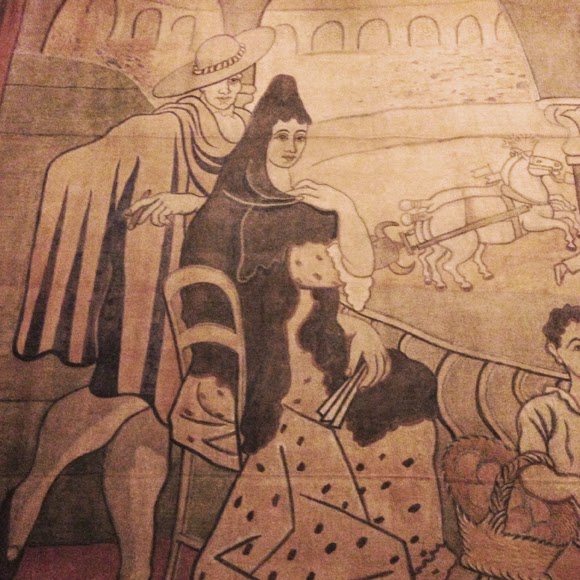
In the case of “Le Tricorne,” the work was painted by Picasso for Serge Diaghilev, and a deeper examination would be needed to uncover the intricacies of their arrangements. We can imagine that their relationship was probably informal and not regulated by a written contract. Nevertheless, the work was made for Diaghilev and was also physically delivered into his possession for the purpose of staging the ballet; the existing artwork at the Four Seasons has already been “cut down from its original size” (see here). As noted earlier, the work is not a mural per se, but the different interests identified by Brutocao and Bjorgum would seem to apply to an artwork like this one – part of a set design prepared for a collaborative, interdisciplinary, and creative use by another artist. Per Oliver’s assessment, if title in Le Tricorne passed out of Picasso’s hands into Diaghilev’s, the artworks would clearly be beyond the reach of VARA. If, however, title to the work had remained with Picasso, and passed to his heirs upon his death – and this is something to keep in mind in relation to other pre-1991 works of art – VARA could reach the work despite the fact that it was created long before anyone had ever dreamt of the statute.

The issue of standing is also interesting, and, at a practical level, is related to the question of duration. VARA specifies that the moral rights provided by the statute are personally held by the artist and cannot be waived. For the most part, this will mean that VARA rights can only be exercised by the artist: in works created on or after the effective date of VARA, the rights endure only for the lifetime of the artist. In the case of pre-existing works that are eligible for protection, however, VARA rights will endure after the author’s death (perhaps one of the policy anomalies arising from VARA). In line with copyright practice, the heirs of the artist would be able to act after the author’s death; but, what about other organizations, to whom the artist might bequeath works and, implicitly or explicitly, rights?

For example, if an artist were to appoint an organization like the New York Landmarks Conservancy to protect his or her works for the post mortem auctoris period when they would remain under copyright protection, it would seem that the designated organization should be able to assert VARA rights on behalf of the deceased artist. Nevertheless, the general position of VARA is not to recognize the rights of public interest organizations. In this respect, VARA offers more limited protection than state statutes in at least two states, California and Massachusetts, which both allow public interest organizations to sue for integrity. Writing in the year 2000, Christopher J. Robinson aptly commented that this approach amounts to “granting a public cause of action for what are effectively community moral rights” – and these provisions in state law, which go beyond the scope of VARA, should not be pre-empted by the federal statute. Internationally, Russian copyright law, which gained some U.S. exposure in the Russian Kurier case of 1998 provides for such contingencies, stating that “any interested person” can sue for moral rights protection; Russian law also allows an author to designate a moral rights “executor” who will take care of the author’s moral rights after his or her death (see Russian Civil Code Art. 1228.2; Arts. 1266 & 1267).

“Recognized stature” is something that would need to be shown before the VARA provisions on destruction could be invoked. In the case of the Picasso, the test would seem to be easily satisfied; but the recent destruction of the murals at 5 Pointz raises some sobering reflections about the limits of courts (and others) to perceive recognized stature in contemporary and unconventional creative works (see IPKat here and here; Lexology here).

... And, what about the resale right, droit de suite, in works that are no longer owned by the original artist but sold on for ever more fabulous sums by subsequent owners? It’s beyond the scope of VARA, but California, once again in the vanguard, has its own Artists Resale Royalty Act (s. 986 of the California Civil Code, available here). The Act has faced Constitutional invalidation in the United States (2012, currently pending appeal), but the U.S. Copyright Office is interested in introducing a resale royalty in the United States to reflect the harmonized droit de suite in the European Union (see here and here). The title of the latest proposed bill?... “American Royalties, Too” (Feb. 2014).
Posted for Mira by Jeremy

Thursday, 22 May 2014

Picasso and Potato Chips

Le Tricorne (detail)
In the lobby of the Four Seasons Hotel on East 57th Street in New York, hangs a mural. Anyone who has visited the hotel has walked by it, and many may have stopped for a moment, at least, to look. It is known as “Le Tricorne,” and was painted by Picasso as a set decoration for a performance of Diaghilev’s Ballets Russes. It has adorned the lobby of the hotel since 1959.

Not everyone thinks that it’s a good Picasso. The current owner of the hotel, reportedly, has never liked it. As part of a renovation planned in the hotel at large, he now hopes to remove it. And, strangely enough, the proposed move has caused an outcry in New York City. The owner is dealing with his own property. Why would his rights to do so be limited?

In New York, two answers to this question seem to be emerging: first, that the public may have some interest in the Picasso as an artwork in a public locale, even if that locale is privately owned; and, secondly, that undertaking the risk of destroying an artwork, particularly one by a major artist, may violate that public interest. It is curious that both of these views seem to take precedence so readily, for at least some New Yorkers, over private property interests.

The problem is a practical one: the painting is mounted on a wall, and removing it is almost certain to cause damage. The work is so delicate that attempting to remove it could, apparently, make it “crack like a potato chip”. If the project goes ahead, we could witness a a potential replay on American soil of the scenario in the notorious Indian case of Amar Nath Sehgal v Union of India. In that instance, a mural painted by one of India’s most eminent artists, appreciated by then-Prime Minister Jawaharlal Nehru and considered a “national treasure of India,” was removed from the walls of a government building in Delhi. The mural was badly damaged in the process – even the part of the mural containing the artist’s signature was broken off the artwork – and Mr Sehgal spent the better part of three decades pursuing action against the Indian government. His claim was grounded in moral rights, strongly protected in the Indian Copyright Act of 1957, but the litigation raised a number of interesting questions about the interpretation of an Act closely based on Article 6bis of the Berne Convention in most relevant respects. Notably, given the scale of the damage to Sehgal’s work, and the potential for further damage, was outright destruction of an artwork prohibited under Indian law? In 2005 the Delhi High Court responded with a resounding “yes.” The Court’s reasoning was innovative, revolutionary: it said that a high standard of protection must be applied to artworks of national importance, confirmed, in this case, by India’s membership in international treaties for the protection of cultural heritage. Indeed, membership in these treaties constitutes the background to India’s section 57 provisions on moral rights, and the context in which they are (now) subject to judicial interpretation.

Where the destruction of artworks is concerned, American law, which generally does not recognize the moral rights of authors, is exceptionally strong. Many readers will be aware that the United States has no generalized protection for moral rights in its copyright law – and, arguably, after the Dastar case, no strong alternative doctrine for the protection of an author’s right to attribution and the integrity of his or her work, either. However, it does have a well-known statute for the protection of the moral rights of artists who create works of visual art, the Visual Artists Rights Act of 1990, known as VARA. The enactment of VARA followed closely on the heels of U.S. membership in the Berne Convention in 1989, and probably owes its pedigree, at least to some extent, to art protection statutes in U.S. states such as California’s Art Preservation Act (CAPA, 1979) and New York’s Artists Authorship Rights Act (1984). The provisions of VARA are controversial in some respects. For example, if a work is treated derogatorily, a possible solution is for the artist to request the removal of his or her name from public presentations of the work in the altered form (as in the earlier New York statute). In this regard, the provision offers protection to the artist’s reputation, but not to the integrity of the work per se, which may well be compromised in these circumstances. VARA also introduces the balancing concept of intention, superimposed on the requirement of showing damage to the artist’s honour or reputation as in Article 6bis of Berne, and effectively replacing it (1); where intention to harm is shown, the requirement of damage to reputation is waived.

This statute may be unique in the world in prohibiting the destruction of artworks. This applies particularly to “works of recognized stature.” William Landes, writing in 2002, commented that the idea of “recognized stature” had a “relatively well-settled meaning[...],” and case law at the time supported that view; but the recent incident of the destruction of the 5Pointz mural complex in New York City [discussed on the IPKat by Miri Frankel, here] brings out some potential difficulties. The 5Pointz muralists are now suing for damages, and may well be able to show that the court got things wrong – though nothing, of course, can now bring the works back (see here and here).

Where does this leave things with Picasso’s mural? Given its authorship, the ease of establishing that the Picasso is a work of “recognized stature” seems fairly straightforward. Accordingly, VARA could be invoked by the New York Landmarks Conservancy, which owned the Picasso after it was donated to the group in 2005, to prevent its possible destruction by removing it from its place in the Four Seasons Hotel. Such a ruling can be predicted with reasonable assurance in only a few jurisdictions in the world – including India, strongly pro-moral rights, and the United States, strongly ambivalent, which both agree on the principle that destruction of a work should be prevented, in so far as possible, by artists’ moral rights.

Above all, the case fascinates because of Picasso’s absence from the debate. Moral rights are often said to serve the aggrandizement of individual artists or (gasp) their heirs. In this case, however, the dispute would seem to have little impact on Picasso’s reputation or the wealth of his heirs. On the other hand, the painting has aptly been called “Picasso’s most readily accessible painting” (Terry Teachout in the Wall St J, cited here), and it presents the alluring image of art interwoven with the fabric of life in ways that are not usually possible in Western cities. In this case, at least, moral rights are widely perceived as a public interest issue. Mr. Rosen finds himself in the eye of an unusually powerful storm.
(1)  (3) subject to the limitations set forth in section 113 (d), shall have the right—(A) to prevent any intentional distortion, mutilation, or other modification of that work which would be prejudicial to his or her honor or reputation, and any intentional distortion, mutilation, or modification of that work is a violation of that right, and
(B) to prevent any destruction of a work of recognized stature, and any intentional or grossly negligent destruction of that work is a violation of that right.
This blogpost, composed by Professor Mira T. Sundara Rajan, was posted for her by Jeremy.

Wednesday, 8 January 2014

For your delectation and possible dissection: a Copyright Troll Infographic

This blogger receives offers or requests on a pretty well weekly basis from people who compile infographics  on a variety of issues. Most are of only tangential relevance to IP law or of no relevance at all.  However, the infographic below is right on target so far as copyright is concerned, bearing the title “What Every Website Owner Should Know About Copyright Trolls”.  There are two things that should surprise no-one. One is that the law cited is that of the United States; the other is that there's nothing on the infographic to say so.  Readers' comments are of course welcomed.

Copyright Trolls

Source: Online-Paralegal-Degree.org

Monday, 11 March 2013

Sherlock Holmes and the Case of the Copyright Expiration Date

This post comes from a very welcome source, being a guest post by our friend and former 1709 Blog team member Miri Frankel (now Associate General Counsel, Aegis Media Americas):

The Case of the Copyright Expiration Date 
In February Leslie Klinger, a Los Angeles attorney, filed a lawsuit against the estate of Sir Arthur Conan Doyle -- the creator and author of a series of fictional works featuring legendary investigator and crime-solver Sherlock Holmes.  According to the Complaint, filed in a federal court in Illinois (the location of the estate’s US licensing agent), Mr Klinger is the author of numerous books and articles relating to the “Canon of Sherlock Holmes, a phrase that refers to the four (4) novels and fifty-six (56) stories by Sir Arthur Conan Doyle featuring the fictional character of Sherlock Holmes and other related characters and story elements”.  Mr Klinger’s Complaint raises copyright law questions that could easily be the subject of a Sherlock Holmes caper.  
US copyright law, applied to the works of Sir Conan Doyle, creates a scenario whereby most of the works have entered the public domain, while only ten stories that were published after January 1, 1923 remain under copyright protection until 2023, at the latest.  For years, the Conan Doyle Estate has demanded and collected licensing fees from authors who created works drawing from or based on the Sherlock Holmes character or other elements from the world of Sherlock Holmes.  According to this March 6 article in the New York Times, Mr Klinger himself paid a licensing fee to the Conan Doyle Estate in connection with a 2011 publication (the Complaint asserts that his then-publisher, Random House, agreed to pay the licensing fee despite his objection).  
But Mr Klinger’s view, and the view of other, sympathetic authors who have created new stories based on elements from the public domain works of Sir Conan Doyle, is that these licensing fees are not necessary, and the Conan Doyle Estate should not be allowed to threaten them with lawsuits to extract licensing fees.  The Complaint asserts that only new, original elements first published in the stories that remain under copyright protection are still protectable; copyright no longer protects, however, any elements that had already been published in earlier Sherlock Holmes works, so all such elements are now in the public domain.  
For its part, the Conan Doyle Estate claims that all elements of the Canon of Sherlock Holmes remain protected by copyright because, “Holmes is a unified literary character that wasn’t completely developed until the author laid down his pen.”  In other words, the character of Sherlock Holmes and all related copyright elements remain protected until 2023, the date upon which the final story published by Sir Conan Doyle enters the public domain.  
Can copyright of all works in a series legitimately be extended until the natural expiration of the copyright term for the final work in the series?  The answer to this question could have a broad impact on the status of copyrights held by authors who create series of works over many years.  I’m not aware of any prior precedental judgments that accept such an outcome, but if any readers know of other cases on this point, please let us know in the comments to this post.   
Some questions in copyright
law are not so elementary,
are they Watson?
 
To some extent, trade marks derived from elements of such works could help protect the rights holder’s interests in the works.  Indeed, the Conan Doyle Estate also asserts trade mark rights in the word mark Sherlock Holmes and the silhouette image of a pipe-smoking Sherlock.  Klinger reportedly intends to challenge the validity and enforceability of the estate’s purported trade mark rights in connection with demanding licensing fees (though he has not done so in the current copyright-related Complaint).  A Katpost in 2010 generated quite a debate on the validity in the UK of a trade mark that arises from a copyright work that falls into the public domain.  Perhaps this question will soon be asked and answered under US law.    
On the other hand, even if the estate’s copyrights are found to have expired, it still retains its reputation as a foremost expert on all things Sherlock Holmes.  Being an authorized licensee of a respected and prominent stakeholder, such as the Conan Doyle Estate, often comes with favorable benefits, including marketing and advertising support from the licensor and, in the case of the Conan Doyle Estate, permission to use the estate’s official licensee seal on book covers or product packaging.  This notion holds equally true in uses that may be considered fair use; though fair use is permitted under copyright law, in some situations it still may be worth the cost of a licence fee to secure authorization, if possible and appropriate, from the rights holder of the underlying elements.  The ROI on the licence benefits may exceed the cost of the licence fee – and prevent costly litigation.     
Klinger Complaint available here
10 Famous Fiction Books in the Public Domain here

Tuesday, 19 February 2013

Class action certification: the key to protecting authors' interests?

Whether Google Library’s book-scanning is fair use is at issue in several lawsuits in the United States, the oldest of which is the Authors Guild’s class action. An appeal is pending against its class-action certification. According to Ilaria Maggioni, recent developments in those other cases might influence that outcome, as she explains in her recent article “Happily ever after?”, published in Intellectual Property Magazine, December 2012/January 2013.

According to Ilaria, reversal of class action certification on appeal is crucial to preserving bargaining power for authors. Maintaining the Google Books suit as a class action is likely to foster continuing inadequacy and unfairness of settlement proposals that may ensue. The October 2012 HathiTrust decision by a district court [noted on this blog by Iona Harding here] recognised fair use of Google’s digitisation on behalf of large university libraries. This created a new obstacle for copyright owners and their representatives since the HathiTrust purports to scan books for benefit of the visually-impaired, but HathiTrust does not correspondingly limit access to its digital library. The district court’s regard for that benefit may have led it to blur the applicable standards for fair use, says Ilaria.

Monday, 21 January 2013

NBC Universal settles font dispute for a record $3.5 million

The 1709 Blog is most grateful to Maxine Horn (CEO, Creative Barcode) for drawing our attention to recent media reports from the Hollywood Reporter and Extensis.com, announcing a US $3.5 million settlement by NBC Universal over an alleged licence infringement of Brand Design Co's 'Chalet' font. According to Maxine:
"The exact terms of the settlement remain unknown. However the settlement figure will have designers and their lawyers quaking in their boots when they give thought to instances in which they could have breached a font licence agreement.

Fonts and typefaces are purchased under licence, particularly by graphic design houses. Some are commissioned specifically by a corporate firm and are provided in digital font files to a design supplier, to enable them to use the correct typeface across a brand's marketing, advertising and packaging collateral.

The Brand Design Co, USA, settlement figure reached was based on $175 authorised licence fee multiplied by an alleged 20,000 unauthorised downloads of its Chalet font, used across the NBCU network. The licence holder was an NBCU subsidiary, Oxygen Media, which had purchased just a basic 36-user Chalet typeface and font software licence. Breach of use can occur when employees, freelance staff or students are working on client projects but are not advised of whether the fonts and typefaces are exclusive and under licence. Designers moving jobs often store typefaces under licence to their former firm or a client of their former firm and continue to use them, unlicensed, on projects in their new employers firm or on commissioned freelance contracts".
Maxine offers some further reading here and here

Thursday, 6 December 2012

Work for hire: should patent law borrow from copyright?

Joshua L. Simmons (Kirkland & Ellis LLP, New York NY) writes to tell us of an unusual cross-discipline paper he has authored, which embraces a problem faced by both patent and copyright law. He explains:
"My new paper, "Inventions Made For Hire", was published last week. The PDF is available on SSRN here and an eBook version is available from the New York University Journal of Intellectual Property & Entertainment Law here. 
The article is a comparison of the developments in copyright law and patent law in the nineteenth century that resulted in copyright law developing a work made for hire doctrine while patent law only developed a patchwork of judge-made employment doctrines. The article theorizes that patent law did not develop an inventions made for hire doctrine, because inventive activity was almost exclusively perceived to be performed by individuals. It goes on to suggest that, as patentable inventions today are generally perceived to be invented collaboratively, the Patent Act should be amended to borrow from the Copyright Act and adopt a principle similar to the work made for hire doctrine".
It's an interesting thesis, and a plausible one.  What do readers of this blog think, though?

Thursday, 1 November 2012

US artists' resale rights: deadline extended

Earlier this morning the 1709 Blog posted this notice concerning the US Copyright Office's request for information about the operation of artist resale remuneration schemes in other countries.  The blog has now received the following welcome email from Jason M. Okai (Counsel for Policy and International Affairs United States Copyright Office):
"I read your posting this morning titled, "US seeks views on resale royalties: deadline looms." I am writing to let you know that the deadline is extended to December 5, 2012. A second Federal Register Notice was published on October 16, 2012 extending the deadline by thirty days.

You will find this notice at the following URL: https://www.federalregister.gov/articles/2012/10/16/2012-25370/extension-of-comment-period-resale-royalty-right".
Thanks, Jason, for letting us know.

Tuesday, 17 July 2012

Fair use in the US: the Wiley case and prior art for patents

From our friend Philippa Malas comes another guest post, this time on a subject that goes right to the core of intellectual property -- the citation of copyright-protected materials on patent proceedings. As often happens, most of the dynamic of the dispute which has triggered the current debate comes from the United States, but readers are invited to filter the issue into their own jurisdictions and consider the likely outcome there. Anyway, as Philippa explains:
The trigger for debate
The United States Patent and Trademark Office (USPTO) filed a motion in June 2012 to intervene in a case which argues that the reproduction of scientific journal articles as prior art in US patent applications infringes copyright under Copyright Act 17 U.S.C. §501. Will the US courts finally be able to reconsider and clarify the scope of “fair use” post-American Geophysical Union v Texaco Inc. 60 F.3d 913 (2d Cir.1994)? Maybe.

The background

In February 2012, publishers John Wiley & Sons, Ltd and the American Institute of Physics filed claims against two US law firms: Schwegman, Lundberg & Woessner, P.A.; and McDonnell Boehnen Hulbert & Berghoff LLP. The firms submitted copies of articles published by Wiley and AIP as prior art in patent applications. Wiley and AIP contend that the copies filed with the applications are unauthorised and that even copies made for research but not ultimately used in filings (distributed internally or to clients/opposition) also infringe as the copying is not covered by any licence. Wiley and AIP argue that the firms, by not paying licence fees specifically for these uses, are making a profit; they are using the ‘free’ copies as part of a service for which they receive compensation from the client. US patent applications, however, require the disclosure of certain information (37 C.F.R. §1.56), including prior art which helps establish whether an invention already exists. It is not surprising that the USPTO has taken a particular interest in these cases stating “the United States and the entire patent system instituted by Congress are at risk of serious harm if the USPTO is denied intervention”. It argues that a finding in favour of the Plaintiffs would have a “significant adverse effect not just on patent prosecution, but also patent infringement litigation”.

Fair use

The relevant defence to these claims is found under the US Copyright Act 17 U.S.C. §107: the “fair use” provision. This is an exception to the exclusive copying and distribution right imposed by 17 U.S.C. §§102 and 106. Fair use is not defined under the Copyright Act and therefore each case is determined to a great degree on its own facts (Campbell v Acuff Rose Music, 510 U.S. 569, 578 (1994). So far, so good but the regime also provides a framework to assist the court in determining whether the exception applies:
(1) the purpose and character of the use (including whether it is commercial/not for profit);

(2) the nature of the work to which the right is attached;

(3) the amount of the portion used in relation to the work as a whole and

(4) how the use effects the potential market for or value of the work.
The framework is cumulative as the weight of one factor can tip the balance in favour of fair use even if the argument under another limb is weak. These four limbs were considered by the U.S. Court of Appeals for the Second Circuit in American Geophysical Union v Texaco, 37 F.3d 882 (2nd Cir. 1994); a case which caused some consternation as it settled out of court before the fair use principles could be addressed and clarified by the Supreme Court. The appellate court held that Texaco could not rely on fair use to exculpate its scientists who had photocopied articles from scientific journals without paying royalties. This was regardless of Texaco having subscribed to the journals. In relation to the first limb, the court ruled that consideration of Texaco’s profit motive was relevant but failed to examine the difference between direct and indirect commercial use and instead drew an ambiguous distinction between institutional and independent research. They also held that the market was affected under limb four, relying on Texaco’s ability to make royalty payments via the Copyright Clearance Center (CCC). The Supreme Court has not been given the opportunity to reassess the framework since.

The USPTO’s view

The USPTO made clear how it would apply the current principles to this case before filing its intervention. In January 2012, it released a memorandum which opined on whether fair use was available for, what it termed, non-patent literature (“NPL”) which was copied and submitted during the course of patent applications or prosecutions. The memo applied relevant case law to each limb of the framework and unremarkably, concluded that both the USPTO and the applicant’s copying and supply of NPL fell within the exception. To reach this conclusion it argued that:
(1) NPL is submitted as evidence for a non-commercial governmental purpose. The use is arguably ‘transformative’ (a copyright work is used in a different context to serve a different function from the original) which is more likely to be considered fair use than non-transformative;

(2) NPL is factual, published work which receives a lesser degree of protection than expressive and/or unpublished work;

(3) the amount of the work used varies from a part to the entirety of a work but when considered with other limbs of the framework, a finding of “fair use” would be likely;

(4) as NPL is typically published several years prior to use in patent applications, its commercial value is limited. NPL is only used in the patent examination process, which the USPTO does not allow to become freely available on the internet (its is not published under Public PAIR) and means there is no market that is impaired by the use of the NPL.
The Intellectual Property Owners Association (“IPO”) has also taken an interest in the debate and on 11 June 2012 passed a resolution agreeing with the USPTO’s position: copies of NPL used “in the course of preparing and prosecuting patent applications and maintaining comprehensive files relating to prosecution is fair use under 17 U.S.C. §107”. Its position appears to be broader than the USPTO’s which carefully stated that it did not take a position on Wiley and AIP’s other submission regarding the use of copyright material more generally in the course of the litigation process.

How will the court addresses this wider contention, especially while concurrently implementing the fair use framework for NPL? One outcome could mean that law firms will have to keep a more watchful eye on their general use of copyright material, ensuring that they are aware of the extent of their existing intellectual property licences and subscriptions.

Not fair?

As skillful as the USPTO’s application of the principles might be, the four-limb framework offers little scope for certainty when trying to assess whether fair use applies. The second and third limbs are not overly complex in basis and as the USPTO’s memorandum shows, can be widely construed in support of the other limbs, which reiterates the importance of case-by-case analysis in this area. It also highlights a difference between “fair use” in the US, which is applicable to any work, and its cousin “fair dealing” in the UK which is subject to three limitations: fair dealing for the purposes of non-commercial research or private study; fair dealing for the purposes of criticism or review; and finally fair dealing for the purposes of news reporting. First, the UK court is required to find that a substantial part of the work has been copied after which it addresses whether the copying can be justified under one of three fair dealing exceptions. There is no general discretion for the court to find a use ‘fair’ and it could be argued that this leaves the UK court with less room to manoeuvre especially with the ever increasing pace of technological development. For the time being it does at least give rights holders and prospective infringers a greater capacity to predict what can and cannot be copied. In contrast, the US test leaves us to grapple with fluid principles which could eventually be cast in favour of one side of the rights holder vs public interest balance, depending on the stakeholders involved.

The US framework also provides a conceptual minefield when construing the first and fourth limbs. As the Texaco case demonstrates, this is especially so in relation to the shifting boundaries of publicly and privately funded research. Analysing the effect on the market is not straight-forward and the conclusion in Texaco that the CCC offers a mechanism by which such an effect can be judged is not necessarily concrete. The USPTO’s argument above supposes that a rights holder’s interests are overridden if a government body requires a copy of copyright material. Such reasoning cannot be right. It would undermine the intrinsic nature of a copyright regime and while the USPTO acknowledges that there is no rule, per se, that provides a blanket fair use exemption for government institutions, it references a number of cases which it argues lean towards such an exemption. Once again, this highlights the unpredictability of the fair use framework as the cases cited by the USPTO are broad in their factual basis and cannot automatically support such a general deduction. Guidance from the courts on these two limbs would be invaluable.

No stable basis

The reason for the breadth and difficulty of the US fair use test occurs because the nature of copyright does not provide a stable basis on which a fair use test can be formulated. The well recognized weighing of the rights holder’s interests against the public benefit remains at the fore. If this cannot be easily construed, how can a fair use doctrine be similarly defined? Perhaps this accounts for the difficulty of the current US regime and is the reason for much emphasis placed on the importance of each case turning on its own facts. In the UK, the exceptions for fair dealing are much narrower in scope which means flexibility is sacrificed in favour of some notion of certainty. The UK government continues to consider extending the exceptions but even this will not put the UK provisions in line with the US. Meanwhile, in a decision which is interesting to consider in relation to the US case, the UK government has recently announced its intention to make all publicly funded scientific research available under Open Access by 2014. The debate about open access to scientific knowledge and research may well prove an additional consideration in the Wiley and AIP cases which already require the court to perform a delicate balancing act of numerous conflicting interests.

Sunday, 8 July 2012

US library lending "under threat", says LCA

The Library Copyright Alliance (LCA), which consists of the American Library Association (ALA), the Association of College & Research Libraries (ACRL) and the Association of Research Libraries (ARL), has filed an amicus curiae brief with the US Supreme Court in support of Supap Kirtsaeng in Kirtsaeng v Wiley & Sons (first noted on the 1709 Blog here).

Textbook publisher Wiley claims that Kirtsaeng infringed its copyrights by reselling in the US cheap foreign editions of its textbooks which his family lawfully purchased abroad. The LCA believes an adverse decision in this case could affect libraries’ right to lend books and other materials manufactured abroad. Kirtsaeng maintains that he is entitled to do this under the US equivalent of the European doctrine of "exhaustion of rights", the “first-sale doctrine”. By this provision, anyone who buys a lawful copy of a book or other copyright protected work is entitled to sell or lend that copy. The US Court of Appeals for the Second Circuit ruled that the first-sale doctrine applied only to copies manufactured in the United States. This odd interpretation of the law effectively strips libraries of their first sale right to lend their own copies of works made abroad, says the LCA. In its amicus brief, the LCA asks the Supreme Court to reverse that decision and apply the first-sale doctrine to all copies manufactured with the lawful authorization of the holder of a work’s U.S. copyright.

There's a lot riding on the outcome of this case so far as libraries are concerned, since a significant portion of US library collections is said to consist of resources that were manufactured overseas. More than 200 million books in US libraries have foreign publishers, and many books published by US publishers were actually printed in other countries; these books do not always indicate where they were printed. If a book does not specify that it was printed in the United States, a library would not know whether it could lend it without being exposed to a copyright lawsuit.

Thanks, Chris Torrero, for the link.

Wednesday, 20 June 2012

Hopping Mad

From guest blogger Philippa Malas comes this thoughtful piece which the 1709 Blog commissioned on a fascinating development in the US: Philippa, who used to work within the art world at Sotheby's, is a persistant IP enthusiast who studied for the Bar course last year.
"Hopping Mad

The major US television networks are potentially hopping mad at the release of a new digital video recorder (“DVR”). “The Hopper” was recently launched by the third largest satellite television provider in the States, DISH. Subscribers to Primetime Anytime can activate the Hopper to record the entire prime time broadcast schedule aired across NBC, ABC, CBS and Fox networks (the “Networks”). The Hopper also features “Auto Hop” which automatically skips the adverts of the stored prime time content during play back. DISH actively markets its product as “commercial free TV”. Ted Harbert, NBC Broadcasting Chairman referred to the device as “an attack on our ecosystem”.

DISH pre-empted objections to its product by filing suit in New York for declaratory relief, arguing that it had complied with its transmission licences and that copyright had not been infringed. Unsurprisingly, the Networks disagreed. Auto Hop allows the consumer to skip advertising during prime time periods which generate significant advertising revenue. NBC, CBS and Fox -- but not ABC -- (the “Networks”) filed suit in Los Angeles for copyright infringement with Fox also suing for breach of contract, in an action which has been stayed pending a motion to dismiss brought by DISH against CBS and NBC. A hearing date in New York is set for 2 July 2012.

The US Copyright Act confers an exclusive right on a copyright owner to reproduce, distribute and prepare derivative works which are based upon the works capable of attracting the right, § 106(1). The Networks contend that infringement has occurred under § 501, alleging (a) direct infringement and (b) secondary infringement through (i) inducement of infringement; (ii) contributory infringement; and (iii) vicarious infringement. It is worth identifying the substance of these objections, then considering the case in relation to EU provisions.

Direct infringement

The Networks argue that the Hopper’s storage capacity (two terabytes or 2000 hours of video content) combined with the Primetime Anytime service means a user can create an on demand library which is copied to a device under the ongoing remote control of DISH. DISH is creating and distributing unauthorised copies of the Networks’ work which directly infringe their rights under §. 501. Note: it is the user and not DISH that is responsible for activating the service and therefore for creating the copy.

Secondary infringement

Inducement to infringe

The Networks also claim that by providing the user with the Hopper and related features, DISH are promoting the use of its products for infringement and inducing infringement (§. 101). They claim that DISH targets known markets for infringement, namely consumers who wish to watch content without paying for permanent copies of ad-free works (via iTunes or Hulu.com). This draws parallels to terminology used in the US internet file-sharing case MGM Studios v Grokster. The Supreme Court found against Grokster, which had aimed to satisfy a known source of demand for copyright infringement. It would be difficult to draw the same conclusion in the instant case. DISH’s customers are likely to assume that the third largest US satellite TV provider had obtained the requisite broadcasting licenses and are therefore, dissimilar to the potential pirates a Grokster-type scenario might pre-suppose. In Grokster, the defendants were also found liable as the court established that they had not developed tools to diminish infringing acts and that they were gaining an economic benefit by selling advertising space on their site. DISH is gaining economic benefit and markets the Hopper to an audience as a way of avoiding the advertisements. It is not easy to determine whether infringement has occurred under this head.

Contributory infringement

Second, the Networks allege contributory infringement. The provision of DISH’s services and the Hopper facilitate and assist the user to infringe copyright. FOX’s pleadings allege that DISH has control over one of two storage elements in the Hopper and can monitor its users’ and prevent infringement but that it fails to do so. Success on this ground depends on whether DISH is aware that the users are infringing copyright. Its declaratory relief filing is evidence to the contrary. Even if the users are recording broadcasts, the activity could be exempt under fair use, as established in Sony v Universal City Studios 464 U.S. 417 (1984), and there would be no secondary infringement.

Vicarious infringement

Finally, the Networks argue that DISH vicariously infringes their rights. As DISH has partial control over the Hopper, it has the power to control infringing conduct of its customers. Again, the difficulty here is that it is the customer (not an agent of DISH) which is creating the copy. Control is only recognized in cases which establish a recognised agency relationship. Since the user is not obliged to use the Hopper’s features, infringement is not an inevitable conclusion.

An EU perspective

It seems that the Networks may have difficulty pursuing the infringement claims. Only Fox has filed for breach of contract. Fox also states that it is not taking issue with ‘traditional DVRs’, merely DISH’s particular product. From an EU perspective, that would be a wise path to adopt following the conclusions of the Court of Justice of the European Union (CJEU) in Airfield v Sabam C-431/09 and C-432/09 and more recently FAPL v QC Leisure C-403/08 and C429/08. In Airfield the court considered ‘communication to the public’ under the Satellite Broadcasting and Cable Retransmission Directive (93/83). It held that permission from a rights holder was required when a satellite provider intervenes in the communication from the original broadcaster, making works accessible to a public (‘new public’) wider than that conceived under the original authorisation. This is regardless of whether the programmes are already being broadcast by means reaching viewers directly. DISH counter that they obtained the relevant licences to permit the retransmission of the broadcast. In FAPL, the CJEU again examined ‘communication to the public’, concluding that it was not irrelevant that such a communication is of a profit-making nature [177]. DISH might also struggle with a defence under Article 5(1) Copyright Directive (2001/29). The copies stored on the Hopper are more substantial reproductions than those considered in ITV Broadcasting Ltd and others v TV Catch Up Ltd [2011] EWHC 1874 (Pat) (applying Infopaq)".
A katpat to Chris Torrero, for steering us to the initial link on IP Brief

Friday, 20 January 2012

Automated half-hour TV trials for small copyright claims?

After the mega-controversies over SOPA/PIPA and Megaupload, it's good to see that the US has not lost sight of the smaller picture. This blog is reminded by Rob Kunstadt that, back in October of last year, the US Copyright Office requested suggestions for the handling of small copyright claims [Federal Register of October 27, 2011, Docket No. 2011-10]. Together with Professor Fritjof Haft (Professor of Law and Legal Informatics, EBS Law School, Wiesbaden, Germany) Rob has responded to this request with a 16-page comment which you can read here. In essence, Rob explains:
"The first prong is to institute special procedural rules to expedite such cases. The procedural rules must be designed so that the desired effect is achieved automatically, by ‘social engineering’ … A set of such rules for efficiently handling small business disputes has already been proposed by co-author Kunstadt, and they were published under the title ‘Half-hour Trials, as on TV’ in the National Law Journal of March 13, 2000, p. A22. They may readily be implemented for the handling of small copyright cases. 
The second necessary prong is use of computer-automation to facilitate the preparation and disposition of small copyright cases by easing the workflow for parties and judges. Work on such automation is already underway and it has been implemented in Germany by co-author Haft, in connection with NORMFALL software for expedited case-handling on a ‘one-write’ basis." (pp. 3-4).
This blogger is fascinated with the notion of social engineering as a means of resolving small copyright disputes, but wonders whether the world is ready for it ...

Wednesday, 11 January 2012

Moral rights debate and artistic doomsday rhetoric

The 1709 Blog has learned of a new debate on moral rights which has just been published in the Texas Law Review and its online companion publication, See Also. According to Stephen Fraser (Online Content Editor):
"A student note, "Moral Rights: Well-Intentioned Protection and its Unintended Consequences", analyzes the concept and focuses serious criticism on the right of integrity. 
See Also advances the debate in Professor Robert C. Byrd’s "Response to Ms Mills’ Note, Of Geese, Ribbons, and Creative Destruction: Moral Rights and its Consequences". Professor Bird applauds Ms Mills’s reasoned criticisms and additions to the academic debate. However, Professor Bird concludes by recognizing the “artistic doomsday rhetoric” that has been levied against moral rights and argues in favor of a measured approach to the issue. Ms Mills’s Note and Professor Bird’s Response are available at http://www.texaslrev.com/issues/vol/90/issue/2/mills (Response available on the right-hand side of the page)". 
In this age of real-time online debate, blogs and webinars, it is mystifying that so many traditional academic law journals have taken so long to appreciate the potential for interactive debate and that readers and contributors have been so slow to demand it. Even the Texas Law Review's small nod towards genuine debate and spontaneous response must be welcomed.

Friday, 9 September 2011

Fair Use Event for Readers in Washington, D.C.

Happy 1709 readers in Washington, D.C. – and unhappy ones in need of a little pick-me-up – can get a special preview of the book Reclaiming Fair Use: How to Put Balance Back in Copyright by Patrica Aufderheide and Peter Jaszi.  A reception for the book will be held at Washington College of Law this coming Tuesday.

Details
Where: 6th floor student lounge, Washington College of Law, 4801 Massachusetts Av., NW
When: 16:30, Tuesday, September 13th
Books: On sale for $10
Fair and fun: “Good food, fair use-friendly music, and friends”
RSVP: klbieze [@] gmail.com

More on Reclaiming Fair Use here: http://centerforsocialmedia.org/reclaiming

image

Thursday, 8 September 2011

More Scrutiny for First Sale

First comes suit, then comes jury, then comes appeal after appeal after appeal.

imageA defendant previously found liable for copyright infringement has filed an appeal for an en banc rehearing of his last appeal.  A jury found Supap Kirtsaeng was liable for willful infringement of eight copyrighted works belonging to John Wiley and Sons.  Faced with a rather large damages bill ($600,000), Kirtsaeng did the usual thing and appealed.  The Second Circuit affirmed, in a 2-1 majority, the District Court.  Now Kirtsaeng has filed another appeal, asking for an en banc rehearing in the Second Circuit.

Infringing Acts

Kirtsaeng, a Thai student studying in the US, had friends and family ship him books legally printed in other countries but not authorized for importation into the United States.  He then sold those books on eBay, reimbursed his friends and family for their trouble and kept the remainder of the proceeds.  We’re not talking small change here where the books were used for his studies and then sold after the semester.  Kirtsaeng took in somewhere between $900,000 and a million dollars doing this.

First Sale – What does “made under” mean?

The first sale doctrine in the US Copyright Act allows people to resell copyrighted works “lawfully made under this Act.”  The Second Circuit held that “made under” means made domestically and so the reselling copyrighted items made elsewhere is not protected by the first sale doctrine.  This is the same issue that came up in Costco where the Supreme Court upheld the 9th Circuit on a 4-4 split.

The Second Circuit looked at Costco and found it rather unhelpful, being a Supreme Court 4-4 split.  The court also tried to do a statutory analysis of the “made under” clause and decided the statute was rather ambiguous.  In the end, the court’s decision that “made under” means made domestically rests on language from a 1998 Supreme Court case, Quality King Distributors, Inc. v. L’anza Research International and some jockeying with the Copyright Act trying to make sense of the first sale doctrine language (§ 109(a))  in conjunction with part of the Act prohibiting unauthorized importation (§ 602(a)(1)).  Then the court punted:

If we have misunderstood Congressional purpose in enacting the first sale doctrine, or if our decision leads to policy consequences that were not foreseen by Congress or which Congress now finds unpalatable, Congress is of course able to correct our judgment.

Kirstaeng’s New Appeal

In his appeal for en banc, Kirstaeng argues that Quality King was misinterpreted and that the Second Circuit’s decision is in conflict with decisions from other Circuits (note: as a matter of legality, this is allowed but it is often grounds for a Supreme Court review of the issue).

Kirstaeng argues that the text of the first sale doctrine is not ambiguous because the Supreme Court found that it was “unambiguous” in Quality King.  Basically, Kirstaeng attempts to show the court’s arguments are really in favor of allowing the first sale doctrine as a defense for imported goods but the court just didn’t want to admit it.

The majority’s opinion conflicts with the text, history, and purpose of the Copyright Act, as well as the Supreme Court’s reading of those sources in Quality King. The opinion’s most remarkable feature, however, is that the majority all but conceded those points. Indeed, it repeatedly expressed deep skepticism about the correctness of its own interpretation. It offered a decision at odds with itself.

We’ll keep you posted if the en banc rehearing is granted.

Wednesday, 31 August 2011

More on US Termination, a How to

I don’t have any moving stories of the importance of the Village People in my life like Nicholas Smith’s wonderful post on the US termination right at IP Whiteboard.  - Although I will admit that The Village People’s Greatest Hits was the first cd I purchased with my own money; – But, I would like to draw your attention to a very detailed how-to-guide on termination rights by Digital Music News: The Comprehensive Guide to Reclaiming Your Old Masters…

Note: If you’d like some background on the US termination right before getting into the guide, see Ben’s earlier post, Terminal Blues for Record Labels?

The Guide gives a bit of background on the termination law, explains the affect terminations may have on record labels and outlines the steps artists wishing to terminate their contracts should follow. 

It also, and perhaps most interesting to the copyright gurus reading this blog, explores in detail the ‘work for hire’ issue that will often be the deciding factor in whether a termination is successful or not.  As the Guide points out, if a work was created as a work for hire, the person who created the work cannot reclaim the rights.  This is because although they created the work, they are not the legal author.  Authorship in works for hire vests with the hiring entity. 

Of course, most record label agreements would state that the works at issue are works for hire.  The golden nugget lies in the fact that saying something doesn’t make it so.  (A common theme in copyright lately.)  The Guide gives a great analysis of the work for hire doctrine, complete with Congressional drama and RIAA trickery.  Check it out.

Wednesday, 3 August 2011

A Rose by Any Other Name

No matter what you call it or how you try to frame it, internet streaming is internet streaming.

rose with raindropZediva tried to claim otherwise, setting up a rather elaborate system that attempted to get around the copyright law requirements for licensing movies streamed over the internet.  A lot of times this is how the law is figured out, attempts to get around it lead to law suits and court-issued clarifications.  (See the Napster/Grokster/Limewire string of cases.)  But in this case, the Zediva folks missed an important part of copyright law history, and the District Court for the Central District of California issued an injunction.

How Zediva tried to avoid licensing fees

First, I want to acknowledge that I was not able to locate a copy of the decision so my information is coming from various news sources, all listed at the end of this post.

Zediva set-up the service to mimic a video rental store.  Users rented a dvd that Zediva had purchased and the dvd was played in a remote dvd player also purchased by Zediva and shown to the customer via the internet.  One article mentions that users would sometimes get messages that movies were out of stock.  I’m guessing this occurred when customers had rented out all of the DVDs Zediva had purchased of that film. 

Rather than finding this system as a way of remotely renting purchased DVDs, the court found that this was just an annoyance and potential source of confusion for customers learning about video streaming. 

Zediva wasn’t paying licensing fees, trying to rely on the first sale doctrine saving their rental model.  But, as one law professor pointed out, Zedvia seemed to have missed the case where renting a video to be watched in a booth inside the store was infringement.  (That case was Columbia Pictures Indus. v. Redd Horne, Inc. from 1984.)  Even if Zediva could persuade the court that it was renting and not streaming movies, the facts are more similar to Redd Horne than to a regular video rental store.

However, the court did not buy the rental concept and instead found that Zediva was transmitting the performance to the public and thus infringing copyright.  Wonder if they’ll be another attempt at a work around…

Media Post News: http://www.mediapost.com/publications/?fa=Articles.showArticle&art_aid=155164

Read Write Wed: http://www.readwriteweb.com/archives/citing_copyright_law_judge_orders_movie_streaming_service_shut_down.php

CNET: http://news.cnet.com/8301-31001_3-20050579-261.html?tag=mncol;2n

Thursday, 21 July 2011

A Motion for Fair Use

imageThe courthouse for the United States District Court, Eastern District of Wisconsin* is majestic, beautiful, dignified. The 100-year old structure’s granite tower draws eyes upward, past elegantly arched windows and into the clear blue sky.  Marble and ornately carved wood add an air of grandness to the sedate black-robed men and women who spend their days in the building’s courtrooms and chambers.  Sunlight pours into the entrance-way atrium from a glass sky-light high above.  It’s a peaceful place, where footsteps echo down from long open balconies and sophisticated women in well-pressed skirts dart in and out of doors.

But this month, one Federal Judge in Wisconsin had to deal with something far less dignified than his magnificent surroundings.  As Judge Stadtmueller’s opening line explained, “Federal lawsuits seldom touch on such riveting subjects and regard so many colorful parties as the present matter.”  The present matter: a copyright dispute over a song called “What What (In the Butt).”

This is one case where no summary could be as entertaining as the actual judicial opinion, and so it will give the basic copyright issues. You can read the full Brownmark Films, LLC v. Comedy Partners decision for yourself.

Dry Background

Brownmark Films made a ridiculous music video that was a smash hit on YouTube.  South Park (Comedy Partners) featured its own 58-second version of the song, performed by a character named Butters Stotch.  Brownmark brought an action for violation of the US Copyright Act (Section 101) against Comedy Partners.  Comedy Partners filed a motion to dismiss on the grounds that Brownmark’s suit failed to state a claim on which relief could be granted.  (A 12b(6) motion for the Fed Civ Pro junkies out there.)

Defenses Raised

Comedy Partners made 2 arguments in its defense: 1) Brownmark lacked standing to bring a federal copyright suit, 2) the use on South Park was permissible under the doctrine of fair use.

Standing – registration and transfer

In order for a US copyright holder to sue for infringement in a federal court, the work involved must be registered with the US Copyright Office.  And, the person bringing the suit has to have exclusive rights to the work.  The song at issue here was registered and two of the joint authors properly transferred their rights to Brownmark such that he had exclusive rights.  In discussing this issue, the court recognized a circuit split between the 9th and 7th Circuits on whether joint copyright owners can grant an exclusive license.  The court sided with the 7th Circuit, saying joint owners can grant exclusive licenses.  This is probably a good thing since the Eastern District of Wisconsin is in the 7th Circuit.  The court goes on to comment further on a wider rejection of the 9th Circuit’s perspective, noting that it “has been widely lampooned in several respected treatises.”

Fair Use – Parody

Factor 1: purpose and character of the use – “to lampoon the recent craze in our society of watching video clips on the internet that are — to be kind — of rather low artistic sophistication and quality.“  The work is transformed by replacing the original performers with a South Park character, and commentary is made on the value of viral videos.  [Tell that to Justin Bieber.]  In favor of Comedy Partners.

Factor 2: nature of the work – “the "nature" of the copyright in question does not help this court assess whether South Park's parody is a fair use.”  Factor ducked.  In favor of, neither side?

Factor 3:amount and substantiality of the portion of the work used – “the use of the copyrighted work in the South Park episode was relatively insubstantial.”  Only a small amount of the song’s lyrics were used.  In favor of Comedy Partners.

Factor 4:effect of the use on the work’s potential market – “there is little risk that derivative work in question would somehow usurp the market demand for the original.”  In favor of Comedy Partners.

The result: dismissal of the suit, with prejudice.

Strange Procedures?

There are some very interesting nuggets hiding in this apparently standard fair use analysis.  The court notes that normally, to bring in materials from outside of the complaint, i.e. the two video clips at issue here, the court needs a motion for summary judgment rather than a motion to dismiss.  The difference is that in summary judgment, the court is making a decision to a valid legal dispute with the facts given in the pleadings.  In a motion to dismiss, the court is deciding whether or not there is a valid legal dispute to judge. 

When necessary, a motion to dismiss can be transformed into a motion for summary judgment.  But here, the court points out an exception, “where the material in question is expressly referenced in the complaint and is central to the plaintiff's claim,” and continues to make a decision on whether or not there is a valid legal dispute here.

The Court acknowledges another problem to proceeding with a fair use analysis on a motion to dismiss.  Fair use is generally regarded as an affirmative defense to infringement.  Don’t you need a valid dispute, a valid claim, before there can be a defense to it?  Normally, yes.  But here again, the court finds an exception.  If the plaintiffs prove the defense in their own pleadings, then the court can proceed under the motion to dismiss.  And that’s what the court found here.

The court says that this practice is common place.  If that is so, why keep viewing fair use as an affirmative defense instead of as not infringement?  Seems like it would require less legal gymnastics.

Picture credit:Milwaukee Federal Building cc-by compujeremy available at http://www.flickr.com/photos/compujeramey/2041317259/. The photo was cropped for the blog.

* More information about the Milwaukee Federal Building here.  The author spent a splendid 6 weeks exploring the building as an intern.
For our European friends, don’t forget the old quip, “America, where 100 years is a long time and 100 miles is a short distance.”