Showing posts with label book review. Show all posts

Tuesday, 11 March 2014

Canadian Copyright Law

Canadian Copyright Law, Fourth Edition, by Lesley Ellen Harris, has recently been published and may be of interest to the Canadian readers of this blog. The book covers the basics (and more) of Canadian copyright law. It bills itself as "The indispensable guide for publishers, web professionals, writers, artists, filmmakers, teachers, librarians, archivists, curators, lawyers and businesspeople" and this blogger would tend to agree. The book provides a good overview of copyright in Canada and its straightforward easy-to-digest writing will appeal to non-lawyers with an interest in copyright law as well as students grappling with the subject for the first time.

The appendices contain some helpful extracts, including the forms required to apply for copyright clearance, and the book also contains a table summarising the main IP rights in Canada, which non-lawyers, or indeed IP lawyers from other jurisdictions will find useful.

If you are battling with Canadian copyright law for the first time I would recommend starting with this book!

Thursday, 2 May 2013

The Copyright Pentalogy


The lovely city of Ottawa
A little Canadian news before this blogger heads back to the UK: this week the University of Ottawa Press has published The Copyright Pentalogy: How the Supreme Court of Canada Shook the Foundations of Canadian Copyright Law, a book which collates the work of a number of Canada's leading copyright scholars to attempt to examine the implication s of the five copyright decisions handed down by the Supreme Court of Canada last summer (see here and here). The five decisions all touched on different aspects of copyright law and different industries, so this book should provide a pretty comprehensive analysis of the state of copyright law in Canada at the moment.
The book is for sale, but the great (and unusual, for an academic work) news, is that it is also available as a free download under a Creative Commons licence. The book can be downloaded in its entirety or each of the 14 chapters can be downloaded individually. This is the first of a new collection from the UOP on law, technology and society, of which Michael Geist is the editor, that will be part of the UOP's open access collection.

In analysing the five decisions, this book covers fair dealing, technological neutrality, the scope of copyright law (in particular the establishment of a new "right" associated with user generated content) and the implications of the decisions for copyright collective management.
For those looking for more detail, editor Michael Geist will be writing more about the individual contributions on his blog in the days ahead and will provide more information on the plans for a conference on the copyright pentalogy being planned for autumn.

Thursday, 15 March 2012

Code Wars reviewed

Code Wars: 10 years of P2P Software Litigation, by Rebecca Giblin, is reviewed here for the 12709 Blog by Stavroula Karapapa, Lecturer in Law at Brunel University.  This is what she has to say:
"Over the past ten years or so, P2P file-sharing represents one of the main challenges to copyright law and an area which has attracted intense scholarly attention. Rebecca Giblin's book represents a significant addition to this growing body of literature by providing a legal and technological account of the first decade of P2P legal discourse. The book takes off from the proposition that despite the attempts to combat file-sharing via litigation and legislation, and in spite of the legal successes from the right-holders’ front, the phenomenon of file-sharing persists. 
What clearly emerges from Giblin’s account of the so-called “Code Wars” is a rigorous insight of the inefficiencies of the current copyright norms in dealing with file-sharing technologies. Giblin identifies three such inefficiencies. First, technology progresses with its own logic and shapes its own law, which in Giblin’s words is an “anti-regulatory code”. Secondly, the software industry follows its own rules: most file-sharing software development lacks a profit motivation and, in this light, the principles that govern the hardcopy world cannot fully apply in the online context. Finally, the mentality of “sharing” is very widespread amongst file-sharing software innovators, who do not wish to enhance security against copying of their software. 
Based on her convincing diagnosis of the fundamental differences between the hardcopy and online worlds, Giblin puts aside the so-called “physical work assumptions” and lays down clear insights on possible ways of improving laws dealing with the liability of P2P software providers. Building upon the proposals set forth by Peter Menell and David Nimmer, Giblin's principal suggestion is to extend the tort law standard of “reasonable alternative design” to cases of P2P liability and, in the final chapter of her book, she actually develops a test that could apply to such cases. Promising, yet feasible, the application of this test in file-sharing cases could show the way forward".
Full details of this book can be found on its web page here.

Thursday, 8 December 2011

Moral rights: a book review

Moral Rights - Principles, Practice and New Technology, by Mira T. Sundara Rajan, is reviewed here by Iona Harding and Emily Sweetland.  Iona and Emily both belong to Baker & McKenzie LLP, where they are Associates in the firm's Intellectual Property Group. Iona and Emily write:
"The initial question posed in this book may well be the same question that many readers of this review are currently asking themselves: why care about moral rights? If that is the case, Mira Rajan has at least succeeded in knowing something about her readers and their level of interest in the subject matter. Her answer is that moral rights are "vital now more than ever as we enter the Digital Age."

This is a theme throughout the book, which begins by addressing the evolution of moral rights both throughout history and throughout the world, as well as the place of moral rights in the international copyright regime. The book then comprehensively discusses moral rights in the information technology, digital music, film, and arts industries, before looking at moral rights and open access and the future of moral rights.

With sometimes highly evocative language, the author walks us through the history of moral rights, comparing the doctrine in France (where a clear distinction is made between economic rights in a work and the author's droit moral) with that in Germany (where a monistic approach discourages the separation of economic and moral rights). She then looks at how the UK came to adopt moral rights, and explains why we rejected the concept when the Statute of Anne was passed, only acknowledging it fully in the Copyright, Designs and Patents Act 1988 (CDPA). Case studies of "younger" jurisdictions such as Canada and Japan provide an interesting counterpoint to the European approach, with the role of honour and reputation in Japanese culture being a driver behind the country's strong protection of moral rights and its unusual stance in allowing corporations to have moral rights in their works. 
To some it may seem that moral rights have become irrelevant in the digital age, where there is more distance than ever between the author and his work. Mira Rajan's view is that the fact that moral rights have become more difficult to enforce in practice does not mean that they are no longer relevant. However, the book reveals that moral rights are fundamentally a cultural phenomenon, a concept which is enormously dependent on the social value attributed to the author of a work and which cannot easily be codified. The practical question of how to legislate for those rights is difficult: there appears to be no clear answer, although the breadth of protection offered throughout the world may be testament to the need for moral rights regulation to provide the flexibility and "delicate nuances" which are needed in the Digital Age and which are not, she argues, sufficiently protected by the copyright regime. 
The impact of technology on moral rights is discussed over the course of a number of chapters covering music, film, visual arts and open access separately. The author explains that moral rights should be protected despite evolving technology and, as the forerunner of commercial digitisation, the music industry should provide a framework of how to apply moral rights to digital works. Fundamentally, although we may need to adapt moral rights to fit with the way the world now works, the principles of integrity, attribution and disclosure should apply equally to digital and analogue works. However, no practical examples are given as to how moral rights could or should be adapted. 
There is one small point that needs attention. The work states, at p.381, that in the UK a producer is the author of the copyright in a film but the director is entitled to moral rights "even though he is not considered an author". For films made on or after 1 July 1994, s.9(2)(ab) of the CDPA however states that the author of a film is its producer and the principal director. Unless the producer and the principle director are the same person, the film is a work of joint authorship (s.10(1A)). Professor Cornish's comments which follow appear to have been made in 1989 so are now out of date.  
The author is undeniably passionate about her subject, meaning that her writing is engaging and convincing. The narrative is rich and is illustrated with examples and stories, making it easy to read and the main themes are repeated in every chapter. Because the book deviates into philosophical and cultural arguments more than is usual in a legal textbook, it is likely to appeal to academics looking for a well researched and thorough analysis of the social and historical context of moral right,s rather than to practitioners looking for a guide to help them advise on the application of moral rights to the evolving digital world".
Moral Rights: Principles, Practice and New Technology is published by Oxford University Press. ISBN13: 9780195390315; ISBN10: 0195390318. Paperback, 572 pages. Price $150. Web page and further details here.

Thursday, 6 October 2011

A conference -- and a book

"It's all good fun", said Maud, "but what the Glastonbury
Festival really needs is something a bit more, well, muddy"
This year's "Music and Intellectual Property" Conference, organised by CLT, takes place in Central London on Monday 5 December 2011. The programme is a bright and challenging one, with two 1709 Blog team members taking part in it. Ben Challis (Glastonbury Festival) is taking a look at business models in the music industry, giving some pointers as to what we should look for when deciding which are the winners, which the duds, while Jeremy Phillips is in the chair.

Topics covered this year are as follows:
  • Music copyright and policy: Too Much, Too Quickly?
  • What’s New, What’s on the Way: A European Perspective
  • Infringement - Has the Same Old Tune Changed?
  • Business Models and the Music Industry: Successes and Failures
  • Online Piracy and The Digital Economy Act 2010 - Where Are We Now?
  • Collective Copyright Management in Court
  • Music and Copyright in the Patents County Court
For more details and registration, just click here.

This is the second year that CLT has offered Music and Copyright. Last year's conference was a great success and, coincidentally, one of its star speakers -- the University of Glasgow's Dr Andreas Rahmatian -- has just published a very thought-provoking and stimulating critique of proprietary interests in the creative sector: it's Copyright and Creativity: the making of property rights in creative works, published by Edward Elgar Publishing.

What is this book about? According to the publicity material:
"Copyright and Creativity discusses the making of property out of creative works through the legal mechanism of copyright. It shows the manner in which the law translates a great variety of expressions of the human mind into its normative system and transforms them into the property right of copyright or droit d’auteur.

This timely book examines the proprietary features of copyright, the inherent limitations of its powers, and its justification and relationship to the non-proprietary realm of the public domain. The latter part of the book deals with the ‘propertisation/commodification’ of human authors themselves through their works as alienable objects of property, the well-known ‘Romantic author’ critique as a sophisticated justification of that commodification, and at an international level, neo-feudal and neo-colonial developments as a result of this process.

This detailed study will appeal to undergraduate and postgraduate students, legal sociologists, and specialists in copyright, property theory, or legal theory and political philosophy with particular interest in property theory. Practitioners within bodies involved in legal policy, organisations concerned with law reform, European institutions, and international organisations will also find much to interest them in this book".
This blogger read one of the chapters pre-publication and can confirm that it is a work of substantial scholarship which will be much appreciated by anyone who has a good understanding of legal systems, jurisprudential notions of property and the principles of copyright.  It makes no concessions to lazy reading, sloppy thinking or common law sentiments. There's also an excellent 22-page bibliography which reflects not only the author's linguistic skills but the considerable breadth of his inquisitive instincts when chasing strands of thought. For a relatively small book, it's a big, big read.

Bibliographical details: Hardback,  xx + 314 pages. ISBN  978 1 84844 246 7. Price £79.95 (online price £71.96). 35% discount for 1709 Blog readers who purchase it by 31 October .£51.96 + carriage charges. Web page here.

Tuesday, 23 August 2011

Feeling cultural and relational? Try a little copyright ...

Copyright, Communication And Culture: Towards a Relational Theory of Copyright Law, is a hot-off-the-press title from Carys J. Craig (Associate Professor of Law, Osgoode Hall Law School, York University, Toronto). It is this reviewer's impression that a great deal of bright, sparkling thinking on copyright is emanating from Canada at the moment, and this is just the latest example of it.

What does the publisher say? According to the web-blurb:
"In this provocative book [This is a given: as readers of this blog will know, there is no obscure nook or cranny of contemporary copyright law and practice that is so bland and inoffensive that it will fail to provoke anyone at all], Carys Craig challenges the assumptions of possessive individualism embedded in modern day copyright law, arguing that the dominant conception of copyright as private property fails to adequately reflect the realities of cultural creativity [though it does adequately reflect the realities of the human urge to retain control, if not absolute ownership, of (i) the fruit of one's labour and (ii) anything one has paid for.  Can we choose our realities?].

Employing both theoretical argument and doctrinal analysis, including the novel use of feminist theory, the author explores how the assumptions of modern copyright result in law that frequently restricts the kinds of expressive activities it ought to encourage [This is a tricky proposition, with that great big 'ought' in the middle of it. And is there a serious criticism that the same assumptions result in the encouragement of expressive activities which ought to be restricted -- or is that too sensitive a point?]. In contrast, Carys Craig proposes a relational theory of copyright based on a dialogic account of authorship, and guided by the public interest in a vibrant, participatory culture. Through a critical examination of the doctrines of originality and fair dealing, as well as the relationship between copyright and freedom of expression, she explores how this relational theory of copyright law could further the public purposes of the copyright system and the social values it embodies.

This unique and insightful study will be of great interest to students and scholars of intellectual property law, communications, cultural studies, feminist theory and the arts and humanities [Funnily enough, the publishers -- who almost routinely say their books will be useful to practitioners -- don't say so here. There is actually some significant discussion of case law, by the author and by those whom she cites, from which policy-oriented lawyers and judges can benefit]".
This is a fascinating read, and a slow one for anyone who takes time to absorb the impact of abstract nouns and their full import. For various readers -- including those who love raw, undiluted Locke and those who felt that Lior Zemer's re-imagination of him in The Idea of Authorship in Copyright (Ashgate 2007) hit their intellectual sweet spot -- this book will be a bit of a bumpy ride. For those who see virtue in the creative tensions which exist in current copyright norms, it is even bumpier. Buy it for a friend you enjoy discussing copyright with, read it together and you'll never be bored.

Bibliographical data: publisher: Edward Elgar Publishing, 2011. viii + 265 pages, hardback. ISBN 978 1 84844 839 1. Price £65 (online, direct from the publisher, £58.50). Book's web page here.

Wednesday, 22 December 2010

Moral Rights: the book

Moral Rights, spearheaded by British barristers and scholars Kevin Garnett and QC, Gillian Davies, is a massive work on what many practitioners would mistakenly write off as a topic of minor importance. In truth, while the volume of litigation on moral rights -- particularly the right of paternity and the right to the integrity of one's work -- has never been great, the number of problems caused by a failure to understand these rights and to take them into account in a commercial setting has increased, and is likely to continue to do so now that the universal medium of the internet has both amplified the effect of many moral rights infractions and increased the likelihood of their being seen by authors. The categorisation of these rights as "moral" as opposed to "economic" has been to some extent to blame for their neglect: while they are not economic in the sense that rights such as the reproduction and transmission rights influence trade in copyright works, they can have a resoundingly economic impact whether they are exploited, waived or enforced.

While both Kevin and Gillian are very much associated with patents (Kevin is currently a Board of Appeal member at the European Patent Office, where Gillian once chaired a Technical Board of Appeals and sat as a member of the Enlarged Board), and both are creatures of Hogarth Chambers, it is for their work in the field of copyright that they are probably best known and most appreciated:  both have been major contributors to the same publisher's IP soap Copinger and Skone James on Copyright, first published in 1870 and thus even more long-running than Coronation Street.  Gillian has also served a term at the helm of IFPI, so the copyright credentials of this pairing are unimpeachable.

So what does the book do? Why go to such lengths to create and publish a weighty tome on so under-estimated and misunderstood a topic?  The publishers don't give away much information themselves (certainly, when compared with most other publishers of legal books, Sweet & Maxwell are quite stingy with their information). Anyway, according to the book's web page, Kevin and Gillian offer "a practical insight into an area not covered by other texts" -- which is mainly true.  Most books on copyright say something about moral rights, but you'd have to lay a lot of them end to end in order to cover the ground this subject-specific title does.  The publishers then list its virtues.  It:
• Examines moral rights in the UK in detail and contrasts with that of key EU and international jurisdictions
• Discusses the historical treatment of moral rights in the UK
• Considers copyright, the paternity right, the right to privacy and transmission of moral rights
• Offers a practical and comparative approach to an area about which little has been written
• Looks at how moral rights have developed internationally, and examines their treatment in international and regional conventions and treaties
• Compares moral rights in more established civil law jurisdictions with those in less developed common law jurisdictions
• Examines moral rights in 19 of the key European and international jurisdictions, with each jurisdiction being covered by a local copyright expert
• Covers each jurisdiction systematically and comprehensively
• Discusses the significant case law from civil law jurisdictions
• Includes relevant sections of the Copyright, Patents and Designs Act 1988 for easy reference
• Features an extensive bibliography>
Fortunately the authors are not expected to do this alone.  They are assisted by a team of many talents, drawing on national (and in some cases multinational) expertise supplied by a long list of contributing experts among whom can be found such household names as Adolf Dietz, Willem Grosheide, Paul Torremans, Irini Stamatoudi and Elizabeth Adeney, aided and abetted by Maria Mercedes Frabboni, Patricia Akester, Jacques de Werra, Gadi Oron and more besides.  Quite why this useful information -- which adds considerable value and authority to the book -- is not made available to visitors to the book's web details is beyond the understanding of this reviewer.  The book itself is a tour de force.  It covers practically every possible issue arising from the various moral rights and is not just a one-stop-shop but a springboard from which the reader can reach out to different legal traditions, technologies and cultures and learn more than he or she ever imagined to exist on the subject.  Well done!

Bibliographical details. Published by Sweet & Maxwell, October 2010. ISBN 9780421729407. Hardback, cxii + 1,177 pages. Price £165. Book's web page here.  Rupture factor: considerable.

Sunday, 24 October 2010

Book review: more arrows than Agincourt

A handsome new fourth edition of Intellectual Property and Media Law Companion, authored by Alasdair Bleakley (Addleshaw Goddard LLP), Edward Baden-Powell (Michael Simkins LLP) and Jeffrey Eneberi (Just-Eat), was published earlier this year. As the publishers state, this is the only title in the UK market that combines intellectual property and media law in a single book. While this is true, it may be fairer to categorise it as first and foremost a media law text, but with a useful quantity of some of the main and/or more media-relevant bits of IP to provide some helpful reinforcement.  According to the web-blurb:
"Lawyers, media and technology professionals, and students of the law, alike, will benefit from the clear layout and style of this book – making it a ‘must have’ for your bookshelf. This book should be your first point of reference when advising your clients or colleagues, or for enabling you to excel in your particular field of media or technology.
With case and legislation citations included throughout, this is a user-friendly starting-point for researching primary sources".
This book's strength does not lie in its extent of coverage of the law, which in around 550 pages including lists and the index was always going to be selective.  It lies in the book's sheer accessibility and confident guidance to the reader.  If you've got a library shelf full of authoritative texts spanning the entirety of IP and media law, this is not the book that will provide that penetrating insight on which you base your arguments to the Supreme Court.  It is however a very handy device for any lawyer who is working under the time pressure imposed on him by any commercial client who lives with deadlines and who, when he asks his lawyer a question, expects the answer by return (and at not much less speed than Roger Federer might be expected to return a serve).   With excellent diagrams and lists, more arrows than Agincourt and more bullets than the British Army will be able to muster after the spending cuts, this book rushes along at a breathless pace which suggests that it might be a good idea to get into training before reading it.

The best bits of this book are the chapters at the end, which are problem-based or industry-specific.  Content clearance, marketing, the music industry, TV and film --these give the authors a chance to demonstrate not only what the law is (and frankly there's not a lot of law on things like clearance of rights) but on what the problems are and how to tackle them head-on.  These are the zones in which Experience is King and the Law is a mere handmaiden. This reviewer bets that the bits at the back are the bits that get the heaviest usage too.

Bibliographical data: publisher, Bloomsbury Professional. ISBN 978 1 84766 042 8. Paperback, xxxvi + 521 pages. £35. Book's web page here.

Wednesday, 20 October 2010

Book Review: International Copyright 2nd Ed.

imageNormally, I like to sit and read a book cover to cover before reviewing it, but the Second Edition of Paul Goldstein and Bernt Hugenholtz’s International Copyright is not a sit-down-and-read type of book.  It is a reference book, the kind you want to have near your desk at all times.

The book covers the usual suspects, Berne, TRIPs, the UCC, etc.  Sounds not so exciting, but wait.  The neat part comes in how these are approached and what else is included.  The book is arranged in sections of what I can best describe as biggest-issue topics: Norms,

Territoriality, Term of Protection, Economic Rights, Moral Rights, you get the picture.  Each relevant treaty and agreement is addressed under each topic, showing you the interplay between them.  The effects of smaller agreements, such as regional agreements and directives, are also included in these sections.

In addition to the scholar-favorite topics of norms and traditions, the book includes information about the reality of enforcing contracts (Section 4.4.3 specifically address what happens when the law of the protecting country and the law of the contract conflict), and there is an entire chapter devoted to enforcement.

Most of the examples given in the book appear to be from North America or Europe.  While this is a little disappointing, it is also understandable – the main agreements, the underlying principle's of today’s copyright, and the authors are Western in origin.  To the author’s credit, the index indicates that the book does include some information from every region of the world.

The Appendix is a nice addition.  Although all the information in it – copies of the main treaties and lists of their signatories – can be found on wipo.int or Wikipedia, it’s nice to have the information just a thumb flip away.

From the publishers:

“Written by two of the most experienced practitioners in the United States and abroad, International Copyright: Principles, Law and Practice (Oxford, October 2010) proves to be a great analysis of the principal legal doctrines affecting copyright practice.”

Title: International Copyright: Principles, Law and Practice
Authors: Paul Goldstein (Stanford University) and Bernt Hugenholtz (University of Amsterdam)
Publisher: Oxford University Press
Pages: 407 (book-book), 565 (with appendix and index), 592 (with preface and everything)
Color: very pretty medium green
Sturdy, heavy-weight paper-back cover
List Price: $95.00

Wednesday, 13 October 2010

Global Copyright: 300 Years -- but how many more?

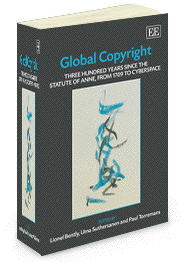
Global Copyright: Three Hundred Years Since the Statute of Anne, from 1709 to Cyberspace is the title of this splendid and exuberant celebration of copyright, edited by the talented triumvirate of Professors Lionel Bently (Herchel Smith Professor of Intellectual Property Law, University of Cambridge), Uma Suthersanen (Queen Mary, University of London) and Paul Torremans (School of Law, University of Nottingham).  Given the number of death notices which copyright has received recently, this collection of essays might be the last to commemorate this great right -- which more than any other has shaped and channelled the flow of global culture over the previous century -- before it dwindles into insignificance in the brave new world of free access and perfect, irresistible reproduction.

As a purveyor of fine intellectual property texts, publisher Edward Elgar is having none of this pessimism (though it would be difficult to find any publisher advertising its wares on the basis that, if you don't buy them now, you'll be too late because their subject matter will have become a quaint historical footnote, like frankalmoigne).  So how does it describe this work?

This innovative book celebrates the tri-centenary of modern copyright, which began with the enactment of the Statute of Anne by the British Parliament in 1709, and was soon followed by other copyright legislation abroad. The Statute of Anne is traditionally claimed to be the world’s first copyright statute, and is thus viewed as the origin of a system of national laws that today exists in virtually all countries of the world. However, this book illustrates that while there is some truth in this claim, it is also important to treat it with caution.
Written by leading experts from across the globe, this comprehensive (historical) analysis breaks new ground on modern copyright issues such as digital libraries, illegal downloading and distribution, international exhaustion and ‘new formalities’. The expert contributors consider what lessons can be learnt from the achievements made during the last 300 years, and whether they can be used to overcome the new challenges facing copyright.
This in-depth scientific analysis of the legacy of the Statute of Anne 300 years on from its origins will provide copyright practitioners, academics, policy makers and postgraduate students with a unique and fascinating read.

In other words, the experience of the past can help understand the present, but don't too excited about its value for the future, which is conditional on too many technological uncertainties.

There's a wonderful cast of contributors, though some of the lesser lights twinkle just as brightly in this firmament as do their better-known colleagues. It would be invidious to pick out names, so for once I won't.

Bibliographic details. Published 2010. xiii + 522 pages. Hardback. ISBN 978 1 84844 766 0. Price£125 (the publisher's online discount brings this down to £112.50). This book is also available as an ebook 978 1 84980 642 8.  Web page here.

Wednesday, 23 June 2010

Parody: a new title

The web page says this book isn't published yet (it isn't officially out till August), but I spotted a copy on the table in the reception area of Oxford University Press's palatial headquarters in Jericho. The Oxford Book of Parodies, edited by John Gross, is sadly short of detailed analysis of the legislative and case law provisions governing parody as a defence to copyright infringement, private rights versus freedom of speech, transformative use and so forth, but it is rich in enjoyable examples of parody and great fun. Says the web-blurb:
"Parodies come in all shapes and sizes. There are broad parodies and subtle parodies, ingenious imitations and knockabout spoofs, scornful lampoons and affectionate pastiches. All these varieties, and many others, appear in this delightful new anthology compiled by master anthologist John Gross.
The classics of the genre are all here, but so are scores of lesser known but scarcely less brilliant works. At every stage there are surprises. Proust visits Chelsea, Yeats re-writes "Old King Cole," Harry Potter encounters Mick Jagger, a modernized Sermon on the Mount rubs shoulders with an obituary of Sherlock Holmes. The collection provides a hilarious running commentary on literary history, but it also looks beyond literature to include such things as ad parodies, political parodies, and even a scientific hoax.
The collection includes work by such accomplished parodists as Max Beerbohm, Robert Benchley, Bret Harte, H. L. Mencken, George Orwell, James Thurber, Peter Ustinov, and Evelyn Waugh. And the "victims" include Chaucer, Shakespeare, Milton, Wordsworth, Poe, Longfellow, Emily Dickinson, Conan Doyle, A. A. Milne, Raymond Chandler, Agatha Christie, Cole Porter, Ernest Hemingway, Allen Ginsberg, Martin Amis, and many others. The first and longer of the book's two parts is devoted to English-language authors, arranged in chronological order, along with parodies that they have inspired. The second part includes sections on more general literary topics, on aspects of individual authors which transcend the format of the first part, and on a handful of foreign writers".
Sadly I wasn't kept waiting more than a few minutes, so had little opportunity to sample this book's contents -- but it did seem fun.

Tuesday, 23 March 2010

Harmonizing European Copyright Law

Harmonizing European Copyright Law: The Challenges of Better Lawmaking, by the talented team of Mireille van Eechoud, P. Bernt Hugenholtz, Lucie Guibault, Stefan Van Gompel and Natali Helberger, was published towards the end of last year. The title is published by Wolters Kluwer within its Information Law Series and is based upon the results of two major studies which the European Commission commissioned in 2006 and 2007 -- not that the Commission has a great track record in taking the reports that emanate from the University of Amsterdam's Institute for Information Law ((IViR) warmly to its heart.

The book's web-blurb states as follows:
"This book will provide analysis of the current state of play of and suggest direction for future development of European copyright law and related rights. The acquis communautaire is reviewed in depth, starting with an analysis of the exact competence of the EC in relation to its declared policy ambitions from the past to the present.

Next, the body of European copyright law is described. This is done not in the traditional way, i.e. on a directive-by-directive basis, but following a scheme of the principal elements that national copyright and related rights law share (e.g. what is protected subject matter, who are beneficiaries, what is the nature and extent of the exclusive rights and limitations, term of protection). Of all principal issues, the degree and scope of harmonization is analysed, put into the perspective of Member States’ obligations under the relevant international treaties (e.g. Berne Convention, Rome Convention, TRIPS agreement, WIPO internet treaties).

In addition, a number of items on the European Commissions current legislative agenda are subjected to a critical review, in light of our findings on the successes and shortcomings of the harmonization process so far".
The principal headings into which copyright is divided relate to (i) what is protected, to whom does it belong and for how long? (ii) the various rights to stop people doing things and the borders of those rights, (iii) those conceptually new-fangled topics, "rights management information" and technical protection measures. Following this, the study focuses on specific areas in which copyright is brought to bear: (iv) extension of term for sound recordings, (v) the term of protection of co-written musical works ('musical', in this context, including works which consist of both music and lyrics), (vi) the increasingly popular topic of orphan works, (vii) an appraisal of harmonisation ("blessings and curses") and (viii) the 'last frontier' of territoriality. Each of these units has its own conclusions and assessment.

Probably the best assessment overall of Europe's attempts at harmonisation may be summarised as follows: difficult task, not always well done; improvements are needed in terms of (i) identifying the issues, (ii) formulating the correct policy for dealing with them and (iii) articulating that policy in the manner best able to facilitate its consistent implementation. Let's hope that the next edition of this work can, without loss of the sometimes painful directness which characterises it, offer news of improved performance in this, the most slippery and intransigent of Europe's IP rights to harmonise.

Bibliographic details: ISBN 9041131302 , ISBN 13: 9789041131300. Hard cover, xviii + 375 pp. Price: $US 145. Web page here.

Tuesday, 2 March 2010

Copyright in Jewish Law

Copyright in Jewish Law is the title of a book recently published by Feldheim Publishers. Its author, Rabbi Nachum Menashe Weisfish, is a Jerusalem-based scholar of Jewish law who has trawled a wide variety of source materials in order to produce what the publisher describes as
"the first sefer [this term is used for a book with Jewish religious content rather than, say, a secular legal textbook] to clarify what is and what is not permissible to copy. A definitive work, with practical answers to questions regarding photocopying machines, compact discs, computers, the internet, and more. Widely acclaimed by Gedolei Yisrael [those whose scholarship is acknowledged by others], and with extensive Hebrew footnotes and sources, this sefer is a great aid to Rabbanim [rabbis], talmidei yeshivah [students of institutions where Jewish law is learnt], and laymen alike".
From this introduction it can be seen that the text of Rabbi Weisfish's work is addressed to students of Jewish law who seek to understand how the issues raised by copyright -- a body of rules that is not obviously addressed in the Bible itself or in ancient oral tradition -- are tackled and resolved by mainly modern Jewish thinkers. The text is in a clear and accessible English, though this work is a new rendition of the author's earlier work, in Hebrew, Mishnas Zechoyos HaYotzer. The footnoted source materials, a little disconcertingly for the English reader but invaluably for the Jewish scholar, remain in the original Hebrew.

The reader who is well-versed in copyright law will find this tome something of a culture shock since discussion of the usual international treaties and conventions, national statutes and judicial lawmaking is notably absent. Instead, he will be introduced to rulings, majority and minority opinions, analogies and syllogisms which are a far cry from the laws he deals with on a daily basis. However, as one might expect in any religious system in which divine law is generally limited neither in time nor in space, the rules that govern copyright under Jewish law do not depend on the mere chance that one is living in 21st century New York rather than, say, the 19th century Ungvar in which Rabbi Shlomo Ganzfried composed his abbreviated code the Kitzur Shulchan Aruch, one of the many legal materials cited in this book. So, if you want a fresh look at copyright, this book offers you a fascinating intellectual holiday from your habitual copyright thoughts.

Bibliographic details. ISBN: 978-159826-442-5. Hardback, xxvii + 259 pages, 2010. Book's web page here. And before you ask, the text reads from left to right ...

Monday, 2 November 2009

Media Law and Practice

Media Law and Practice, edited by David Goldberg, Gavin Sutter, and Ian Walden, was published just a week or so ago, and I've just had a chance to make it look a little less new by riffling the pages a few times and sampling the contents. The editors are not merely editors: they have written a good proportion of the text themselves, supplementing their own efforts with those of a team of colleagues, suitably qualified by their experience, their status and/or their scholarship to complete the spread of topics under discussion.

To some, the notion of a work of this nature being written by a "team" may conjure up the image of a benign group of lawyers discussing each point among themselves and patiently recording the fruits of their consensus. To others it may convey the vivid image of a pack of huskies trotting obediently to the crack of the editorial whip. In modern publishing, particularly with editors and contributors scattered across a large geographical swathe, most teams have little chance to meet one another other than through the electronic media which are the subject matter of much of this book, or through the cherished but decreasingly-practised ritual of the launch party.

The team includes John Enser, an author of this weblog and this reviewer's comrade-in-arms at Olswang LLP (where he is a Partner in the Media, Communications and Technology Group and Head of Music). John's chapter, 'Commercial Communications', makes gripping reading for anyone puzzled by current attitudes towards product placement or TV without frontiers (O for Frontiers without TV!). Other members of the team include Irini Katsirea (Lecturer in Law, University of Middlesex), whose chapter on 'Cultural Diversity in Broadcasting' introduced me to a new vocabulary and set of legal concepts that simply did not feature during my formative years as a lawyer. More familiar territory was covered by Rosalind McInnes (Principal Solicitor, BBC Scotland) in her chapter 'Contempt of Court': the law, at least, seemed familiar, though it seems that the judiciary are more prudent/squeamish about putting the boot in than they used to be.

According to the OUP web-blurb, this tome offers the following delightful prospects:
"* Wide-ranging coverage of the law regulating both traditional and new media, including newsgathering and broadcasting in those formats;
* ... giving in-depth analysis of how the various forms of intellectual property law interact with media law;
* Written by a team of academics and practitioners, combining rigorous academic discussion with analysis of genuine practice issues.
This book is a reference guide for practitioners to the major legal and regulatory issues in the field, but could also be used as a media law textbook for a course of academic study. Each chapter is written by an expert in the field. Throughout the book, the authors cover the relevant aspects of law governing the media in its many forms, with an emphasis on the practical operation of the law in this sector. It not only discusses the theoretical basis of legal concepts such as defamation, but also analyses the application of the law in the high paced environment of daily newspapers, the changing reality of what constitutes "broadcasting", including the regulation of distribution channels, and the regulation of material distributed via those channels, and examines the implications for defamation law of the online, borderless world. Amongst other things, the book also covers intellectual property issues in the media, with a specific emphasis on copyright works, trade marks and the exploitation of intellectual property via licensing. The work primarily discusses the identified themes in the context of UK and EU laws.
Readership: Practitioners (barristers and solicitors working in media law); in-house lawyers for international, national and local media organizations; judges, especially (but not restricted to) those who may be asked to determine matters involving the media; academics who research or teach media law; post-graduate/advanced students whose study involves issues relating to the media and undergraduate law and media students whose degree includes a course on media law".
This seems, in keeping with OUP's policy of being reasonably honest about its titles, to be a fair description of the book which, this reviewer believes, will provide valuable information about law, practice and, above all, contemporary attitudes for the short period between now and the publication of the second edition -- which you can hasten by making sure to buy the first!

Bibliographic details
. 634 pages, ISBN 978-0-19-955936-7, Paperback. Published by Oxford University Press, October 2009. Price: £75. Web page here.

Monday, 27 July 2009

Peer-to-Peer: a new book

Cometh the hour, cometh the book. Peer-to-Peer File Sharing and Secondary Liability in Copyright Law, edited by the distinguished academic and practitioner Alain Strowel, is a title that has "flavour of the month" stamped all over it, as it is launched for the benefit of a readership currently struggling to make sense of the Pirate Bay drama, the debate over "three stripes and you're out" and the martyrdom of Jammie Thomas-Rasset.

This book is one of those curious little beasts that is very much a product of its time. Five years ago it would have been unimaginable; in five years time it will probably be history. But right now it provides a valuable, readable and sometimes provocative set of insights into the issues that now drive copyright pundits to distraction and copyright-based businesses to possible extinction.

One of the most striking things about the contributions in general is that their authors have resisted the temptation to navigate by crystal ball and have based so much of their analysis on existing (if largely recent and sometimes unfamiliar) case law. Another striking thing is the geographical focus of the debate: the fact that peer-to-peer issues were identified and discussed so swiftly in the United States, as well as the easy availability of American case law, information and scholarship, sometimes leads the reader to wonder whether this is really an American debate to which the rest of the world is kindly invited to respond. If this is so, we Europeans have only ourselves to blame and it is for us to play catch-up.

The contents of the book are as follows:
1. Liability of Users and Third Parties for Copyright Infringements on the Internet: Overview of International Developments: Allen N. Dixon

2. Legal Issues in Peer-To-Peer Filesharing, Focusing on the Making Available Right: Michael Schlesinger

3. Secondary Liability for Copyright Infringement with Regard to Hyperlinks: Alain Strowel and Vicky Hanley

4. Copyright Control vs. Compensation: The Prospects for Exclusive Rights after Grokster and Kazaa: Jane C. Ginsburg

5. Global Networks and Domestic Laws: Some Private International Law Issues Arising from Australian and US Liability Theories: Graeme W. Austin

6. A Bipolar Copyright System for the Digital Network Environment: Alexander Peukert
7. Sharing Out Online Liability: Sharing Files, Sharing Risks and Targeting ISPs: Bob Clark

8. A Reverse Notice and Takedown Regime to Enable Public Interest Uses of Technically Protected Copyrighted Works: Jerome H. Reichman, Graeme B. Dinwoodie and Pamela Samuelson
The 1709 Blog hopes this book does well, and looks forward to what will undoubtedly be its many sequels as the world of peer-to-peer continues to evolve.

Bibliographic details
. Publication date 2009. xviii + 322 pp. Hardback, ISBN 978 1 84720 562 9. Full price £ 79.95 (with publisher's online discount £ 71.96). Web page here.

Tuesday, 23 June 2009

Contemporary Research in Copyright now available in paperback

The first in the series of Research Handbooks in Intellectual Property brought out by Edward Elgar Publishing, Copyright Law: a Handbook of Contemporary Research, was published last year. Edited by eminent legal scholar Paul Torremans (School of Law, University of Nottingham, UK and Faculty of Law, University of Ghent, Belgium), it has now come out ina much more affordable paperback format too. According to the publisher's blurb,

"Copyright law is undergoing rapid transformations to cope with the new international digital environment. This valuable research Handbook provides a thorough and contemporary tableau of current thinking in copyright law. It traces the changes undergone and the challenges faced by copyright, as well as its roots and its diversity, combining to present a colourful picture of a dynamic research area.

The editor brings together an elite group of international copyright scholars who offer incisive and original analysis of a wide range of issues and aspects of copyright law, and in some cases a multiplicity of perspectives on a single topic. Rigorous and often thought-provoking in nature, this research Handbook clearly maps the current landscape, and will also undoubtedly stimulate further research in the field.

Analysing the cutting edge of current copyright research, Copyright Law will be of great interest to researchers, students, practitioners and policymakers".

I'm biased because I'm the Series Editor for the Research Handbooks in Intellectual Property -- but I really do think it's a good book to have, not least because it is a refreshing read which makes a pleasant enough change from having to battle through exhaustive and earnest accounts of the law. Also, while many academics are a bit defensive about their special subjects, sending out a message of "This is MY subject, so keep of it!", the tone of most of this collection is more one of "Come on in, the subject's fine!".

Though it would be indivious to single out any chapter for particular praise, I particularly enjoyed Reto Hilty's chapter on copyright law and scientific research, in which the need to treat the scientific sector differently from the entertainment and cultural sectors in terms of access to works and fair dealing shines through; I also liked Brigitte Lindner's realistic appraisal of the scope for deploying alternative dispute resolution in that sticky area where copyright law meets technical solutions to copying. Most thought-provoking though was "Draw me a public domain" by Valérie-Laure Benabou and Séverine Dusollier, which talks of terminologies, metaphors and other things that get the grey cells working furiously away.

Bibliographic details: publication date 2007. viii + 544pp. Hardback, ISBN 978 1 84542 487 9. Full price £130. Price with publisher's online discount £117. Paperback 978 1 848 447097. Full price £49.95 Price with publisher's online discount £39.96.