

There’s only two sources of power on other planets/outer space, and that is nuclear and solar.
Wind and water and biomass and geothermal and fossil fuels are out of the question, because of lack of said things or lack of oxygen to burn anything.
That being said, “nuclear” only works if it’s steady-state and does not use water/air input. That excludes steam engines and such, and basically only leaves RTGs (Radioisotope Thermoelectric Generator).
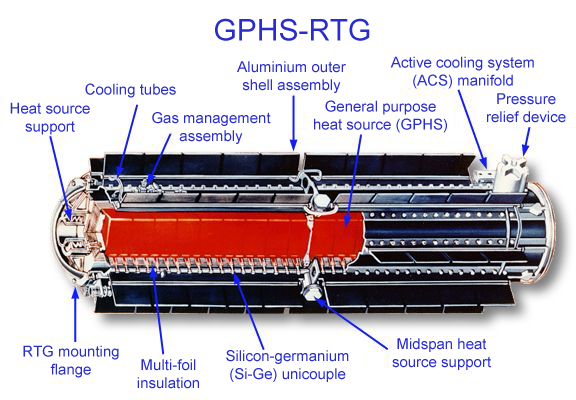
These are solid-state devices (meaning they have no moving parts) and convert the heat directly into electricity using TEGs (Thermoelectric Generator). They don’t need water or air input.

RTGs have an overall fuel efficiency of around 3-5%, meaning they translate around 3-5% of the radioactive decay heat of the nuclear material into electric power output.
Edit: For the sake of documenting stuff, i’d like to point out that my comment that “nuclear only works if it’s steady-state and does not use water/air input” is probably wrong, as some engines such as stirling engines can deal with normal-pressure air, no water needed. NASA is indeed building closed-loop stirling generators to be used on the moon with efficiencies around 20% IIRC instead of 5% which RTGs would have, so they’re more efficient.
astronaut on bicycle genny