AI Should Not Certify Work. It Should Help Prove It.


A lot of people talk about AI in regulated industries like the goal is to replace human judgment. I honestly think that is the wrong starting point.
In industries like testing, inspection, and certification, trust does not come from removing humans. Trust comes from making the work more traceable, more complete, more searchable, and easier to prove.
That is the way I think about AI inside Oryxen. Not as a magic decision-maker. Not as a chatbot sitting on top of documents. Not as something that replaces inspectors, engineers, or quality managers.
AI in Oryxen exists for one reason. To reduce the administrative drag around proof. I understood this more clearly when I spent time around a real TIC operation in the UAE. I was not sitting in a room thinking, “What AI features can we add?” I was asking people how their work actually breaks. I spoke with engineers, admins, sales teams, and people inside operations. These are the people who live inside the workflow every day. And the pattern became very clear.
The pain was not abstract. It was very practical. One of the strongest signals came from the field side. Engineers deal with reports, inspection evidence, old certificates, site documents, handwritten notes, and client-provided PDFs. A lot of that information already exists somewhere, but someone still has to read it, copy it, clean it, and enter it again.
Sometimes the document is a scanned PDF. Sometimes it is a legacy certificate. Sometimes it is a site report. Sometimes the handwriting is hard to read. And even when the information is visible, someone still has to repopulate it digitally.
That is not intelligent work. That is friction. So the first practical AI idea was not, “Let AI certify the inspection.”
It was much simpler.
Can we help extract the useful fields from existing documents? Can we identify the certificate type or subtype? Can we map the extracted information into the correct digital form? Can we reduce the amount of repeated typing? That became the logic behind Oryxen’s extraction service.
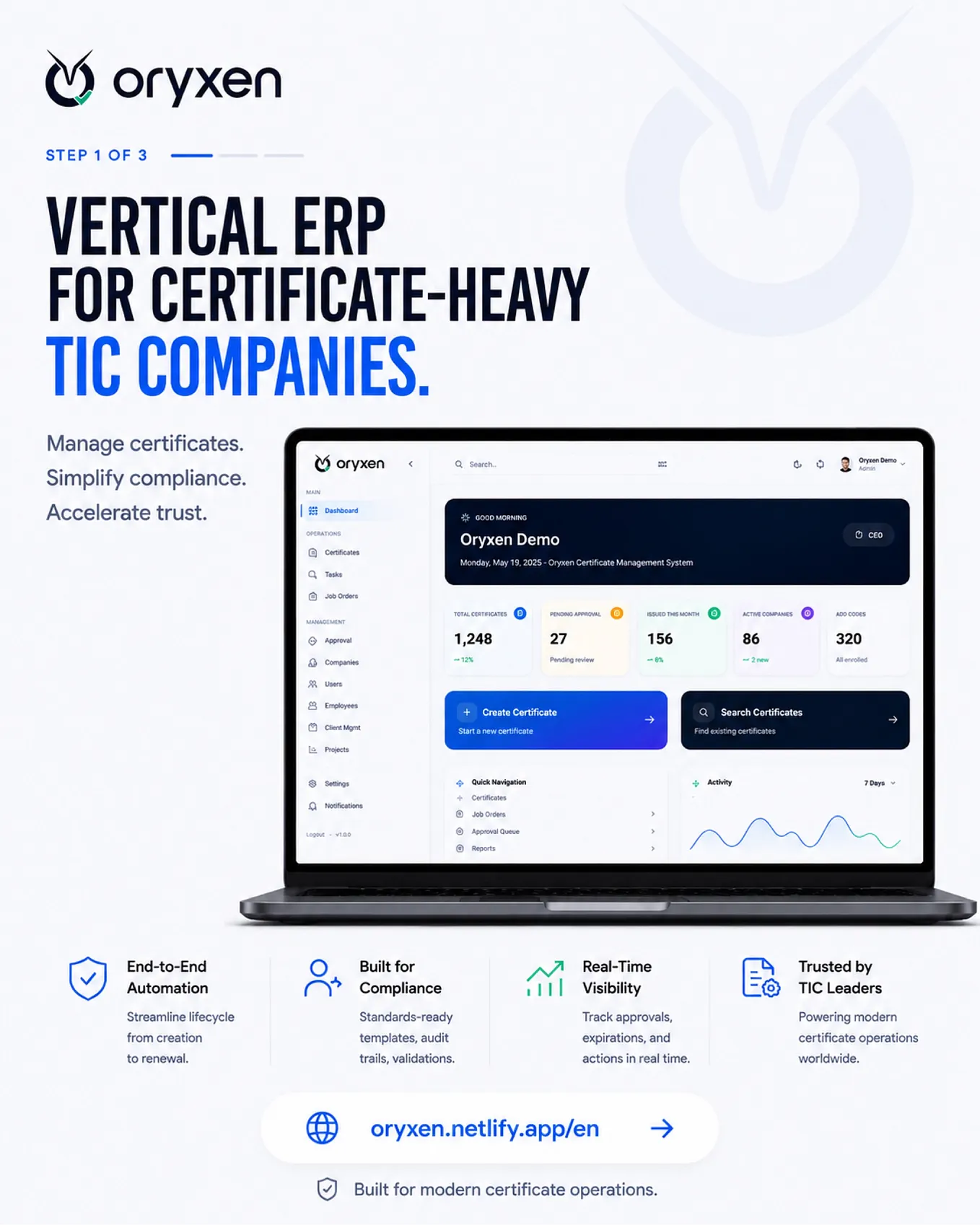
The goal is not to remove the engineer. The goal is to remove unnecessary re-entry. A document comes in, Oryxen reads it, extracts the relevant fields, matches it with the right type or subtype, prepares the form, and then a human reviews and confirms it.
That last part matters a lot!
In regulated work, AI should assist the workflow. It should not become the accountable authority.
The second pain came from admins and sales teams. Certificate-heavy companies do not operate with one static document forever. Letterheads change. Formats change. Legacy templates need to be inherited. New inspection types need to be added. Different certificate types may require different structures.
Every time a template changes, the workflow around it can become messy. This creates a real operational burden because the certificate is not just a PDF. It is connected to the job order, the client, the inspection type, the engineer, the approval process, the expiry date, and the audit record.
So the question became simple. Can Oryxen understand templates as structured operational objects, not just files?
That is where the template service came from. The idea is to analyze the template structure, understand the fields, connect it to certificate types and subtypes, and store that logic inside the system. Later, when an admin creates a job order or a team assigns a new engineer for a specific certificate type, the right template logic is already available.
The system does not treat templates as random documents. It treats them as part of the workflow. That matters because in TIC, templates are not design assets. They are operational infrastructure.
The third AI use case is more subtle, but very important. Before a certificate or report moves forward, teams need to know whether required fields are complete. This does not mean AI should check whether the technical judgment is correct. That would be dangerous and misleading.
Instead, the AI-assisted policy checker is designed around completeness. Are required fields missing? Is a mandatory input empty? Has the form been submitted with an empty value where evidence should exist? Is something incomplete before approval?
If yes, the system raises a flag. Not a vague warning. A proper operational flag. This is important because many workflow mistakes are not complex. They are small gaps that become expensive later. A missing field. An empty date. An incomplete reference. A skipped attachment.
These issues can delay approvals, create audit problems, or force teams to redo work. The policy checker exists to catch those gaps earlier.
Get Ahmad Jamil’s stories in your inbox
Join Medium for free to get updates from this writer.
Again, the principle is simple. AI does not replace accountability. AI helps humans avoid preventable mistakes.
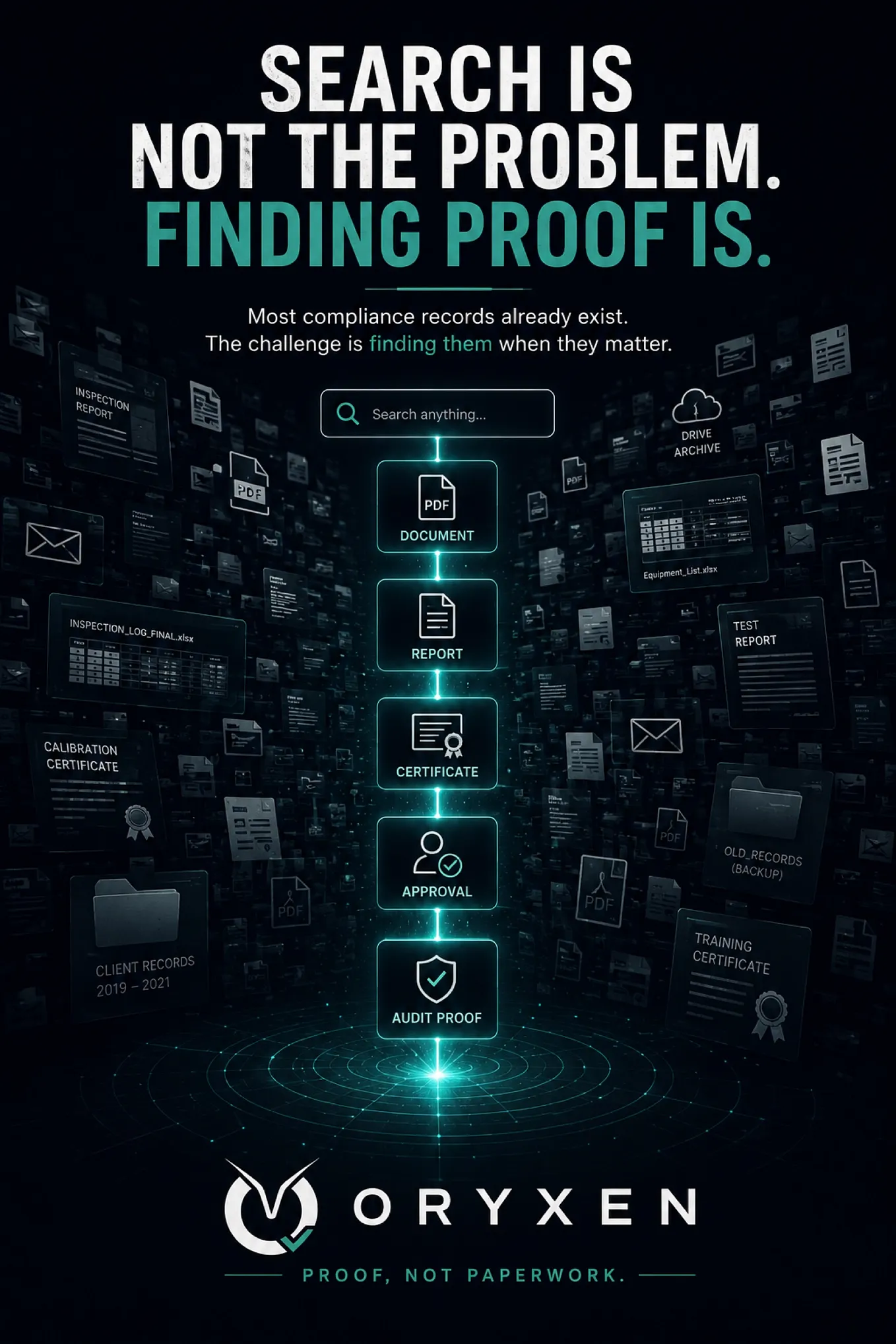
Another pain point came from certificate history. Once a TIC company has thousands of certificates, simple folder-based searching becomes painful. People need to find records by company name, certificate type, equipment, expiry date, approval status, job history, or sometimes by meaning.
Simple search is still useful. If someone knows the certificate number, client name, or job ID, keyword search works. But real operational search is often messier.
An admin might want to find calibration certificates expiring next month. A manager might want old lifting equipment certificates for a specific client. A quality team might need records related to one inspection type with approval history.
That is where semantic search becomes useful. Oryxen uses semantic chunking and retrieval so certificate history can become searchable by meaning, not only exact file names or keywords.
This is not AI for entertainment. This is AI for memory. Certificate-heavy companies do not only need to store records. They need to retrieve proof when it matters.
The more I worked around these workflows, the more obvious the principle became. AI in regulated industries should not be positioned as a replacement for human judgment. That is the wrong promise.
The better promise is this. AI should reduce the cost of structure. It should help extract fields. It should help classify documents. It should help map legacy records. It should help detect missing inputs. It should help retrieve evidence. It should help teams find proof faster.
But humans should remain accountable for technical decisions, approvals, and certification authority.
That distinction matters.
Because in TIC, trust is not created by automation alone. Trust is created by traceability.
Who did the work? What evidence was attached? Which certificate was generated? Who reviewed it? Who approved it? What changed? When did it expire? Where is the proof?
That is the layer Oryxen is building around. The mistake many people make is thinking AI needs to be dramatic to be valuable.
I do not think that is true. Sometimes the most valuable AI is boring.
It reads the document. It extracts the fields. It finds the old certificate. It detects the missing input. It retrieves the evidence. It helps a human finish the work faster and with fewer gaps.
That is not flashy. But it is useful. And in certificate-heavy industries, useful beats impressive.
Oryxen’s AI layer came directly from operator pain. Engineers wanted less retyping. Admins wanted better template handling. Sales teams needed visibility around jobs and renewals. Quality teams needed completeness before approval. Managers needed searchable proof.
That is the kind of AI I believe in. AI that does not pretend to be the authority. AI that helps the real authority work better.
Because in TIC, the goal is not to generate more content. The goal is to prove the work happened.
Cleanly. Traceably. Reliably.
That is where AI belongs.
Proof, not paperwork.
SOLO FOUNDER
AJ❤️