The $1 Million Combine Is a Warning, Not a Wonder


There is something remarkable about today’s largest combine harvesters.
They can adjust threshing settings while moving through the field, map yield variations in real time, steer with remarkable precision, transmit machine data remotely, and help operators harvest more acres with fewer interruptions. In engineering terms, modern combines are among the most sophisticated machines in agriculture.
They are also becoming extraordinarily expensive.
Depending on the model, header, technology package, and configuration, a new high-capacity combine can cost hundreds of thousands of dollars, with flagship machines approaching the seven-figure range.
That does not automatically make them overpriced. For a large operation harvesting thousands of acres within a narrow window, higher capacity, lower grain loss, better automation, and fewer labor requirements can justify a very expensive machine.
But it raises a more interesting question:
What happens when the most advanced harvesting technology becomes economically practical for only a small part of the farming market?
The price is not just paying for horsepower
It is easy to look at a modern combine and assume that the higher price mainly comes from a larger engine and greater harvesting capacity.
That is only part of the story.
A modern flagship combine is increasingly a mechanical system wrapped around an electronics and software platform. Sensors monitor crop flow and machine load. Automated systems adjust threshing and cleaning settings. GPS and guidance systems reduce overlap. Yield monitors collect field-level data, while telematics allow machines to be monitored and diagnosed remotely.
Much of this technology has real value.
Automation can reduce operator fatigue. Better adjustment can reduce losses. Remote diagnostics can shorten downtime. More accurate harvesting data can help improve decisions in future seasons.
The issue is not whether this technology works.
The issue is that every additional layer of capability also increases the amount of capital tied up in one machine.
And that matters because harvesting equipment spends most of the year parked.
Utilization changes everything
A $700,000 or $1 million combine can make economic sense if it harvests enough acres every year.
On a very large farm, the cost can be spread across thousands of acres. Higher capacity may also allow the operation to finish harvesting earlier, reducing weather exposure and grain losses.
The calculation changes quickly as annual utilization falls.
A smaller operation still has to absorb depreciation, financing, insurance, maintenance, storage, and repairs, even if the machine only works for a relatively short period each year.
That is why purchase price alone tells us very little about whether a combine is actually expensive.
A machine that costs twice as much but harvests four times the acreage may have a lower machinery cost per acre. A cheaper combine that spends most of the year unused may be the less economical investment.
The more useful question is not:
How much does the combine cost?
It is:
How much productive work will this machine perform over its useful life?
The technology race creates a real trade-off
High-capacity harvesting equipment has helped large farms become extraordinarily productive. It allows fewer operators to manage more acres and complete harvest within shorter windows.
But those same advantages reinforce economies of scale.
A large operation can spread expensive machinery across more acres, negotiate financing more easily, employ trained operators, and maintain a fleet of supporting equipment.
A smaller farm often cannot.
This does not mean expensive machinery alone is responsible for farm consolidation. Land prices, interest rates, labor availability, input costs, succession, and commodity margins all matter.
But machinery is part of the equation.
When each generation of equipment becomes more capable and more expensive, farms need enough annual work to justify that investment. The economics naturally favor operations capable of keeping those machines busy.
But not every farm needs the same combine
One mistake in discussions about agricultural technology is treating the largest and most advanced machine as the benchmark for the entire industry.
Agriculture does not work that way.
A 5,000-acre grain operation in the Midwest and a 50-acre rice farm in Southeast Asia are both farms, but their machinery requirements have almost nothing in common.
The first may benefit enormously from a large combine capable of harvesting huge volumes with minimal labor.
The second may care far more about maneuverability, wet-field performance, simple maintenance, fuel consumption, spare-parts availability, and purchase price.
That distinction becomes even more important outside North America.
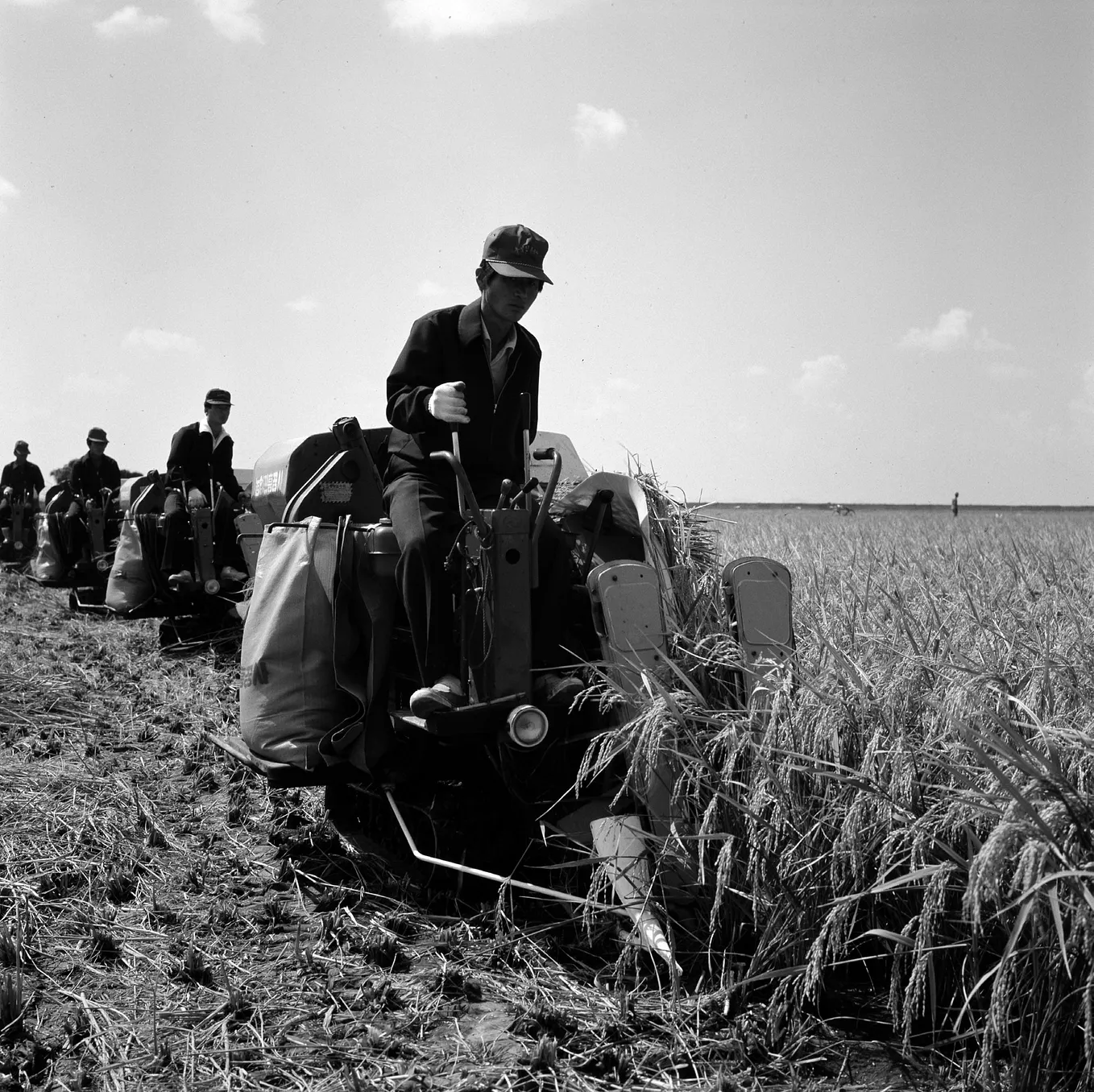
Across Asia, Africa, and Latin America, agricultural mechanization is expanding rapidly, but much of that growth is happening through smaller and more affordable machines rather than flagship combines.
Manufacturers in China, India, Japan, and other machinery-producing countries serve this part of the market with compact combines, crawler harvesters, tractor-mounted equipment, and machines designed for smaller fields.
Get Wishope’s stories in your inbox
Join Medium for free to get updates from this writer.
One example is iharvester, which offers smaller combine harvesters and related agricultural equipment for markets where field size, crop conditions, and equipment budgets differ significantly from those of large North American grain farms.
The point is not that these machines are substitutes for an X9 or an IDEAL 10.
They are not.
They solve a different problem.
A $50,000 machine and a $1 million machine can both make sense
Comparing them directly can actually be misleading.
A flagship combine is designed around very high throughput. Large farms may need that capacity because a short harvest delay across thousands of acres can cost more than the additional machinery investment.
A smaller combine sacrifices some of that throughput in exchange for lower capital requirements, easier transportation, better maneuverability in smaller fields, or simpler maintenance.
For many farms, the economically superior machine is therefore not the one that can harvest the most acres per hour.
It is the one whose capacity most closely matches the farm’s annual workload.
This is also why machinery markets look so different from country to country.
Field size, crop type, labor cost, access to credit, local repair capacity, road infrastructure, and even soil conditions all influence what “good machinery” means.
There is no globally optimal combine.
There is only a combine that makes sense for a particular farming system.
The overlooked cost is downtime
Purchase price also tends to dominate the conversation because it is easy to see.
Downtime is harder to see until harvest begins.
A sophisticated machine with excellent productivity can become very expensive if a critical component fails and the farm cannot get it running again quickly. The same applies to a cheaper machine whose spare parts are difficult to source.
For this reason, ownership economics should include more than the sticker price.
Parts availability, dealer support, maintenance requirements, operator familiarity, fuel use, repair complexity, and resale value all contribute to the real cost of harvesting.
For smaller farms in particular, a machine that can be repaired quickly with readily available components may sometimes be more valuable than one offering higher theoretical capacity.
Harvesting is unusually sensitive to this problem because time cannot simply be recovered later.
When the crop is ready and weather conditions are favorable, every lost day matters.
Maybe the real divide is not high-tech versus low-cost
It is tempting to frame the machinery market as a contest between expensive Western equipment and inexpensive machines from emerging manufacturing markets.
That misses the larger point.
The more meaningful divide is between machines designed for different economic realities.
Large farms need productivity per hour.
Smaller farms may need productivity per dollar invested.
Contract harvesting businesses may care most about annual utilization and reliability.
Rice farmers in wet fields may prioritize crawler mobility.
Farms far from dealerships may value repairability and spare-parts availability more than another layer of automation.
None of those priorities is inherently better.
They simply reflect different constraints.
What the million-dollar combine really tells us
The seven-figure combine is not evidence that agricultural engineering has gone in the wrong direction.
In many ways, it represents the opposite.
Modern harvesting machines can do things that would have seemed impossible a generation ago, and on farms large enough to use that capacity, the technology can deliver genuine economic value.
But it also shows how specialized modern agriculture has become.
At one end of the market, farms are investing in highly automated machines capable of harvesting enormous areas with fewer operators.
At the other, millions of farmers are still looking for something much simpler: a machine they can afford, maintain, and keep working through the harvest season.
Both markets matter.
The future of agricultural mechanization will probably not be defined by one universally superior machine. It will be defined by a much wider range of equipment designed around different farm sizes, crops, labor conditions, and levels of capital.
That may be the more useful lesson behind the million-dollar combine.
The question is not whether agriculture needs more technology or cheaper machinery.
It is whether farmers can access the right amount of technology at a cost their operation can actually support.