The Second Crop Nobody Ordered

Farm accounting counts the grain a harvester takes out of a field. Nothing counts the seed it puts back.
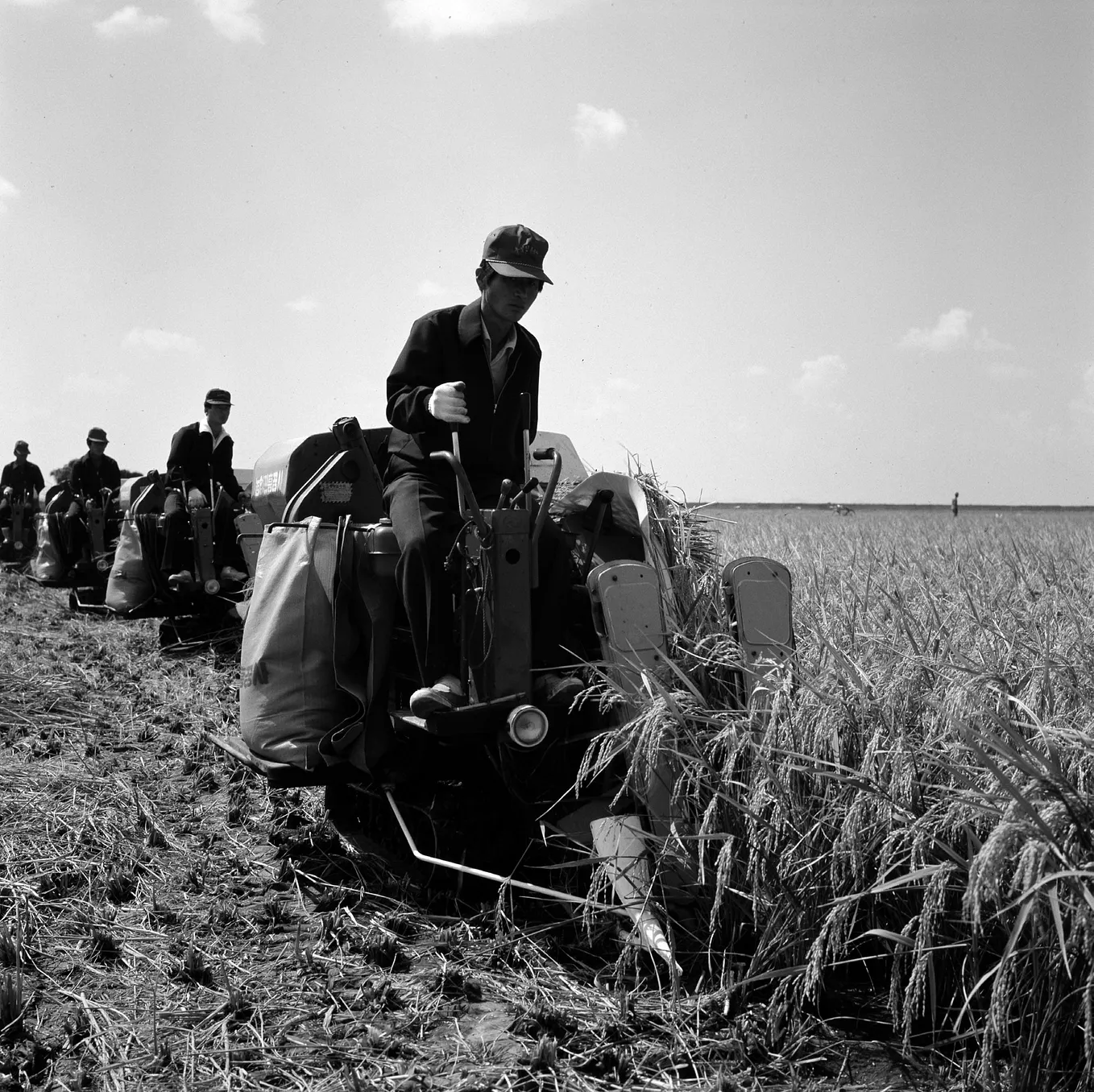
New Holland rice combine harvester working in a paddy field in Langkawi, MalaysiaThree weeks after the combine left his field, Hemanta Sahu walked back into it for a completely ordinary reason. He wanted to check whether the stubble had dried enough to burn before the next puddling. What he found instead was rice.
Tall, pale, red-awned rice standing a head above the stubble, shedding grain when he brushed past it. He had not sown it. Nobody in the village admits to having sown it. And it was not scattered at random either — it ran in bands, thicker along two or three lines that followed the direction the machine had travelled, in the lines where the discharge had fallen.
He had done the season correctly. Certified seed from the block office. Transplanting inside the window. A pre-emergence spray, and a second pass when the first flush came up. He had hired a tracked combine from a contractor who, that month, was working his way through three districts. The machine took four hours and left behind a clean field and a stack of straw. Hemanta paid by the hour. Two seasons later he was still paying.
I keep coming back to that field, because nothing about it is exotic. A farmer who did everything the extension pamphlet says, a machine everyone agrees is a good machine, and a weed problem that arrived in straight lines.
The Machine Makes Two Passes, And Only One Gets Measured
Mechanised harvesting is accounted for as a single operation. Grain in, grain out, losses recorded in kilograms per hectare, moisture and broken grain noted at the mill. That is the whole ledger.
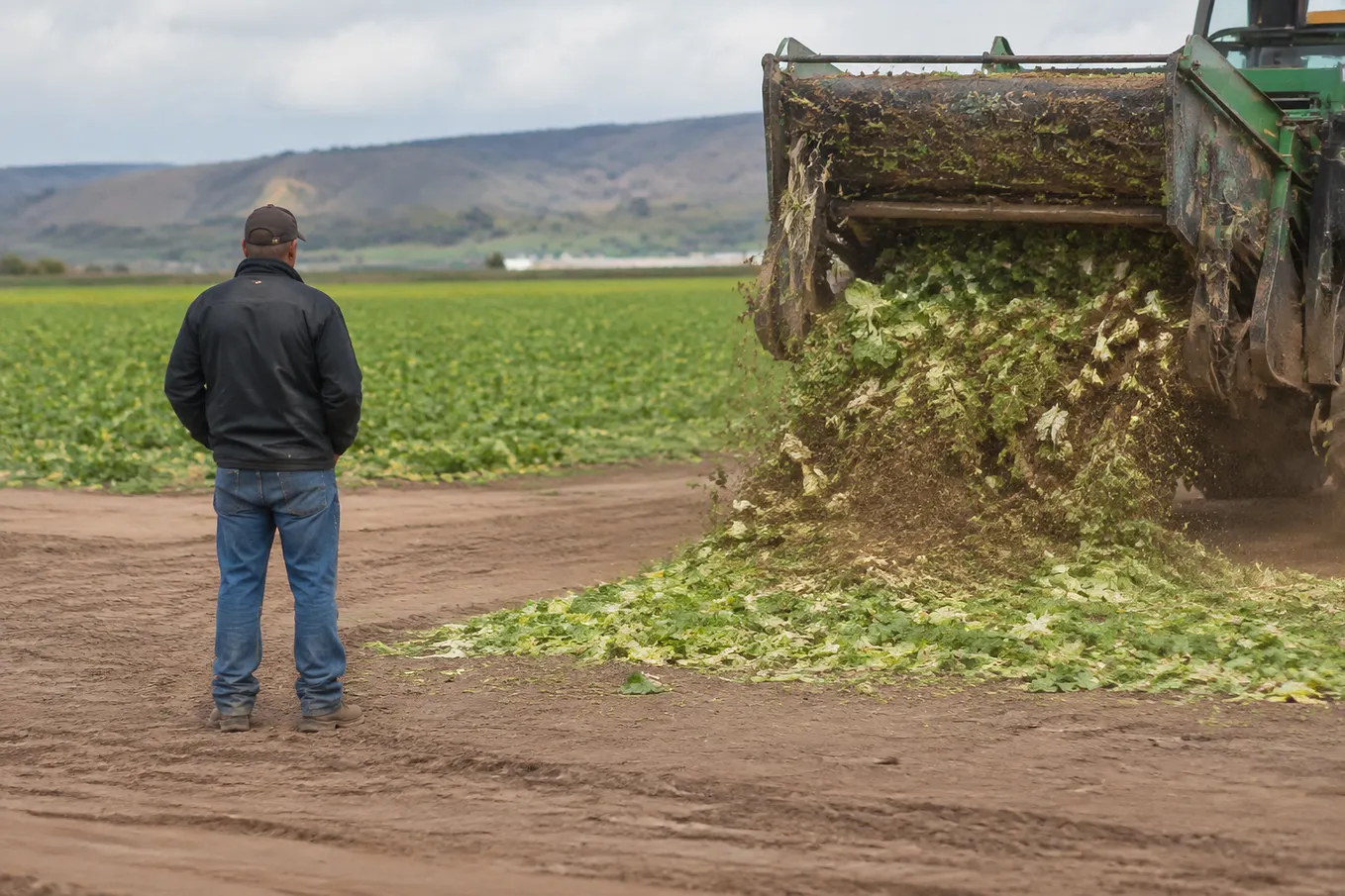
But a combine does two things with the biology standing in front of it. It takes the crop out, and it puts seed back. Not as a metaphor. The machine collects seed at the header, separates it inside the threshing and cleaning system, and discharges it out the back, distributed evenly across the ground it has just stripped.
Left to itself, a weed drops its seed more or less where it grew. A patch stays a patch, and a farmer can walk out and deal with a patch. The harvester picks that patch up, carries its seed the length of the field, and spreads it. A problem that occupied one corner becomes a problem with uniform coverage — and it does this at precisely the moment the farmer’s ability to see anything disappears. Harvest leaves the field looking clean.
I have started calling this the second crop, and the bill for it the seed debt. Both arrive a season late, which is most of the reason nobody has ever added them up.
Straw and chaff discharged from the rear of a John Deere combine harvesterWhat Actually Happens To A Weed Seed Inside A Combine
Cross-sectional diagram of a combine harvester showing crop, straw-chaff, and grain flow pathsThis is not speculation. It is the best-documented thing about weed seed movement that almost nobody outside weed science talks about.
In Australian grain systems, researchers found that with the harvester set up correctly, roughly 95 per cent of the annual ryegrass seed entering the machine exits in the chaff fraction — the light residue stream that gets spread out the back (Walsh and Powles 2007; Broster et al. 2016). Work at Virginia Tech puts numbers on how much seed is even in play at harvest time: on-farm sampling found Italian ryegrass retaining about 37.5 million seeds per acre, Palmer amaranth about 56 million, and common ragweed roughly 257.6 million.
Machine setup turns out to matter enormously. A properly adjusted combine puts more than 90 per cent of the weed seed into the chaff; a badly adjusted one can send up to half of it out with the straw instead, which changes where the seed lands and what can be done about it.
Here is the part I find genuinely uncomfortable. The chaff is the waste stream. Every engineering decision that shaped the back of a combine — chop it, spread it, get it out of the way so the next pass can run — was made about residue disposal. Nobody designed the waste stream around what the waste contains. The weed seed travels in the one part of the machine nobody was looking at, because the machine was built to optimise grain recovery and nothing else.
Claas Lexion combine harvester with active straw chopper at the rearThe Invoice Arrives In Somebody Else’s Season
Weeds are the largest single biological cause of crop loss on earth. A 2025 review of precision weed control puts the figure at roughly 1,800 species causing about 31.5 per cent loss of plant production globally, worth around USD 32 billion a year; for India the same review cites yield losses of roughly 14 to 36 per cent across ten major crops, about USD 11 billion annually. Herbicide resistance compounds it. Heap’s international database, as cited in a 2026 survey of Manitoba growers, records 534 unique cases of herbicide-resistant weeds covering 273 species and 21 of the 31 known herbicide sites of action.
None of that is caused by harvesters. But a share of it is distributed by them, and distribution is what turns a manageable infestation into a systemic one. This is the part that gets misdiagnosed: when a herbicide appears to stop working across a whole field in a single season, the usual conclusion is that resistance has just arrived. Often the resistance arrived years ago in one corner; what arrived this year was the machine, carrying the seed.
Kerala, Where The Second Crop Won
The clearest Indian case is rice, and it is ugly.
In a 2014 paper in the Journal of Crop and Weed, C.T. Abraham and Nimmy Jose describe what happened in Kerala’s paddy tracts: heavy weedy rice infestation forced farmers to abandon the crop, with yield reductions of about 30 to 60 per cent depending on severity (3 to 10 mature weedy plants per square metre). During 2008–09, several farmers abandoned the crop without harvesting at all. Then the sentence that stopped me: “Infestation became serious from 2005 when farmers started relying more on chemical weeding and mechanized harvesting.”
I want to be careful with that, because it is the kind of sentence people over-quote. The Kerala work does not isolate the machine’s share. Direct seeding, herbicides replacing hand weeding, and acute labour shortage all moved in the same years, and any of them could carry the causal weight. What the literature does say plainly is that farm machinery is one of the recognised pathways — Chauhan’s 2013 review lists machinery alongside irrigation water, cattle and contaminated seed, and the standard preventive recommendation is to clean harvesting and sowing equipment before moving it into a new area.
Two details make the system-level point better than any single study. First, weedy rice is a serious problem in eastern and southern India, where direct seeding is common, and largely absent from Punjab and Haryana, where paddy is transplanted — the same machines, a different establishment method, a completely different outcome. Second, the damage is non-linear: reviews report densities of 35 to 40 weedy plants per square metre cutting yields by about 60 per cent in tall cultivars and up to 90 per cent in short ones. Jharkhand recorded 24 to 32 per cent infestation across Ranchi, Khunti and East Singhbhum, with estimated losses of 10 to 45 per cent.
A vector is not a cause. It is a distribution network. Distribution networks are what turn a field-level problem into a regional one.
Why The Bill Never Reaches The Machine
A paddy combine harvester being transported on a truck in Sri LankaStandard economics says an input that imposes downstream costs eventually gets priced. If harvesters spread weeds, the cost should come back to the machine — higher weed-control bills, lower land value, operators forced to clean up. Four things stop that from happening, and none of them are mysterious.
Get Wishope’s stories in your inbox
Join Medium for free to get updates from this writer.
The first is timing. The seed goes in during harvest; the symptom appears the following season, in a different crop, under different weather. No farmer connects a weed flush in August to a machine hire in April, and neither would I.
The second is diagnosis. Confirming that a weed patch came from last season’s combine requires seed-bank sampling and, ideally, genetic comparison. Rural extension diagnoses by eye. Nothing in the system produces the causal chain, so nothing in the system can issue an invoice.
The third is the payment structure. Custom operators are paid by the hour or by the acre. The clean-out protocol that University of Maryland Extension recommends — running straw bales through the raised header, flushing the grain tank, blowing out the residue — costs real time inside the narrowest window of the year. Scheduling harvest order so that heavily infested fields are cut last, which the same guidance recommends, costs scheduling flexibility in a season where everybody is already queuing. Nobody’s rate card has a line for either.
The fourth is that the machine is shared, so the externality has no owner. India set up 27,828 custom hiring centres between FY2014 and FY2020, according to a Ministry of Agriculture and Farmers Welfare report cited in a 2024 Mitsui analysis, and some contractors own multiple combines and travel to more than ten states to do custom harvesting. One machine now links the seed banks of dozens of farms across multiple agro-ecologies. The person best placed to prevent the spread is the person with the least incentive to pay for it.
The Machine Is Not The Villain Either
I should be clear about what I am not saying. Combines did not invent weedy rice, and the answer is not to go back to sickles. Manual harvesting was slower, more expensive, and in a labour-scarce season it cost farmers yield they could not afford to lose.
The point is narrower and, I think, more useful: the harvester’s residue stream is where an externality lives, and nobody has ever asked the machine to account for it.
You can see this in the documentation. Open the specification sheet Wubota publishes for its 4LZ-5.0 full-feed rice combine — cutting width 2,200 mm, feeding capacity 5.0 kg per second, ground clearance 340 mm, productivity 0.33 to 0.63 hectares per hour, 100 hp turbocharged engine. It is a serious, detailed sheet. It contains no line for where the chaff goes, what fraction of non-grain seed is retained, or whether the machine can be configured to concentrate residue rather than broadcast it.
That is not a criticism of the manufacturer. It is a description of what buyers ask a machine to be. Subsidy programmes ask the same questions: horsepower, area covered, timeliness, cost per hectare. If procurement ever asked about the seed pathway, the line would appear on the spec sheet within a season.
What Would Have To Be Counted
There is a whole toolkit for this, developed mostly in Australia under the name harvest weed seed control, and it works. Chaff lining and chaff tramlining concentrate the seed-laden residue into narrow rows, and an estimated 12 per cent of Australian growers were using those techniques by 2020. Integrated impact mills mounted at the back of the combine pulverise the chaff fraction and kill more than 90 per cent of the seed in it. Trials cited by University of Maryland Extension report a 99 per cent kill rate for Palmer amaranth and common ragweed with one commercial mill, a 98 per cent reduction in viable waterhemp seed in Missouri work, and Iowa State findings that about 95 per cent of weed seed can be concentrated behind wheel tramlines.
Annual ryegrass, Lolium rigidum, in Ajloun Forest Reserve, JordanI do not want to oversell the transfer to rice. A USDA-ARS review of harvest weed seed control in North American crops lists the obstacles plainly: high moisture at harvest, untimely harvest, crops like maize that the current techniques do not suit, plus the risk that weeds adapt to the technique and that species composition shifts. Asian rice adds its own problems — enormous straw volumes, wet fields, small plots, and machines owned by contractors rather than the people whose fields they work. The Australian toolset does not drop into the Mahanadi delta unchanged, and anyone who says otherwise has not stood in a paddy at harvest.
What transfers cheaply is unglamorous. Harvest order — cut clean fields first, infested ones last. A documented clean-out between farms, with the time and the disposal area paid for explicitly in the hire rate rather than absorbed by goodwill. Cutting low, since seed retention at harvest height is what makes any of this tractable. And machine hygiene as a condition attached to the public money that is already flowing: India’s Sub-Mission on Agricultural Mechanization subsidises machinery purchases and custom hiring centres, and it could require a cleaning protocol for subsidised harvesters at roughly the cost of a signature.
There is also a breeding lesson sitting in plain sight. Japan’s rice breeding history includes selection for non-shattering cultivars specifically to reduce grain loss at combine harvest, while much of tropical Asia still grows easy-shattering varieties whose seed is on the ground before the machine arrives. Crop and machine have been co-designed for one hundred years. They have simply never been co-designed around what leaves the back of the machine.
Lolium rigidum annual ryegrass plantsAnd there is a research gap I would love to see someone close. Combine architecture varies enormously. Half-feed machines draw only the panicle through the thresher and discharge straw largely intact — the Iseki 808G-class machines Wubota lists carry a 1,450 mm cutting width and an optional vertical straw binder — while full-feed machines swallow the whole plant and chop and spread it. Those two designs must produce very different seed pathways. I have not found a single study comparing them on that question, which is odd, because it is cheap to answer and it would tell us whether the fix belongs in the machine shop or in the field.
Counting The Second Crop
Weedy rice shatters early. That is the whole trick: the seed is on the ground before the combine ever arrives, which is why hand-rogueing fails and why the problem always seems to be one step ahead of the farmer.
It also means the machine was never the origin. It is the distribution network — and the reason a problem that used to stay in one corner of one field now shows up in bands across three districts. That is not an argument against mechanisation. It is an argument for noticing that a machine performs two operations, and that we have spent seventy years measuring one of them.
Hemanta is not running an experiment, and nobody is sampling his seed bank against a control plot. He is farming the way everyone around him farms, on a ledger that has one column. The second crop ripens first and shatters first, and every year it is harvested too — it just never appears on anyone’s invoice.
Niladri is a government agriculture officer in Odisha, India, working with tribal farming communities in the Eastern Ghats. He writes independently on climate adaptation, indigenous farming systems, and rural livelihoods. He can be followed on LinkedIn.
Sources
Full source list with URLs is in the accompanying fact ledger. Key references:
- Walsh et al., “Harvest weed seed control: impact on weed management in Australian grain production systems,” Crop & Pasture Science (CSIRO) — https://www.publish.csiro.au/cp/cp21647
- Flessner & Russell, “Harvest Weed Seed Control,” Virginia Cooperative Extension SPES-135 — https://www.pubs.ext.vt.edu/SPES/SPES-135/SPES-135.html
- “Minimizing Combine Weed-Seed Movement,” University of Maryland Extension — https://www.extension.umd.edu/resource/minimizing-combine-weed-seed-movement
- USDA-ARS, “Current outlook and future research needs for harvest weed seed control in North American agronomic crops” — https://www.ars.usda.gov/research/publications/publication/?seqNo115=376144
- Abraham & Jose, “Weedy rice invasion in rice fields of India and management options,” Journal of Crop and Weed 10(2), 2014 — https://www.cropandweed.com/archives/2014/vol10issue2/60.pdf
- Chauhan (2013) pathways of weedy rice spread, reviewed in Agricultural Reviews — https://arccjournals.com/journal/agricultural-reviews/R-2538
- OECD, Biology of Rice (Vol. 9) — seed shattering and combine harvesting — https://www.oecd.org/en/publications/safety-assessment-of-transgenic-organisms-in-the-environment-volume-9_e49bd2e8-en/full-report/component-11.html
- Ministry of Agriculture & Farmers Welfare CHC figures, cited in Mitsui MGSSI, “Farm Mechanization in India” (2024) — https://www.mitsui.com/mgssi/en/report/detail/__icsFiles/afieldfile/2024/04/16/2402i_nozaki_e.pdf
- Heap, International Herbicide-Resistant Weed Database — https://www.weedscience.org