Comparison of the top 5 best oracles

What an advantage RedStone has over them!
Hi everyone, I was inspired by an article from the RedStone team that compared 3 oracles, but today I decided to compare the 5 most popular oracles and make a comparison from a slightly different angle, so today we will do a great job and compare the 5 most popular oracles in cryptocurrency, we will analyze their pros and cons, talk about the power of the community, talk about numbers and much more!

A little insight into what oracles are
Blockchain oracles play a crucial role in the decentralized finance (DeFi) and broader blockchain ecosystem. As blockchain technology becomes more pervasive, the demand for accurate, reliable, and secure off-chain data integration has grown exponentially. Oracles bridge the gap between the on-chain and off-chain worlds, enabling smart contracts to interact with real-world data and execute complex logic based on external events. Without oracles, blockchains would remain isolated, limiting their use cases to applications that rely solely on on-chain data.
What Are Blockchain Oracles?
In simple terms, a blockchain oracle is a service or protocol that connects blockchains with external data sources, such as market prices, weather conditions, sports scores, or even real-world events. Oracles retrieve, verify, and deliver this data to smart contracts in a secure and tamper-resistant manner. They ensure that decentralized applications (dApps) can operate effectively by providing the necessary information to trigger automated processes within smart contracts.
Why Are Oracles Essential for DeFi and Blockchain Ecosystems?
Oracles are indispensable for DeFi because they provide accurate and real-time data, enabling protocols to function correctly. For example, price feeds from oracles allow lending platforms to calculate collateral values, decentralized exchanges to set trading prices, and stablecoins to maintain their pegs.
Let me tell you a little bit about each oracle we’re going to compare today
Chainlink


Chainlink provides off-chain data to a wide range of blockchain-based ecosystems: layer-1s. Layer-2s, sidechains, and all kinds of DApps running on smart contracts. It was launched as an Ethereum-based oracle in 2019 by SmartContract, a San Francisco-based software company. In December 2021, Eric Schmidt, former CEO of Google, joined Chainlink as a strategic advisor for future projects.
Chainlink provides on-chain services to hundreds of blockchain platforms and software firms, including Avalanche, Aave, Ampleforth, Compound, Swisscom, T-Systems, and the Associated Press.
Overall, Chainlink is a highly secure multi-chain platform offering real-time on-chain services to hundreds of blockchain projects and software firms. Two of its most popular features are:
- Chainlink Verified Random Function (VRF): a protocol that generates a set of random values, and cryptographic proof of those values was determined. This function is mainly used by smart contracts running DApps that rely on unpredictable outcomes.
- Chainlink Automation: formerly Chainlink Keepers, it helps smart contracts with maintenance tasks, such as harvesting, liquidating, rebase, and setup costs and risks when accessing off-chain markets.
Chronicle Protocol


Chronicle Protocol is a novel Oracle solution that has exclusively secured at times over $20B in assets for MakerDAO and its ecosystem since 2017. With a history of innovation, including the invention of the first Oracle on Ethereum, Chronicle Protocol continues to redefine Oracle networks. A blockchain-agnostic protocol, Chronicle overcomes the current limitations of transferring data on-chain by developing the first truly scalable, cost-efficient, decentralized, and verifiable Oracles, rewriting the rulebook on data transparency and accessibility.
Pyth Network


Pyth Network price feeds provide real-time financial market data to smart contract applications on 50+ blockchains. Pyth’s market data is contributed by over 95 reputable first-party data providers, including some of the biggest exchanges and market making firms in the world. Each price feed publishes a robust aggregate of these prices multiple times per second. The protocol offers over 450 price feeds covering a number of different asset classes, including US equities, commodities, and cryptocurrencies.
Pythnet Price Feeds are available on 40+ blockchain ecosystems, and can also be used in off-chain applications. They are available on mainnet for most EVM chains — including Ethereum, BNB, Avalanche, and more — several Cosmos chains, Solana, Aptos, Sui, and NEAR.
Switchboard


Since our launch in April 2021, Switchboard has secured billions of dollars of on-chain volume offering high security/ low latency guarantees for its pricing data.
Get Andrey_24’s stories in your inbox
Join Medium for free to get updates from this writer.
Switchboard has been deeply involved in the step-by-step evolution of each of these archetypes. By closely observing market behavior, we have identified and addressed many persistent pain points in blockchain oracles.
RedStone Oracles


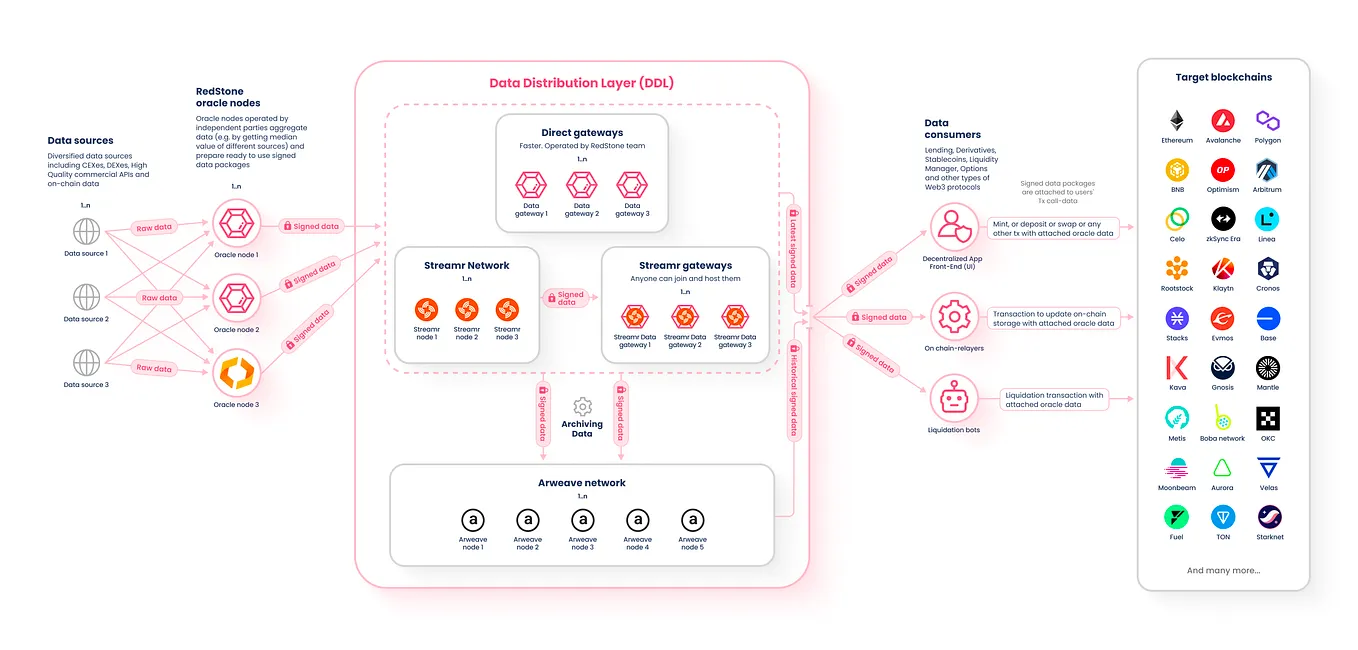
RedStone Oracles is a leading oracle provider directly fulfilling this need. Trusted by 100+ dApps and securing billions of dollars of value, RedStone provides customizable and cost-efficient data streams for builders empowering the next generation of dApps. RedStone also provides data feeds to blockchains and layer 2 scaling solutions across the entire blockchain ecosystem that are both EVM and non-EVM compatible. The current model of oracle systems suffers from key inefficiencies, all of which RedStone Oracles was specifically designed to solve from the bottom up. This makes RedStone a unique oracle service.
Analysis of the total value provided by all oracles

The graph highlights the Total Value Secured (TVS) by five blockchain oracles — Chainlink, Chronicle, Pyth, Switchboard, and RedStone — as of October 5, 2024. Chainlink leads with 49.05% TVS, though its dominance is gradually declining due to growing competition. Chronicle and Pyth hold 13.23% and 9.8%, respectively, while Switchboard and RedStone secure smaller but steadily growing shares at 2.11% and 1.72%. RedStone stands out for its rapid growth, with its TVS percentage increasing consistently year after year. This growth is driven by its modular approach, support for both Push and Pull models, cross-chain capabilities, gas-efficient solutions, and bespoke offerings like ultra-low latency oracles and on-chain Proof of Reserves. RedStone’s innovative features and expanding adoption position it as a rising contender in the oracle market, steadily gaining ground against more established players.
Let’s compare these 5 oracles according to different criteria

Let’s take a look at in which industries RedStone excels over other oracles.
RedStone outperforms other oracles in several key areas. It offers the broadest cross-chain support, available on 60+ chains compared to 18+ for Chainlink and 10+ for Chronicle second only to Pyth. RedStone also leads in gas efficiency by optimizing for DeFi’s gas-sensitive applications, making it more cost-effective than competitors. Its ability to provide custom data types, such as Proof of Reserve feeds, demonstrates greater flexibility and innovation compared to oracles such as Pyth, which are primarily focused on market price data. In addition, RedStone is recognized as the fastest growing oracle in 2024, indicating its rapid adoption and momentum, outpacing more established players in terms of growth. Finally, the emphasis on decentralization and the upcoming launch of the $RED token further strengthens its competitive advantage by promoting community-based management and scalability.
Let’s compare the oracle’s social networks
One and rather unimportant factor is the community of the project. As they say, the stronger the community, the easier it is for the project to live. And it’s really true, it is the users, ardent supporters, ambassadors and Influencers that make the community really alive, evolving and growing fast. That’s why I decided to choose this criterion to compare our oracles!
Chainlink

Chainlink has been on the market for a long time and has a good reputation, and a pretty great Moni Score 9788 is the highest score among other oracles.

Since the project has been on the market for a long time, it does not need ambassadors or influencers for marketing companies, but at the same time its community is a little fading, it should be noted that Chainlink in comparison with other oracles is holding up quite well, but this is only because at the moment it is a monopoly in the field of oracles.
Chronicle Protocol

Probably among all other oracles Chronicle Protocol has the weakest strength in the community, this project is on the market since 2017 and it has shown itself perfectly, but because of the exclusive work with only one DAO it limits itself in spreading to other projects well and accordingly its community is very weak, as we can see Moni Score 1074 and it has only 91 Smarts, also it has no ambassador programs or Influencers who could promote the project further, well in fact they don’t need it as they don’t have a token and also they work with only one DAO.
Pyth Network

Pyth is a very strong project directly related to Solana has a very large community and its supporters, it is in second place in our rating by Moni Score and has 8291, this is quite a large indicator. As we know, last fall they released the $PYTH token, until recently they had an ambassador program. Since the project’s token was released not so long ago, its community still remains strong, many different collaborations including NFT projects.
Generally speaking, Pyth Network is probably one of the first in terms of community strength, it has already moved away from the usual community in the form of influencers and ambassadors, but it attracts in a slightly new way, as I already said, collaborations with NFT collections, projects distribute airdrops for staking $PYTH.
Switchboard

Switchboard hasn’t been around for long compared to Chainlink and Chronicle. It has a pretty average Moni Score of 2740, its community is weak compared to others, but it has something in common with Chronicle, they both don’t have a token and in fact, the community isn’t that important to them!
RedStone

If we talk about RedStone, they probably have the strongest community at the moment, probably somewhere on par with Python, it’s just that they don’t have their own token yet and the project is developing a little differently. If you type RedStone into Twitter, you’ll have 1000+ posts about the project, thousands of miners post daily and support each other not only on Twitter but also in other social networks. This is probably more than just a community!

There are currently over 220+ thousand people in their Discord who communicate daily and create various content by mining RSG.
Conclusions
Comparing all the leaders of cryptocurrency oracles, we have understood a lot, learned who prevails in what areas, who has more collaborations, who has a stronger community and much more! I would like to make a small conclusion on all this. In my opinion, at the moment there are three leaders on the market: Chainlink, Pyth and RedStone. Chainlink is a monopolist in the literal sense, it has been on the market for many years, has good authority, and many collaborations, and also good technologies. Pyth is not so long ago on the market, but it is developing very quickly and has a large community and, so to speak, it is on the hype, If we talk about RedStone, this is the fastest growing oracle over the past year, it has achieved a lot, its community is unique, the RedStone community is slightly different from Pyth, but it is definitely not weaker! It is also worth noting that in 2025 RedStone will have TGE and the $RED token will appear. And then, in my opinion, a real war will begin between these three megalodon oracles. And together with you, we will be interested to see how it all ends!