What types of integration does RedStone have?


Redstone utilizes 4 integration models in its technology. All models are different and each is unique and used in different cases. Today we are going to analyze all 4 integration models and tell you about the pros and cons of each one and also tell you about their features!
Pull Model

Fetching prices on-demand
RedStone’s Pull Model is a groundbreaking innovation that transforms how decentralized applications (dApps) interact with data. Unlike traditional blockchain oracles that rely on a “push” mechanism — where data is continuously uploaded to the blockchain at fixed intervals regardless of demand — RedStone’s Pull Model operates on an on-demand basis. This shift provides a more efficient and cost-effective approach to data interaction, addressing some of the key limitations of traditional oracles.
RedStone’s Pull Model: How It Works
The Pull Model developed by RedStone eliminates these inefficiencies by delivering data only when it is requested by a dApp. Here’s a step-by-step breakdown of how the system operates:
Off-Chain Data Storage
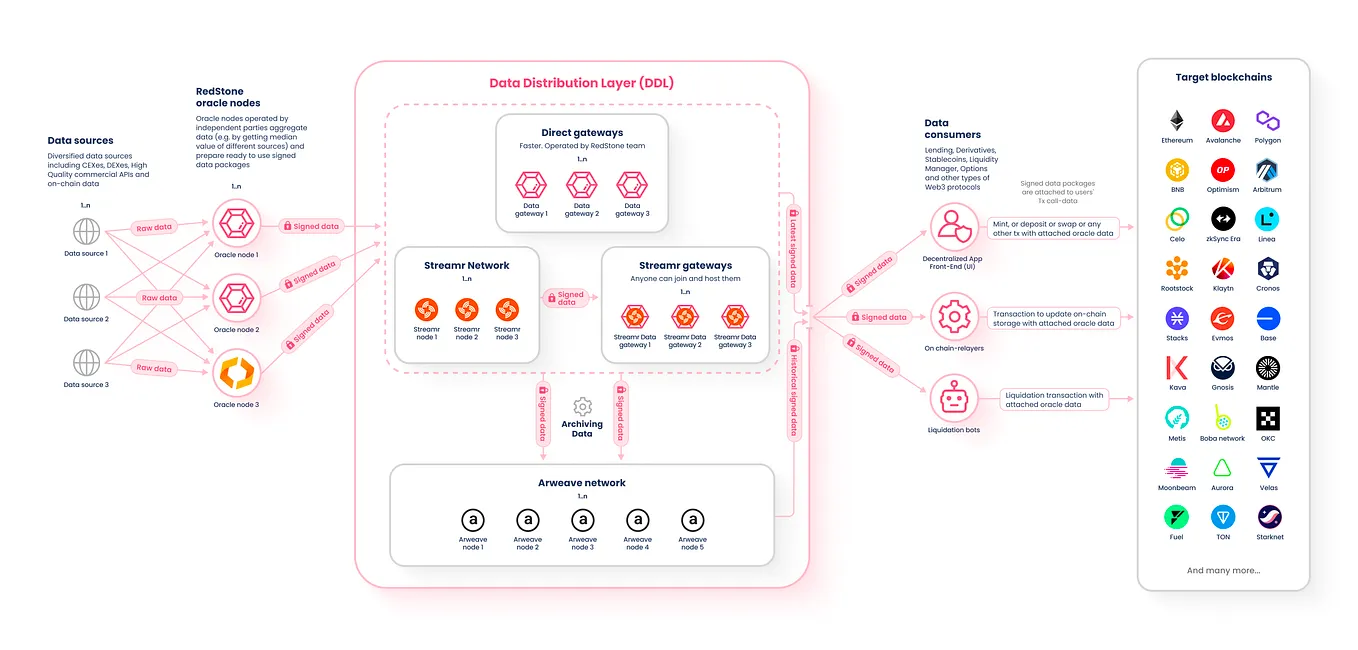
Instead of storing data directly on the blockchain, RedStone maintains it off-chain on its Decentralized Data Layer (DDL). The data is packaged as signed, verifiable bundles that are readily available for fetching.
On-Demand Data Retrieval
When a dApp requires data, it initiates a transaction that includes a request for the specific data feed. RedStone then attaches the relevant data feed to the transaction’s call data.
Use of Call Data
Call data is a part of a blockchain transaction that passes parameters to smart contracts. By embedding the data feed in the call data, RedStone eliminates the need for bridges or external infrastructure like Wormhole, streamlining the data delivery process.
Data Integrity and Backup
To ensure the integrity of its data, RedStone leverages Arweave, a decentralized storage network, to back up its data feeds. This backup provides an independent, tamper-proof record of every data feed, making it possible to verify historical data independently of RedStone’s infrastructure.
Single-Transaction Solution
RedStone’s approach fits seamlessly into a single transaction, allowing developers to fetch, verify, and use data within the same operation. This design reduces complexity and enhances the user experience for developers.

Pluses of the model
Cost Efficiency
No on-chain storage, вata remains off-chain, eliminating storage costs.
Updates only on demand, resources are used only when necessary, reducing unnecessary expenses.
Scalability
The model scales effectively as the volume of data requests grows, without increasing on-chain storage requirements.
Simplified Infrastructure
By embedding data directly in call data, RedStone eliminates reliance on external bridges or additional infrastructure, reducing potential points of failure.
Data Integrity
Arweave backups ensure that all data feeds are independently verifiable, enhancing trust and reliability.
Improved Developer Experience
Developers can integrate RedStone’s data feeds into their applications with minimal complexity, thanks to the just-in-time delivery mechanism.
Minuses of the model
Latency
Since data is fetched on demand, there may be a slight delay compared to pre-stored on-chain data.
Off-Chain Dependency
Relying on off-chain storage introduces a dependence on RedStone’s infrastructure and the availability of the Decentralized Data Layer.
Data Availability Risks
If the DDL experiences downtime or disruptions, data may become temporarily inaccessible.
Initial Integration Complexity:
dApps may require modifications to their architecture to fully leverage the Pull Model, potentially increasing initial development efforts.
Transaction Costs for Call Data:
While call data is more efficient than full on-chain storage, embedding large data packages in call data can increase transaction size and associated gas fees.
Push Model
Pushing feeds on chain

The RedStone Push model is a variation of the traditional Oracle framework, distinguished by its focus on developer autonomy. In this model, data is periodically pushed on-chain by a relayer at intervals defined by the developer, providing significant flexibility compared to oracles with rigid update schedules. RedStone Push empowers developers to determine the timing and conditions for data updates, whether on a fixed schedule, in response to specific events, or only when certain criteria are met.
Get Andrey_24’s stories in your inbox
Join Medium for free to get updates from this writer.
To utilize this system, developers rely on the relayer to transmit data directly to an on-chain storage location specified by the protocol. This design ensures that data is accessible precisely when needed, allowing for seamless retrieval from on-chain storage. The flexible update mechanism enables precise control, whether updates are scheduled, event-driven, or conditionally triggered.
RedStone positions RedStone Push as a reliable and customizable solution tailored for dApps that demand lower update frequencies or fewer price feeds. It prioritizes protocol security and efficiency while granting developers full control over the timing and integration of data updates.

Pluses of the model
- Developer-controlled update schedules.
- Customizable intervals for data updates.
- Cost-efficient for low-frequency update needs.
- Data stored transparently on-chain.
- Enhanced security through minimized updates.
- Versatile and developer-friendly integration.
Minuses of the model
- Relayer dependency introduces potential risks.
- Unsuitable for real-time or high-frequency data.
- Greater developer responsibility for scheduling.
- Delays possible with conditional updates.
- Additional resources needed for monitoring triggers.
- Potential scalability issues with widespread adoption.
RedStone X
An eXtreme protection against front-running

RedStone X is a model specifically designed to protect protocols vulnerable to front-running attacks, which are common in derivatives protocols. Front-running occurs when attackers exploit transaction ordering to benefit from rapid price fluctuations.
This model employs a Deferred Execution Pattern, a secure two-step process. First, a user’s intention to interact with the protocol is recorded on-chain without locking in the price. The actual price is pushed only in the subsequent block, once the transaction is ready for settlement. This mechanism prevents front-runners from predicting or manipulating the final price.
RedStone X stands out as an innovative solution tailored for high-stakes DeFi use cases such as perpetuals, options, and derivatives. While highly specialized, it is indispensable for dApps requiring frequent data updates and enhanced security against front-running threats.

Pluses of the model
- Protects against front-running attacks.
- Ensures secure transaction settlement with the Deferred Execution Pattern.
- Ideal for high-stakes DeFi protocols like derivatives and perpetuals.
- Supports high-frequency updates without compromising security.
Minuses of the model
- Limited to protocols requiring protection against front-running.
- May introduce slight delays in price finalization.
- Complex implementation compared to simpler models.
RedStone ERC7412
Push and Pull models combined

RedStone ERC7412 combines the strengths of both the Pull and Push models. It offers on-demand data access, similar to the Pull model, while incorporating features for secure and continuous updates, akin to the Push model. The model operates through multi-call transactions and includes mechanisms like “stale” data prevention. This ensures that outdated data is automatically refreshed before being used, guaranteeing developers access to accurate and current information at all times. As the most flexible Oracle integration model in RedStone’s lineup, ERC7412 allows instant access to the latest data with built-in automated freshness checks. It is an ideal choice for projects that require reliable, on-demand data.
And finally, I would like to say a few words about this model RedStone ERC7412 stands out as a versatile and reliable solution that combines the best aspects of existing Oracle models to meet the needs of modern decentralized applications with precision and efficiency. For me as a user, this is probably one of the best models I have ever encountered!
Useful links