Week 3: Roaming through History, Lectures, and Stories

As I was entering into my third week as a Borlaug-Ruan Intern here at ICRISAT in Hyderabad, India, I thought that I had explored most parts of campus. Yet this was the week I learned that ICRISAT is not only just a research campus, but actually layered and historical land stacked with centuries. This week I finally had the chance to walk through all of them: a one thousand year old idol resting quietly beside a modern research block; a castle wall inscribed with a centuries-old legend; a vault chilled to sub-zero temperatures, holding the future of a continent’s harvests inside small paper envelopes.
We entered the second week of the ISSCA-ITEC International Training Course on Fostering Innovation and Entrepreneurship in Agriculture for Sustainable Development and it picked up right where the first had left off, except the long lecture days had by now settled into something closer to a comfortable rhythm I recognized faces across the training hall, knew which seat by the window Musa preferred, and could usually predict which question Amanda would raise before the moderator even opened the floor. Even so, each morning still opened into excitement and eagerness for me.
I found myself scribbling notes, listening to expert lectures, and in conversation with researchers, academics, and policymakers whose work I had, until three weeks ago, only ever encountered as citations at the bottom of a page.

Among the week’s sessions, three left a lasting mark as important lessons and impressions. The lecture on Inclusive Value Chains for Sustainable and Resilient Food Systems redefined how I view a harvest: it is the initial link in a supply chain, yet the smallholder farmer who cultivates the crop often has the least control over it. The discussion on Policy Frameworks Enabling Agri-Tech Startups showed how much invisible scaffolding, licensing, subsidies, land access laws, determines whether a promising piece of agricultural technology ever actually reaches a field, rather than staying a good idea in a research paper. And the session on Innovative Processing and Post-Harvest Technologies for Value Addition made clear how a top-down level shift is happening to mitigate how much food and how much of a farmer’s labor is lost to bridge the gap between the harvest and market.
Over this week, I really left that lecture hall every afternoon thinking less about invention and more about preservation of crops, yes, but also of labor.
One afternoon between sessions, I found myself at the same lunch table as a policy researcher who had spent over two decades working across ministries in three different countries before moving into academia. I had gone into the conversation expecting to ask about her published work, but she was far more interested in asking about mine: my hometown, my hopes for after this internship, why an eighteen-year-old from Iowa had ended up at ICRISAT in the first place. She told me about the best agricultural policy she ever drafted that was started not in a ministry office but in a conversation exactly like this one, over a plate of food, with someone whose title she hadn’t yet bothered to check. I have thought about that exchange more than once since.


Between the formal training sessions, our cohort was also given the chance to explore the campus itself, and it was on one of these guided walks that I first realized how much history ICRISAT preserves. Past the greenhouses and the cultivation fields, the grounds hold something closer to a protected sanctuary as ancient relics and medieval architecture seem to be folded directly into farmland.
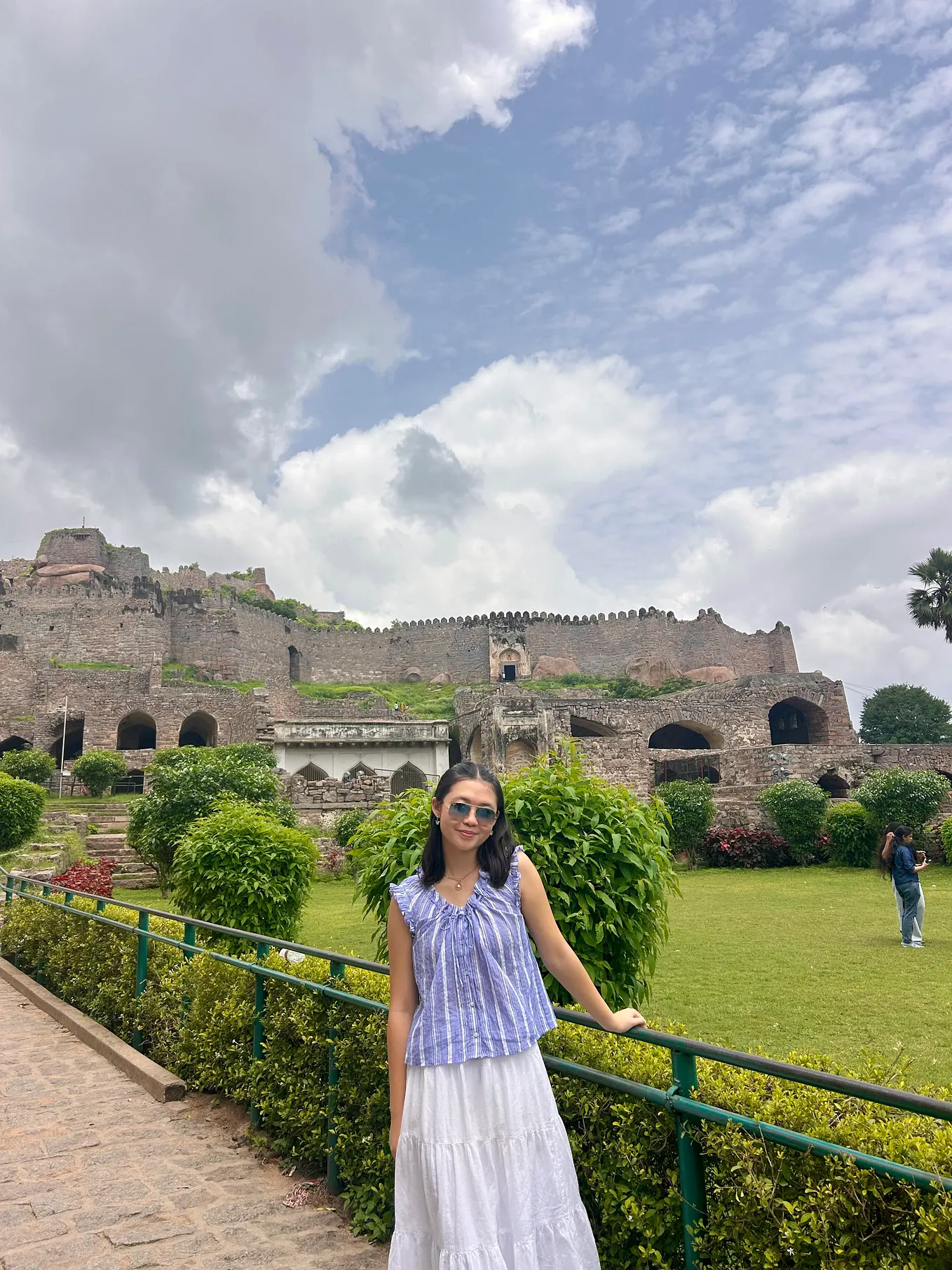
We stopped first at the Ancient Ganesha Idol near the main building complex. Discovered during road excavations in 1973, the five-ton stone statue predates the institute itself by nearly a thousand years. Standing before it, weathered but intact after a thousand years spent first underground and now above it, it has since become an important focal point of worship on campus. From there, we walked to Manmool Castle, a medieval structure tucked inside the complex that I would have otherwise assumed was simply another outbuilding.


Our guide pointed us to the legend inscribed directly on its walls where hidden somewhere beneath the castle lies buried treasure and gold coins, guarded still by djinns, or genies. The tour continued to the Qutb Shahi Mosque, preserved from the Qutb Shahi dynasty era and still actively maintained by ICRISAT’s own staff. We ended near a church, estimated to be over five hundred years old yet still active and hosting weekly sermons and services.
Get Anna Lu’s stories in your inbox
Join Medium for free to get updates from this writer.
At the last stop, we visited the ICRISAT seed and soil museum houses that exhibit soil types, geological formations, and the seeds of indigenous dryland crops. Often just called the seed museum, the RS Paroda Gene Bank functions in practice as something closer to a doomsday vault as its state-of-the-art genebank stores more than 130,000 seed accessions, millets, sorghum, chickpeas, and more, collected from 144 countries. We walked past rows of small labeled envelopes, each one holding a crop variety that might not exist anywhere else on the planet.

By Friday, the ISSCA-ITEC training course came to a close, and I found myself unexpectedly unprepared for how much I would feel it. Over two weeks, I had absorbed an enormous amount from the lecture halls and the site visits. But sitting through the closing session, I realized the material was almost secondary to who had delivered it and the camaraderie I had formed among mentors turned peers. I was in a room with people who had spent twenty or thirty some years restructuring supply chains across entire regions, who had built agri-tech companies from nothing, who had shaped the policy that decided whether a farmer down the road from them could access credit or not. Talking with them, even briefly, did more to sharpen what I want out of my own career than any single lecture could have.
It is one thing to read about the range of paths inside agriculture but it is truly another to sit across from a group of mentors that I look up to at once and realize how much room there still is to carve out something of my own.
When the closing remarks ended, the goodbyes came quickly and all at once. I exchanged numbers, promised to visit Dominica and Algeria in some undefined future, and watched the training hall so full and loud just an hour earlier empty out until it was just tables and chairs again. It was a strange kind of quiet that made me realize I was proud to have been in that room and also sad in a bittersweet way.


During the weekend, out of interest to try something new and after hearing recommendations from a friend, I discovered for the first time India’s equivalent of DoorDash called Swiggy. On the app (where everything is also about a tenth of the price as in the US), I ordered masala popcorn chicken and chili paneer to my flat with great enthusiasm. It was delicious and I highly recommend trying Levain Bakery in Hyderabad! I also spent an afternoon wandering parts of campus entirely on my own. It turns out there was quite a lot I could learn: the exact sound peacocks make right before sunset, the corner bench where the tea sellers set up each afternoon, and the patch of garden that catches the best light around five o’clock. Walking around the lushness of lawns, palm trees, and lakes, it felt like a quiet escape into nature.


That same weekend, I read through a newsletter written by another Borlaug-Ruan intern and as the foundation supervisor noted, something in it also caught my attention. He had written honestly about how even while surrounded by meaningful work and kind colleagues, there were inevitable periods of loneliness. I recognized it immediately because it is a strange specific kind of loneliness — one that rarely shows up during the busy stretches of fieldwork or lectures — but arrives instead in the quiet of the evenings back at the flat or on a Saturday with no set plans when you remember that your friends, family, and home are thousands of miles and several time zones away.
Even all of us interns are scattered right now across different institutions and countries, each of us building a version of this same experience largely alone. So this week, I set up a standing weekly meetup for the interns: just an open video call where there is no agenda required and we can check in, celebrate, or just chat freely in the same virtual room together.
While we are tackling unique challenges across different continents, this weekly touchpoint helps bridge the distance. It reminds us that while we may be conducting our research individually, none of us are truly navigating this global journey by ourselves.
Reflecting on this week, I keep returning to how much of life lives here just within this campus. Three weeks in, I am beginning to understand that this internship is so much more multifaceted than I anticipated and the incredible learning experience has been incomparable.