Week 5: Written Walls and Well-Worn Walks

Somewhere in my fifth week here at ICRISAT, I stopped walking through campus and started exploring and understanding it more. For the first month, the route from my flat to the office was just a route: a series of turns I made half-awake, past buildings I registered as the building where my desk is and the building with the good air conditioning. This week I started taking the long way, and the long way turned out to be full of things I had been walking past for over a month without seeing.
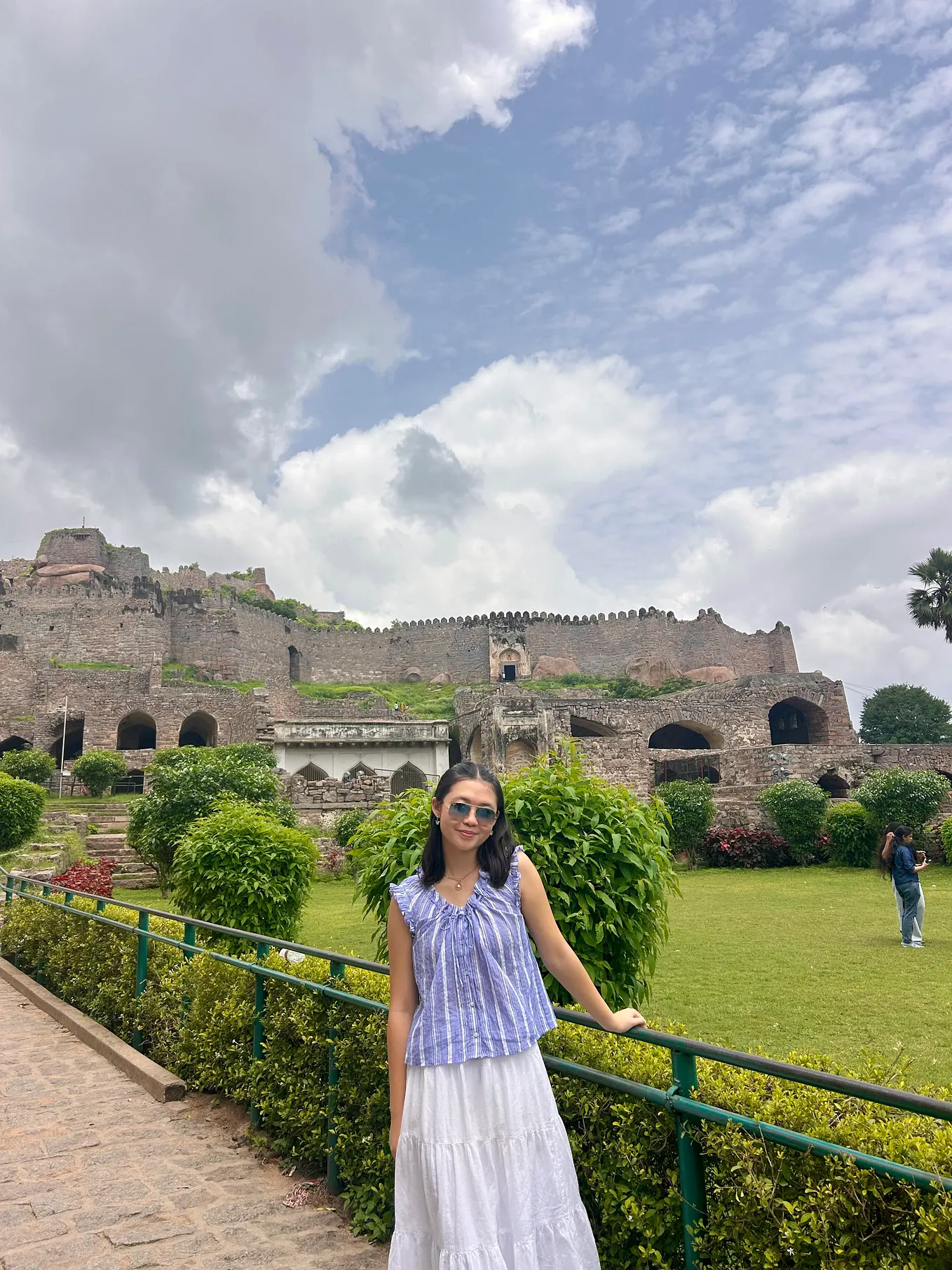
The campus is enormous, over three thousand acres of dryland research fields, greenhouses, laboratories, and long stretches of trees, and the architecture threaded through it is genuinely beautiful in a way I wasn’t expecting from a research institute. The buildings are low and built to breathe, with deep overhangs that throw shade across the walkways and open corridors that catch whatever breeze is moving.
Everything is oriented toward the light and the heat rather than against them. Five weeks in, I’ve started noticing how much cooler the covered walkways stay than the open ones, which I assume was the entire point. The buildings here were designed by people who expected to still be doing this work in fifty years.

A particular feature of the campus that actually stopped me this week were the quotes. They are set into walls and stones and plaques all around campus, and once I noticed the first one I started finding them everywhere, beside entrances, along paths, at the edges of the fields. Some are about global hunger; some are about science; some are about the specific, stubborn belief that the two are connected, and that the second one can do something about the first.
What I learned this week is that a lot of them aren’t decorative. They’re pulled directly from speeches given right here on this campus, by world leaders, Nobel laureates, and partners who came to see the work in person. They aren’t sentiments someone selected from a book. They’re a record. Someone stood on this ground, said those words to a room of people who worked here, and someone else decided that sentence was worth keeping in stone.
That reframed the campus for me. The institute has been running since 1972. The people who work here now are working on questions that were being asked out loud in these same buildings decades before any of us arrived, and the walls are essentially a transcript of that continuity.
The words on those walls are a reminder that the work here is a relay, not a sprint, and that everyone currently on campus plays a contributing part of it.


My research this week built directly on the foundation I laid in Week 4. I was given raw interview transcripts of two women entrepreneurs building millet-based food businesses here in Hyderabad, Telangana, and my job was to turn each one into two separate documents: a biographical entrepreneur profile written in the founder’s own first-person voice, and a detailed third-person policy analysis and research profile sitting alongside it.
The first case was Smt. K. Padmavati Annapurna of Sri Haritha Agro Food Products, who left a five-year career in IBM’s hardware marketing division in 2007 and started a food processing unit in 2009, back when almost nobody in the country was talking about millets. The second was Ms. Vijayanjali of Millet Chef, who resigned from an MNC after her son was born and rebuilt from two rooms into a line of nearly two hundred maida-free, sugar-free, rice-free products that now reaches as far as Dubai.

The transcripts themselves arrive completely unstructured, which is the part I underestimated. People do not narrate their own lives in chronological order. They loop back, they drop the most important detail as an aside in the middle of a sentence about something else, and they answer the question you asked four questions ago.
So before I wrote a single line of either document, I read each transcript through line by line and coded it into themes: origin and motivation, technical self-teaching, market channel decisions, financing, gendered constraints, institutional interactions, policy friction. Only once I had that map did I let myself start writing the profile, and I wrote it in first person deliberately, staying as close to their actual phrasing and rhythm as I could. That constraint matters more than it sounds. It is the difference between a story about a woman and a story told by her.

The policy analysis is a completely different document with a completely different job, which is why I keep them structurally separate rather than merging them. For each case, I worked through what is genuinely succeeding in the business and why, the root causes behind what is not working, and then recommendations broken out by audience: for the entrepreneur herself, for ICRISAT, and for policymakers.
Get Anna Lu’s stories in your inbox
Join Medium for free to get updates from this writer.
The two transcripts turned out to rhyme in ways I did not expect. Both women taught themselves food science with no formal training. Both hit the same wall on financing, where schemes advertised as collateral-free still required collateral in practice, or where banks simply did not want the paperwork of a government guarantee. Both described the same gendered friction, including clients asking to speak to a husband before signing anything. Two interviews is not a dataset, but seeing the same structural barrier surface independently in both is exactly the kind of pattern the rest of this project is built to test.
The pattern I am chasing is not whether these women succeeded — in becoming entrepreneurs they already have. It is what they had to route around to get there, and whether the same obstacle keeps showing up in case after case.

Outside of the research itself, this week was mostly about learning even more about the people, culture, and history and stories that shaped the country, which is becoming the through-line of my entire summer.
The evening walks have continued and become a daily ritual. Once the heat lets go around six or seven and the light goes gold across the fields, a rotating group of us will head out around the grounds, and we talk about nothing in particular: work, families, weather, what we’re planning after the summer. Those turn out to be the conversations where I’ve learned the most about the people I sit beside all day. Meals do the same thing. Lunch at the canteen, tea in the afternoon, dinners that start as should we get something and turn into two hours at a table.

Most of what I understand about how research actually gets done here, I learned through a conversation shared on a walk, during a meal, or over a cup of tea, instead of in a meeting.
There are several other interns on campus, and after work this week we ordered from Swiggy again, which is essentially India’s DoorDash and which I have now used enough times to know the best choices. This time a friend and I got momos, which are essentially dumplings that are steamed or fried, and the variety here is wonderfully staggering. We ordered paneer momos, vegetable momos with a Darjeeling chilli sauce I was not prepared for and immediately loved, with peri peri fries on the side.
Then, at the bottom of the menu, we found chocolate momos, which I did not know existed and which we ordered without hesitation. Safe to say that they were all excellent and it was super cool to try another culture’s dumplings besides my own.


The part of the week I keep coming and thinking back to actually had nothing to do with food or architecture. One of my coworkers recently had a baby, and this week she invited me to come visit her at the daycare on campus. I hadn’t known until speaking with her that ICRISAT has a daycare on-site, and learning that told me something about this place that no plaque could.
I realized that the researchers and staff here don’t just work on campus: they live here, their families live here, and their kids grow up in the same few square miles of fields and labs and tree-lined roads where their parents spend their days doing science.So I went and I got to hold her baby, and play with the other kids there, all of them children of the institute’s researchers and staff. It was one of the warmest afternoons I’ve had here.
I spent a while afterward thinking about what that daycare represents. Everyone here talks about ICRISAT’s work in generational terms: food security for the next fifty years, seed varieties bred for a climate that hasn’t fully arrived, resilience for farmers whose grandchildren will farm the same land. It’s easy to hear that as an abstraction.
But the generational language people use about this work isn’t rhetorical. It’s literal, and it’s on the same campus.

Five weeks in, I keep noticing that this internship keeps giving me the same lesson from two directions.
The research version is that context determines meaning. A single entrepreneur’s story means something different depending on what structural conditions you place around it, and my job on this project is to build that frame carefully enough that readers see the real shape of things rather than the shape I handed them.
The living version is the same idea, quieter. A wall is a wall until you know a Nobel laureate stood in front of it. A building is a building until you understand it was designed for the angle of this specific sun. A campus is a workplace until you meet the kids growing up on it.
None of the things I noticed this week were new. The quotes have been on those walls for decades. The daycare has always been there. What changed is that I slowed down enough to see any of it, and I only slowed down because the people here kept inviting me to.
The most useful thing I’ve gained this summer isn’t a research skill. It’s the habit of asking what I’m walking past. Five weeks down, I’ve stopped counting how long I’ve been here and started counting how much time is left.