Electricity Market Fundamentals

Welcome, energy enthusiasts! Whether you’re an industry professional or someone new to the field, you will explore the fascinating world of the electricity market. Discover how the interplay between supply and demand affects electricity prices in different markets and timeframes. This blog post serves as a comprehensive guide to understanding the intricacies of power markets. Let’s explore this essential part of today’s energy landscape!
Electricity Market Overview
In every market, the price is decided by how much people want something (demand) and how much of it is available (supply). The electricity market is unique because electricity must be produced at the same time it is consumed. So, in the electricity market, supply and demand happen together, and the key element that controls everything is the price.
When there’s a lot of electricity available but not many people using it (low demand), the price is low. On the flip side, when many people want electricity but there’s not much available (low supply), the prices go up. Things can change quickly in the electricity market. Then, people who sell and buy electricity need to keep a close eye on prices because they can change suddenly until the electricity is delivered [1].
Who are the participants across the electricity market?
The electricity market involves four key participants [2], each assuming distinct roles based on the specific type of electricity market under consideration:
- Generators employ a variety of fuel sources and technologies, ranging from renewable resources to fossil fuels, and from embedded generation to transmission, to produce electricity.
- Consumers aren’t limited to families turning on appliances in their homes. In the electricity market, consumers also include factories, hospitals, transport, and other services that use electricity.
- Suppliers meet generators and consumers in the middle. These companies buy electricity from generators, which they then sell to customers.
- Flexibility providers ensure energy system flexibility, which is the ability to adjust supply and demand to achieve energy balance.
What Makes the Electricity Market Unique
Electricity markets stand out for their distinctive qualities [3], such as:
- Supply is highly variable and difficult to predict. Electricity supply changes dramatically over time, a challenge exacerbated by the growth of variable renewable energy generation technologies such as wind and solar. Demand, while more predictable than supply, also varies depending on the weather.
- Storage is difficult and expensive in large volumes. Unlike other commodities, you can’t store electricity in a warehouse. While improving, the deployment of long-duration storage technologies isn’t matching the pace of renewable energy penetration in the energy mix. Therefore, electricity has a different value over time.
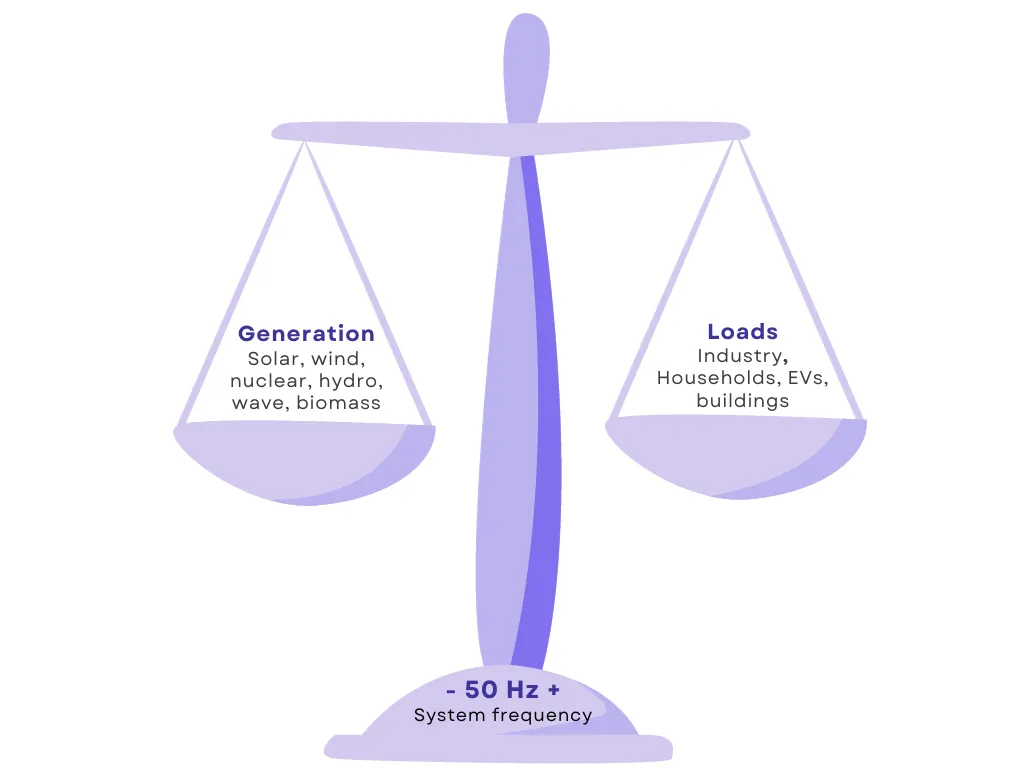
- Supply and demand must be instantaneously and continuously matched. The stability of the grid relies on consumption and production always staying in balance. Therefore, the ability to change the generation/consumption of electricity at short notice has value.
- Physical constraints must be obeyed. Energy is transported on a power grid, and that grid has physical limitations such as frequency and voltage stability requirements, as well as thermal limits which complicate the intersection between markets and grids. Therefore, electricity has a different value over space.
- There are a wide variety of market participants. Compared to other markets, electricity markets must accommodate the needs of more participants with more diverse capabilities and risk appetites.
Wholesale Electricity Prices
The wholesale electricity market is where electricity is bought and sold before being delivered to consumers [2]. Its two main participants are generators and suppliers. This market is a complex system with various submarkets, each providing distinct price signals that guide producers and suppliers in their planning.
Electricity trading can occur several years ahead in the futures market, where long-term or bilateral contracts help buyers mitigate the risk of price increases. As the supply date approaches, predictions about actual consumption and generation become more accurate, leading to two markets within the short-term spot market: the day-ahead and intraday markets.
On the day-ahead market, participants on the day-ahead market trade in electricity for the following day. Bids and offers specifying the amount and supply time must be submitted by midday. The exchange then determines the wholesale price for each hour of the next day and finalizes the selection of winning bids and offers [1]. The wholesale price determined in this way is an important reference value for the electricity market, influencing subsequent trading activities and providing valuable insights for market participants.

Single-Day-Ahead Coupling (SDAC) is the most liquid marketplace in Europe, allowing it to serve as a reference price for forward contracts, power purchase agreements, and support schemes [3].
The wholesale price of electricity depends on a range of factors, including the level of demand, carbon taxes, cost of fuel, and availability of resources like wind and sun [2]. This price therefore fluctuates throughout the day, which can affect which generators are most competitive in the wholesale market.
What is a power market auction?
A power market auction is a centralized operation that enables participants to trade anonymously and determines prices on supply and demand. The auction process is designed to respond to the demand at the lowest possible price [4].
Get Brandon Vargas’s stories in your inbox
Join Medium for free to get updates from this writer.
Day-ahead power market auctions take place at a specific time of the day, every day. The bids of buyers and sellers are placed in merit order (starting with the plants that can generate the most electricity for the lowest price). The intersection between demand and supply is found and equilibrium is reached, setting the clearing price.
When multiple buyers and sellers participate in a power market auction, that auction is usually “pay-as-clear.” Pay-as-clear simply means that the price is defined by the highest successful bid, called the clearing price, once it is determined [3]. This is as opposed to “pay-as-bid” auctions, where each successful bidder only gets the price stated in the bid. This arrangement is not common, notable cases include the UK and the Nord Pool’s intra-day market [4].
Power market auctions are operated by automated, computerized processes, enabling a large volume of market participants which often have complex requirements to rapidly reach an agreement on a clearing price.

The Relationship between Natural Gas and Electricity Prices
Electricity prices are determined by aligning supply and demand with the marginal costs associated with the most expensive operating power plant. Notably, solar and wind technologies contribute to lower marginal costs as they do not rely on fuel for electricity production and are exempt from carbon emission allowances.
In the European context, the production of electricity using coal and natural gas tends to be more costly. In consequence, when electricity demand peaks, natural gas-fired power plants typically influence and set prices on the spot markets due to their higher operational expenses.
Can electricity markets be decoupled from natural gas prices?
The only direct way to decouple the social costs of electricity production from natural gas is to stop using natural gas to produce electricity completely. In the short term, this is not an option since we need dispatchable energy sources to balance the grid and satisfy a fluctuating demand. The only option to separate natural gas prices from electricity prices is by modifying the current electricity market model. Normally, changing the market model takes years as the best alternative must be developed, legislation must be changed, and market players need time to adapt to the new situation.
While natural gas continues to play a substantial role in generating electricity in Europe, and if natural gas prices remain elevated, the overall costs of electricity production will likely stay at higher levels.
Spot vs Wholesale Electricity Market
Making the distinction between spot and wholesale electricity market prices is important because it allows market participants to understand the different timeframes and contractual arrangements involved.

While the electricity spot market is a subset of the wholesale electricity market, the wholesale market itself includes a wider array of transactions that may involve longer timeframes, future delivery, and additional market mechanisms beyond immediate spot transactions.
Retail Market Electricity Price
The retail electricity market is the segment of the electricity industry that involves the sale of electricity directly to end-use consumers, such as residential, commercial, and industrial customers. In this market, electricity retailers or providers interact directly with consumers, offering them various service plans, pricing options, and additional services.
Retail consumers do not pay wholesale prices for electricity. Electricity suppliers generally add a risk and profit margin to the wholesale price. In addition, consumers pay taxes and other charges. Although wholesale electricity prices vary from hour to hour or even from quarter to quarter, retail consumers typically pay a fixed amount per kWh for the duration of their contract or at least per month. Wholesale prices represent only a fraction of the total retail price [5].
Recap and Conclusions
In this blog post, you delved into the fundamental elements of the electricity market, shedding light on its mechanisms. You explored the key actors — generators, consumers, and suppliers — each playing a crucial role in the dynamic interaction of supply and demand. From the nuances of wholesale electricity prices to auctions, navigated through the different electricity markets.
One critical relationship underscored here is the link between natural gas (NG) and electricity prices, often intertwined due to their shared usage in power generation. While these prices can exhibit a close association, the possibility of decoupling them remains a point of exploration, holding potential implications for market stability and consumer costs. The electricity market in Europe may be reformed soon. Stay tuned for more insights on this topic and more to come.
Finally, to stay updated on future explorations of energy markets and insightful analyses, consider following me on Medium. Join me in the ongoing conversation about the evolving landscape of electricity markets and the broader energy sector. Together, let’s continue exploring the ever-evolving world of electricity markets! 👏🏻👏🏻👏🏻
References
- SMARD. “This is how the electricity market works.” SMARD Strommarktdaten, 4 Jan. 2024, https://www.smard.de/page/en/wiki-article/5884/5840
- ESO, “Electricity Markets Explained.” 4 Jan. 2024, https://www.nationalgrideso.com/what-we-do/electricity-markets/electricity-markets-explained
- Marcelo Torres. “Power Market Auctions: Explaining the EU Electricity Market.” N-side, 31 May. 2023, https://energy.n-side.com/blog/power-market-auctions-101-explaining-the-eu-electricity-market
- Fariba Mousavi, Morteza Nazari-Heris, Behnam Mohammadi-Ivatloo, Somayeh Asadi, Chapter 1 — Energy market fundamentals and overview, Editor(s): Behnam Mohammadi-Ivatloo, Amin Mohammadpour Shotorbani, Amjad Anvari-Moghaddam, Energy Storage in Energy Markets, Academic Press, 2021, Pages 1–21, ISBN 9780128200957, https://doi.org/10.1016/B978-0-12-820095-7.00005-4.
- Sanne de Boer and Cristian Stet. “The Basics of Electricity Price Formation.” Rabobank, 2 Sep. 2022, https://www.rabobank.com/knowledge/d011318792-the-basics-of-electricity-price-formation
- Phuc-Vinh Nguyen, “Overview of the European Electricity Market” Institute Jacques Delors, 30 Nov. 2022, https://institutdelors.eu/wp-content/uploads/2022/11/Infographie_Marche_electricite_A4_EN.pdf