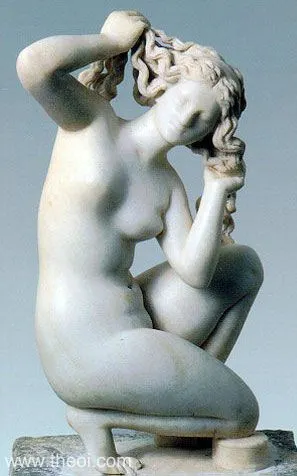
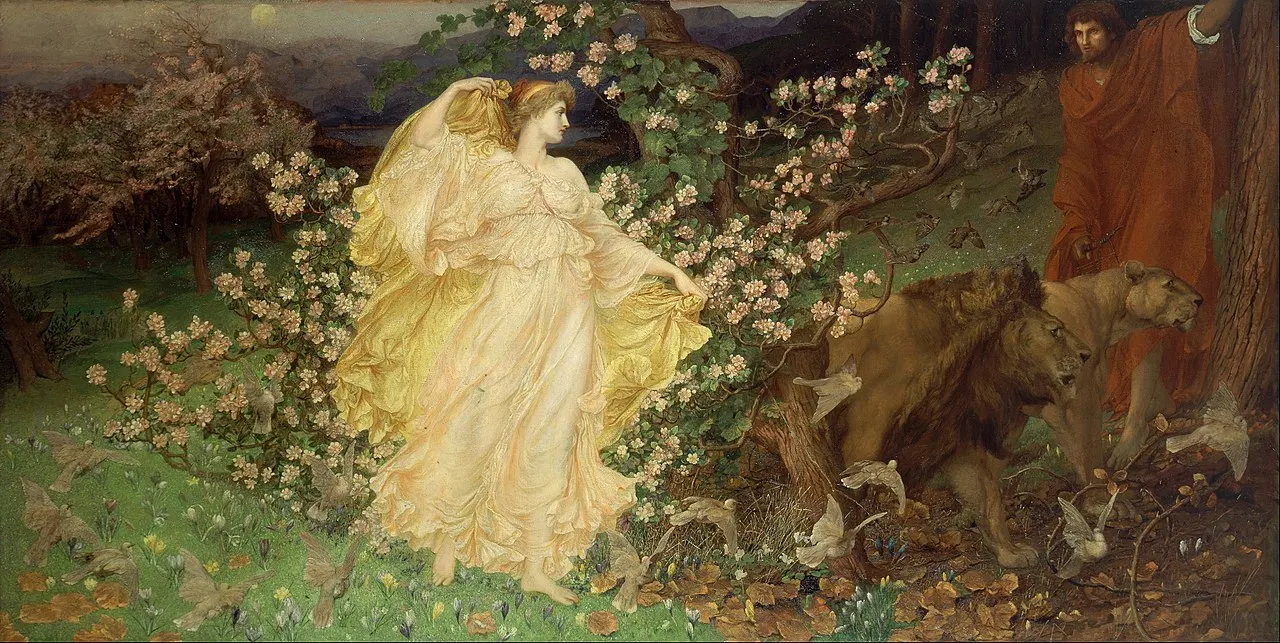
Aphrodite Myths Hesiod
The Birth of Aphrodite


In the beginning, when the world was still raw and restless, Ouranos, the Sky, came down each night to lie over Gaia, the Earth, driven by desire. But their son, Kronos, had been waiting in hiding, tense as a drawn bowstring.
When the moment came, Kronos reached out with his left hand and, with a jagged sickle in his right, struck. In a single swift motion, he cut off his father’s genitals and hurled them away behind him. They fell into the sea, vanishing beneath the waves.
But the sea did not simply swallow them. Around the immortal flesh, white foam began to gather and spread, drifting across the water for a long time. And from that foam, something extraordinary began to form.
A maiden.
She rose slowly from the sea, first carried toward the island of Cythera, and then onward to Cyprus. There, she emerged fully from the waves, both beautiful and awe-inspiring. Wherever her feet touched the ground, grass sprang up beneath them, as if the world itself welcomed her.
This was Aphrodite.
Gods and mortals gave her many names, each echoing her strange and powerful birth. She was called Aphrodite, the foam-born (Aphrogeneia), because she arose from the sea’s foam. She was Kythereia, for her passing by Cythera, and Kyprogenes, for her arrival in Cyprus. Some even called her Philommedes, linking her origin to the severed flesh from which she came.
She was not alone. At her side came Eros, Love itself, and with him Himeros, Desire. They followed her from the very moment of her birth, like shadows that would never leave.
Aphrodite & The Creation of Pandora
When Zeus decided to punish mankind, he did not send thunder or fire this time. Instead, he planned something far more subtle.
He ordered Hephaestus to quickly shape a being from earth and water. This figure would look like a beautiful young woman, with the face of an immortal goddess, but inside, she would carry something much more complicated. Hephaestus gave her a human voice and strength, forming her carefully like a living statue.
Then the other gods stepped forward, each adding their own gift.
Athena taught her how to weave and embroider intricate patterns, filling her hands with skill and grace.
Aphrodite crowned her with beauty and charm, but also placed within her a restless longing and a deep, aching desire that could trouble the body and mind.
And Hermes gave her a cunning spirit, along with a shameless and deceitful nature.
Each god contributed something, layering gifts upon gifts, until she was complete.
They named her Pandora, meaning “All-Gifted,” because every god of Olympus had given her something. But despite her beauty and talents, she was not meant as a blessing.
The Birth of Eros
When the severed flesh of Ouranos fell into the sea, it did not simply disappear. White foam gathered around it, spreading across the water, and from that foam a maiden began to form.
She was Aphrodite, rising radiant and newly born from the waves.
But she did not enter the world alone.
At the very moment of her birth, Eros came into being alongside her, and Himeros followed close behind. Whether they were born with her or from her is not entirely clear, but the meaning is unmistakable: love and desire arrived in the world together with Aphrodite.
Get GuidesToGods’s stories in your inbox
Join Medium for free to get updates from this writer.
Aphrodite Consort of Ares
In myth and art, Aphrodite is often shown beside Ares, an intense pairing of love and war. They appear together in many scenes, from divine feasts on Olympus to great mythic events like the Trojan War. Their relationship is usually portrayed as passionate, but also complicated, since Aphrodite was married to Hephaestus.
Despite this, she and Ares had several children together.
One of them was Harmonia, born from their union even while Aphrodite was still married to Hephaestus. Harmonia would later marry the hero Cadmus.
They also had other children who reflected their parents’ combined powers. Phobos (Fear) and Deimos (Terror) followed Ares into battle, spreading panic and chaos among soldiers. Some traditions also include Eros or Anteros among their children.
Aphrodite Loves: Phaethon
The dawn goddess Eos once united with Cephalus and gave birth to a son, Phaethon. He was strikingly beautiful, almost like one of the immortals themselves, but still very young, standing at the edge of adulthood with the innocence of a child.
While he was still in that early bloom of youth, before he had fully grown into himself, Aphrodite noticed him.
Drawn by his beauty, she swept down and carried him away. She brought him to one of her sacred temples and placed him there as her attendant, a kind of divine guardian who would serve her through the night.
Aphrodite Loves: Ankhises
On the wooded slopes of Mount Ida, a quiet meeting took place between divine beauty and mortal life.
Aphrodite, the “beautiful-crowned” goddess, came together in love with the mortal hero Anchises. Their union was not fleeting or meaningless, but part of the weaving of fate itself.
From this meeting, she bore a son: Aeneas.
He was born in the wild, forested heights of Mount Ida, a place often tied to hidden divine encounters.
Aphrodite Wrath: Tyndareus
Once, the king Tyndareus was offering sacrifices to the gods. But in the ritual, he made a serious mistake: he forgot to honor Aphrodite.
For a goddess whose power touches every heart, being ignored was no small thing.
Aphrodite grew angry, and instead of striking Tyndareus directly, she chose a more subtle and lasting punishment. She turned her power toward his daughters, shaping their fates through love, desire, and betrayal. Because of her anger, they would not remain faithful in marriage. They would marry more than once, abandon their husbands, and bring scandal upon themselves.
And so it happened.
Timandra left her husband Echemus and went to live with Phyleus.
Clytemnestra abandoned her husband Agamemnon and took Aegisthus as her lover instead, a choice seen as worse and more destructive.
And Helen of Troy betrayed Menelaus, leaving his marriage bed and bringing about the events that would lead to the Trojan War.
Aphrodite Favor: Hippomenes
A great crowd had gathered to watch a dangerous and dazzling contest.
At its center stood Atalanta, swift-footed and unmatched in beauty. She moved like wind over the earth, her shining garments stirred by the breeze, and all who saw her were struck with awe. None could easily look away.
Her father, Schoeneus, spoke to the gathered people and made the rules clear: many men desired to marry his daughter, but none would win her without a trial. The challenge was simple and deadly. Any man who wished to marry her must race her. If he won, he would gain her hand and great rewards. But if he lost, he would lose his life.
Against such odds, Hippomenes stepped forward.
Atalanta herself cared nothing for marriage or the gifts of Aphrodite. She rejected love and ran free of it. But Hippomenes knew he could not defeat her by speed alone. So he turned to cunning.
Before the race, he called upon Aphrodite, asking for her help. The goddess gave him three golden apples, shining with irresistible allure.
The race began.
Hippomenes ran hard, but Atalanta was faster, closing in on him with ease. Just as she was about to overtake him, he dropped the first golden apple. It flashed on the ground like a small piece of sunlight. Drawn by its beauty, Atalanta turned aside for a moment and picked it up.
That brief delay saved him.
He threw the second apple, and once again she could not resist. She paused, grabbed it, and lost more time.
Still, she was fast. Even with two delays, she was nearly at the finish.
At the last moment, Hippomenes cast the third apple. Atalanta turned again to seize it, and that final hesitation was enough. He crossed the finish line first, escaping death and winning the race.