Aphrodite Myths Homer
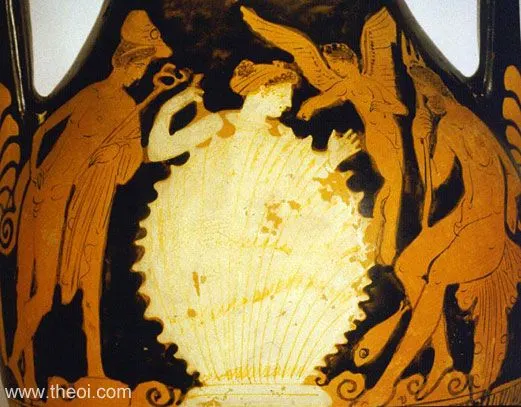
The Birth of Aphrodite (Myths showing Zeus & Dione as the parents)


During the Trojan War, even Aphrodite was not beyond harm.
When she entered the battlefield to protect her son, she was struck and wounded by the hero Diomedes. Hurt and shaken, she fled from the chaos of war back to Mount Olympus, seeking comfort.
There, she fell into the arms of her mother, Dione. Gently, Dione held her, soothing her like a child, and asked who had dared to injure her so. With calm hands, she wiped away the divine ichor from Aphrodite’s wound until the pain faded and her body was whole again.
It is a rare moment where the goddess of love appears vulnerable, not as a force of desire, but as a daughter seeking care.
Another story shows a different kind of wound, one not of the body, but of trust.
Aphrodite was married to Hephaestus, but she took Ares as her lover. When Hephaestus discovered their affair, his anger was sharp and calculated. He forged an invisible net of unbreakable chains and trapped them together, exposing their betrayal.
Humiliated and furious, he declared that he would return Aphrodite to her father, Zeus, and demand back the gifts he had given for her hand in marriage.
Aphrodite & the Creation of Pandora
In the halls of Zeus stand two great jars at his threshold, quiet and unmoving, yet full of everything that shapes human life.
One holds blessings, the good things that make life bright. The other holds evils, all the hardships and sorrows that weigh people down.
When Zeus gives to a person, he often mixes from both. A life may carry joy and pain side by side, fortune rising and falling like shifting weather. But sometimes, he gives only from the jar of suffering. Then a person’s life becomes heavy with hardship, driven by need and misfortune, wandering the world without honor, unnoticed by gods and mortals alike.
Later storytellers connected one of these jars to Pandora. Some said she was given the jar of evils, releasing suffering into the world. Others claimed it was the jar of blessings. (by this we know Homer acknowledged the myth of Pandora being gifted by Gods, and as such Aphrodite had direct involvement in it)
Aphrodite & the Seduction of Helen
When Paris speaks to Helen, he admits that his passion for her has never been stronger, saying that even when he first carried her away from Sparta and lay with her in love, it did not compare to the desire he feels now. This shows how Aphrodite’s influence can intensify emotions beyond reason.
Helen herself is aware of this power and even resists it. At one point, she rebukes Aphrodite, questioning why the goddess continues to deceive and manipulate her. She wonders if Aphrodite plans to send her to yet another man in some distant land, showing her frustration at being controlled by divine forces.
Others also criticize Aphrodite for this. The hero Diomedes accuses her of leading women astray, blaming her for causing situations like Helen’s elopement with Paris. Similarly, Athena mocks Aphrodite, suggesting that she is once again persuading a Greek woman to abandon her home and follow the Trojans she favors.
In the end, Helen herself reflects on what happened and expresses regret. She says that her desire to return home came too late and that she now mourns the “madness” Aphrodite placed upon her. Because of the goddess’s influence, she left behind her homeland, her child, her marriage, and a husband who lacked nothing in character or appearance.
Aphrodite & the Marriage of Hektor
When Andromache hears of Hector’s fate in the Iliad, she collapses in grief, and the ornaments of her headdress fall with her, the diadem, the woven bands, the delicate circlet. These were no ordinary adornments, but gifts once given to her by Aphrodite herself on the day of her marriage, when Hector led her from her father’s house and offered rich bridal gifts.
Get GuidesToGods’s stories in your inbox
Join Medium for free to get updates from this writer.
Aphrodite & the Trojan War
While gods like Athena and Ares clash head-on, she lingers at the edges, pulling strings of desire and protection.
The tension between her nature and the battlefield is obvious. Athena openly criticizes Ares for his brutality and broken promises, while Hera complains to Zeus that Ares causes destruction unchecked, all while Aphrodite and Apollo seem almost carefree, letting chaos unfold. Even among the gods, Aphrodite is seen as someone who stirs hearts, not one who should be caught in the machinery of war.
This contrast shows most clearly in the story of Paris and Helen. Paris, protected again and again by Aphrodite, is mocked for relying on beauty and love instead of strength. Hector shames him, saying that neither his charm nor Aphrodite’s gifts will save him in real combat. And yet, when Paris faces Menelaus in a duel and is on the verge of defeat, it is Aphrodite who intervenes. At the last moment, she snaps the strap of his helmet, whisks him away in a mist, and carries him safely back to his chamber.
Then she goes to Helen, disguising herself to summon her back to Paris. But Helen sees through her immediately. She doesn’t respond with obedience, but with bitterness. She accuses Aphrodite of manipulating her life, dragging her from place to place for the sake of desire. For a moment, it feels like a mortal pushing back against a god. Aphrodite’s response is sharp and dangerous. She reminds Helen that defiance has consequences, and fear wins. Helen follows.
Back in the chamber, Paris speaks not of honor or battle, but of desire. He brushes off his defeat and pulls Helen back into love, his passion clearly stirred by Aphrodite’s influence. Meanwhile, Menelaus is left searching the battlefield like a hunter who has lost his prey, unaware that divine hands have already rewritten the outcome.
Aphrodite’s role in war becomes even clearer in the story of her son, Aeneas. When he is struck down and nearly killed, she rushes into the battlefield to save him, wrapping him in her arms. But here, her limits are exposed. Diomedes, empowered by Athena, attacks her without hesitation and wounds her. The scene is almost jarring: the goddess of love bleeding, shocked, retreating from a place she was never meant to stand in. Even Zeus later tells her plainly that war is not her domain, that she should concern herself with love and marriage instead.
Still, she does not abandon those she cares for. When Hector’s body is dragged behind Achilles’ chariot, it is Aphrodite who quietly protects it, anointing it with divine oil and keeping the dogs away. Even in death and destruction, she preserves what dignity she can.
Aphrodite Loves: Ares & Hephaistos
A bard sings of the secret affair between Aphrodite and Ares, a pairing as inevitable as fire meeting dry wood. She is married to Hephaistos, the master craftsman, but her heart strays toward the god of war. Ares courts her lavishly, showering her with gifts, and eventually the two begin meeting in secret, slipping into Hephaistos’ own bed as though the world itself were blind.
But the world is not blind. The sun sees everything.
Helios, ever-watchful, catches them in the act and carries the news straight to Hephaistos. Back in his forge, he creates something brilliant and terrible: a web of chains so fine they are nearly invisible, yet utterly unbreakable. He lays them carefully over his marriage bed, disguising the snare, then pretends to leave for Lemnos. Ares, thinking the path is clear, returns almost immediately. He finds Aphrodite at home, freshly returned from Zeus’ palace. There’s no hesitation. He takes her hand, invites her to bed, and she agrees. The moment they lie together, the chains snap tight.
Suddenly, the lovers cannot move. Arms, legs, everything pinned in place. Hephaistos calls the gods to witness the scene. One by one, they gather. Zeus, Poseidon, Hermes, Apollo. The goddesses stay away out of shame, but the male gods laugh. The laughter ripples through Olympus like thunder rolling over hills.
They mock the situation with a kind of amused wisdom: the slow, limping smith has outwitted the swift and powerful Ares. Only Poseidon takes the situation seriously. He steps forward like a mediator, urging Hephaistos to release Ares and promising that the war god will pay whatever penalty is demanded. Hephaistos hesitates, distrustful, but eventually agrees when Poseidon personally guarantees the debt.
The chains fall away. Ares flees to Thrace without looking back. Aphrodite, radiant even in disgrace, retreats to Paphos, her sacred home, where she can wash away the humiliation in ritual and perfume. Hephaistos calls her “beautiful but shameless,” and there’s a hint that this scandal fractures their marriage beyond repair. Later traditions show him with another wife, while Aphrodite continues her bond with Ares openly.
Aphrodite Loves: Poseidon
In the Odyssey, Ares and Aphrodite are caught in the trap set by Hephaistos after their secret affair is exposed by Helios. They are bound in invisible chains and unable to move, lying together in the bed of Hephaistos while the other gods are summoned to witness them.
Hephaistos calls the gods to see the scene and demands compensation for the dishonour, refusing to release Ares until his bride-gifts are returned by Zeus. The gods arrive and witness the trapped lovers.
Among them, Poseidon does not laugh like the others. Instead, he pleads with Hephaistos to release Ares, promising that he will personally guarantee payment of whatever penalty is required and ensure that Ares fulfils it in full before the assembled gods.
After further negotiation, Hephaistos agrees and releases the chains. Ares departs immediately to Thrace, and Aphrodite goes to Cyprus, specifically Paphos.
In some later scholia on the passage, it is said that Aphrodite showed gratitude to Poseidon for securing her release, and that this gratitude led to a later affair between Aphrodite and Poseidon.
Aphrodite Loves: Ankhises
Aineias is consistently presented in Homeric tradition as the son of the mortal Ankhises and the goddess Aphrodite.
He is described as the leader of the Dardanians in the Trojan War, born from the union of Aphrodite with Ankhises on Mount Ida, where the goddess lay with a mortal man. This divine parentage is repeatedly acknowledged throughout the Iliad.
Aineias himself refers to his lineage when speaking in battle, stating that he is the son of Ankhises while his mother is Aphrodite. Other characters and even gods recognize this identity. Apollo, in disguise, reminds him that he is considered to be born from Aphrodite, daughter of Zeus.
In dialogue with Achilles, Aineias explicitly compares their lineages: Achilles is said to be the son of Peleus and the sea-goddess Thetis, while Aineias is the son of Ankhises and Aphrodite. Both heroes are thus framed as semi-divine figures, each linked to a goddess mother and a mortal father.
Aphrodite Wrath: Diomedes & Akmon
After being wounded by Diomedes during the fighting at Troy, Aphrodite withdraws from the battlefield and returns to Olympus. There she falls into the arms of her mother Dione, who comforts her and asks which god has harmed her.
Dione explains that Athena has urged Diomedes to attack Aphrodite, and then speaks to her daughter about the fate of mortals who challenge the gods. She contrasts the brief, vulnerable lives of heroes with the enduring nature of the immortals, noting that even the strongest warriors will one day be replaced by suffering left behind in their families.
She then advises Aphrodite not to seek direct revenge against Diomedes himself, but instead suggests a different form of retaliation: that his wife Aigialeia, daughter of Adrastos, may be made to cause him grief, bringing sorrow into his household in his absence.
Aphrodite Favor: Daughters of Pandareus
The daughters of Pandareus are left orphaned after their parents are killed by the gods. Aphrodite takes care of them and raises them, feeding them with cheese, honey, and wine. Hera grants them exceptional beauty and intelligence, Artemis makes them tall and strong, and Athena teaches them skill in crafts and fine work.
When they reach maturity, Aphrodite goes to Olympus to ask Zeus to grant them marriage, since he knows the fates of mortals. While she is away petitioning Zeus, the Harpies seize the girls and carry them off. They are handed over to the Erinyes, who enforce punishment and suffering, and the girls do not receive the happy marriages that were being sought for them.