Top Competitive Intelligence Services for Enterprise Teams in 2026


The most expensive mistake we watch enterprise teams make with competitive intelligence has nothing to do with which vendor they choose. It happens one step earlier, at the moment they treat competitive intelligence as a single thing to shop for. It isn’t. The phrase covers at least four different kinds of company, each built to answer a different question, and a shortlist that lines them up against each other ends up comparing products that were never alike. You can do everything right after that point, run a clean RFP, negotiate hard, check references, and still buy the wrong category for the decision you were trying to support.
We are Ficstar, and we have collected competitive data for enterprise teams since 2005. In that time we have completed more than 1,000 projects for over 200 enterprise customers, and today we process more than a billion product prices every month. Competitor price and product monitoring is the large majority of what we do, which means we spend most of our time with pricing, e-commerce, and merchandising leaders. It also means we sit at the bottom of the stack this article is about, underneath the analysts and the software, so we tend to see where the category confusion actually costs people. This guide is our attempt to draw the map we wish more buyers had before they started their search.
Why “top CI services” lists mislead
Search for the top competitive intelligence services and you get two different worlds jumbled into one ranking. Research and analyst firms like Gartner and Forrester sit next to competitive intelligence software like Klue and Crayon, as if a company chooses one or the other. Underneath both sits a third thing many teams actually run on every day: the raw competitor pricing and product data that pricing and merchandising groups feed into their decisions. Three different purchases, one list, ranked as though a buyer picks a single winner.
The confusion is not the fault of the people making the lists. Even Gartner defines competitive and market intelligence broadly, spanning corporate, product, go-to-market, and sales decisions drawn from many internal and external sources. That breadth is exactly the problem. Two services can both wear the “competitive intelligence” label and sell completely different things. The only way to make the choices clear is to stop ranking and start sorting, by the decision each service is built to support.
The four layers, and the question each one answers

Once you sort by decision rather than by label, four distinct layers appear. They are complements far more often than substitutes, which is the single most useful thing to understand about them. A strategy team can subscribe to an analyst firm, a product marketing team can run CI software, and a pricing team can feed live competitor data into its models, all inside the same company, because each layer makes a different thing reliable.
Analyst and market research firms answer the strategic question: what is happening in this market, and what does it mean for where we place our bets. Gartner, Forrester, IDC, Euromonitor, and GlobalData are the recognizable names, and they sell curated research, forecasts, market sizing, and expert interpretation. This is the layer for executives, strategy leads, and product leadership. Its honest limit for a pricing team is cadence and coverage. A five-year market forecast is genuinely valuable, and it will never tell you what a competitor is charging for a specific product this afternoon. (A quick aside worth flagging: AlphaSense and CB Insights get filed here constantly, and neither is a classic analyst firm. Judge them by what they do, not the shelf they land on.)
Competitive intelligence and sales enablement software answers a different question: how do we respond to competitor moves and equip our go-to-market teams. Klue, Crayon, and Contify are active examples, and all three appear in Gartner’s 2026 covered-vendor set for competitive and market intelligence platforms. This layer turns scattered competitor signals into workflows, alerts, competitor profiles, battlecards, and win-loss analysis that reaches sales and product marketing. It solves a real organizational problem. What it is usually not architected to do is deliver a complete, normalized feed of every competitor price and product record a pricing function needs. Some of these products touch pricing signals, so the honest question is not whether they see any price data, but whether industrial-scale, matched product and price data is the job they were built for. Usually it is not, because that is a different job.
Digital and web intelligence tools answer the online-footprint question: how are competitors performing and winning attention on the web. Similarweb is the clearest example, benchmarking traffic, keywords, referrals, advertising, and audience behavior. This category grew a new dimension in 2026, because AI search became its own competitive surface. Similarweb now tracks generative AI chatbot traffic and AI brand visibility alongside conventional web metrics, and the reason is visible in the data. Pew Research Center found that Google users who saw an AI summary clicked a traditional result on 8% of visits, compared with 15% when no summary appeared. How people reach competitor sites is shifting, so where a competitor shows up in AI answers now belongs in its digital profile. The limit here is the same shape as the others: knowing how much traffic a competitor pulls is not the same as knowing what it is charging for a given product right now.
Price and product intelligence is the fourth layer, and it is the one we live in. It answers the most concrete question a pricing or merchandising team asks: what are competitors selling, for how much, where, and right now. This is direct observation of competitor offers, current advertised prices, promotions, stock and availability, and product attributes, matched to your own catalog and normalized into a consistent structure. It is worth separating three terms that get used interchangeably. Price monitoring is the observation of competitor prices and offer conditions across sources over time. Price intelligence is the next step, where those matched, timely observations become comparisons and inputs for a pricing decision. Competitive intelligence is the broad umbrella that contains all of the above.
Buy a packaged tool, or have the data collected for you
Inside that fourth layer, an enterprise buyer really faces one fork in the road. You can license a packaged dataset or operate a self-service tool and own the collection work yourself, or you can have the exact data you need collected and delivered for you. That second path is what defines Ficstar.
We are a fully managed service, not a tool you log into. Our team designs the crawlers, handles product matching, runs quality assurance, and delivers the data in the format and on the schedule your team works in. You receive finished data rather than another system to operate. That model exists for the teams whose requirements fall outside what any packaged product covers: specific sources, particular fields, unusual update frequencies, or a competitive universe no off-the-shelf dataset was built around. When a packaged product already covers what you need and your team can own the upkeep, we will tell you so. This is a premium, fully managed approach, and it is aimed squarely at the situations where owning the collection operation yourself would cost you more attention than the data is worth.
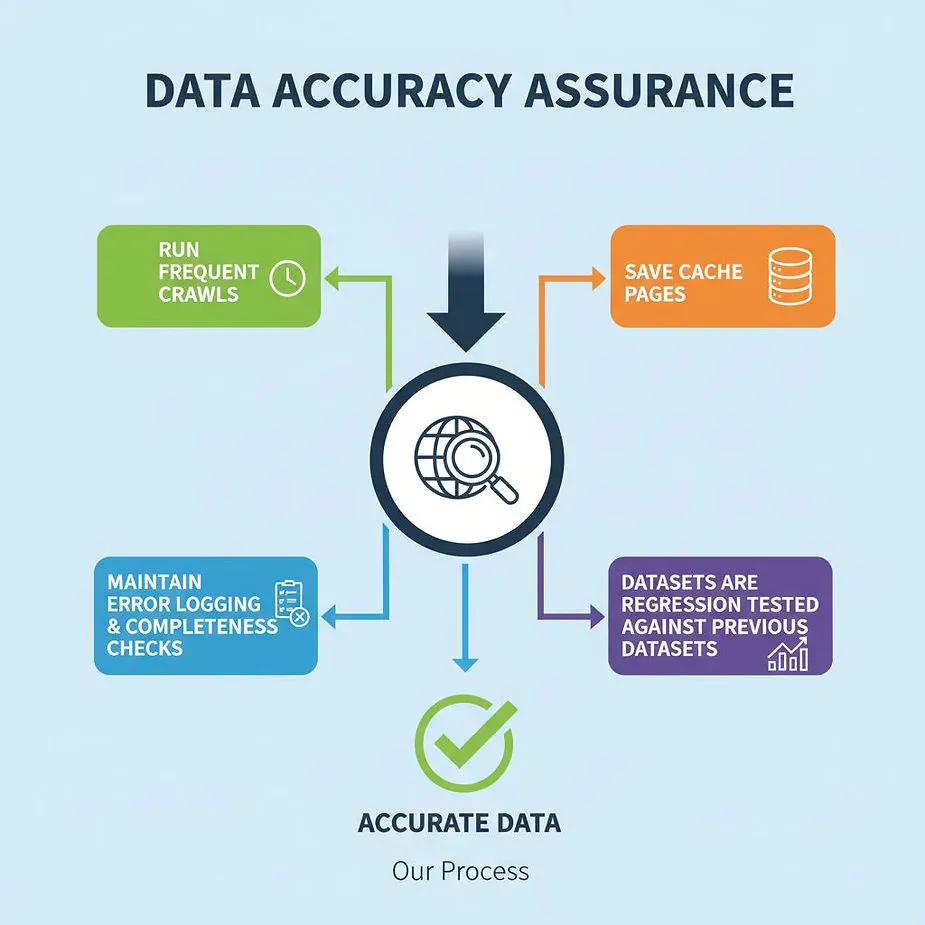
The reliability of that data is the entire point, so we treat data quality as our responsibility, not yours. Every pricing dataset runs through more than 50 quality assurance checks, and we rerun collection before delivery when something looks off. That is what we mean when we say we own accuracy: not a promise of magical perfection, but a commitment to stand behind the numbers we hand you. We aggregate from many sources into one feed, pulling competitor sites along with marketplaces like Amazon, eBay, and Walmart.com, we flag minimum advertised price violations, and we keep historical trends so your team can see how competitor prices move. You can see how that works on our competitor price monitoring page.
Here is something this audience will recognize immediately: most competitive intelligence clients cannot be named publicly, and that is normal for this kind of work. We keep strict confidentiality and information barriers in place, which is how we can work with competing companies in the same industry without anything crossing between them. For an enterprise buyer, that discretion is not a footnote. It is part of what you are evaluating. When a proof point calls for a name, we can point to cleared clients like Advance Auto Parts, Texas Instruments, Digi-Key, and Barnes & Noble, but the quieter relationships are the norm, not the exception.
Get Ficstar’s stories in your inbox
Join Medium for free to get updates from this writer.
Jorge Diaz, Pricing Manager at Advance Auto Parts, described the problem this layer solves better than we can: “We have nationwide and local competitors with different pricing strategies. We used to struggle shopping for competitor prices as we need their data to keep our pricing competitive. Ficstar has offered us a great solution for our competitor price data needs. Now we can catch up all the price changes from our competitors no matter how they make the changes. Ficstar’s data service is super reliable. We’re absolutely happy with them.”
Why the data layer is genuinely hard at enterprise scale
It is worth being honest about why a managed service even exists for this layer, because the difficulty is easy to underestimate until you are living inside it. Reliable price and product collection is not a build-it-once task. It is an ongoing engineering problem that never fully sits still.
Start with the pages themselves. A 2026 systematic review of web extraction research found that traditional approaches relying on fixed page structures are fragile, because a layout change breaks a selector-based scraper. AI-assisted extraction adapts more gracefully, which is real progress, and it does not remove the need for current source observations and error checking underneath it. Then add the fact that many sites actively defend against automated access. Rate limits, IP-based controls, CAPTCHAs, and login-required pages all turn collection into continuous maintenance rather than a one-time setup. We absorb that work with advanced block-bypass technology and proactive monitoring that updates our crawlers when a site changes, so your coverage does not go dark the week a competitor redesigns their site.
Matching is the problem people forget, and it is often the harder one. A competitor’s price is useless until you know which of your products it maps to. When a shared identifier like a GTIN exists, matching can be clean. When it does not, and competitors list the same item under different names, matching becomes an entity-resolution problem that needs far more than title text to solve well. We run automated product matching across thousands of SKUs and add manual review where an ambiguous match calls for it, so the comparison you get is genuinely apples to apples rather than apples to something that merely sounds similar.
Minimum advertised price monitoring is the clearest illustration of why this granularity matters. Enforcing a MAP policy requires an advertised-price observation tied to a specific seller, product, and moment. An industry average or a general read on a competitor’s strategy cannot do it. You need to know exactly who advertised what, where, and when, and that is only possible with source-level data collected and timestamped at the offer.
Which type fits your team
The fastest way to narrow the field is to start from your primary need and work back to the layer, then to specific providers. Most enterprise teams end up using more than one, so read this as a map of which decision each layer owns, not a hunt for a single overall winner.
- If your need is the strategic market picture, forecasts, and industry narrative, look at analyst and market research firms: Gartner, Forrester, IDC, Euromonitor, GlobalData.
- If your need is competitor tracking, battlecards, and sales enablement, look at competitive intelligence software: Klue, Crayon, Contify.
- If your need is competitors’ online traffic, search, and AI visibility, look at digital and web intelligence tools like Similarweb.
- If your need is live competitor prices, promotions, and product data across many sources and SKUs, that is the price and product intelligence layer, and it is what we are built for: Ficstar
If that last line is your hardest problem, we are the answer. If your hardest problem is strategic narrative or seller enablement, one of the other layers will serve you better, and you can always add a data layer underneath later.
How to evaluate a provider once you know the layer
Picking the layer is the hard part. Evaluating within it is more familiar work, as long as you keep four dimensions separate so a slick interface cannot cover for weak data and a low license price cannot hide high operating overhead.
The first dimension is data capability: the exact sources, fields, geographic variants, refresh interval, accuracy, matching, and history you require. The second is the operating model: what the vendor manages versus what your team must configure, monitor, repair, and quality-check. The third is integration: how the data is delivered and whether it drops cleanly into your pricing, merchandising, or BI workflows. The fourth is the commercial model: onboarding, recurring fees, source and SKU counts, matching work, new-source additions, and what happens to your data if you leave. A useful RFP move is to ask every vendor to price the same set of sources, SKUs, fields, countries, and refresh requirements, and to state plainly which ongoing work stays with your team.
Confidentiality deserves its own gate. Your source lists, target products, and collection specifications reveal your competitive priorities even when the underlying data is public. Ask about access controls, encryption, client segregation, retention, and confidentiality terms. For our part, we work only with publicly available data and adhere to GDPR and CCPA.
One evaluation habit is worth dropping entirely: treating “real time” as a universal requirement. Freshness should be judged against the decision it feeds. A five-year forecast does not improve by refreshing hourly, while a competitor price in a fast-moving category can go stale in a day. The right question is not “is it real time,” it is “how quickly after a source changes does the data become available, and does that speed match how often we actually act on it.”
The market is growing, and the numbers are messier than they look
Demand is clearly rising. Fortune Business Insights estimates the competitive intelligence tools market at roughly $0.87 billion in 2026, growing to about $4.03 billion by 2034, an annual rate above 21%. Treat a figure like that as directional rather than a precise census, because a report counting narrow CI software lands somewhere very different from one counting broad market-intelligence functionality. The signal that matters is the direction, and the direction is not subtle: enterprise investment in competitive data and intelligence is climbing, not leveling off.
That growth is exactly why the category confusion this article started with is getting more expensive, not less. More money is flowing into more kinds of “competitive intelligence” every year, and the four layers are drifting further apart in what they actually deliver. The teams that will spend well are the ones that stop shopping for a category and start shopping for a decision.
If the decision you are trying to support is a pricing or merchandising one, and your hardest problem is getting accurate, matched competitor price and product data across many sources and SKUs, that is precisely what we do. We collect the exact data you need, handle the matching and the quality checks, and deliver it in your format and on your schedule, so your team spends its time on pricing decisions instead of maintaining crawlers. Start your free trial and tell us which competitors and products you need to track.