Avoidable Bombs

Live from Ukraine
Khotin’ – We returned to the inaccessible border areas between Ukraine and the Russian Federation that the criminals under Putin’s orders would have reduced to a gray zone if the ЗСУ had not penetrated Kursk.
At 11:36, we entered the office of the mayor of Khotin, who just six months ago escorted us while we recorded previous reports from these tormented areas, which are still visible on La Ragione’s YouTube channel and website. From midnight to that time, as many as 21 Russian Kabs had tormented this portion of the Sumy oblast. This is the new face of war, and we must document how all this is avoidable now. There is no better proof than taking a tour around these parts to understand the usefulness of the Ukrainian incursion into Russia. All the areas we wrote about just six months ago – then targeted daily by enemy artillery – are today pierced by gliding bombs that can be fully neutralized if the West were to lift the senseless restrictions by which Ukraine is forced to defend itself with one hand tied behind its back and not being able to hit the enemy within the territory from which it fires.
To be clear, when an area is within artillery range, it is already done for: its fate is the same as Bakhmut, Chasiv Yar, Avdiivka, and all the other cities that the Russians have reduced to a shapeless pile of rubble. Blow after blow, the 120 mm Soviet-style shells cause every building to collapse, making ‘gray’ (this is the term used to identify them in military jargon) all those areas that until a few days before had hosted life. When an area is instead within range of gliding bombs, its fate is far from sealed because if the air defenses were put in a position to operate as they should, the planes from which they glide would end up being shot down.
In just under an hour, we saw this new reality firsthand: thanks to the Ukrainian offensive on Russian territory, Khotin has maintained a semblance of normality that otherwise would have been destined to vanish forever under Russian fire. That inevitable hail of bullets to which it was previously subjected has now been replaced, however, by a slow – but very avoidable – drip of guided aerial bombs.
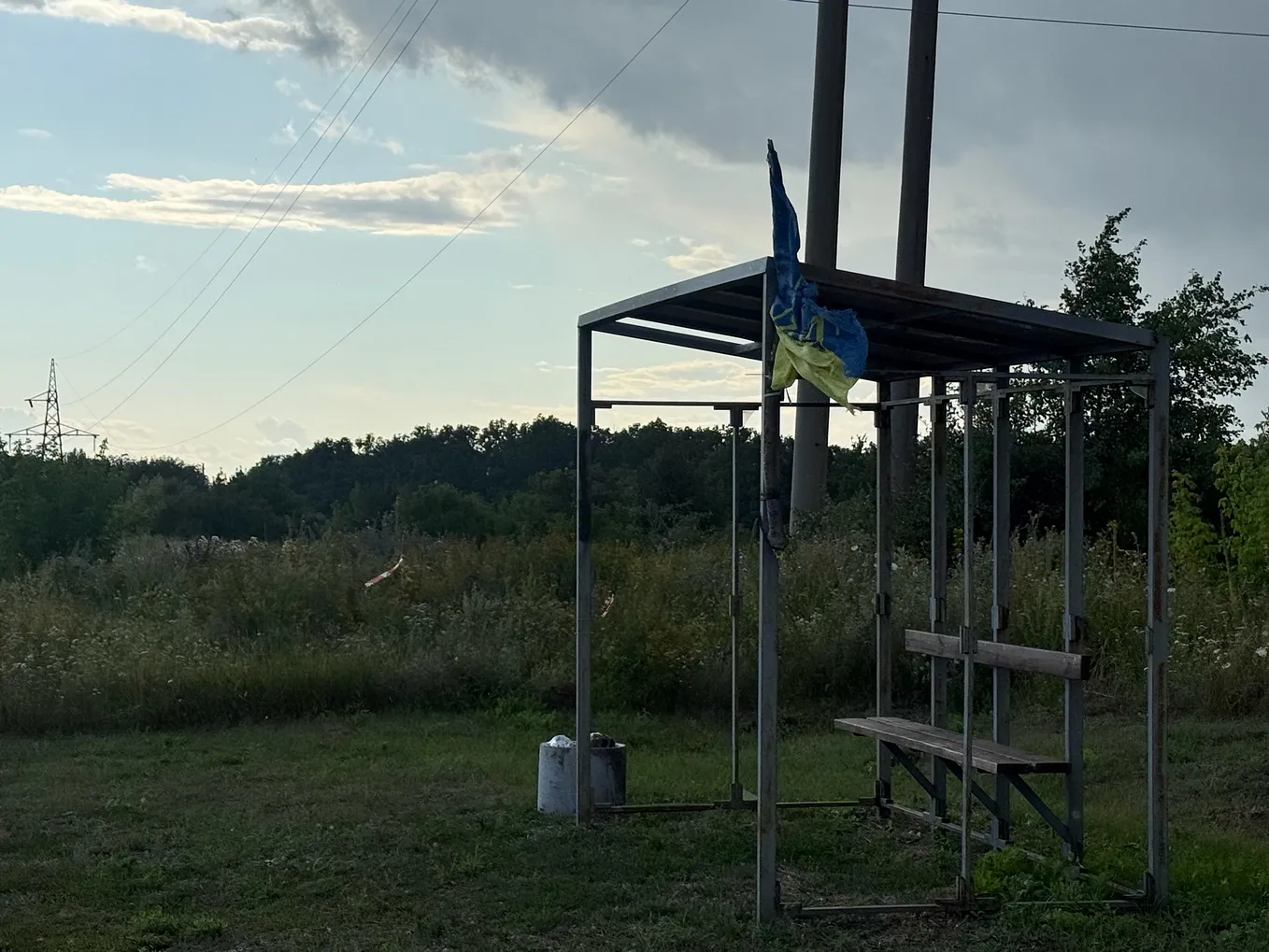
To give our readers a clear image of the current state of these places, we have chosen to film the same infrastructures from which we recorded a few months ago. The contrast is evident. We filmed a granary that fell under the blows of three Kabs, an elementary school that partially collapsed following an equal number of glide bombs and the wheat fields – now intact – that were once dotted with craters as black as coal.

We ate the same borscht that we consumed just eight hundred meters from the Russians a few months ago, knowing that today they are over forty kilometers away from here. We spoke with the same people who, until June, had no alternative but to abandon their homes, seeing them today more determined than ever to resist and defend their land. The common thought of all these people is that if it is true that today, that hail of bullets to which they were subjected has disappeared, their safety no longer depends on the skill of the Ukrainian Armed Forces but on the conscience of Kyiv’s Western partners.
«Now the Russians are distant. Khotynska, Yunakivka, Kindrativka, and all the other villages around here are outside the range of Russian artillery but continue to be hit by slow-gliding bombs that can be completely neutralized. This makes daily life in these places even more frustrating, but it also gives an idea of the new reality of this war. The responsibility of those who shoot must be taken into account as much as the cowardice of those who do not allow us to defend».
Underlining the goodness of the choice made by the Zelensky government, the inhabitants of these places invite us to make Western leaders understand with our work that their lives are also in their hands.
Get Giorgio Provinciali’s stories in your inbox
Join Medium for free to get updates from this writer.
Mykola lives on the ground floor of a three-floored house because he knows that if one of those GPS-guided bombs were to break through his roof, it would be held back by at least three walls before reaching him. Larissa takes care of her garden and can now run to take cover when she hears the air alert, whereas before, she could not predict the threat of enemy artillery in any way.
Without the Ukrainian advance into Russian soil, all the areas from which we write today would be ghastly lands, ashes. Speaking with the mayor of Khotin, we learned that the same high-tech Chinese drones that reduced Kherson to a wasteland had begun chasing people here, too, even while driving their cars.
«All of that has disappeared. It was like experiencing first-hand that part of the movie “Terminator” where the machines attack humans without possibly striking back. From barren, the countryside you see around here is now lush, and the houses have been repaired, but the Russians invariably strike, shooting at civilians».
Ivan explains his daily life in this way, mentioning the fact that he was able to partially resume his farming activity while continuing to fear that the end could come upon him at any moment.
Our duty as journalists to those who have never seen these areas even once in their lives – and, fortunately for them, have never experienced even a minute of this horror – is to emphasize the avoidability of Russian violence. To move even just thirty meters before the creation of the buffer zone in the Kursk region, we had to run because the artillery was massacring every single building in Khotin. It was inevitable. The only possible countermeasure was to move it away, pushing Russians backward. All this pain is evitable now that Ukraine has done so: it has no sense to prevent these people from defending themselves as international law allows them to.

If you like this article and want to share it, here’s a ‘friend link’: