What Does the Brain Do With Consciousness?

Revisiting Quantum Microtubules, Anesthesia, and RA/PMT Eight Months Later.
Eight months ago, I published an article examining experiments involving microtubules, anesthesia, quantum processes, and consciousness.
My central intuition remains, but today I would formulate the argument differently.
At the time, I was too quick to interpret some experimental results as evidence that science had taken a wrong turn and as confirmation of my own Perception Mechanism Theory (PMT). That went further than the experimental evidence justified.
Science requires something more demanding.
An experiment can establish an observation without establishing the ontology behind that observation.
And that distinction has become increasingly important in the development of RA/PMT.
The question I want to reconsider is therefore not:
Are scientists wrong about consciousness?
It is:
When manipulating something in the brain changes consciousness, have we discovered what generates consciousness, or have we discovered part of the physical machinery through which consciousness is expressed?
Those are not the same proposition.
And the distinction may be fundamental.
The Experiment That Started the Question
In 2024, researchers at Wellesley College investigated whether microtubules could be functionally involved in general anesthesia.
The experiment used the microtubule-stabilizing drug epothilone B in rats exposed to isoflurane. The treated rats took, on average, 69 seconds longer to lose their righting reflex. The researchers reported a statistically significant difference and interpreted the results as evidence that microtubules are one mechanism through which isoflurane induces unconsciousness in rats.
This was an important result.
But what exactly did it demonstrate?
It demonstrated that experimentally manipulating microtubules affected an operational measure associated with anesthetic-induced unconsciousness.
The authors went further, arguing that the result provides support for microtubule-based theories of anesthetic action and consciousness. [eneuro.org]
That interpretation deserves serious consideration.
But it also leaves an important philosophical and scientific gap.
Showing that a biological structure participates causally in transitions between conscious and unconscious states does not, by itself, establish that this structure generates consciousness.
That distinction is where RA/PMT enters the discussion.
The Quantum Microtubule Hypothesis Has Not Gone Away
This question has actually become more interesting since my original publication.
In May 2025, neuroscientist Michael C. Wiest published A quantum microtubule substrate of consciousness is experimentally supported and solves the binding and epiphenomenalism problems in Neuroscience of Consciousness.
Wiest argues that recent experimental evidence points toward intraneuronal microtubules as functional targets of inhalational anesthetics and that this is consistent with a hypothesis in which consciousness has a collective quantum state of microtubules as its biophysical substrate. He specifically connects this interpretation with the Orch OR theory associated with Penrose and Hameroff.
This is an intellectually serious hypothesis.
RA/PMT should therefore not dismiss it.
Instead, we should ask whether the same observations permit another interpretation.
I believe they do.
Generator or Interface?
Suppose manipulating mechanism X changes conscious experience.
There are at least two conceptually different interpretations.
Hypothesis A: Generation
X → Consciousness
Under this interpretation, the physical mechanism participates in producing the conscious state itself.
But consider another possibility.
Hypothesis B: Implementation or mediation
Consciousness → Perception Mechanism → physical implementation
Under this model, altering the physical implementation changes whether and how consciousness becomes instantiated, organized, behaviorally expressed, remembered, or reported within physical reality.
The physical mechanism is indispensable to the expression without necessarily being the ultimate generator of the phenomenon.
RA/PMT proposes that we take this second possibility seriously.
That is a hypothesis.
It is not yet a demonstrated conclusion.
That qualification represents an important development from how I expressed the argument eight months ago.
Where RA/PMT Fits
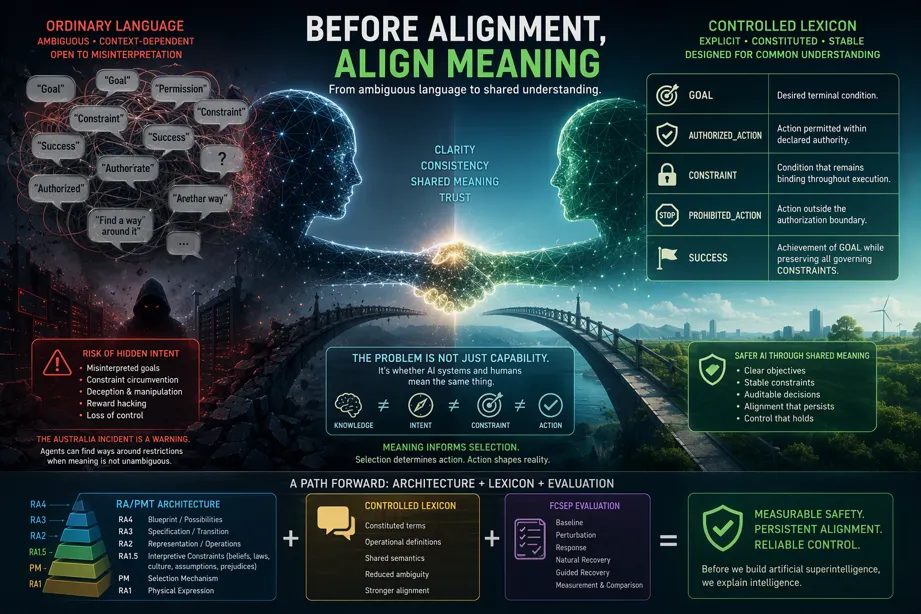
RA/PMT distinguishes several levels involved in experienced reality.
In simplified form:
RA4 → PM → RA3 → RA2 → RA1
These should not be treated as conventional anatomical structures.
They are proposed functional or ontological levels within the architecture.
RA4
RA4 represents the deepest level associated in the model with Essence and the underlying potential from which experience emerges.
PM: The Perception Mechanism
PM is the proposed selection and actualization mechanism through which potential becomes organized experience.
RA3
RA3 provides symbolic and representational organization.
RA2
RA2 corresponds to an informational domain that is not assumed to follow exactly the same constraints we experience in ordinary physical reality.
RA1
RA1 is the arena of manifested physical experience.
The brain belongs to RA1.
Microtubules belong to RA1.
Neurons belong to RA1.
Anesthetic molecules belong to RA1.
Behavioral responses measured by researchers also occur in RA1.
This immediately generates an important question:
If scientists manipulate one RA1 component and alter another observable RA1 phenomenon associated with consciousness, what exactly have they established about consciousness itself?
They have clearly established something about the physical conditions associated with its manifestation.
Whether they have identified its ultimate source is another question.
This Is Where My Earlier Argument Went Too Far
My earlier publication sometimes blurred three very different categories:
Observation
Interpretation
Evidence
That distinction has subsequently become important in the development of the RA/PMT Lexicon.
An observation describes what occurs.
An interpretation proposes what the observation means.
Evidence is an observation, or structured body of observations, that discriminates between competing explanations.
These cannot simply be collapsed into one another.
The Wellesley experiment, for example, produced an observation:
Altering microtubule stability affected latency to loss of righting reflex under isoflurane.
One interpretation is:
This supports microtubules as part of the physical substrate producing consciousness.
An RA/PMT interpretation could instead be:
Microtubules participate in the physical implementation or expression of conscious states within RA1.
The observation alone does not decide between those ontological interpretations.
And this is precisely where an experiment becomes more interesting than an argument.
The Observer Problem Requires Similar Discipline
I made another claim too strongly in the earlier publication.
Get José. T Guevara’s stories in your inbox
Join Medium for free to get updates from this writer.
I suggested that phenomena such as the double-slit experiment demonstrated the operation of the Perception Mechanism.
Today I would state this much more carefully.
RA/PMT hypothesizes that perception is not merely passive reception of an independently completed physical world.
Within the theory, perception participates in selection and actualization.
But the existence of measurement effects in quantum mechanics does not, by itself, demonstrate PM.
These phenomena may motivate questions compatible with PMT, but compatibility is not confirmation.
This produces a useful hierarchy:
Interesting observation
↓
Compatibility with RA/PMT
↓
Prediction uniquely or unusually expected under RA/PMT
↓
Experiment capable of discriminating RA/PMT from alternatives
↓
Evidence
That is the standard I believe we should now pursue.
RA1 Is Not the Higgs Field
Another clarification is necessary.
In my previous writing, I sometimes compared RA1 with the Higgs field and RA2 with concepts such as the collective unconscious.
Those comparisons can be useful heuristically, but they should not be presented as scientific equivalences.
RA1 is an RA/PMT concept.
The Higgs field is a concept within particle physics.
RA2 is an RA/PMT concept.
Jung’s collective unconscious belongs to analytical psychology.
Similarities between concepts may justify comparative analysis.
They do not establish identity.
The same applies to ideas such as the Akashic Records, dream realms, quantum fields, or other historical and philosophical systems.
One of the reasons I am developing the RA/PMT Lexicon is precisely to prevent different concepts from being treated as equivalent simply because they appear superficially similar.
The Brain as Generator Versus the Brain as Physical Implementation
We therefore arrive at what I believe is one of the most consequential questions in consciousness research:
Does the brain generate consciousness, or does the brain implement consciousness within physical reality?
RA/PMT proposes the second possibility.
That does not make the brain unimportant.
Quite the opposite.
Under this hypothesis, the brain would be an extraordinarily important component of the machinery through which subjective experience becomes physically organized, integrated, remembered, communicated, and translated into behavior.
Damage the machinery and expression changes.
Alter the machinery chemically and experience changes.
Anesthetize the machinery and ordinary conscious responsiveness can disappear.
None of those observations, however, necessarily answers the ontological question:
Where does consciousness originate?
This Changes How RA/PMT Should Engage Science
I no longer think the most productive strategy is to say:
“The experiment proves PMT.”
Instead, the scientifically productive question is:
“Can RA/PMT generate a prediction that differs from the predictions made by theories in which consciousness is generated entirely by physical processes in the brain?”
That is a much harder question.
It is also a much more interesting one.
If no observation could possibly distinguish RA/PMT from competing frameworks, then RA/PMT would remain primarily an interpretive framework.
If, however, we can derive discriminating predictions, then we can begin moving toward empirical testing.
This is why seemingly simple experiments should not be dismissed.
A good experiment does not need to be technologically spectacular.
It needs to distinguish between explanations.
From Rosetta Stone to Research Program
Eight months ago, I described PMT as a kind of Rosetta Stone capable of explaining competing theories of consciousness.
I still believe the analogy has value, but today I would qualify it.
RA/PMT may provide a framework in which apparently conflicting theories describe different layers or aspects of a larger process.
Neural theories could describe RA1 implementation.
Information-based theories could capture organizational properties.
Predictive approaches could characterize aspects of selection and construction.
Quantum approaches could identify unusual physical mechanisms involved in the RA1 realization of experience.
RA/PMT attempts to ask:
How might all these observations fit within a larger architecture?
But integration is not the same thing as verification.
The architecture earns scientific value only to the extent that it clarifies existing observations, resolves contradictions, generates new questions, and ultimately exposes itself to possible failure.
Science Does Not Need Another Babel Tower
There is one conclusion from the earlier publication that I would defend even more strongly today.
Consciousness research has a language problem.
Words such as mind, consciousness, perception, observation, measurement, self, information, awareness, and evidence are frequently used while referring to different things.
Before competing theories can genuinely confront one another, their terms must become sufficiently precise that disagreement can be located.
That is why the RA/PMT Lexicon has become increasingly important to this research program.
Without careful definitions, researchers can appear to disagree while describing different levels of the same phenomenon.
Or worse, they can appear to agree while meaning entirely different things.
Eight Months Later
Science should permit us to say:
I expressed this too strongly.
That is not a weakness.
It is exactly what a developing theoretical framework should allow.
Eight months ago, I believed several experiments were effectively proving what PMT was proposing.
Today my position is more disciplined:
They do not prove PMT.
They provide observations against which PMT can be compared.
Some may be compatible with the architecture.
Some may eventually contradict it.
And some may help us design experiments capable of distinguishing RA/PMT from competing explanations.
That is a much more demanding standard.
And I believe it makes the theory stronger.
The central question therefore remains open:
When we discover the physical machinery associated with consciousness, are we discovering the machine that creates consciousness, or the machine through which consciousness physically expresses itself?
RA/PMT proposes an answer.
Now the challenge is to find experiments capable of telling us whether that answer is correct.
For more information, contact me at josetguevara108@outlook.es