Week 1: The part where it gets serious

This is my final major project blog for the MA Service Design course at UAL LCC. A few weeks of thinking out loud and figuring it all out in real time. Stick around :)
The ‘Final Major Project’, as the name suggests, carries a lot of weight. For everyone on the MA Service Design course at the University of the Arts London, this is the exact moment where everything converges — all of the methodologies, the tools learnt, the critical essays and the collaborative breakthroughs, all distilled into this one significant, self-directed piece of work.
Over the past eight months, this course has been nothing short of a rollercoaster. From the earliest sessions on the ‘Ways of Working’ unit to ‘Design Futures’, I have had the opportunity to partner with real-world stakeholders, facilitate co-design workshops, learn new research methodologies, and navigate the discomfort of collaborating with people whose backgrounds and expertise are very different from my own. It has, genuinely, changed how I think.

Before any of this, I was a graphic designer. For three years, I worked entirely within the visual communication field, and honestly, I loved it. But somewhere between client briefs and brand guidelines, I kept finding myself drawn to a bigger question: not just how something looks, but how it works, who it works for, and who it excludes. I was guided by a handful of mentors in multiple projects that gradually expanded my frame of reference, and that’s what has eventually brought me to an MA in Service Design.
Service design has forced me to think critically, to examine every perspective, and to get comfortable with the uncertainty that is part of the design process. I am more comfortable with uncertainty than I ever thought I would be. Which is fortunate, because the final major project, from what I have heard, demands a lot of it.
Three weeks, three canvases, and one decision
Choosing the focus for my final project took three weeks. That might sound like a long time, but the process itself was revealing. I started by mapping every area of interest I could think of across every sector and field, generating problem statements, framing ‘how might we’ questions, and stress-testing each one against my own motivations.

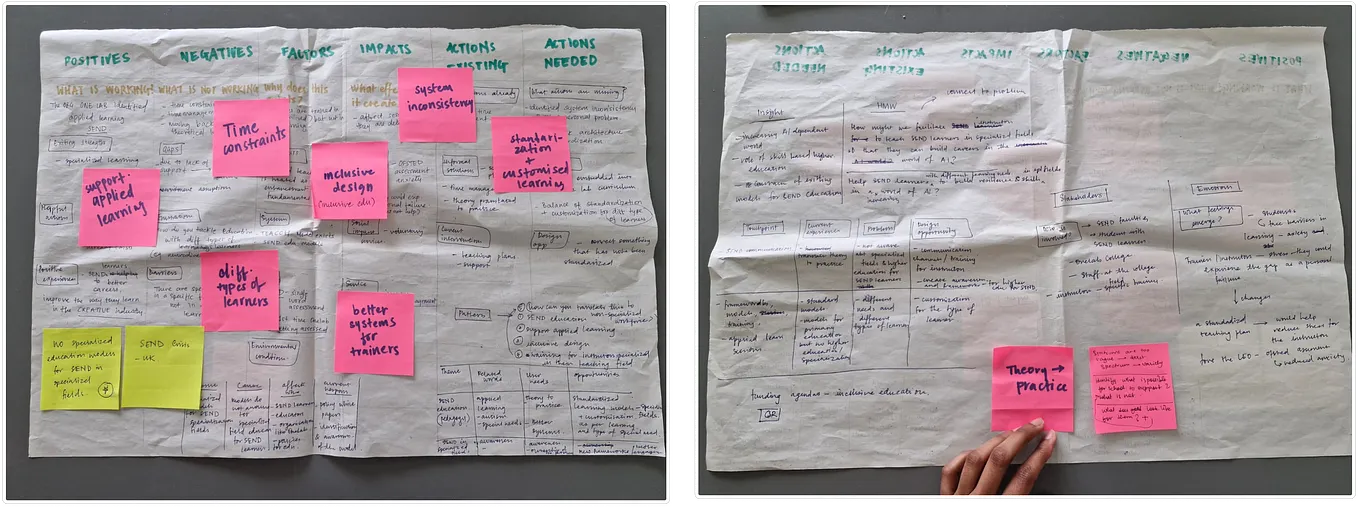
For our first class, we each had to come in with three canvases covering three different problem areas. Mine were:
Get Maitreyi Mandrekar’s stories in your inbox
Join Medium for free to get updates from this writer.
1. Design practice & social impact: How the emotional and psychological demands of designing for vulnerable communities affect the designers themselves.
2. Identity, leisure & urban social infrastructure: How hobbies function as identity anchors and how the structural conditions of adult life break the foundation that once made them possible.
3. Men’s health and well-being after retirement: Psychological and social dimensions of masculine identity in later life, and how men navigate self-worth when career and provider roles diminish.
I spent time developing the first topic — the well-being of designers working in social impact. I spoke to my peers, faculty, and industry mentors to test the idea. Even though the feedback clearly stated that the gap genuinely exists, the more I explored it, the more I felt it facing inward than outward.
Then, quite by chance, I came across a supported project my faculty had shared — a collaboration opportunity with a specialist institution in Tower Hamlets, London called OneLab College. OneLab trains SEND (Special Educational Needs and Disabilities) learners in design, digital media, and entrepreneurship.
I am drawn to this project because of its complexity, the genuine stakes involved, and a long-held personal belief that everyone has the right to education that sees and supports them fully. I will be honest, I come to this with zero expertise in special education. But I come with curiosity and a belief in the power of inclusive design methodologies.
And that brings me to the end of the week 1 blog. Follow along, for this is only the beginning.