Education Support (2025) reports that 1 in 4 teachers and education staff have actively considered leaving due to pressures on their mental health and wellbeing — a figure that is significantly higher in SEND-specialist contexts.
At the start of this project, the learner was at the centre of everything. The SEND crisis, AI reshaping the creative industry, and inconsistency in teaching at specialist colleges — it all converged on the young people being failed by a system not designed for them.

That framing was right. But my first meeting with the CEO of OneLab College shifted something fundamental. Within the first twenty minutes of the meeting, a new problem had surfaced, one I hadn’t fully anticipated.
You cannot fix the learner experience without first fixing the experience of the people who deliver it. OneLab, like many other specialist SEND colleges, has experienced significant staff turnover. But the question worth asking is not simply how much, it is why? A report by the National Foundation for Educational Research (2026) found that staff retention in specialist SEND settings is one of the most acute workforce challenges in the UK education system today, and the Chartered College of Teaching (2025) says that the primary reasons for this are inadequate training, emotional overload, and a lack of structured professional support. These aren’t abstract pressures. These are built over time, in instructors who were hired for their creative expertise. Over time, they find themselves navigating one of the most complex professional environments in education — without the right tools, training, or support to do so sustainably.
This doesn’t just affect the tutors; it also indirectly affects the learners. For young people with autism, associated learning difficulties and neurodiversity, consistency is not a preference — it is an educational necessity. Every time a key instructor leaves, a learner loses not just a teacher but a trusted relationship that may have taken months to build. As Holmes (2018) argues in Mismatch, exclusion is always a design failure — a gap between what a system demands and what it actually provides. That gap exists here, and it is experienced simultaneously by instructors who are burning out and by learners who are losing consistency.
Get Maitreyi Mandrekar’s stories in your inbox
Join Medium for free to get updates from this writer.
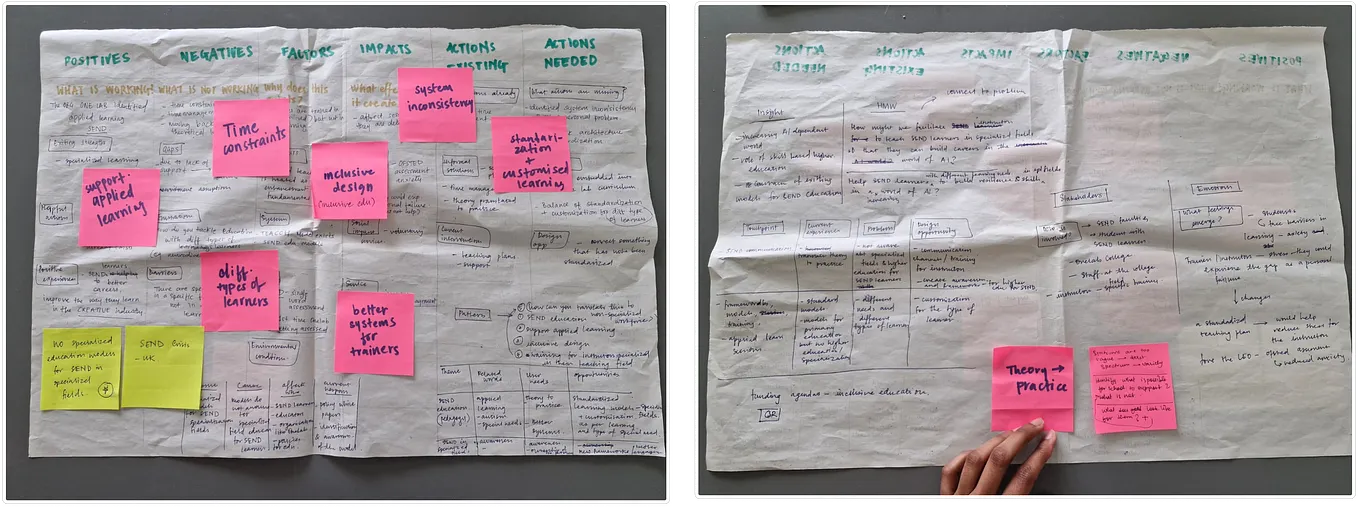
After mapping the existing research on SEND workforce challenges, a clearer picture of the problem began to emerge.

From that mapping, five research questions came forward:
- What are the key moments of breakdown in an instructor’s experience at OneLab? Where do motivation, confidence, and a sense of purpose most commonly erode?
- To what extent is staff turnover a symptom of individual burnout, and to what extent is it an organisational design failure — in onboarding, support structures, career pathways, and role clarity?
- What support structures would help instructors feel competent rather than overwhelmed when working with SEND learners without formal training?
- How does staff instability affect the consistency and quality of learning for SEND learners? What would a more stable workforce make possible?
- How might the instructor journey be reshaped, from recruitment through to career development, so that working in specialist creative SEND education becomes a sustainable and fulfilling path?

These questions now sit at the heart of my project. The central research question I am pursuing is:
How might we create the conditions for instructors in specialist creative SEND colleges to build sustainable, meaningful careers — so that the passion that drew them to the work becomes a source of sustenance rather than depletion, and SEND learners benefit from the consistency and continuity their education depends on?
In the bigger picture, the learner has not left the frame. But the intervention point has shifted — from the classroom to the systems that determine who is in the classroom, and for how long.
References:
Chartered College of Teaching. (2025). The SEND crisis and teacher retention: Understanding the impact and solutions — Chartered College of Teaching. [online] Available at: https://chartered.college/news-blogs/the-send-crisis-and-teacher-retention-understanding-the-impact-and-solutions/.
Education Support (2025) Teacher Wellbeing Index 2025. London: Education Support. Available at: https://www.educationsupport.org.uk/media/3qeajx41/teacher-wellbeing-index-2025.pdf (Accessed: 29 May 2026).
Holmes, K. (2018). Mismatch: How exclusion shapes design. Cambridge, MA: MIT Press.
National Foundation for Educational Research (NFER) (2026) School Support Staff Workforce in England 2026. Available at: https://www.nfer.ac.uk/media/331d1end/school_support_staff_workforce_in_england_2026.pdf (Accessed: 29 May 2026).