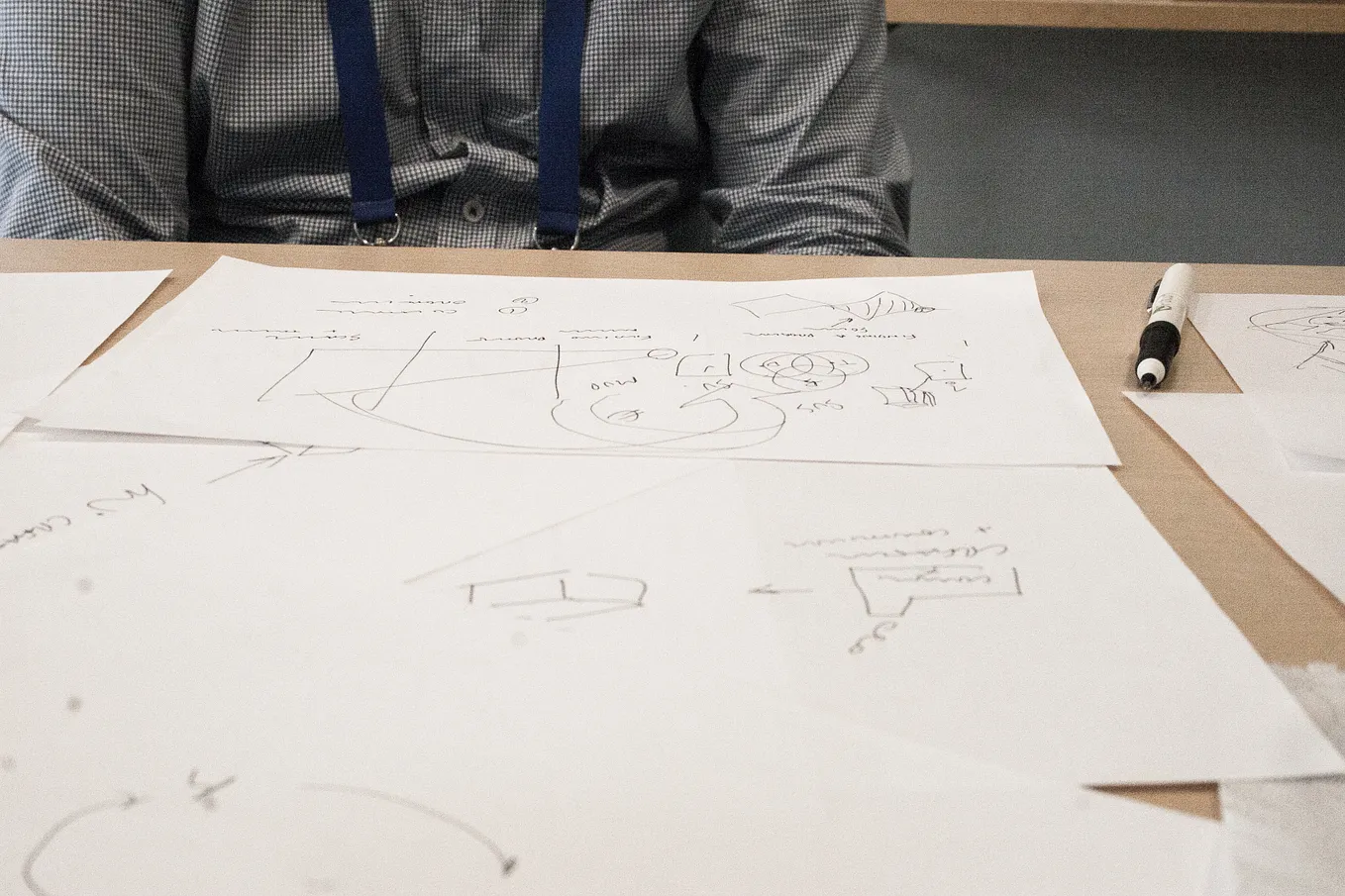
Educational impact: ME310 Global Design Innovation Course
Taking a Global Innovation Course from Stanford University Down Under

The only way to do it, is to DO IT.
During my studies I have been very lucky. But this lucky … I would have never dreamed of. It all started from the desire to push the boundaries, always dream and aim higher; never asking for permission, but forgiveness – if even that.
This is the realisation I had on my way Australia where I was headed as a Visiting Fellow to instruct at Melbourne’s Swinburne University, a public university of technology, established in 1908. I had been a Teaching Assistant already for two years before that, which had me teaching at Helsinki’s Aalto University, Kyoto’s Institute of Technology and Palo Alto’s Stanford University. It was the perfect job, being surrounded by the most inspiring global network and motivated students, getting all the travel one could wish for and at the same time being involved in the kind of educationthat only a few years back had completely blown my own horizon and fundamentally changed my understanding of education and what it means to have real impact.
And it all began by pushing the boundaries about doing a bit of a different style course. Now I was on a mission and my mission was to introduce and kickoff the ME310 at Melbourne’s Swinburne University, instructing the course for its very first month Down Under, infusing its culture, its madness, its ambiguity. A mission I was very much looking forward to.
ME310 Global Innovation Challenge
The ME310 is a very special type course, based on the kind of educational concept of project and problem based learning. Mixed in is a huge amount of ambition and global team work challenges. Introducing the foundations of the course, the curriculum, its culture – that was my job.
“ME310 is a high-tech, globally distributed graduate course in Project-Based Engineering Design, Innovation, and Development”, Larry Leifer, founding director of the Center for Design Research at Stanford (CDR) and the Hasso Plattner Design Thinking Research Program at Stanford.
Students in the ME310 commit a full academic year to take on a real world design challenge brought forth by corporate partners. The course name itself represents its deep root in the Mechanical Engineering Department in Stanford. Its home is found in the d.school, which is a design school based in Stanford University, in cooperation with the German Hasso Plattner Institute of University of Potsdam. The school itself was founded by David Kelley in 2004, aiming at integrating business and management training into more traditional engineering and product design education.

Stanford Design Innovation Process
Through the course of the project, students learn, apply, and experience the Stanford Design Innovation Process and many of its tool sets. Teams observe and interview users to better understand their needs, benchmark existing technologies and products to identify the design opportunities, extensively brainstorm to discover the obvious, crazy, and novel ideas, and iteratively prototype to quickly test their ideas and get a better understanding of their designs. The end result is a refined design concept backed with key insights. The course curriculum presents its own terminology, constantly being challenged and changed itself, even giving Co-Instructors like myself to have a lasting impact, by introducing new elements to the teaching, such as the Dirty Tuesday.
Get Maria Lumiaho’s stories in your inbox
Join Medium for free to get updates from this writer.
Unlike many other academic engineering projects, which require students to optimise one variable, students must design a complete system while being mindful of not only the primary function but also the usability, desirability, and societal implications. Throughout one academic year, student teams prototype and test many of their design concepts and in the end create a full proof-of-concept system that demonstrates their ideas.
This is well demonstrated by the very first challenge the students are prompted with, which is to build a fully-functional Paperbike – a vehicle fully made out of paper-based materials. This challenge has long traditions in Stanford, adapting the challenge only ever so slightly each year with some of the oldest bikes still to be found in the d.school’s ME310 loft. The aim is to level the playing field (chances are no one will be an expert in building Paperbikes, not to mention the probability of ever having attempted building one) and to help the teams to explore and understand team dynamics.
In the fall of 2013, the concept of the Paperbikes was altered into HungryHippos, that had to be operated in shallow water. Driving the bureaucracy–loving Australians into disbelief, we not only convinced the rule-obeying university workshop employees into erecting a blow-up kiddies pool in their premises to test weaponry and tools, but also managed to convince a nearby public swimming pool to fill an abandoned real kiddies pool, in order to carry out the Local Paperbike Race according to the specifications. This is the kind of madness this course comes with.

Only after the global Paperbike race carried out in Stanford, about a month into the course, the teams get to know their final team members including their global team partners as well as their corporate challenges and their industry coaches.
Truly Global Collaboration
On every project, student teams at Stanford collaborate with another team from a foreign university, with the network expanding across various continents and timezones. The diversity not only adds various skill sets but also different cultural perspectives on the design challenge that increases the chances of breakthrough innovation. Diversity has been demonstrated to correlate highly with design team innovation, and it is one of the core variables that Stanford’s Center for Design Research finds valuable. For students, the experience of working with different cultures is necessary in this globalised world as most designers, engineers, and projects managers operate in distributed work teams.
The culture of innovation
Part of the challenge in extending the ME310 to Melbourne’s Swinburne University was also to infuse the deeply rooted ambiguity and craziness that comes with this out-of-the-ordinary course. It is extremely difficult to convey just how different this course really is. It even created its very own terminology, in an attempt to capture and convey its approach so radically different from traditional programs. The ME310 is made up of SGM’s andLGM’s (Small and Large Group Meetings), it invites students, researchers, global partners and corporate partners and coaches to SUDS and SuperSUDS(Slightly Unorganised Design Session) and allows students to travel the world to meet their team partners as well as carry out the field work essential for tackling their complex, real-life challenges.
“In design, everything is context”, Larry Leifer.
Building prototypes at a rapid pace is a fundamental part of the curriculum, challenging the students to build Dark Horses, Funky and Functional Prototypes, each exploring different aspects of envisioning a solution, pushing students to explore the weird and the crazy as much as the familiar and the obvious. Over the years we have had students control entire games with their tongues and other body parts, cut open brand new test cars to accomodate their prototypes, and to simply push the boundaries of what’s normal and accepted in order to test their visions.
Extending the reach
Swinburne is now in its second year, having just had participated in the global Paperbike Race 2014 in Stanford University, after which the global teams will receive their corporate briefs, meet their global teams and start their innovation journeys all over again.
Despite the obvious scepticism at first, the magic of the course came through at last. The first SGM’s and LGM’s nobody really understands how this works. Students are shy and put off by its unconventional style. They need to deep–dive, to let go before they can fully immerse, before they start dancing with ambiguity. The ME310 is now an inherent part of the Swinburne Design Factory in Melbourne, with a designated space and coach and industry partners. Swinburne had a fulminant start with two brave teams, including a three-way global collaboration across three continents, deep diving into the fundamentals of the course in its first year and succeeded in demonstrating the impact of the course, achieving nothing less but its integral role in the university’s program for hopefully many years to come.
I am proud to have been part of so many journeys and have all the students and teaching staff to thank for making this incredible community happen. In the end, it’s all about the people. In the end, my mission succeeded but it had to come to an end.
I feel incredibly lucky, indeed.