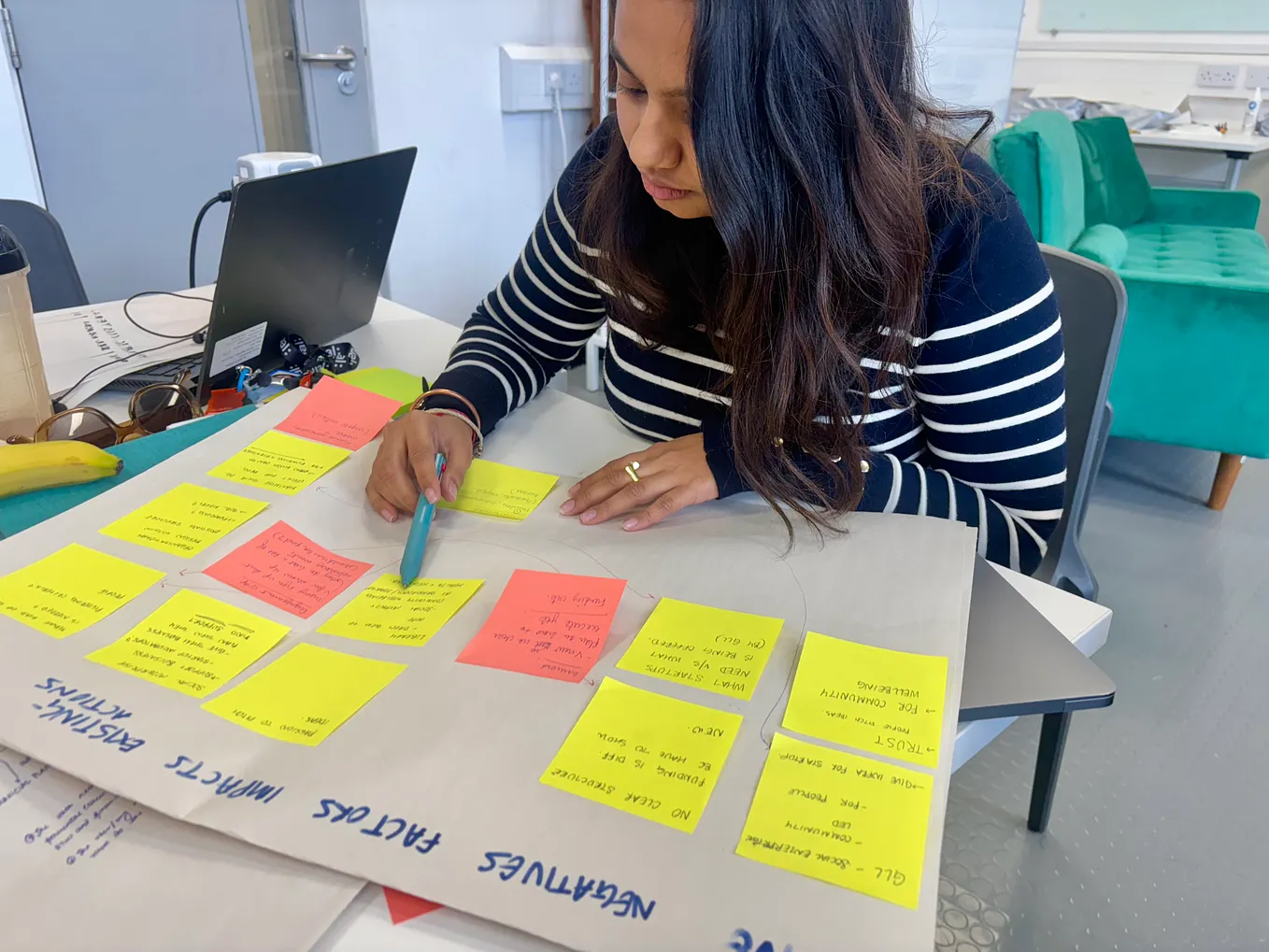
Week 3: The Business of Doing Good

This is my journey documenting the Final Major Project (FMP) for my MA Service Design at the University of the Arts London.

I come from a business family. Growing up, entrepreneurship was not an abstract idea. It was in the stories my parents shared, in the way my father built something from the ground up with our family alongside him. It gave me an understanding that business is not just about money but also about the people, the relationships you build, and a purpose. That background has always shaped how I see the world, and somewhere in the back of my mind, so has the possibility of building my own practice one day.
When I came across the GLL brief, something about it felt a little personal. Engaging with startup accelerator programmes and the founders who go through them is not just a research exercise for me. It is also a way of understanding the reality of what building a business actually looks like in London today. What the structures are. Where the support exists and where it falls short. What it feels like to show up with an idea and try to make it into something real.
That personal lens does not change the rigour of the research, but it does change how I am approaching it. I do not want to just treat this as a final major project, but something I can learn from and take away for a lifetime.
Understanding Startup Accelerator Models
Grasping GLL’s programme meant first understanding the landscape it sits within. Not all accelerators are built the same, and the difference matters for how you design support.
Most people’s idea (including mine) of a startup accelerator is shaped by models like Y Combinator or Bethnal Green Ventures: equity-based programmes, fixed timelines, competitive cohorts, and a demo day where founders pitch to investors. Success is measured through funding raised, valuations, and exits. As Hathaway (2016) notes, traditional accelerators are built to compress time, connecting startups to capital and networks at a pace that would otherwise take years.

Social enterprise accelerators operate under a fundamentally different logic. Selection is based not only on business viability but on mission alignment, and support tends to be more holistic because founders are navigating something more complex: the tension between generating revenue and staying true to a social purpose. As Alvarez de Mon, Núñez-Canal and Merladet (2025) argue, the relationship between a social accelerator and the enterprises it supports is shaped by shared values rather than shared financial interest. The metrics are harder to define. Community impact and social value do not convert neatly into numbers, and that changes everything about how you design the support around them.
Designing for Social Impact
Get Riya Kamdar’s stories in your inbox
Join Medium for free to get updates from this writer.
This is where service design becomes particularly relevant. Designing for social impact means working with a different set of values, where success is not just about whether a business scales but whether it creates meaningful change for real people. Sparviero (2019) makes a compelling case that social enterprises need their own frameworks precisely because commercial models were never built to hold both financial and social dimensions at once. For GLL, this raises important questions about what the programme is measuring, what it is promising founders, and how it defines its own success.

Questions That Shaped My Thinking
Going into the kick-off meeting last week, I had prepared a set of questions for the GLL team.
Some were about identity: do you see GLL becoming more of a traditional accelerator, or something fundamentally different because of your community infrastructure and social enterprise model?
Others were about the gap between intent and reality: where do you feel there is a mismatch between what startups ask for / need versus what is currently available to them?
But the question that stayed with me most was more observational rather than a direct question: the accelerator feels like it is almost becoming a way for GLL to extend its role as community infrastructure, not just as a leisure or library provider, but as an enabler of local social systems. Is that something GLL is consciously evolving toward?
That framing has shaped how I have been thinking about the project ever since. It suggests the brief is not just about improving a programme. It is about unlocking the purpose of what an organisation can further become for the community.

What Comes Next
With a clearer sense of the landscape GLL operates within and the questions worth asking, the next step is to look more closely at the people and structures around the programme. That means beginning to map the stakeholders, understanding who is closest to the programme and who sits further out, and examining how those relationships shape what the programme can and cannot do. The goal is to move from understanding the context to understanding the system.
References
Alvarez de Mon, I., Núñez-Canal, M. and Merladet, J. (2025) ‘The role of social accelerators supporting social entrepreneurship: A narrative perspective of a special relationship’, Journal of the International Council for Small Business. Available at: https://doi.org/10.1080/26437015.2025.2509687
Hathaway, I. (2016) ‘What startup accelerators really do’, Harvard Business Review. Available at: https://hbr.org/2016/03/what-startup-accelerators-really-do
Sparviero, S. (2019) ‘The case for a socially oriented business model canvas: The Social Enterprise Model Canvas’, Journal of Social Entrepreneurship, 10(2), pp. 194–212.