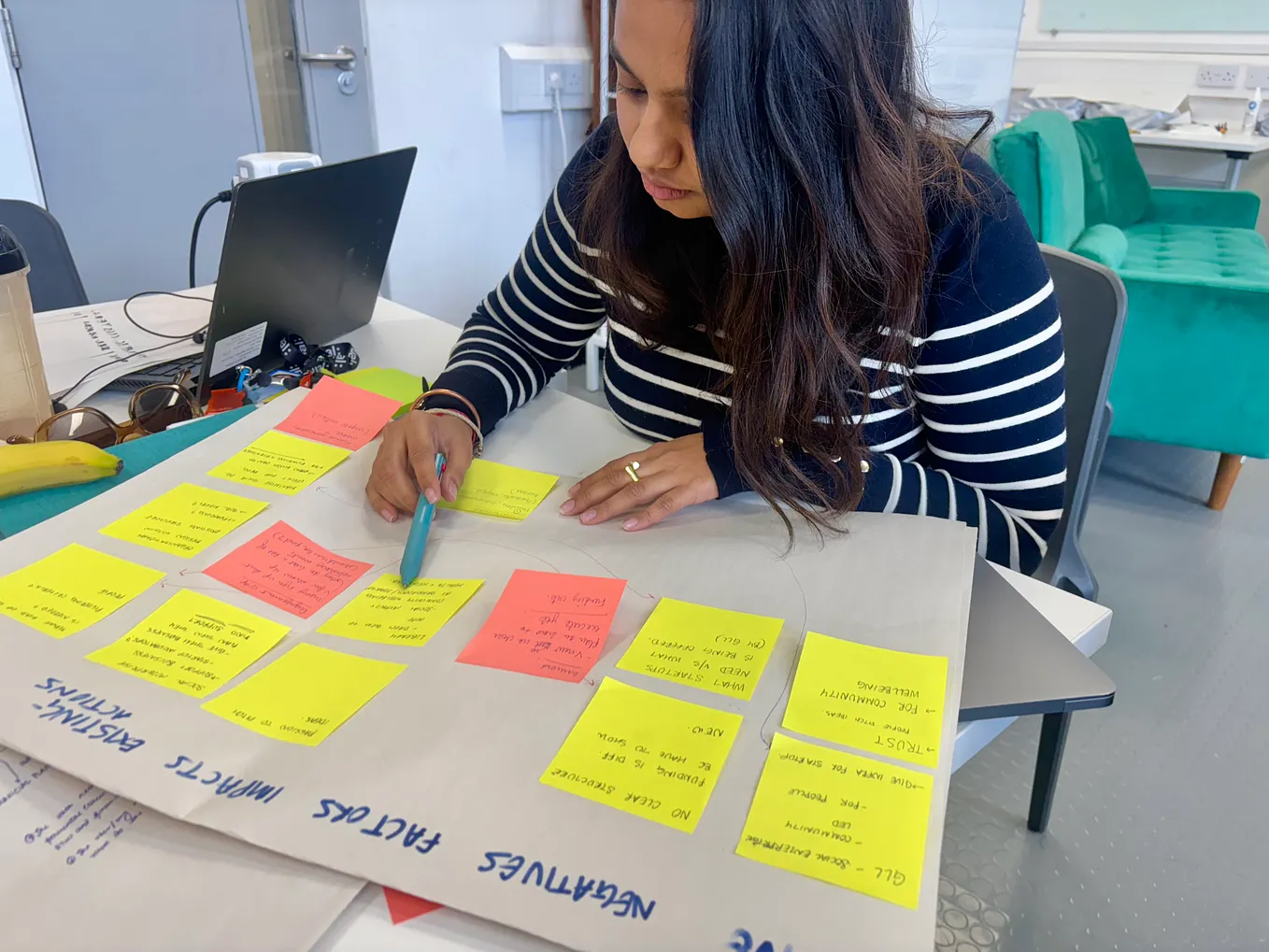
Week 5: Pitch, Pause, Reflect

This is my journey documenting the Final Major Project (FMP) for my MA Service Design at the University of the Arts London.
Making the Pitch
Five weeks in, and it was time to put the thinking in front of my tutors and peers.
The formative assessment took the form of a short video pitch, which meant taking everything I had built over the previous four weeks and trying to shape it into something clear enough to communicate. I actually found the format interesting because it changed how I had to think about my topic.

Writing lets you hedge, but speaking it out loud through a video format, forces you to decide what you really mean. That process made me decide what I actually thought, and then say it clearly enough to let the viewer into the narrative. The spoken pitch surfaced which parts of the argument were solid and which were still vague in my own thinking. It was a signal about where the thinking still needed to develop.
What Came Back
The tutors’ feedback began with something that felt really encouraging after five weeks of sitting with so much uncertainty: “Excellent framing of the issue and strong use of statistics. Clear identification of a gap.” That was genuinely reassuring, because it confirmed that the direction was making sense.
At the same time, the feedback also pointed to what still needed work. The theoretical framing and value proposition needed to be clearer, and I was encouraged to develop journey maps, service ecosystem maps, and financial flow diagrams to better understand how the programme creates and sustains value. That felt very useful because it gave me a more grounded next step rather than just developing it further. The suggestion to look at comparable successful models and think about whether they could be transferred was the part that stayed with me most. It felt like a real direction to explore rather than just a general improvement point.
A Different Kind of Perspective
The peer feedback operated differently, and that difference is worth naming. Tutor feedback comes from someone invested in the project’s rigour. Peer feedback comes from people encountering the work for the first time, without the weeks of context that shaped it. Both are valuable, but for different reasons.
One peer wrote: “Great video, very clear framing.” Another followed with: “Would like to know more on how the startup programme works and the ecosystem mapping.” That gap between understanding the problem and understanding the programme is something someone already inside the research would not notice. Peers did.
Their questions, about stakeholder value, about how founders are supported differently, about what sustainability might actually look like for GLL, are reminders that whatever comes out of this project will be encountered fresh. Designing for that requires staying honest about what is still unclear, not just what has been figured out.

What Comes Next
The feedback has given the next phase a clearer shape. I have signed up for two events in the coming weeks: a business connect where I hope to speak directly with founders, and a talk on scaling success by the chairman of Bromley Football Club, which feels relevant to the question of how purpose-driven organisations sustain themselves over time.
My tutor also suggested mapping existing non-tech social enterprise accelerator programmes across London before speaking to founders. Taking that research into the events and using it as a starting point for conversation feels like the right bridge between desk research and lived experience.
Five Weeks In

Looking back across these five posts, it is striking how much the project has shifted. Week 1 was about finding a direction. Week 2 was about beginning to understand the system. Week 3 brought in context and personal motivation. Week 4 was where the analysis produced something tangible. And Week 5 is the moment where other people’s thinking came in and changed the shape of what comes next.
That feels like how research is supposed to work. You build something, you put it out into the world, and it comes back different. Not broken, just more honest about what it still needs to become.
The Reading List So Far
The sources below have been central to framing the research across these five weeks. Each one has contributed something different: theoretical grounding, contextual understanding, methodological direction, or a framework for thinking about the work ahead.
Annotated Bibliography 1
Irwin, T. (2015) ‘Transition Design: A proposal for a new area of design practice, study, and research’, Design and Culture, 7(2), pp. 229–246. Available at: https://www.researchgate.net/publication/282432370_Transition_Design_A_Proposal_for_a_New_Area_of_Design_Practice_Study_and_Research
Describe:
Irwin proposes Transition Design as a new area of design practice that repositions designers as agents of long-term, systemic change. The article argues that contemporary design must move beyond product and service-level solutions to engage with complex, interconnected problems that unfold across multiple scales and timescales. Irwin’s central viewpoint is that design has a responsibility to address the deeper structural conditions that produce these problems, rather than treating their symptoms in isolation.
Get Riya Kamdar’s stories in your inbox
Join Medium for free to get updates from this writer.
This acts as foundational text for anyone working at the intersection of design and systems change. Its conceptual framework is particularly useful as a research lens because it encourages a shift in how questions are framed, moving away from asking what can be fixed toward asking what conditions need to change. For a project rooted in qualitative research and participatory methods, this reframing is valuable. It supports approaches like stakeholder mapping, systems mapping, and in-depth interviews, where the goal is not just to document a service but to surface the underlying assumptions and structures that shape it.
This source provides my FMP the theoretical grounding to position GLL’s accelerator programme within a larger system, rather than treating it as a standalone service to be optimised. Transition Design encourages me to ask not only how the programme could be improved, but what wider conditions around social entrepreneurship support in London might need to shift over time.
Annotated Bibliography 2
Von Friedrichs, Y. and Lundström, A. (2016) ‘Social entrepreneurship as collaborative processes in rural Sweden’, in Andersen, L.L., Gawell, M. and Spear, R. (eds) Social Entrepreneurship and Social Enterprises: Nordic Perspectives. Abingdon: Routledge, pp. 158–177.
This chapter examines how social entrepreneurship develops through collaborative processes rather than individual initiative, drawing on case studies from rural Sweden. The authors argue that social enterprises are not simply founded by lone entrepreneurs, but emerge from networks of community relationships, shared purpose, and local partnerships. Their viewpoint positions collaboration as central to both the formation and sustainability of social enterprises.
The chapter offers a valuable framework for thinking about how ecosystems of support shape entrepreneurial outcomes, which is directly relevant to a service design lens. Its primary limitation is context: the rural Swedish setting differs significantly from urban London, and the community structures described may not map directly onto the diverse, high-density environment GLL operates within. That said, the relational model of entrepreneurship it presents has broader applicability.
This source is relevant to my FMP because it reframes the entrepreneur not as a self-sufficient individual but as someone embedded in a wider network of collaboration and support. This challenges me to look at GLL’s accelerator programme not only as a service delivered to founders, but as a potential facilitator of collaborative processes across London’s entrepreneurial communities, which is an important distinction for how I could approach my research and design direction.
Annotated Bibliography 3
Alvarez de Mon, I., Núñez-Canal, M. and Merladet, J. (2025) ‘The role of social accelerators supporting social entrepreneurship: A narrative perspective of a special relationship’, Journal of the International Council for Small Business. Available at: https://doi.org/10.1080/26437015.2025.2509687
Using qualitative case analysis, this article examines the relationship between a social accelerator and nine social enterprises with high social impact, exploring how that relationship is built, maintained, and what makes it distinct from more conventional accelerator models. The authors’ position is that social accelerators occupy a particular role within the entrepreneurial ecosystem, one that goes beyond funding or mentorship to involve a deeper, more values-aligned form of support that is shaped by the social mission of the enterprises involved.
This source is valuable precisely because it uses a qualitative, case-based approach to examine something that is often discussed in abstract terms. Seeing that methodology applied to a small number of enterprises in depth, rather than surveying a large sample, gives me a useful reference point for how rich, contextual research in this space can be conducted and justified. It also affirms that the relational dimension of accelerator support is worth examining closely, not just the programmes and tools on offer.
GLL’s accelerator programme sits squarely within the social enterprise space this article addresses, and the idea of a “special relationship” between accelerator and enterprise is something I want to explore from a service design perspective. Where this article analyses that relationship through a business and entrepreneurship lens, through my research I want to understand what that relationship looks and feels like from the founder’s point of view, and how it might be designed more intentionally for the programme’s sustenance.
Annotated Bibliography 4
Sparviero, S. (2019) ‘The case for a socially oriented business model canvas: The Social Enterprise Model Canvas’, Journal of Social Entrepreneurship, 10(2), pp. 194–212.
Sparviero challenges the assumption that conventional business model frameworks can be applied to social enterprises without significant modification. The article argues that the Business Model Canvas, designed around commercial logic, was never built to accommodate organisations where social mission sits at the core of how they operate. For social enterprises, it is not an additional layer but a defining one. Sparviero’s position is that social enterprises require their own conceptual infrastructure, and the Social Enterprise Model Canvas is put forward as a more appropriate framework for helping these organisations articulate how they create, deliver, and sustain value across both social and financial dimensions.
This article is particularly useful because it bridges theory and practice. Rather than simply critiquing existing frameworks, it offers a concrete alternative, which makes it a strong reference point for research that involves working directly with founders and social entrepreneurs. The canvas it introduces also provides a vocabulary for talking about social value, stakeholder relationships, and mission-driven decision making in a structured way, which is helpful when designing research tools or facilitated activities.
This source is relevant to my FMP in two ways. First, it deepens my understanding of the social enterprise context that GLL operates within and the kinds of entrepreneurs its accelerator programme is designed to support. Many of those founders may be navigating the same tension between social purpose and business viability that this article addresses. Second, the Social Enterprise Model Canvas could serve as a useful reference when developing workshops or research activities that help founders articulate what they are building, what trade-offs they are making, and where they need more support.
Annotated Bibliography 5
Reason, B., Løvlie, L. and Brand Flu, M. (2015) Service Design for Business: A Practical Guide to Optimizing the Customer Experience. Hoboken, NJ: Wiley.
The book presents service design as both a creative and strategic discipline, focused on improving user experiences through structured, human-centred methods. The authors argue that great service experiences do not happen by accident but are designed intentionally, and they ground this argument in real-world case studies drawn from business contexts. Their central viewpoint is that organisations which genuinely understand their users’ journeys are better equipped to deliver consistent, meaningful, and lasting outcomes.
What makes this book especially useful for my research is how it communicates. Chapter 3, The Customer Story, is particularly relevant as it argues that understanding customers more deeply is the foundation for any meaningful service improvement or innovation. Alongside this, Chapter 6 on Tools offers a range of visual frameworks, journey maps, and service blueprints that make abstract concepts tangible and immediately applicable. Having well-structured visual methodologies to draw from is helpful both for developing my own thinking and for communicating ideas to stakeholders throughout the project.
This source supports my FMP in the research and synthesis phases. The Customer Story chapter gives me a framework for capturing how entrepreneurs experience GLL’s accelerator programme in a way that is both empathetic and analytical. The tools in Chapter 6 then provide structured ways to map those experiences, identify where support feels present, where it falls away, and where the gaps are, and ultimately to present design recommendations in a way that is accessible and actionable for the GLL team.
Annotated Bibliography 6
Kalbach, J. (2016) Mapping Experiences: A Complete Guide to Creating Value Through Journeys, Blueprints, and Diagrams. Sebastopol, CA: O’Reilly Media.
Kalbach offers a comprehensive guide to value-centred design through various forms of visual mapping, arguing that tools such as journey maps, service blueprints, and experience maps are not simply documentation techniques but strategic instruments for understanding how people interact with organisations and services. The book’s central position is that making experiences visible through structured diagrams enables organisations to surface gaps, align teams around a shared understanding, and make more informed design and business decisions.
What makes this book particularly useful is its systematic breakdown of different mapping approaches and when each one is most appropriate. For example, in Chapter 1, Alignment Diagrams (Page 11), Table 1–1 distinguishes between customer journey maps, experience maps, service blueprints, mental model diagrams, and spatial maps, which is a strong reference point because it clarifies not just what each tool captures, but how it frames the relationship between individual experience and organisational structure. That level of methodological clarity is very helpful when deciding which tools to use at different stages of a research process, and it is the kind of thinking that is easy to overlook when reaching for a familiar method out of habit.
Working with founders across GLL’s accelerator programme will require different mapping tools at different stages. Journey maps and experience maps will help me capture and communicate what founders go through from their own perspective, including the moments where support feels most and least present. Service blueprints, on the other hand, will allow me to examine what is happening within GLL’s structures behind the scenes. Having a clear framework for choosing between these tools will add rigour and intentionality to how I design and conduct my research.