Full Spectrum Infrared Sauna: Reading the Emitter Spec Sheet

A full spectrum infrared sauna mixes emitter types: a carbon panel at 100 °C radiates mostly near 7.8 µm, a halogen lamp at about 2,000 °C near 1.3 µm. The surface temperature on the spec sheet tells you which kind you are buying.
Updated: 2 October 2026

An infrared cabin heats the people in it mainly by radiation from emitters rather than by hot air, and its cabin air runs at 45 to 60 °C, the range reported in a 2018 systematic review of dry sauna bathing. What differs between cabins is the emitters: their size, their surface temperature and therefore the part of the infrared spectrum they radiate in.
This note explains how to read those emitters from a manufacturer’s data sheet using two laws of physics and one standard. It makes no claim about what any wavelength does to the body; that is outside what a manufacturer of rooms can say.
What is a full spectrum infrared sauna?
That the cabin combines emitters with different surface temperatures, so its radiation covers more than one band. A typical combination pairs large, cooler panels radiating mostly beyond 4 µm with small, very hot lamps radiating near 1 µm. The name describes a mix of sources, not one special emitter.
Every hot surface radiates a broad spread of wavelengths, and where that spread peaks depends only on its temperature. That relationship, Wien’s displacement law, is what lets a buyer check a spec sheet: a stated surface temperature fixes the peak wavelength, whatever the brochure calls it.
So the useful questions about a full spectrum cabin are practical ones. How many emitters of each type, at what power and surface temperature, and where are they placed relative to the bench.
How does emitter temperature decide the wavelength?
Through Wien’s law: the peak wavelength in micrometres is about 2,898 divided by the surface temperature in kelvin. A panel at 100 °C, 373 K, peaks near 7.8 µm; a ceramic element at 400 °C near 4.3 µm; a halogen filament around 2,000 °C near 1.3 µm.
The law gives the peak, not the whole output. A 100 °C panel radiates across a wide band on either side of 7.8 µm, and even a halogen lamp puts out much of its energy beyond its peak. The peak is the single number that best places an emitter on the spectrum.
These temperatures are examples chosen to span the common emitter types. The real figure for any product is the surface temperature its manufacturer states, and if the data sheet does not state one, that is the first question to ask.
- Emitter type: Large carbon film panel · Example surface temperature: about 60 °C · Peak wavelength (Wien): about 8.7 µm · ISO 20473 band at the peak: mid-infrared · What it usually looks like: flat panel, large area, barely warm to the touch
- Emitter type: Carbon or composite panel · Example surface temperature: about 100 °C · Peak wavelength (Wien): about 7.8 µm · ISO 20473 band at the peak: mid-infrared · What it usually looks like: flat panel, often behind the backrest
- Emitter type: Ceramic element · Example surface temperature: about 400 °C · Peak wavelength (Wien): about 4.3 µm · ISO 20473 band at the peak: mid-infrared · What it usually looks like: rod or plate behind a guard
- Emitter type: Halogen or quartz lamp · Example surface temperature: about 2,000 °C · Peak wavelength (Wien): about 1.3 µm · ISO 20473 band at the peak: near-infrared · What it usually looks like: glowing tube or lamp, visible red light
Why is “far infrared” a marketing name rather than a band?
Because the sauna trade uses it for radiation the ISO standard calls mid-infrared. ISO 20473 divides infrared into near (0.78 to 3 µm), mid (3 to 50 µm) and far (50 to 1,000 µm). A carbon panel peaking near 7.8 µm is, by that standard, a mid-infrared source, whatever the label says.
The CIE uses a different scheme: IR-A from 0.78 to 1.4 µm, IR-B from 1.4 to 3 µm and IR-C from 3 µm upwards. On that scheme the same panel is IR-C. Neither scheme is wrong; they were written for different purposes, and the sauna trade borrowed words from both.
The practical lesson is to ignore the band names and read the temperatures. Two cabins both sold as “far infrared” can have panels at very different surface temperatures, and the temperature is what decides both the wavelength and how hot the panel feels.
How much does an emitter radiate per square metre?
A lot more as it gets hotter, because radiation rises with the fourth power of absolute temperature. By the Stefan–Boltzmann law, with an assumed emissivity of 0.9, a panel at 60 °C radiates about 630 W/m², one at 100 °C about 990 W/m² and a ceramic element at 400 °C about 10,500 W/m².
That is why hot emitters are small and cool emitters are large. To deliver the same power, a 60 °C panel needs roughly 17 times the area of a 400 °C element, which is why low-temperature cabins are lined with panels and high-temperature ones use a few rods or lamps behind guards.
What reaches a person is the net exchange, not the gross output. Against a surface at 30 °C, the 60 °C panel’s net radiation falls to about 200 W/m² and the 100 °C panel’s to about 560 W/m². Distance and the angle between emitter and body then decide how much of that arrives.
What should an infrared emitter spec sheet state?
7 things, and a cabin whose data sheet leaves 3 or more of them blank is hard to compare with any other. Each one maps to a physical property that can be checked, not to a claim about what the cabin does.
- Emitter type and count. Carbon panel, ceramic, halogen or quartz, and how many of each.
- Electrical power per emitter, in watts. The cabin’s total load and the heat it puts into the room.
- Radiating area per emitter. Power divided by area gives the watts per square metre that separate a cool panel from a hot one.
- Surface temperature. The number that fixes the peak wavelength through Wien’s law.
- Spectrum or peak wavelength. Ideally a measured curve; at least a stated peak.
- Position and distance to the bench. Radiation falls with distance, so placement matters as much as power.
- Conformity. The appliance standard for sauna heating appliances and infrared cabins, EN 60335–2–53, which belongs to the manufacturer that certifies against it.
A spec sheet that gives only a total wattage and a band name has told you the size of the electrical supply and a marketing term, and not much else.
How are infrared emitters placed in a cabin?
Behind and beside the seated body, at a distance the manufacturer states, with a guard wherever a surface, such as a 400 °C element, is too hot to touch. Low-temperature panels often sit directly behind the backrest and under the bench; high-temperature elements sit higher and further away, behind a grille.
Get Sauna Dekor Spa Solutions’s stories in your inbox
Join Medium for free to get updates from this writer.
The cabin is designed around those positions rather than the other way round. Bench depth, backrest angle and the number of seats decide where a panel can go, and a cabin sized for two people with emitters placed for one leaves half the bench in the radiant shadow.

Can infrared emitters be combined with a sauna heater?
Yes, in a hybrid cabin with 2 operating modes. The heater warms the air and the stones in the usual way; the emitters add radiant heat for use on their own or alongside it. The cabin then has two operating modes and two electrical loads, and both are designed in from the start.
The emitters in a hybrid cabin have to tolerate the air of the other mode. A panel rated for a 45 to 60 °C infrared cabin may not be rated for the far hotter air when the heater runs, so the emitter’s manufacturer has to confirm it is suitable for combined use.
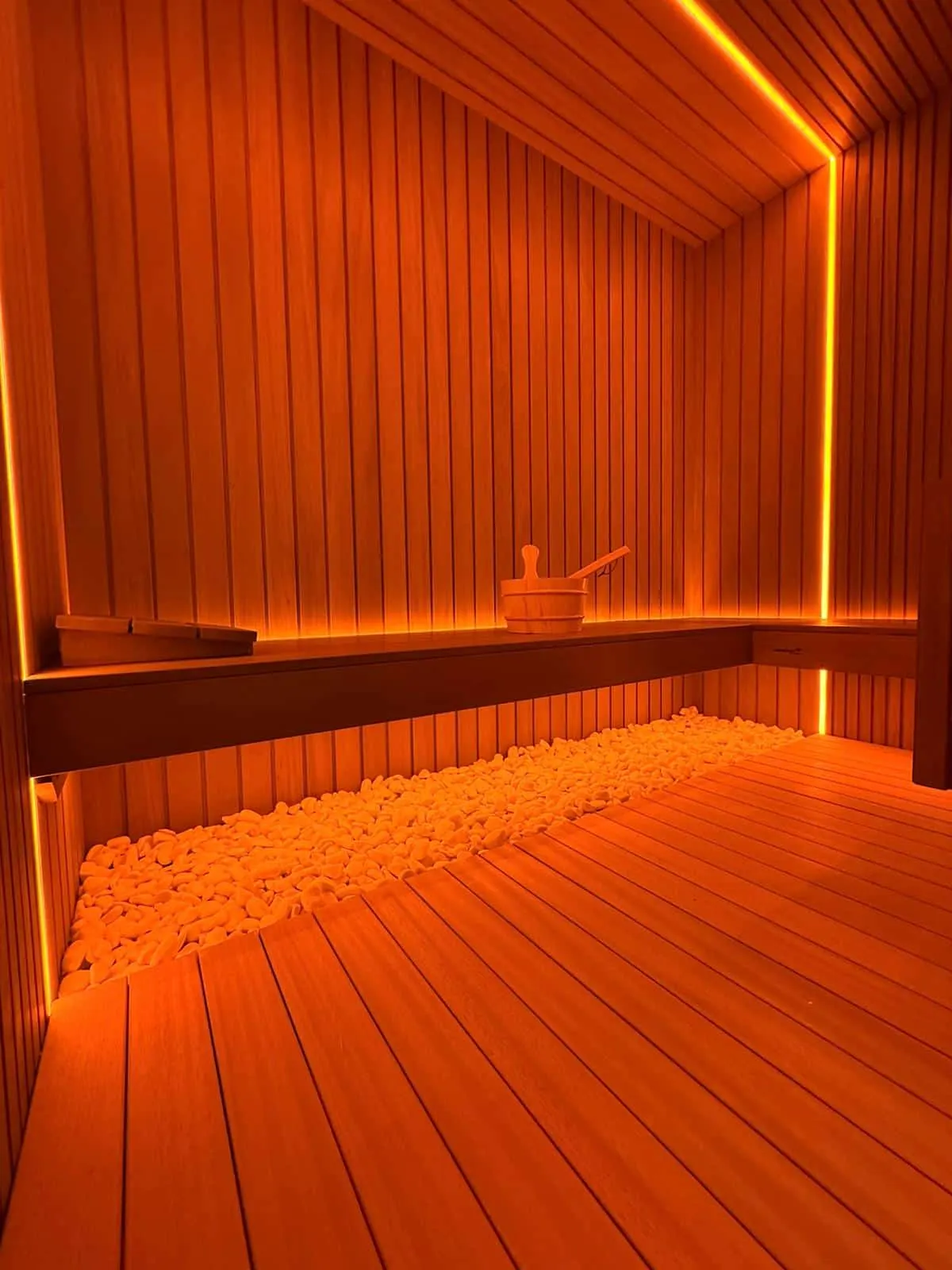
The cabin we show above is one such room. For the cabins we build, our infrared sauna page shows the options, our explainer on what an infrared sauna is covers the basics, and our note on how much an infrared sauna costs sets out what moves the budget.
Who is writing this
Sauna Dekor Spa Solutions has manufactured saunas, infrared cabins, steam rooms and hammams in its own facility in İkitelli OSB, Istanbul, since 1987: 40 years of manufacturing, a team of 19 employees, work under TS EN ISO 9001:2015, and 5,000+ projects in 35+ countries. This article was reviewed by our Managing Partner.
We give a 24-month warranty on workmanship and manufacturing; electrical and mechanical equipment carries a 24-month manufacturer’s warranty; and we give a 5-year warranty on structure and waterproofing.
Infrared emitters, sauna heaters and their controls are not our products. They come from their manufacturers, and any CE marking or EN 60335 conformity of that equipment belongs to its manufacturer rather than to us.
Frequently asked questions about the full spectrum infrared sauna
What is a full spectrum infrared sauna?
A cabin that combines emitters of different surface temperatures, typically cool panels radiating mostly beyond 4 µm and hot lamps near 1 µm. Its cabin air runs at 45 to 60 °C, as with other infrared cabins.
What is the difference between near and far infrared saunas?
The emitter’s surface temperature. By Wien’s law a 2,000 °C lamp peaks near 1.3 µm, in the near-infrared, while a 100 °C panel peaks near 7.8 µm, which ISO 20473 classes as mid-infrared despite the far-infrared label.
Are carbon or ceramic infrared emitters better?
Neither is better in general; they differ in temperature and size. A carbon panel near 100 °C radiates about 990 W/m² over a large area, a ceramic element near 400 °C about 10,500 W/m² from a small one behind a guard.
How hot is an infrared sauna cabin?
The cabin air in infrared saunas runs at 45 to 60 °C, the range reported in a 2018 systematic review. The emitter surfaces themselves are hotter, and their temperature is a separate line on the spec sheet.
What should I check on an infrared sauna spec sheet?
Emitter type and count, watts per emitter, radiating area, surface temperature, spectrum or peak wavelength, distance to the bench, and conformity to EN 60335–2–53 by the manufacturer. Missing lines make cabins hard to compare.
Sources
- Clinical effects of regular dry sauna bathing: a systematic review — J. Hussain and M. Cohen, Evidence-Based Complementary and Alternative Medicine, 2018. The 45 to 60 °C cabin air range for infrared saunas.
- Infrared — Wikipedia, 2026. The ISO 20473 near, mid and far bands and the CIE IR-A, IR-B and IR-C bands.
- Wien’s displacement law — Wikipedia, 2026. The constant of about 2,898 µm·K behind the peak wavelengths.
- Stefan–Boltzmann law — Wikipedia, 2026. Radiated power rising with the fourth power of absolute temperature, used for the W/m² figures.
- BS EN 60335–2–53: sauna heating appliances and infrared cabins — CEN, via en-standard.eu. The appliance safety standard that emitter and cabin manufacturers certify against; the conformity belongs to them.