Steam Generator Sizing: kW per m³ by Wall Construction

Steam generator sizing starts at about 0.75 kW per m³ for an acrylic cabin and doubles to about 1.5 kW per m³ for solid concrete and tile, on EOS’s own table. The wall, not the volume alone, decides the output — and the same rule runs through the Condair and Tylö tables too.

Updated: 24 September 2026
A steam room is sized in kilograms of water per hour, sold in kilowatts and argued about in cubic metres. The three are linked by simple physics and by tables that each generator manufacturer publishes for its own units. Below are those tables, what they assume, and the 6 things that move a commercial room from one row to the next.
How many kW per m³ does a steam generator need?
Between 0.75 and 1.5 kW per m³ for most rooms, depending on what the walls are made of. EOS’s SteamRock II table gives a 9 kW unit 12 m³ of acrylic cabin, 10 m³ of tiled lightweight board, 8 m³ of tile on concrete and 6 m³ of solid concrete and tile.
Read at the largest volume each row allows, the EOS figures settle into four clean ratios that hold from 3 kW to 18 kW:
- Acrylic cabin: about 0.75 kW per m³ (9 kW for 12 m³, 18 kW for 24 m³)
- Tile on foam or lightweight board: about 0.9 to 0.95 kW per m³ (9 kW for 10 m³, 18 kW for 19 m³)
- Tile on concrete: about 1.1 kW per m³ (9 kW for 8 m³, 18 kW for 16 m³)
- Solid concrete and tile: about 1.5 kW per m³ (9 kW for 6 m³, 18 kW for 12 m³)
Those are ceilings, not targets. Each band also has a lower edge, and a room near the lower edge of a band runs its generator well inside its output, which is where a commercial room should sit.
Why does wall construction change the output so much?
Because the first job of the steam is to heat the walls, not the air. A 21 m³ room holds about 23 kg of air and roughly 46 m² of internal surface; a 10 mm skin of tile and bedding over that surface weighs about 926 kg, so the envelope outweighs the air by more than 30 to 1.
Steam that touches a surface colder than about 45 °C condenses on it and gives up its latent heat there. Until the surface layer has warmed through, the room is feeding its walls, and a dense backing keeps drawing heat away from the face for far longer than a light one.
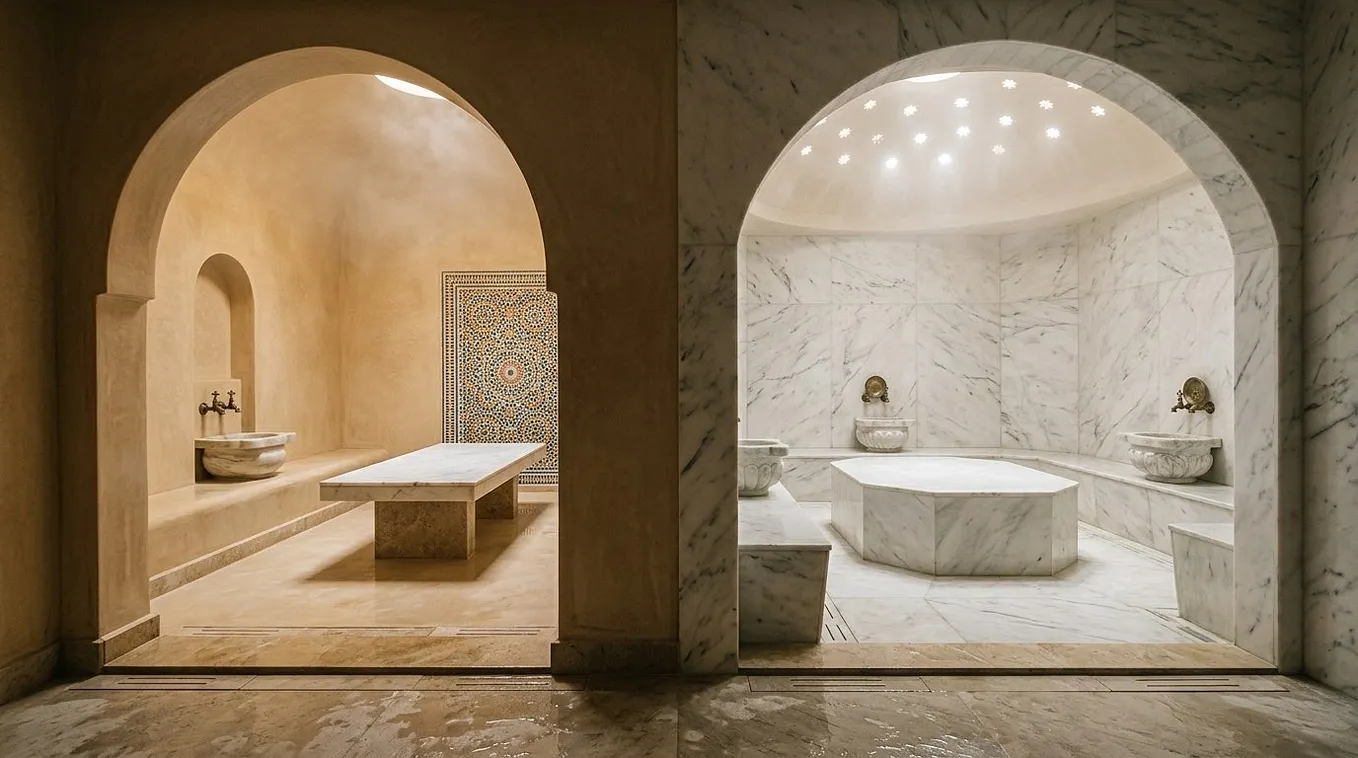
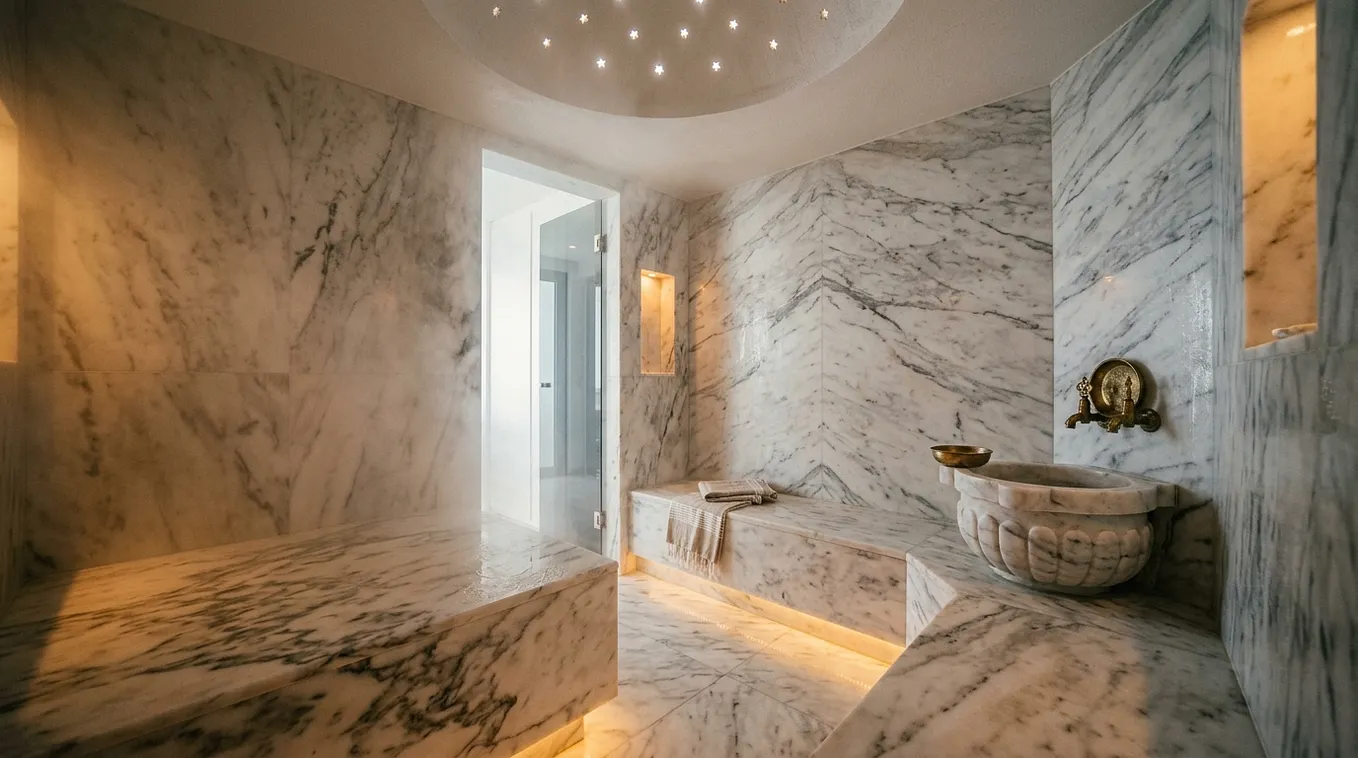
That is the whole difference between the acrylic column and the concrete column. An acrylic shell or an insulated foam board behind tile holds very little heat, so the face warms in minutes and the steam stays in the air. Concrete, brick and natural stone keep absorbing, which is why a stone-clad Turkish hammam sits at the heavy end of every manufacturer’s table, and why the board behind the tile matters as much as the tile itself. An insulated, vapour-tight backing is also what our steam room vapour barrier note is about; here it matters because it moves a room from one sizing column to a cheaper one.

What do the Condair, EOS and Tylö steam generator sizing tables say?
Three manufacturers, three formats, one pattern. Condair gives kg/h for “plastic” and “brick lined” cabins from 4 to 60 m³; EOS gives m³ for 4 wall types from 3 to 18 kW; Tylö gives m³ for light and heavy walls, with and without ventilation, up to 3 × 15 kW.
Each figure below is quoted from the manufacturer’s own document, and each belongs to that manufacturer:
- Condair Sigma installation and operating instructions (2598732, section 4.1.1): plastic cabin 12 m³ needs 10 kg/h, brick-lined 12 m³ needs 15 kg/h; 20 m³ needs 13 or 21 kg/h; 60 m³ needs 29 or 45 kg/h. Condair states that the table does not include losses in steam hoses and distributors, drain losses from water quality, or moisture absorbed by room materials.
- EOS SteamRock II: 3, 6, 9, 12, 15 and 18 kW against acrylic, tile on foam, tile on concrete and solid concrete columns; at 18 kW the range runs from 24 m³ of acrylic down to 12 m³ of solid concrete.
- Tylö Steam Home and Steam Commercial manual (2900 4162, Table 1): a 9 kW unit covers 4 to 10 m³ of heavy wall with ventilation and 6 to 16 m³ of glass or light wall with ventilation; a 15 kW unit covers 10 to 19 m³ of heavy wall with ventilation.
Tylö adds a line that matters more than any volume figure for a hotel: its Steam Home generator is recommended for a maximum of 3 hours of continuous operation, the Steam Commercial for 24 hours. A room that trades all day needs the commercial rating before it needs the right kW.
How do kilowatts convert to kilograms of steam per hour?
At about 1.33 kg/h per kW in the manufacturers’ own figures. Condair’s Sigma 8 draws 6.0 kW for 8 kg/h and the Sigma 15 draws 11.3 kW for 15 kg/h; Tylö lists 9 kW for 12 kg/h and 15 kW for 20 kg/h. Physics puts the ceiling near 1.38.
The physics is short. Taking 1 kg of water from a 15 °C supply to steam needs about 356 kJ of sensible heat and 2,257 kJ of latent heat, 2,613 kJ in all. One kWh is 3,600 kJ, so it can evaporate at most 3,600 ÷ 2,613 ≈ 1.38 kg.
So the published ratios run at about 96 % of the theoretical maximum, and the conversion works both ways. A Condair table asking for 21 kg/h is asking for roughly 21 × 0.75 ≈ 16 kW, and a 9 kW generator can never deliver more than about 12.4 kg/h however it is controlled.
Why do small rooms need more output per m³ than large ones?
Because surface area grows more slowly than volume. In Condair’s brick-lined column a 4 m³ room needs 8 kg/h, or 2.0 kg/h per m³, while a 60 m³ room needs 45 kg/h, or 0.75 kg/h per m³ — less than half the rate per cubic metre.
Converted with the Sigma’s own ratio, that is about 1.5 kW per m³ for the small brick room and about 0.56 kW per m³ for the large one. The 60 m³ room has 15 times the volume of the 4 m³ room but nowhere near 15 times the wall, floor and ceiling area, and it is the area that absorbs the steam.
This is why a single kW-per-m³ figure quoted without a room size is misleading. A rule that fits a 10 m³ hotel steam room will oversize a 50 m³ thermal hall and undersize a 3 m³ steam shower, and the tables are built as curves precisely to avoid that.
How much does ceiling height add to the generator?
Everything above the bench counts, because every table works in m³. On a 3.5 × 2.5 m plan, each extra 100 mm of height adds 0.875 m³; raising the ceiling from 2.4 m to 3.0 m takes the room from 21 m³ to about 26 m³, a quarter more steam for no extra seating.
The extra volume is also the least useful volume. Warm, saturated air collects under the ceiling, bathers sit below it, and a high void takes longer to fill before the steam reaches bench level at all.
A lowered, sloped ceiling in a commercial steam room is usually a sizing decision before it is an aesthetic one. Its drainage and slope are a separate subject; for the generator, what matters is that the ceiling line is fixed on the drawing before the kW figure is.
What do ventilation and the door cost the generator?
A lot, and Tylö’s table shows how much. A 9 kW unit covers up to 16 m³ of heavy wall without ventilation but only 10 m³ with it — about 37 % less volume for the same output. On light walls the drop is 24 to 16 m³, about a third.
Tylö asks for 10 to 20 m³ of fresh air per person per hour. The arithmetic behind the table is easy to reproduce. Saturated air at 45 °C carries about 65 g of water vapour per m³ (vapour pressure 9.59 kPa); conditioned supply air at 24 °C and 50 % relative humidity carries about 11 g. Every m³ exchanged takes roughly 54 g of water out of the room.
For 8 bathers at 20 m³ per person per hour, that is 160 m³/h, or about 8.6 kg/h of steam leaving through the extract — around 6.5 kW of generator output, before the 1 kW or so needed to warm that air. A commercial room is therefore always sized from the “with ventilation” column.
The door is the same loss in bursts. Each opening dumps saturated air, and a glazed door panel counts as light wall in the table, so a heavy room with a large glass front is partly a light room.
How long does a commercial steam room take to warm up?
Longer than the generator takes to make steam. Condair says its Omega produces steam in under 4 minutes from ambient; the room is another matter. Warming a 10 mm skin of tile and bedding in a 21 m³ room by 20 K takes about 4.3 kWh — roughly 11 minutes of a 24 kW supply.
That figure is our own arithmetic, not a manufacturer’s, and its inputs are stated so it can be checked: 46.3 m² of internal surface, 10 mm depth, a density of about 2,000 kg/m³, a specific heat of about 0.84 kJ/kg·K and a 20 K rise.
Take the same calculation 50 mm into a solid concrete or stone backing and it becomes about 21.6 kWh, close to an hour at 24 kW. That is why a heavy room still feels cold at the walls long after the air is full of steam, and why hotels with a morning opening time set the generator timer to start well before it.
Why is the steam line part of the sizing?
Because every metre between plant and room loses steam as condensate. Condair limits the Sigma’s steam hose to 4 m and budgets about 100 Pa of pressure loss per metre and per 90° elbow; Tylö asks for the steam pipe to be insulated where it runs longer than 3 m.
A generator in a remote plant room is a generator partly heating a corridor ceiling. The loss is not in the tables — Condair says so explicitly — so it has to be added by whoever lays out the plant.
Get Sauna Dekor Spa Solutions’s stories in your inbox
Join Medium for free to get updates from this writer.
Two drainage details follow from the same plant layout. Both Condair and Tylö drain their tanks hot, at 80 to 90 °C in Condair’s instructions and 80 to 85 °C in Tylö’s, so the drain run needs heat-resistant pipe with a constant fall. And the generator needs a floor drain beneath it or, in Condair’s words, a leakage monitoring device if there is none.
How does water hardness change the generator choice?
It decides how often a resistance-element generator stops for descaling. Tylö sets the thresholds in its manual: on a commercial unit, water above 4 °dH (about 71 mg/L as CaCO₃) needs a softener, and above 14 °dH (about 250 mg/L) a softener plus a reverse-osmosis filter.
Tylö’s descaling table puts numbers on the cost of ignoring that. For a 12 to 15 kW generator it gives:
- Softened water (0–1 °dH): 700 operating hours between descaling
- Very soft water (0–3 °dH): 350 hours
- Soft water (4–7 °dH): 170 hours
- Medium hard water (7–14 °dH): 85 hours
A hotel steam room trading 12 hours a day reaches 85 hours in about 7 days, and 700 hours in about 58. EOS builds an automatic descaling system with a 5 l descaler container into its SteamRock II for the same reason. In Dubai, Doha or Riyadh the mains supply is frequently desalinated, but it should still be measured at the spa’s own tap, not assumed.
Should the water be softened for every generator?
No — and this is where the generator’s heating principle matters. Condair’s Sigma is an electrode generator: the water itself carries the current, so it needs untreated drinking water of 125 to 1,250 µS/cm, and Condair asks to be consulted before it runs on softened water.
Resistance-element generators work the other way round. Condair describes its Omega as a resistive generator that makes steam “regardless of water quality”, and its Omega Pro as optimised for demineralised as well as drinking water; Tylö’s softener and RO thresholds assume resistance elements too.
The practical consequence for a Gulf project is that water treatment and generator type are chosen together. A very low-conductivity supply suits a resistive unit and can starve an electrode one — Condair offers a Sigma cylinder for 80 to 125 µS/cm water as a separate option. Tylö also notes that a softener raises conductivity while RO lowers it, and its generators drain automatically every 4 hours of operation by default to keep that conductivity down.

When do two or three generators beat one?
When the room outgrows one unit’s table, when steam must not stop during drain cycles, or when the electrical supply is easier to split. Tylö lists combinations from 2 × 9 kW up to 3 × 15 kW, the largest covering 47 to 63 m³ of heavy wall with ventilation.
The drain cycle is the argument most people miss. Tylö states that a single 15 kW commercial generator interrupts steam for about 11 minutes during its automatic drain. In a linked “Multisteam” installation the secondary units drain at 20-minute intervals after the primary, so at least 1 generator is always producing steam.
Two smaller units also let the steam enter the room at two points, which evens out a long room, and they leave half the room’s output running if one unit is out of service. Tylö adds a sizing note for the water side: the softener or RO unit has to deliver the combined water consumption of all generators, in l/h, not the consumption of one.
A single larger unit is not wrong. Condair’s Sigma runs up to 65 kg/h, about 48.8 kW, from one cabinet. The choice is about continuity and service, not capacity.
How would a 21 m³ tiled hotel steam room be sized?
Differently by each manufacturer, which is the lesson. Take a 3.5 × 2.5 m room with a 2.4 m ceiling, tile on a masonry backing, ventilated for commercial use: 21 m³. Tylö’s heavy-wall column with ventilation points to 2 × 12 kW, which covers 18 to 30 m³.
Condair’s brick-lined column gives 21 kg/h at 20 m³ and 24 kg/h at 24 m³, which lands on a Sigma 23 at 17.3 kW — before the hose, drain and material losses Condair tells the planner to add. EOS’s single-unit table stops at 16 m³ for tile on concrete, so this room is beyond one SteamRock II and needs EOS’s own advice.
Three answers — 17.3 kW plus losses, 24 kW, and “more than one unit” — for one room. None of them is wrong. Each table was written for its own generator, its own control strategy and its own assumptions about losses, so a specification picks one manufacturer and follows that manufacturer’s table from end to end. Mixing a Condair kg/h figure with a Tylö kW row is how rooms end up slow.

What does this not decide?
The generator’s own figures, first of all. Every number above is either quoted from a manufacturer’s document or worked out in the open; where a manufacturer’s installation manual differs from this summary, the manual governs, and the generator’s CE marking and EN 60335 conformity belong to its manufacturer.
It does not decide the electrical supply. A 24 kW load, split or single, is a separate calculation with its own protective devices, and it follows the generator choice rather than leading it.
And it does not decide the finish. Mosaic, large-format porcelain and natural stone all sit in the heavy columns of the tables if they are laid on masonry; what moves a room into a lighter column is the backing board and insulation behind the tile, decided early in the design of a commercial steam room.
Who is writing this
Sauna Dekor has designed and built thermal facilities since 1987 and is now in its 40th year, manufacturing in its own Istanbul facility at İkitelli OSB with 19 employees, working under TS EN ISO 9001:2015, with projects delivered in 35+ countries. At the Diplomatic Club in Doha we designed, built and installed the sauna, steam rooms, spa hot tub and pool areas. For steam rooms we work turnkey through our steam room design and installation services: the room shell, the insulated backing, the tiling, the benches, the ceiling, the steam and drain routes and the generator selection against the manufacturer’s table.
What we do not make is equally clear. Steam generators, their control panels, water softeners and RO units are not our products; they come from the equipment manufacturers we buy from, such as Condair and EOS, and any CE marking or EN 60335 conformity on that equipment belongs to its manufacturer rather than to us. The TS EN ISO 9001:2015 certificate is ours; the sizing tables are theirs.
Frequently asked questions about steam generator sizing
What size steam generator do I need for a 10 m³ steam room?
It depends on the walls. On EOS’s table, 10 m³ of tile on lightweight board fits a 9 kW unit, while 10 m³ of solid concrete and tile needs 15 kW. Tylö’s heavy-wall column with ventilation also reaches 10 m³ with 9 kW.
How many kW per cubic metre does a steam room need?
About 0.75 kW per m³ for an acrylic cabin, 0.9 for tile on lightweight board, 1.1 for tile on concrete and 1.5 for solid concrete, on EOS’s figures. Small rooms need more per m³ than large ones because surface area grows more slowly than volume.
How many kg of steam does 1 kW produce?
About 1.33 kg per hour in manufacturers’ figures: Condair’s Sigma 8 draws 6.0 kW for 8 kg/h, and Tylö lists 9 kW for 12 kg/h. The physical limit from a 15 °C water supply is about 1.38 kg per kWh.
Does ventilation change the steam generator size?
Yes, substantially. Tylö’s table gives a 9 kW generator up to 16 m³ of heavy wall without ventilation but only 10 m³ with it. At 20 m³ of air per person per hour, 8 bathers remove roughly 8.6 kg/h of steam.
Do steam generators need softened water?
Resistance-element generators usually do on hard water: Tylö requires a softener above 4 °dH on commercial units. Electrode generators such as the Condair Sigma need conductive drinking water of 125 to 1,250 µS/cm, and Condair asks to be consulted before softened water is used.
Is one large steam generator better than two smaller ones?
Not necessarily. Two linked units keep steam flowing while one drains — Tylö staggers drains by 20 minutes, against an 11-minute interruption on a single 15 kW unit — and they leave half the output running during service.
Sources
- Condair Sigma installation and operating instructions, 2598732–0 EN — Condair Group AG. Steam bath sizing table for plastic and brick-lined cabins from 4 to 60 m³, technical data from 4 to 65 kg/h, steam hose limits and water quality from 125 to 1,250 µS/cm. The figures belong to Condair.
- Condair steam bath generators overview — Condair. Heating principle of Omega, Omega Pro and Sigma, the 2 to 20 kg/h Omega range and steam in under 4 minutes. The descriptions belong to Condair.
- EOS SteamRock II Premium product data — EOS Saunatechnik GmbH. Room volume table for 3 to 18 kW across acrylic, tile on foam, tile on concrete and solid concrete construction, and the integrated descaling system. The figures belong to EOS.
- Tylö Steam Commercial 15 product page and installation manual 2900 4162 — Tylö. Table 1 room volumes for light and heavy walls with and without ventilation, water hardness thresholds, descaling intervals and Multisteam drain sequencing. The figures belong to Tylö.
- Enthalpy of vaporization — Wikipedia, 2026. Reference for the 2,257 kJ/kg latent heat of water used in the kW to kg/h conversion.
- Vapour pressure of water — Wikipedia, 2026. Reference for the saturation vapour pressure at 45 °C behind the 65 g/m³ ventilation calculation.
- Hardness of water — Wikipedia, 2026. Reference for the conversion of German degrees (°dH) to mg/L as calcium carbonate.