Session Design — Regulation Model
The artist-in-residence program at Vinyasa Earth focuses on documenting artistic insights in a research format to allow other researchers to cite artistic/non-scientific insights to support and expand the fields of study still to be explained by science. Nikita Chawda (Writer and Somatic Therapist), along with Abhishek Gore(Curator and Experience Designer), chooses to study A Collective Body: Relating to Move through Stress, Shame and Trauma as a topic of research in the 90-day residency. Following is one of the many insights drawn during this research.

There are so many aspects that can come to one’s mind when you are relating to yourself and others. One of the most important points of relating is how we feel and express our boundaries. Boundaries are relational in nature and because they are relational , they are supposed to be a bridge that helps us relate better instead of it creating a wall. Because we are always shape shifting in response to our environments and people — it is important to note that boundaries are also supposed to shift and remain flexible and if one wants to be able to stay un touch with these moving boundaries — it makes sense that we stay in relation with our bodies which lets us know , not only about our physical but emotional and mental boundaries through sensations.
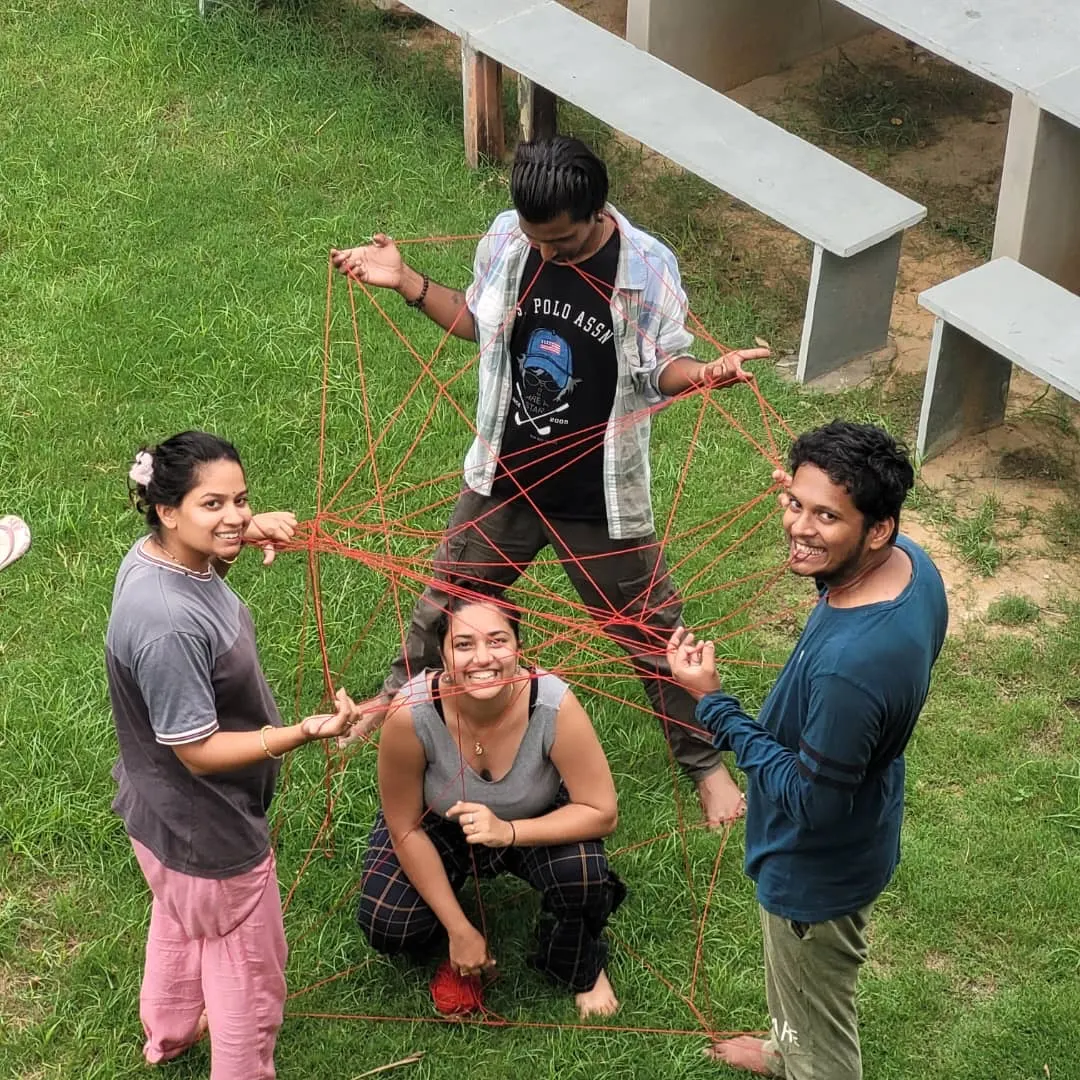
To be able to say yes or no or affirm our boundaries , we learn first how to stay in touch with our bodies with the boundary and we also stay in anchor with the response that comes up toward the yes or no , this practice allows us to learn about our boundaries and also responses that might be stuck in our body mind being , which in turn does not allow us to express it outside. Something such as a boundaries which are relational in nature , it is definitely something that we can explore with much more depth when we are in relation with humans around and trying to listen to our boundaries in this ways , this is exactly what we explored with the community and the following practice can be done in a group of 4–18 members and it is suggested to do this in an open space where participants can move their hands and legs freely.

Here are the steps for the practice
The intention of today’s practice is to come together and sense how our bodies show us the boundaries inside, if we just listen to the signs, symptoms and its language. From here let us begin to notice what our bodies are doing in response to the space, and slowly invite your awareness in your body.
Check in with different parts of your body (head, forehead, ears, neck, chest, spine, pelvis, thighs, knees, feet, back of the feet and from here notice how the NO is showing up in the body right now, where it is? Does it have a sensation? Does it have texture, does it have a movement? What does the no feel like?
Notice what your shoulders, your entire spine, jaw and knees are doing. As you are sensing into your body, go ahead and check in with your throat, and now we will slowly go ahead and say NO aloud, and we will check in with the body — and do it just one more time.
We will choose to sense into the body and go ahead and inquire — What does the body feel when you have said the NO? Do you notice thoughts, beliefs, feelings or emotions or just some unexplainable energy in the system or in different parts of the body.
Stay in touch with this, and we will take some time to extend our arms out in the front and back and one more time. Stay in touch with the response and we will go ahead and say NO one more time.
Then open your eyes , come back to the space, and slowly get up in our places and as our bodies find a stance and adjust itself , we will go ahead and walk in a circle here and notice the distance, pace that your body is choosing.
We will now move into pairing up with each other, and as you are standing with your partner , go ahead and hold each other by wrists — check in with your body , what pressure is okay ? What distance is okay ? It will let you know —
Now holding elbows and do the checkin in again and then we will hold onto shoulders — and do the check in again ,your body knows what feels safe and it will let you know if you just listen and stay with it.
Now, describe to your partner what are you feeling or anything particular in your body or any area of tension.
Slowly begin to open your eyes and let your gaze meet with your partner. Also feeling into the support this body brings to you and how you can bring support for this body here.
We will switch partners and repeat this and this time also stay in touch with your body — it will tell you what it is feeling uncomfortable with, so listen inside. And with this , we will go ahead and hold hands as a group, and now notice these hands that held you , these hands held other hands and how you all held each other here.
To bring this to a closing , we are thanking these bodies that held you, supported you and thank your own bodies for communicating and letting you know about the boundaries that are present here and letting you access this inside.

The Regulation Model
A Somatic Model for Allowing Self-Regulation
Regulation has become one of the most common words we hear today, especially in conversations about the nervous system. But what does regulation actually mean in everyday life?
Our bodies are designed to regulate themselves. Long before there were breathing techniques, mindfulness apps, or nervous system protocols, our bodies evolved in relationship — with nature, with movement, with safety, with touch, with community. Regulation is not something we force. It is something that naturally emerges when the conditions are right.
Have you ever felt a breeze gently touch your face?
Watched two birds chirping to one another as if sharing the morning’s gossip?
Seen a leaf surrender itself to the wind?
Watched a child skip down the road smiling at an invisible friend called life?
Felt the steady earth beneath your feet?
Noticed flowers swaying in the breeze?
Felt your body soften as you rested beside someone you love, your hand placed gently on theirs, sensing a quiet current of calm move through you, as though the whole world slowed down?
Heard the rhythmic sound of a knife meeting the cutting board while preparing a meal?
Noticed a tiny new leaf unfolding on your houseplant?
Watched someone you love laugh so freely that their whole body joined in?
Or simply felt safer because someone you care about was in the next room?
There are countless moments like these. They often pass unnoticed, yet they quietly shape our nervous system every day.
The invitation is not simply to see these moments. It is to notice what happens inside your body while they unfold.
What sensations arise?
Perhaps your chest softens.
Perhaps your breath deepens.
Perhaps your jaw relaxes.
Perhaps there is warmth, openness, expansion, or simply a little more space.
These sensations are not insignificant. They are the language through which your nervous system experiences safety.
Regulation is not the absence of stress. It is not feeling calm all the time. It is the capacity to move.
To move between activation and settling.
Between effort and rest.
Between joy, grief, excitement, anger, tenderness, uncertainty, and back again.
Like a stream, the nervous system is healthiest when it can keep flowing. The movement itself is health.
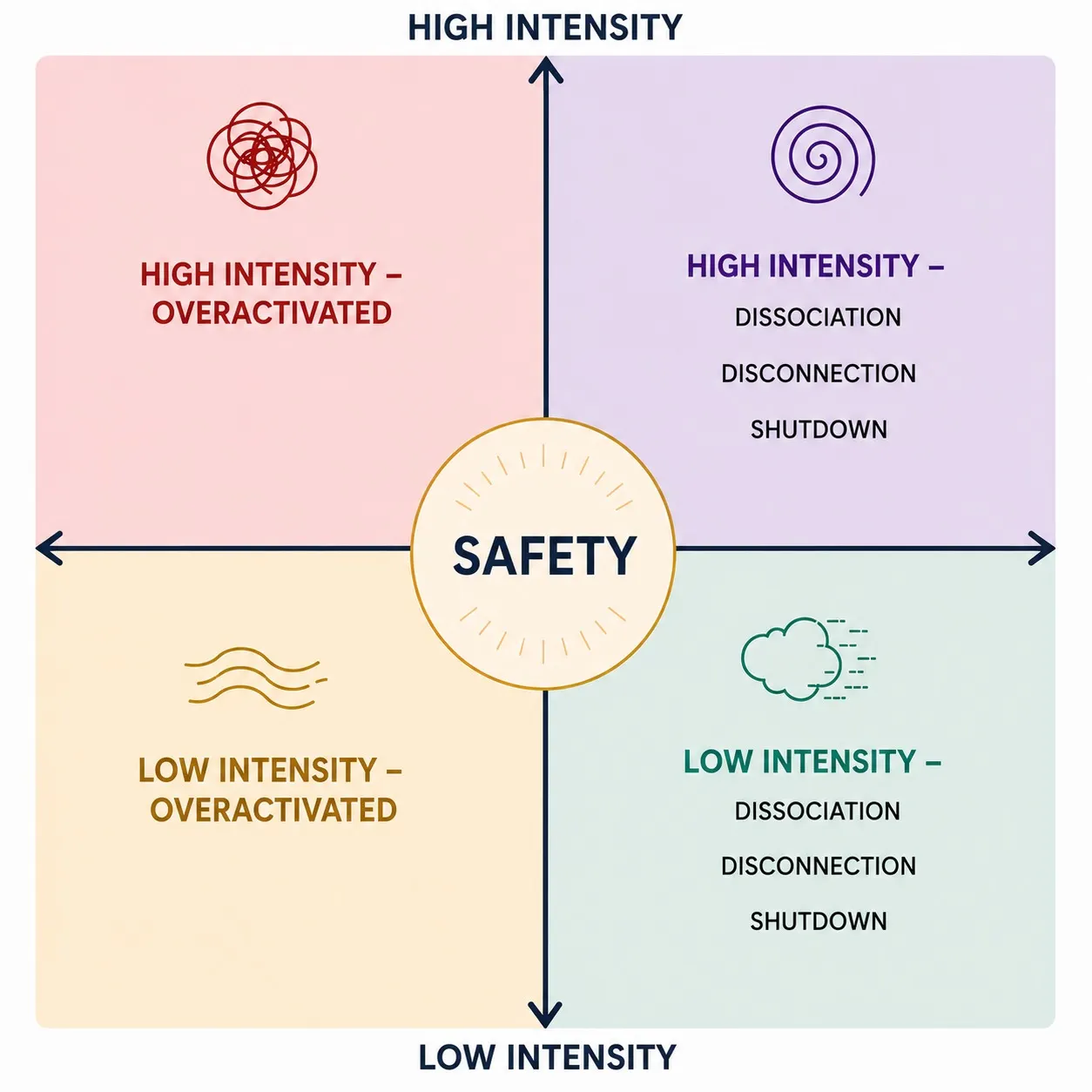
When this flow becomes interrupted for too long, our bodies begin protecting us. We may live in constant activation, always anticipating the next demand. Or we may shut down, become numb, disconnect, exhausted, or unable to feel ourselves fully. Information from the outside world can become overwhelming — or barely reach us at all.
These are not signs that the body has failed.
They are intelligent adaptations.
Our symptoms, behaviours, and even many patterns we come to label as pathology often begin as protective strategies. They are the body’s way of saying:
“I do not yet feel safe enough to return to flow. I am protecting you with the best strategies I know.”
The body is always communicating.
The question is:
Are you listening?
Are you noticing your body’s sensations before your thoughts explain them away?
Can you feel where energy lives in your body today?
Does it feel fast?
Heavy?
Buzzing?
Collapsed?
Expansive?
Curious?
Alive?
This is where somatic work begins — not by changing these sensations, but by meeting them.
From this understanding, I developed a simple framework that supports the body’s own capacity for self-regulation.
The Regulation Model
The body already knows how to regulate itself.
Our role is not to control it, but to create the conditions that allow regulation to emerge.
Receive
The first step to simply notice the space around your in terms of light , colors , textures , things , and naming it to them
The next step is to notice your body — not tracking for any tension or activation here but simply noticing where your body is in relation to the space and what are you noticing inside your body and in different areas like forehead , jaw , shoulders , hands , chest , belly , pelvis , knees , feet?
2. Contain
“Can I stay with what is here without becoming overwhelmed?”
Get Vinyasa Earth’s stories in your inbox
Join Medium for free to get updates from this writer.
Containment creates enough safety for sensations to exist without needing to disappear.
Whether the experience is activation — such as anxiety, racing energy, tension — or numbness, collapse, and disconnection, the first step is simply allowing the body to have an experience while feeling held.
Ways to cultivate containment include:
- Feeling your feet firmly on the ground.
- Leaning your back against a wall or chair.
- Wrapping yourself in a blanket.
- Placing one hand on your heart and one on your belly.
- Naming sensations instead of analysing them.
- Orienting to the room by slowly looking around and noticing colours, shapes, and light.
- Lengthening your exhale naturally without forcing it.
- Feeling the support of the floor beneath you.
Containment tells the nervous system:
“You don’t have to face this alone.”
2. Support
“What does my body need right now?”
Once sensations can exist safely, the body begins asking for resources.
Support is anything that increases the body’s sense of capacity.
Sometimes that means rest. Sometimes nourishment. Sometimes movement. Sometimes another human being. Support is deeply individual.
Examples include:
- Drinking water.
- Eating a nourishing meal.
- Feeling sunlight on your skin.
- Listening to birds or rain.
- Holding someone’s hand.
- Receiving a hug.
- Looking at trees or the sky.
- Gentle rocking or swaying.
- Slow walking.
- Stretching.
- Warm tea.
- Music.
- Prayer.
- A trusted therapist or friend.
- A pet resting beside you.
Support communicates:
“You don’t have to carry this by yourself.”
3. Express
“Now that my body has enough support, how does it want to complete this experience?”
Regulation is movement.
Energy that becomes trapped often seeks completion.
Expression allows the nervous system to finish what it began. Expression is not always dramatic. It can be incredibly quiet.
The body may naturally want to:
- Cry.
- Laugh.
- Shake.
- Stretch.
- Sigh.
- Yawn.
- Speak.
- Dance.
- Write.
- Create.
- Rest deeply.
- Sing.
- Breathe more fully.
- Move the hands.
- Walk.
- Be witnessed.
Expression is not about forcing emotion. It is about trusting the body’s own timing. As activation or numbness begins moving, the nervous system slowly reorganises itself.
This is self-regulation.
Not because we made the body regulate. But because we finally stopped interrupting its innate intelligence.
Healing, then, is perhaps less about fixing ourselves and more about becoming good listeners.
The body has been speaking all along.
The question is whether we are willing to hear its language.
Regulation is the body’s capacity to remain in relationship with the present moment while allowing internal sensations to arise, move, and resolve without becoming overwhelmed, disconnected, or chronically defensive.
Receive
Can I notice my body in the now space and the space around ?
Contain
Can I stay with myself?
Support
Can I care for myself?
Express
Can I trust my body?
To get more wellness models for daily life, follow us.
If you wish to purchase the somatics study done at vinyasa, where we explore and experiment different practices to be with the body, drop us a mail at vinyasa.ashram@gmail.com