Can an Above-Average Runner Become a Good Cyclist?
Discover what happens when a distance runner meets a wall of watts.


I’ve been an avid runner for the past three years, with solid performances in the half-marathon distance — a 1:46 in Prague and a 1:42 in Karlovy Vary. Running has always been my comfort zone. But it’s also a high-impact sport, and in 2024 — an injury-ridden year — my body made it clear: the pounding was adding up.
At my age, I’ve become more sensitive to the wear and tear that comes with regular training. That’s when cycling entered the picture — first as a form of injury prevention, then gradually as a new performance frontier. One year into training, I lined up for the 66 km short course at L’Etape Czech Republic. I finished in 2:46 — right around what I expected, but still a heavy serving of humble pie. It was a bottom-of-the-pack result that told me exactly where I stood.
Riding the L’Etape gave me a clear picture of my strengths and weaknesses. On the flats, I was cruising. I could easily overtake riders in my peer group. But every time the road tilted upward, the tables turned. I’d climb at the same perceived effort, only to watch the same riders breeze by me — again and again. After the third climb, we even shared a laugh: “Hello again.”
So what’s really going on here? Why does a strong runner get left behind on hills — and what does it take to close the gap? Let’s break down the crossover between running and cycling, and what it means to go from above-average runner to competent cyclist.
I. The Start — Calm Legs, Calm Mind
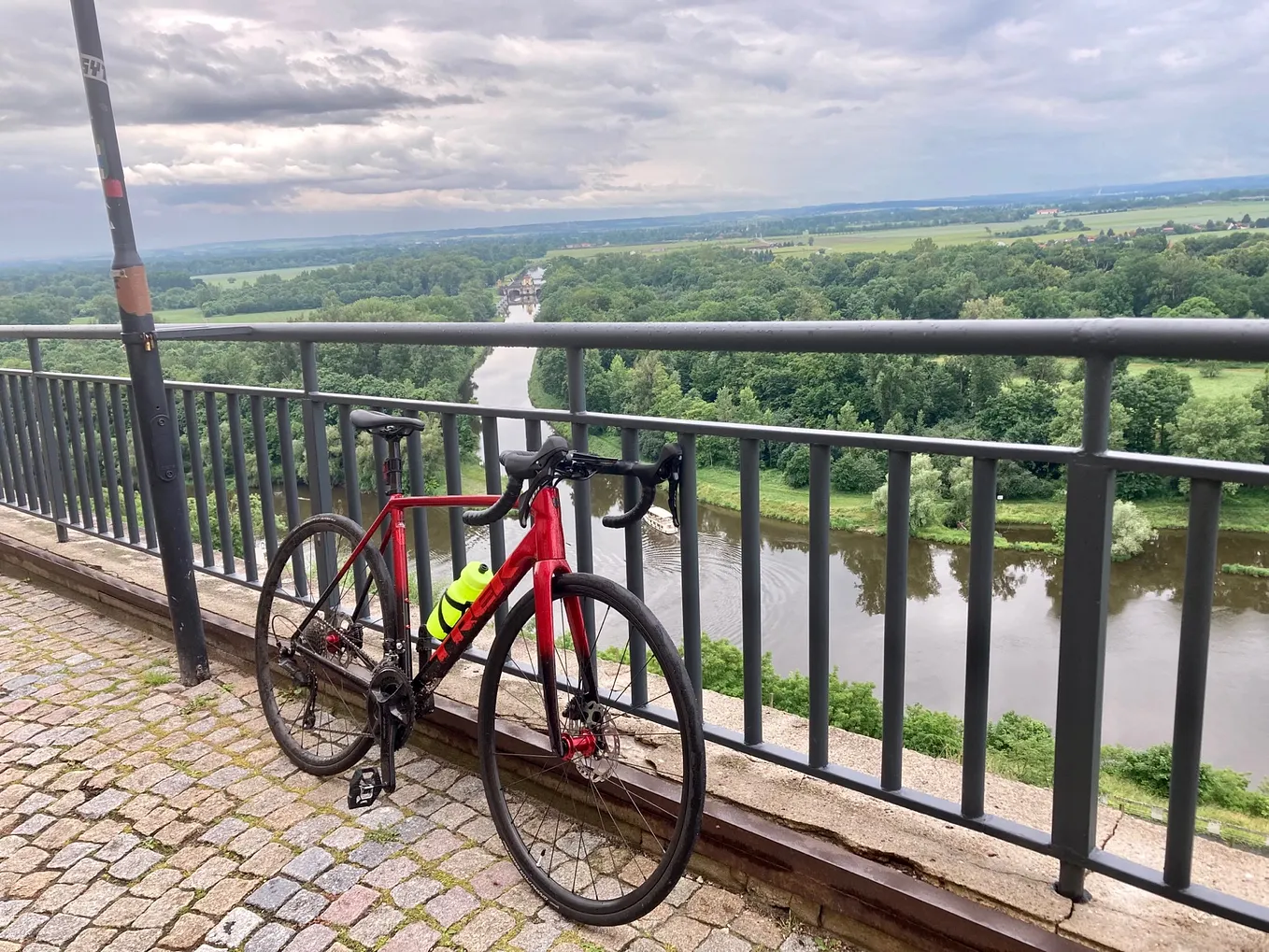
I’m usually nervous at the start line of a distance running event. Will I be able to hold the pace I trained for? What if my strategy falls apart? Can I really beat my last PB? But standing at the start of L’Étape Czech, none of that was on my shoulders. You can see it in the headline photo — I’m grinning. Just me, my Trek Émonda, and 66 kilometers of Czech countryside ahead.
After a year of cycling, backed by a solid base from distance running, I expected to finish in around 2:45. A recent group ride in the area pointed to the same.
I hadn’t managed to recon the course because I caught a bad cold on the day of the ride, so instead I studied the route in detail from home. I scrolled through Google Maps, noted sharp turns after descents, and rehearsed in my head how I’d pace each section.
In road running, I rarely think much about pacing. My approach is intuitive: settle in, stay relaxed, and pick it up when it counts. I started this race with a similar mindset — but I quickly learned that cycling is different. Drafting, positioning, gearing, gradient, even wind direction — they all influence how you ride.
II. The Flats — Running Fitness on a Roll
On the flats, I was flying. My breathing was calm, my cadence steady, and I felt right at home. Years of running had trained me to stay efficient, manage pace, and burn fuel wisely. As a result, I could hold my own — even overtake — during long, steady efforts.
But then came a stretch of cobblestones.
Naively, I’d pumped my tires to 95 psi, expecting the entire course to be smooth tarmac. I like the feedback of high pressure — it helps me feel the road, sense when the rear wheel slips through corners, and stay alert through bumps and cracks. But on cobblestones? I rattled through like a tourist on a city rental bike.
A rookie mistake. I was fast — but maybe not race-savvy yet.

III. The Hills — Where My Aerobic Engine Fell Short
The first timed KOM segment was 2.4 km at a 4.1% gradient. By cycling standards, that’s not especially steep or long. I’d trained on harder climbs, longer efforts. So I settled into a steady, moderate effort — but still, rider after rider floated past me.
Even when I hit my target power zones, I couldn’t match their speed. That’s when it clicked:
I had aerobic endurance — but not enough muscular endurance.
Runners don’t climb under load. Cyclists do. My training had focused on long, steady efforts at moderate intensity. But uphill cycling is different — it’s like strength training on repeat. Torque, not just tempo. My quads, hamstrings, and calves just didn’t have the conditioning of pure-bred cyclists.
As a result, I kept seeing the same riders again and again: I’d pass them easily on the flats, only to watch them glide by me on every climb.

IV. The Final Stretch — Digging Deep
The last 10 kilometers were brutal. I was drained — physically and mentally — and well past the point where I’d normally cross the finish line of a half-marathon. My knees started to niggle, and my hamstrings were starting to cramp. I had to stop twice to stretch them out.
I wasn’t bonking exactly — I had fueled reasonably well — but this race pushed beyond both the length and muscular stress I was used to.

There was another timed KOM segment near the end: 580 meters at a 7.8% gradient. Normally, I wouldn’t wince at that in training. But today, I was spent. I got off the bike and walked it. When I reached the top, a dedicated fan ran up and gave me a big push to get rolling again.
In the final stretch, a few descents gave me a chance to recover. And when the finish line came into view, I got out of the saddle and sprinted — finishing in 2:46 with a burst of energy that probably came more from pride than glycogen.

V. Reflections — Two Sports, Two Engines
After a few days of reflecting on my results, a few things became clear:
Get Zameer Razack’s stories in your inbox
Join Medium for free to get updates from this writer.
✅ My aerobic base from running transferred well
✅ My mental toughness helped in the final stretch
❌ My legs weren’t conditioned for sustained torque
❌ My endurance was runner-focused, not cyclist-calibrated
Long-distance running gave me the tools to manage effort, endure discomfort, and finish strong. But it didn’t prepare my muscles for the slow grind of climbing — or the sheer duration of a bike race.
Switching between running and cycling is more than just swapping shoes for cleats. It’s about developing two different modes of endurance: aerobic endurance, built through time spent in Zone 2, and muscular endurance, built through time spent with muscles under tension.
I laid a solid aerobic foundation as a runner. But to grow into a more proficient cyclist, I’ll need consistent training that specifically targets muscular endurance — especially on the climbs.
Beyond the physical shift, there’s a mental one too. In running, especially longer distances, I get into a flow. After 7 kilometers, I’m no longer consciously aware that I’m running. I trust my instincts and enjoy the ride. Cycling isn’t quite like that. You’re constantly adjusting — to wind, gradient, pack dynamics, cadence. Staying mentally present is part of staying efficient. It’s a different kind of concentration. And that’s exciting — I’m not just cross-training, I’m learning a different racing language.

VI. Next Steps — Building Muscular Endurance as a Duathlete
Realizing that muscular endurance was my limiter changed how I think about cycling training. It wasn’t strength I was missing — I’d already done low-cadence drills, hill repeats, and off-bike strength work for over a year.
What I lacked was the cycling-specific endurance to push under tension for extended periods, especially uphill or late in a race. It’s not just about how hard you can push — it’s about how long your muscles can keep pushing at a moderate effort without fading.
My Duathlon Schedule
My current duathlon plan already looks rather busy:
- Monday — Short Easy Cycle (2 hours) + Strength
- Tuesday — Running intervals
- Wednesday— Cycling intervals (Overgear or Sprints) + Strength
- Thursday — Short Easy Run (1:15 hours)
- Friday — Full Rest Day
- Saturday — Long Easy Run (2 hours)
- Sunday — Long Easy Cycle (4 hours)
Adjusting the Plan
My current duathlon structure has plenty of intensity already, and these workouts come with serious demands. They’re not just harder than what I’ve done before — they’re a different kind of hard.
To make them work, my coach and I restructured the week: Monday stays a short, easy ride, as it’s essential for recovering from the weekend with long runs and rides, and the muscular endurance efforts now land on Wednesday, replacing the usual cycling intervals.
Workouts We’re Exploring
- Sweet Spot Intervals
Effort: Upper Zone 3 to low Zone 4 HR, or a 7/10 RPE
— comfortably hard, just below threshold
Structure: 2–3 × 15–20 min intervals with 5–10 min rest
Why: Builds sustainable strength for climbs and steady efforts - Tempo Rides
Effort: Mid Zone 3 HR, or a 6/10 RPE
— a moderate, steady push you can hold for over an hour
Structure: 45–90 min continuous, or split into blocks
Why: Develops deep endurance and teaches pacing under fatigue - Over-Unders
Effort: Alternate 2 min at “hard but sustainable” (HR Zone 3–4),
then 1 min at “above comfort zone” (HR spikes briefly into Zone 4–5)
Structure: 3–4 × 10 min blocks, 5 min recovery
Why: Trains resilience to surges and lactic fatigue - Low-Cadence Climbs
Cadence: 60–70 RPM
Effort: Moderate to hard (Zone 3–4 HR / RPE 6–7/10)
Structure: 4–6 × 6–10 min climbs, 3–5 min spin recovery
Why: Builds leg strength and torque for hill efforts
Keeping It Sustainable
These workouts are demanding and stack onto an already full training load. To make this sustainable, I’ve found that mobility work, proper sleep, and truly easy runs and rides are non-negotiables. My coach also emphasized keeping an eye on overall fatigue, especially by monitoring heart rate variability (HRV) and resting heart rate (RHR) — regressive trends here often signal when it’s time to back off before fatigue becomes counterproductive.

VII. Conclusion — Duathletes Require Hybrid Engines
Training across two endurance sports has shown me just how differently the body responds to running and cycling. As a runner, I had a strong aerobic base and the mental grit to pace and push through fatigue. But on the bike — especially on the climbs — I learned that aerobic fitness alone doesn’t cut it.
Where running builds cardiovascular strength, cycling demands muscular endurance: the ability to produce steady power under tension, again and again. It’s not just about how fit you are — it’s about how specifically prepared your muscles are for the demands of the sport.
That’s the gap I encountered. And that’s the gap I’m now addressing through focused training — targeting Sweet Spot intervals, tempo efforts, and over-unders to build long-haul resilience in the saddle.
Even though I’m not competing in actual duathlons, I approach training like a hybrid athlete — running or cycling depending on the season, but always working to become stronger in both. With the right balance, both engines can grow — fueling better performance, smarter training, and a whole lot more fun along the way.