Featured
M S Subbulakshmi — Treasure of Instruments


“Her vocal communication transcends words. The cliche of ‘the voice used as an instrument’ never seemed more appropriate. It could fly flutteringly or carry on a lively dialogue with the accompanists.” — New York Times Review, 1966
In this essay, Jeetendra Hirschfeld states that Tanjore Vadivelu (of the Tanjore Quartet) and Balusvami Dikshithar (younger brother of Muthuswami Dikshithar) were the first to adapt the violin in Carnatic music. This was in mid nineteenth century. It is fascinating to learn that Akkammal was one of the first women to play the violin (which would have been in the late nineteenth century). And Akkammal was the grandmother of M S Subbulakshmi.
Akkammal’s daughter Madurai Shanmughavadivu, the mother of M S Subbulakshmi played the veena.

Tanpura
“Even her childhood games revealed her absorption in the art form. One of them started with tuning the tambura carefully until the plucked strings cast a spell with their resonance. Eyes closed, she was lost in another world. Then she stopped, sang without the tambura, and plucked the strings again to check if she had stayed true to sruti. Throughout the day, in between household jobs, she kept returning to the tambura to see if she could recall that pitch steadily and accurately.” — Excerpt from book MS & Radha

In this panel discussion on ‘Rethinking the Making of the Carnatic Voice’, Vijay Siva shares about getting an opportunity to hear the nadam (resonance) of M S Subbulakshmi’s tanpura and how everyone felt they could hear voice of MS in that tanpura and he adds that — ‘It is actually the opposite — the tone of the tanpura is reflected in M S Subbulakshmi’s voice.”
In a rare interview in the 1970s, MS said: “Students of music should devote their attention to the acquisition of purity in voice and strict adherence to the sruti.”[2]

“Sruti was her nature. She could never withstand not being in tune; she felt it was akin to sitting on needles. The way she tuned her two tamburas Lakshmi and Sarasvati and the way she maintained them were a sight to behold.” — R K Shriramkumar in article ‘An Excellent Teacher’ [1]

Miraj Tanpuras

In an article in Sruti Magazine titled ‘Sister Subbulakshmi’, T Sankaran (grandson of Veena Dhanammal) shared details about these 2 Miraj Tanpuras.
Get KavyaVriksha’s stories in your inbox
Join Medium for free to get updates from this writer.
The Six String tanpura on the right
“ The 6 stringed Tanpura — It was two tanpuras in one with a ravishing resonance. Her friend Jayalakshmi AmmaI decided that a strand of pearls and a six-stringed tanpura from Miraj would be just the things to give to someone who had come to be identified with the great Meera Bai. Several of us joined together at a private function to hand over the presents to the Meera of Madurai who acknowledged them by singing Ekkalatilum maravene (I’II never forget) in ragam Natakurinji.” — T Sankaran in Sruti Magazine

The 4 string Miraj Tanpura on the left
“This six-stringer acquired a companion when Semmangudi Srinivasa Iyer, who had one tanpura too many, decided that a Miraj tanpura he had should also go to MS. Its pegs were a bit out of joint and the bridge
was in disrepair but veena-maker S. Ramanathan of Ramjee & Co. in Tiruchi fixed it up tidily. Then Musiri Subrahmania Iyer added a
bit of glamour to it by replacing the wooden tuning beads with four tiny solid-gold horses. These horses originally belonged to the great
laya wizard Kanchipuram Naina Pillai.” — T Sankaran in Sruti Magazine
Veena
“Finally I bow before the Goddess of Music (with the Vina leaning on her left shoulder) who, as the Great Teacher, is the Giver of boons.” — Verse at conclusion of M S Subbulakshmi’s Presidential Address at the Music Academy in 1968

“The manner in which the svaras are woven into the various ragas of Karnataka music can best be studied by playing them on the veena. It is only the veena that can demonstrate the nuances of svarasthanas (the position of notes) and the part played by overtones and harmonics in our music. Students of music should make the veena their teacher.” — M S Subbulakshmi, in a rare interview in the 1970s [2]
MS learnt to play the Veena from her mother. Her sister Vadivambal used to also play the veena.
- Home recording of Veena Practice — MS and K S Narayanaswamy play O Jagadamba in raga Ananda Bhairavi
- MS also played a morning Veena concert along with mentor KSN at Madras Music Academy when awarded the Sangita Kalanidhi in 1968
Mridangam

M S Subbulaksmi learnt to play the mridangam from her brother Saktivel when growing up in Madurai.
Deepa Natarajan shared this fascinating anecdote that for an upcoming dance performamnce by Radha and Anandhi in Delhi that the mridangist suddenly could not come. And it was MS who trained the backup mridangist on playing all the jatis and that ‘MS actually also demonstrated playing the jatis on the mridangam while also reciting them!” [1]
Piano
“Amma sat down on the piano stool and started playing raga Darbari and then sang Hari Tum Haro accompanying herself on the piano.” — in response to S Thiagarajan’s question about how was it possible to compose a tune for Hari Tum Haro on a western instrument like a piano[1]
The music room in Kalki Gardens also had a grand piano. That was the piano that Piano Vadiyanathan used to compose hauntingly beautiful melodies such as Hari Tum Haro and the rarer Gaave Guni.
M S Subbulakshmi’s piano is now in the Kalakshetra musueum. Anil Srinivasan played a key role in restoring it.

Photos
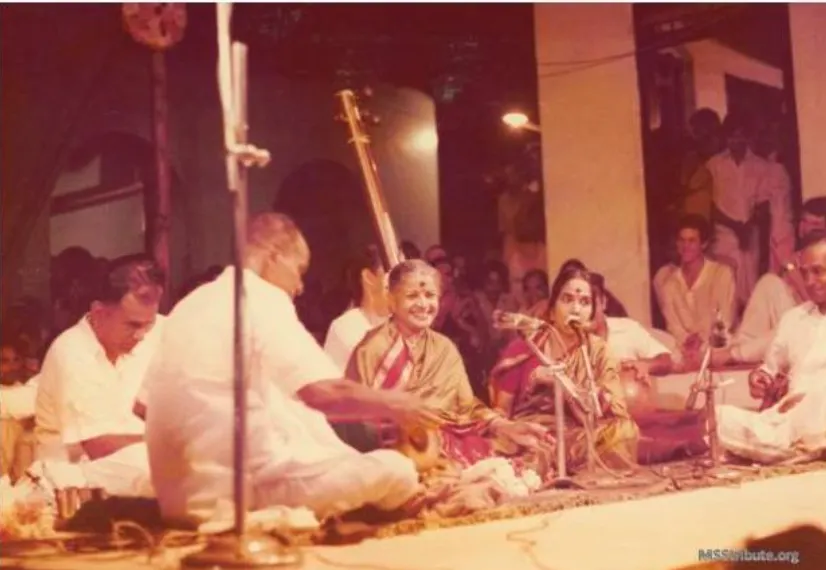
Photos are from the archives of Radha Viswanathan/V Shrinivasan. We thank Shri V Shrinivasan for his kind permission to share in this tribute
References
- Book — Song of Surrender, A Centenary Tribute to M S Subbulakshmi
- Rare Interview with MS in the 1970s