Fabricating Slack

Is your operational performance stuck in a rut? Get unstuck by fabricating organizational resource slack.
The idea of “slack” comes from Eli Goldratt’s famous book The Goal — Introduction to The Theory of Constraints. I have a well-loved copy of the business graphic novel version of The Goal. TOC is a management philosophy that focuses on identifying and managing a system's constraints (limitations or bottlenecks) to improve its overall performance and achieve its goals. The core idea is that a few constraints always limit a system, and improving these constraints is the most effective way to increase throughput.
In the TOC context, slack refers to the excess capacity or underutilized resources within a system, especially outside of the constraint. It represents the potential for work to be done faster than the rate at which the bottleneck (or constraint) can process it. Slack can be desirable or undesirable depending on whether it exists in bottleneck or non-bottleneck activities.
In an asset management context, slack provides degrees of freedom in managing resources to generate value from the organization’s assets. Some slack is desirable and necessary to improve performance.
Too often, our organizations get stuck in a situation where they lack enough resources to manage their assets’ expectations. In a TOC sense, our bottlenecks slow our productivity because we are resource-starved. It certainly feels like we lack the necessary resources. However, in many instances, this is an illusion.
I’ll give you an example. Years ago, I met with a plant manager when I was a large utility's principal reliability engineer. He told me his plant had too many PMs (preventive maintenance work orders) for his maintenance department to handle. He felt he didn’t have enough tradespeople or budget. This surprised me, as our operational performance benchmarking suggested our costs were too high and we had too many people, so I investigated.
Get Paul Daoust’s stories in your inbox
Join Medium for free to get updates from this writer.
I had our maintenance process specialists simulate all our PMs in our CMMS/EAM system (manually adding others that were not automatically triggered) over six years. I compared the total annualized PM hours to the available maintenance resources from the crew of 35 tradespeople. Guess what I found? We only had enough PMs to keep our people busy 13% of the time! That number is low for a mature maintenance organization.
When I shared this information with the plant manager, I asked, “What do you think the other 87% is?” I shocked him with my answer: reactive maintenance. I said, “You don’t have a problem with too many PMs; you have a problem with too much reactive work.” The problem was not a lack of people or budget. The problem was that they were stuck in a vicious reactive maintenance rut.
Initially, he wasn’t pleased that I had exposed his organization’s maturity gap, so I agreed to work with him to improve performance. We did this over time by substituting his maintenance team’s reactive work with proactive work. We got unstuck. We fabricated slack.
Reactive work is maintenance’s equivalent of Parkinson’s Law, which dictates “work expands to fill the available time”. If you don’t have enough proactive work available, then by definition, reactive work must fill the available work capacity. This is a gravity suck to mediocre performance where it feels like there isn’t enough resources, but that’s not the case at all. It is a scarcity of slack and a loss of any degrees of freedom, representing the inefficient and ineffective use of your vast and scarce resources. That is a problem worth solving.
The key to operational excellence in asset management is applying leadership’s agency to reallocate its finite resources to higher-value activities. This means shifting its vast and scarce resources from low-value activities (TOC’s non-bottleneck activities) to high-value activities (TOC’s bottleneck activities). When the activities are executed, problems get solved, freeing up resources (people, budget, and time). These freed resources generate slack in the organization’s resources. Some of that slack can be given to the organization’s stakeholders in the form of value. The remaining slack can be reinvested into the organization to solve more problems, generate more slack, and create more value.
This compounding effect from slack fabrication is the secret sauce. To achieve slack, we must reallocate our resources, solve more problems than before, and reallocate some more. It’s a recursive loop caused at the shop floor and equipment level, with the effects eventually felt at the plant’s bottom line as value is created, carved out without the need for additional resources.
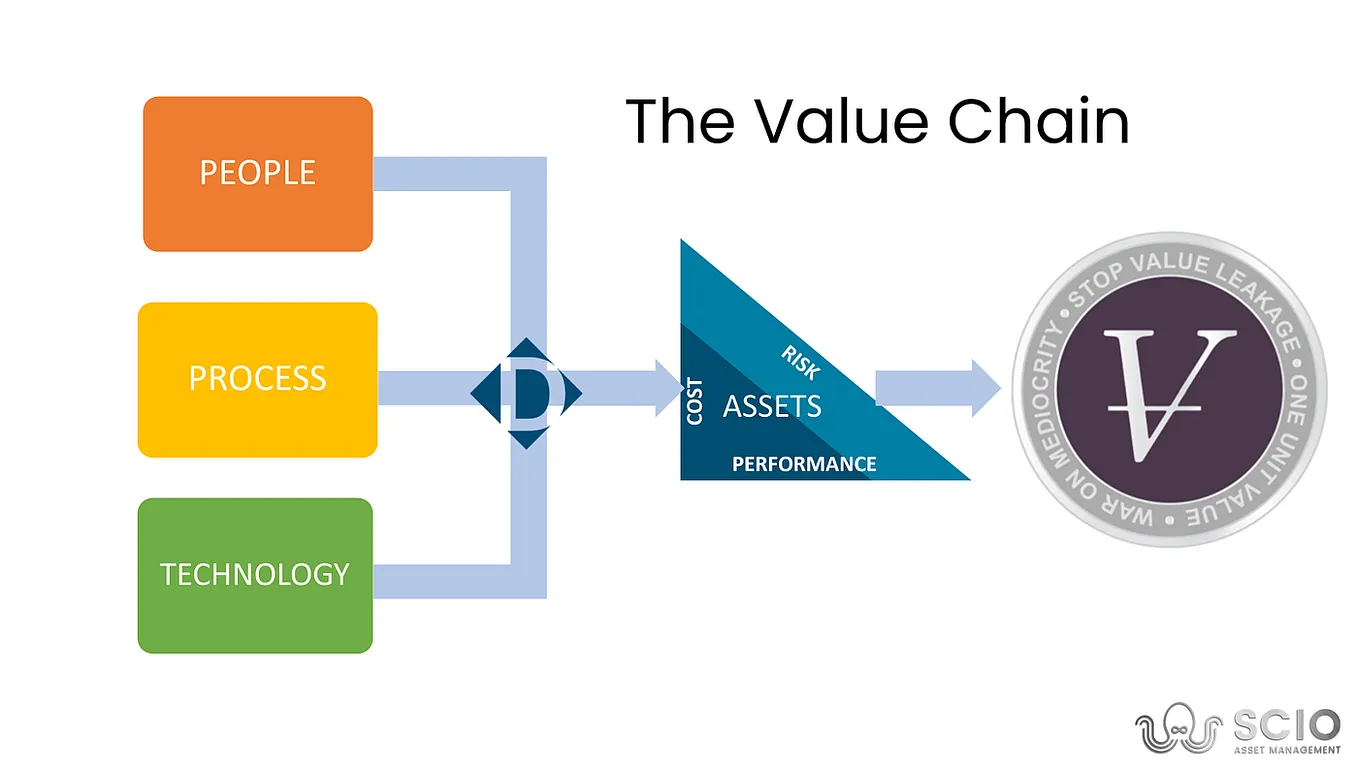
This doesn’t only apply to maintenance, only one of forty subjects in asset management. As a global attribute, slack gives you the freedom to get unstuck and supercharge your organization’s capability through competent people, quality process work rates and volumes, and technology utilization. It provides decision-making freedom to choose higher-value activities that increase asset performance, decrease costs, and limit risks across the lifecycle.
Slack is the objective because it gives us the degrees of freedom to deliver more value with fewer resources — the holy grail of asset management. Top performers provide a 3–5% annualized total shareholder return (TSR) premium. Isn’t that worth seeking? You already have the available resources in your current value leakage. Let’s discuss resource slack and how to fabricate it in your organization.
SEE. THINK. DECIDE. ACT.