Showing posts with label DMCA. Show all posts

Tuesday, 27 November 2018

THE COPYKAT

Internet service provider Cox Communications efforts to move the copyright infringement case it is facing from the American recorded music sector looks like it has failed after the judge in the case published a written statement explaining why he has resisted the shift. The case was filed in the Virginian court that had already heard the partially successful case brought by BMG Rights Management against Cox: BMG argued that Cox should be held liable for the copyright infringement of its customers, because it only paid lip service to its obligations under the Digital Millennium Copyright Act to be able to benefit from safe harbour protection. BMG prevailed at first instance and and whilst that ruling was set aside on appeal many felt the comments of the appellate court were more than useful to rights owners. Cox subsequently settled with BMG. Judge Liam O'Grady has declined to give the case up saying that it makes sense to hear the new action in the court where the BMG dispute was argued out, as many of the issues will be the same saying "Although defendants claim this court's ruling on the DMCA's safe harbour provision will not be relevant to this case, this court's prior ruling will at the very least touch on the issues presented here. The considerable judicial resources this court expended on reaching this ruling on an issue of first impression - a ruling that was upheld by the [appeals court] - cannot be ignored".  The 4th Circuit Court of Appeal said that the DMCA provides a degree of protection to ISPS and other platforms that respond expeditiously to takedown requests. But one of the requirements is that the ISP and other intermediaries to have "adopted and reasonably implemented … a policy that provides for the termination in appropriate circumstances of subscribers … who are repeat infringers" abd Cox wasn't entitled to rely on safe harbor because it did very little if anything even when told about repeat offenders.


Internet services company Cloudflare is also on the receiving end of another lawsuit in the US which could again test the liabilities of the net firm when it provides services to piracy websites - this suit from wedding dress makers Mon Cheri Bridals and Maggie Sottero Designs who are suing the net firm for contributory infringement because it allegedly provides services to websites based out of China that sell copies of the two companies' bridal wear to customers back in the US - and which uses pictures from the plaintiff's own websites to promote the counterfeit copies. The Recording Industry Association of America had previously accused Cloudflare of contributory copyright infringement and in a submission to a US government report on piracy, the RIAA states that: "[Piracy] sites are increasingly turning to Cloudflare, because routing their site through Cloudflare obfuscates the IP address of the actual hosting provider, masking the location of the site".

Universal Music has taken legal action over podcasts published by a global website for poker fans - PokerNews - which they say infringes their copyrights by including tracks controlled by the major label without permission. The major has sued PokerNews owner iBus Media (actually incorporated in the Isle of Man, a self-governing British Crown dependency in the Irish Sea between Great Britain and Ireland) for wilful copyright infringement in the Californian courts. The lawsuit states that: "Among the content made available by iBus Media on PokerNews, and through other forums, are hundreds of podcasts that intentionally incorporate significant portions of plaintiffs' copyrighted musical works". On the Pokernews website it does say “All Content published by PokerNews on the Site (apart from User-submitted Content), including, without limitation, images, photographs, graphics, animations, videos, audio and text . . . are owned by PokerNews and/or its licensors and is protected by copyright and other intellectual property or other proprietary rights.”  UMG clearly disagrees!

New Zealand's Minister of Commerce and Consumer Affairs Hon Kris Faafoi, has released an issues paper marking the first stage of public consultation on changes to the Copyright Act 1994, saying all Kiwis should consider taking part. “Copyright affects all New Zealanders. We create copyright works when we take a photograph, record a video, or write an email, and we use copyright works by watching a sports broadcast, streaming a movie, listening to music, or reading a book,” says the minister.


A group of Satanists who sued Netflix and Warner Bros for $50 million (£38 million) in a copyright row over the TV drama series Sabrina have "amicably" settled the lawsuit. The Satanic Temple claimed the entertainment giants copied its depiction of goat-headed deity Baphomet in The Chilling Adventures Of Sabrina. The only publicly released terms was that "The unique elements of the Satanic Temple's Baphomet statue have been acknowledged in the credits of episodes which have already been filmed."

MBW reports that  YouTube’s Global Head of Music, Lyor Cohen has called the implications of 'Article 13' into question within a monthly newsletter sent to a large group of industry executives as YouTube and Google continue to fight back against the planned copyright reforms in the EU. Cohen warned of what he sees as dangers surrounding the passage of the new European Copyright Directive – including provision Article 13, which would see platforms like YouTube become legally liable for copyright-infringing content uploaded by its users saying "“we believe that the current proposal will create severe unintended consequences for the whole industry. We still have a couple of weeks to work together towards a better final version of the law concluding that songwriters and recording artists might earn LESS money in the future if the reforms are implemented without change. In reply five major European music-industry trade organisations including the IFPI, the  ECSA  and IMPALA  fired off a strongly worded collective response titled “YouTube’s Fact Free Fear-Mongering" saying "“YouTube’s campaign against Article 13 of the Copyright Directive shows a lack of respect for the EU democratic process of law making ....[T]he revisions to the Directive have been under discussion for over four years already and the three main institutions of the European Union have all given their position. The Commission, Council and Parliament have all reached the same conclusion, that there is a value gap, also referred to as a transfer of value, where user upload services are making vast sums of money on creators’ content uploaded by their users, but not paying the right holders who own that content fairly. The result is a serious distortion in the European digital market place which harms right holders, other digital services and citizens. To correct that situation, platforms like YouTube should have to take responsibility for the content they use and monetize, by fairly remunerating their creators and right holders."  


One thing to add would be that even if YouTube were paying over a 'fair share' to the recorded music sector - are they in turn paying over a 'fair' share to the actual creators - the recording artistes? Many would say they receive a pittance and a tiny tiny share of digital revenues and little improvement has been made. Much still to think about! And does 'Big Content' need YouTube more than YouTube needs Big Content? More on this and the EU reforms from a BoingBoing perspective here .

A judge in the U.S. has issued a somewhat scathing opinion in connection with the activities of an alleged 'copyright troll'. In response to an early discovery request by Strike 3 Holdings, Judge Royce C. Lamberth describes the plaintiff as a "cut-and-paste" serial litigant whose lawsuits "smack of extortion". The company runs away at the first sign of a defense, he added, while noting his court is being used "as an ATM". TorrentFreak says that Strike 3 Holdings is one of the most active copyright trolls in the United States, filing more than 1,800 copyright infringement cases in the past 13 months. “Its feigned desire for legal process masks what it really seeks: for the Court to oversee this high-tech shakedown. This Court declines,” the Judge concludes.

AND finally....If you watch YouTube videos without a YouTube Premium subscription, you might have seen a recent pop up advert warning about article 13! And not to be left out of a strong reaction to the planned reforms,  and specifically Article 11, Google is threatening to (possibly) shut down Google News once news aggregators were subject to the 'link tax'.


Tuesday, 17 July 2018

The COPYKAT: "Faceswap" for the Statue of Liberty, trade wars, and embezzlement

It's been an exciting few weeks for copyright around the world. This CopyKat takes a look at three "David vs Goliath" disputes, in which parties (respectively) include the US Government, Fifa and an 8 year-old boy, and one of Africa's largest telecoms companies. Also in the news: YouTube rolls out its anticipated Copyright Match tool, copyright collecting societies in Kenya continue to struggle with accountability, and China launches an IPR awareness campaign.


Lady Liberty "faceswap" will cost the United States Postal Service $3.5M

Between 2011 and 2014, the United States Postal Service (USPS) used an image of the Statue of Liberty for its Forever Stamp series (a type of First Class postage stamp). Unfortunately for the USPS, the image they chose was not actually of the famous statue that towers over New York Harbor designed by French sculptor Frédéric Auguste Bartholdi in 1886. Instead, the image they chose was actually Robert S. Davidson's replica Statue of Liberty which looks over the New York-New York Hotel & Casino in Las Vegas. Davidson sued for – and won – nearly $3.5 (£2.6) million in royalties, plus interest.

As reported by Artsy, an eagle eyed stamp collector identified the mix-up in 2011. The USPS was made aware of the goof in 2013, but went on to print another 1.13 billion stamps with the replica’s image. For context, the judgement cited that the USPS made some $70 million in revenue resulting from sales of this Lady Liberty stamp alone.
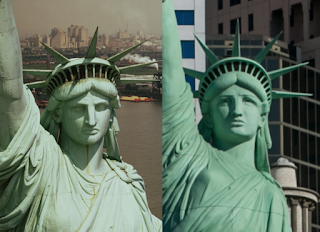
The statues in NYC (left) and Las Vegas (right).


The Post Office purchased the photo used on the stamp from the image service Getty for $1,500 (£1,140). However, the license only covered the rights to Getty's photograph of the statue — and not the statue itself. The USPS neglected to seek permission from Davidson, likely because they simply assumed what it was using was in the public domain.

In its defense, the USPS asserted that the statue is a replica and accordingly, contains no truly original work. If true, this would render Davidson’s copyright claim invalid, and the government would owe nothing for its use of the replica statue’s image.

Davidson was therefore tasked with proving that his copyright in the statue was valid, which under US law requires only a showing of “some minimal degree of creativity” and that it was his own “independent creation” of those original elements.

By way of reminder, the focus is on the expression of an original idea and not the idea itself (Oracle Am., Inc. v. Google Inc., 2014). As such, Davidson’s statue did not need to be wholly original, but rather a “new and original expression” of some previous work or idea – namely, the famous Bartholdi statue.

Davidson argued in his lawsuit that he wasn't trying to create a replica of the original, but rather to craft a fresher, more feminine version. As was later quoted in the ruling, he “envisioned his mother-in-law as inspiration ... and viewed her picture every night during the construction of the face of the statue."

The Court examined photographs and was satisfied that Davidson “succeeded in making the statue his own creation, particularly the face.  A comparison of the two faces unmistakably shows that they are different.” Ultimately, the Court agreed that Davidson’s statue “evokes a softer and more feminine appeal.  The eyes are different, the jaw line is less massive and the whole face is more rounded. “

The USPS’s defense that the stamp fell under the fair use exemption was rejected by the Court. As the USPS printed “billions of copies and selling them to the public as part of a business enterprise … so overwhelmingly favors a finding of infringement that no fair use can be found.”


In case you’re wondering how the USPS – which is a US government agency – can be successfully sued for copyright infringement, 28 U.S.C. § 1498(b) waives sovereign immunity for claims of copyright infringement against the federal government “for the recovery of his reasonable and entire compensation as damages for such infringement.”


YouTube's "Copyright Match" offers enhanced screening technology (for a selected few)

As the CopyKat mentioned last month, YouTube has been beta testing a feature called Copyright Match, designed to find re-uploads of content on other channels. The tool will point content uploaders (creators) to instances where their work has been stolen, and allow them to request that YouTube delete the guilty party’s video on the grounds of copyright infringement. Last week, YouTube channels with more than 100,000 subscribers received access to the new tool.

When a creator uploads a video to the Copyright Match tool for review, other video uploads on different channels will then be scanned to detect similar content has been uploaded. Fabio Magagna, the product manager for the Copyright Match Tool, explained on the YouTube Creators blog that “when there is a match, it will appear in the ‘matches’ tab in the tool and you can decide what to do next”.

Although YouTube already offers an automated copyright-flagging system called Content ID, Copyright Match is different because it’s designed especially for YouTube creators who have problems with unauthorized re-uploads.

By YouTube’s own admission, the Copyright Match is “a powerful feature,” which will be monitored closely in its early stages. Magagna noted that the software will continue to expand over the coming months, “with the long-term goal of making it available to every creator in the YouTube Partner program.” The company insists that takedown requests will be reviewed to make sure they comply with YouTube’s copyright policies.

The introduction of Copyright Match comes at a time of intense debate surrounding user-uploaded content on social media platforms such as YouTube. In particular, The European Parliament recently voted to reject a new copyright directive.  At the heart of controversy for many was Article 13, a section of the proposed directive that focuses on the use of copyrighted material uploaded by users.

And yes, in case you’re wondering: new YouTube video reviews of Copyright Match are already available to watch.


Fifa takes down celebratory World Cup dance video: is this a step too far?

The World Cup is the largest single sporting event on Earth, with nearly half the world’s population tuning in. With England’s (somewhat surprisingly!) good run up to the Semi-Finals, fans of the Three Lions were especially eager to show their support.

When England’s captain Harry Kane scored a goal against Tunisia, a mother filmed her 7-year old boy celebrating the moment. She subsequently posted the short 5-second clip of him dancing in the living room on Twitter. However, FIFA - Football's ruling body - ordered the clip removed from Twitter. FIFA claimed the clip infringed their copyright, as viewers could see blurred football action from the family's TV in the background.

Speaking to the Mirror, Kathryn Conn explained that her son “is a massive Spurs fan and he absolutely worships Harry Kane so he started dancing around in the living room. All you can see on the TV in the background is a really blurry replay of the goal. It's hardly visible."
England captain Harry Kane won the Golden Boot for most goals scored in the tournament.


According to Conn’s tweet on the subject, the copyright notice from Twitter was brought under the US Digital Millennium Copyright Act. Several sources including iNews report that Fifa issued a letter stating: “On behalf of Fifa, we hereby assert that your making available and/or promoting of the protected content on your platform is not authorised by Fifa, its agent nor the law and that your activities in this regard serve as a serious infringement of Fifa’s exclusive rights.”

By way of background, Fifa reports on its finances page that around 95% of its revenues come from the sale of television broadcasting, marketing, and licensing rights related to the FIFA World Cup.
From the 2014 World Cup in Brazil, Fifa hauled in $4.8 billion in revenue, which turned a $2.6 billion profit for the association (which is then re-invested into development projects). Compared to ticket sales earned $527 million, Fifa’s broadcast revenue topped $2.43 billion, while sponsorship fees brought in $1.6 billion.

To date, Fifa’s intellectual property portfolio contains 14,000 trade mark registrations, about 300 registered designs, and 150 copyright registrations covering 157 jurisdictions overall. As is made clear in its 30-plus pages of official guidance on brand protection, Fifa has millions of reasons to be protective of its intellectual property.

Fifa engages in active surveillance and brand protection, which includes court proceedings to halt an infringing situation and seek financial compensation for any damages suffered. However, sharing official content belonging to FIFA by fans without any commercial benefit is expressly permitted, as per the branding guidance. Curious by nature, this CopyKat’s therefore wonders why an account with barely 200 followers was singled out in this instance.


Did Safaricom steal Songa app from former employee?

Web developer Evans Gikunda has sued Radio Africa and Safaricom, accusing them of infringing his copyright when they launched a mobile app, Songa by Safaricom several weeks ago. Safaricom is a leading mobile network operator in Kenya, and its Songa music app enables subscribers “to get their local and international songs in one place and keep them consistently entertained and updated.”
Gikunda claims that he created the music app between 2012 and 2016. In 2013, while working as a developer at Radio Africa, the Chief Executive at Radio Africa Patrick Quarcoo “persuaded Gikunda to partner with him to ensure that the product gets to market” (IPKenya). According to Gikunda, Quarcoo proposed that that once Radio Africa’s Board of Directors sanctioned its participation in his app, they would share out the ownership of the app. The ownership was proposed at Radio Africa – 40%; Gikunda- 30%; Quarcoo- 20%; and the remaining 10% to a strategic partner.
In 2016 Gikunda left Radio Africa (under less than favourable circumstances) and says that after his resignation, Quarcoo sold the app to Safaricom without consulting him. Gikunda had not been “involved in the process at any stage, and neither has he benefited from it; despite the claims he created the platform” (innova8tiv). As with most intellectual property disputes arising between (former) employees and their bosses, establishing the ownership of the copyright subsisting in the Songa app lies at the heart of this matter. Gikunda is asking the High Court to compel Safaricom and Radio Africa to reveal how much money they have made from ‘Songa by Safaricom’ and is seeking damages.

To be successful in his claim, Gikunda will need to establish that he created his app outside the scope of his employment with Radio Africa, and that the app currently used by Safaricom is a reproduction or adaptation of his original app. To complicate matters, Gikunda’s app has been known under a variety of other names, including ‘NakedGroove’, ‘The Platform’, ‘The Music Platform’ and ‘RAMP’ – the latter being an abbreviation of either ‘Radio Africa Music Player’. Additionally, neither Gikunda nor Radio Africa obtained copyright registration, which further confuses the evidence.
This calls into question whether or not Gikunda made the program as part of his employment with Radio Africa (see also the work-for-hire doctrine), as well as the enforceability of moral rights for digital works. To achieve an injunction against the companies, which Gikunda is also seeking, he will need to prove that damages alone are an insufficient remedy.


Copyright woes continue for Kenyan collecting societies

Kenya's High Court

Elsewhere in Kenya, the complicated saga of the copyright collecting societies continues. Most recently, the High Court (pictured) ordered the Music Copyright Society of Kenya (MCSK) to account for the money it has collected as royalties and licence fees since January 1st 2017. Justices RN Sitati, DS Majanja and TW Cherere have given the MSCK thirty days to comply with the order (The Star).
In 2015, it was noted that MCSK's disbursement of royalties to artists has been decreasing for several years. The Kenya Copyright Board (KECOBO), the government organisation tasked with enforcing copyright in Kenya, established a minimum standard of 70% of revenue to be given back to artists. However, MCSK’s disbursement rates to musicians has fallen to 58.9% of collected revenue. Although MCSK was once Kenya’s largest royalty-collecting body, KECOBO revoked its licence in February of 2017 when MCSK failed to provide audited financial statements. The move came amidst allegations from local artistes over embezzlement of their royalties by MSCK.

As the CopyKat discovered back in May, Kenya is not the only African country to be experiencing problems with copyright collecting societies: power struggles with the Copyright Society of Nigeria (COSON) and the Nigerian Copyright Commission continue. 


Copyright awareness comes to China 

China has launched a four-month campaign to protect the intellectual property rights: you can visit the campaign website here. First announced in September, the campaign is seen by many as an attempt to alleviate major concerns among foreign investors, including those in the United States. 

China’s lack of strong intellectual property rights protection measures “frequently draw complaints from foreign investors and have been a long-standing focus of attention at annual talks with the US and Europe” (South China Morning Post). The Trump administration has officially launched a probe into alleged Chinese intellectual property theft which, amongst other things, led the United States to impose punitive tariffs on Chinese products. 

The campaign, which will last for at least four months, has been jointly launched by the National Copyright Administration of China (NCAC), the Cyberspace Administration, the Ministry of Industry and Information Technology and the Ministry of Public Security.

It will target key areas including unauthorized republication of news and plagiarism on social media, unauthorized broadcasting of copyrighted content on short video sharing apps, and copyright violations by setting up overseas servers. The campaign will also push service providers to enhance their internal supervision systems (China Daily).
Chairman Mao Memorial Hall in Beijing
In 2012, an article on Forbes argued that “IP protection will always be an uphill struggle in China and for companies doing business there,” as individual rights – including intellectual property rights – may be in some instances at odds with traditional Chinese society. 

A more recent Reuters article from April of this year explained that while Chinese IP protection laws are comparable to U.S. and European legal standards, the weakness lies in implementation, with high levels of bureaucracy. In particular, “court decisions applying on a provincial level rather than nationally, and judges often having different interpretations of the laws.”

In China, many consider that “even the education system works against an embrace of IP protection,” and until IP infringement is seen as an immediate threat to economic success, “few will really care.” Will a potential trade war be the impetus China needs to close the gap?

Tuesday, 27 February 2018

I thought I saw a COPYKAT ..........


The US Federal Court in New York ruled that it is possible to infringe the copyright by a simple action of embedding a tweet on a website. The case concerned a photo of Tom Brady (New England Patriots quarterback) with Boston Celtics’ General Manager Danny Ainge, which was taken by Justin Goldman and posted on his Snapchat. Shortly thereafter, the photo went viral and was uploaded by a number of users on Twitter. Since the story was newsworthy, a number of news organisations have embedded the link to these tweets on their websites. Goldman has filed a lawsuit against a number of online publications including Yahoo, Time and the Boston Globe for violating his exclusive right to display.


Following the 9th Circuit case Perfect 10 v Amazon, the general position of the US courts has been that the copyright liability rests with the entity that hosts the content that is infringing copyright on its server (the so-called ‘Server Test’), and not the party who links to that material.  According to 17 U.S. Code § 106(5) the author has the exclusive right to ‘display the copyright work publicly’.  Judge Forrest in her summary judgment has rejected the Server Test by saying that “when defendants caused the embedded Tweets to appear on their websites, their actions violated plaintiff’s exclusive display right; the fact that the image was hosted on a server owned and operated by an unrelated third party (Twitter) does not shield them from this result”. Additionally, she noted that the Copyright Act does not suggest that “possession of an image is necessary in order to display it. Indeed, the purpose and language of the Act support the opposite view”.

This decision, together with the potential appeal, is important for all producers of digital content. According to Defendants the Court’s ruling may “cause a tremendous chilling effect on the core functionality of the web”. On the other hand, the judge has observed that there are some questions whether publication of a photo on Snapchat means that the copyrighted work is effectively released into the public domain.


Following the last year’s petition the US Copyright Office is looking at the introduction of the exemption that would ease current Digital Millennium Copyright Act (DMCA) anti-circumvention provisions (renewed every 3 years) in relation to preservation of abandoned video games. Previously, museums, libraries and archives were able to preserve abandoned games by having a right to use emulators and other circumvention tools to make old games playable and keep them accessible. Now, several organisations, including non-profit Museum of Art and Digital Entertainment (MADE) requested for an additional exemption that will allow preservation of online video games. There is a big number of MMPORGs (Massively multiplayer online role-playing games) such as Star Wars Galaxies or City of Heroes, where copyright owners have decided shut down their servers and games cannot be played online anymore.  

On the other hand, major game publishers such as Electronic Arts, Nintendo and Ubisoft have asked the US Copyright Office not to create such exemption. The companies, represented by Entertainment Software Association (ESA), have opposed the proposed changes with a view that such exemption will allow other users to “recreate online game environments using server code that was never published in public”. This may allow ‘affiliates’ to replicate the game and allow everyone in the public to play them, activity for which the companies were previously charging their users. Additionally, as observed by ESA, MADE already charges the general public for the access to the museum, where the users can play the games for the whole day for a fee of $10. The Association says that “public performance and display of copyrighted works to generate entrance fee revenue is a commercial use”, within the meaning of Section 107 “even if undertaken by a non-profit museum”. With a growing market and popularity of retro video games, the US Copyright Office will have to consider arguments of both sides and decide whether to introduce this exemption.


The Council of the European Union, 12 months after the decision of CJEU that the European Commission had an exclusive competence to conclude agreements which affect common rules already in place (here European Copyright legislation), has adopted a decision to approve the ratification of the Marrakesh Treaty.

The Marrakesh Treaty to facilitate access to published works for persons who are blind, visually impaired, or otherwise print disabled, administered by WIPO, entered into force in September 2016. The agreement provides for set of international rules that ensure exceptions in the copyright law so that “blind and visually-impaired people (VIPs) can access cultural materials like books without hindrance” and governs cross-border exchanges. As an effect the publishers can lawfully reproduce materials in a format accessible for VIPs without the fear of being sued for copyright infringement. Following the ratification of the Treaty by the EU later this year, the Member States will be required to introduce adequate exception into their own national laws.


Since the Pirate Bay saga (more on it here) the prosecutors in Sweden have called for a tougher approach towards serious breaches of copyright law. The Swedish penalties comparing to those on the international level were considered to be low. Therefore, the Council of Justice in its report has proposed legislative changes that would create new criminal classification and crime divided into two levels, depending on its seriousness.

At the first level “[a] person who has been found guilty of copyright infringement or trademark infringement of a normal grade may be sentenced to fines or imprisonment up to a maximum of two years.” Whereas, in the case of large-scale infringement “a person may be convicted of gross copyright infringement or gross trademark infringement and sent to prison for at least six months and not more than six years”. To assess whether the crime was of ‘gross’ degree, under the new proposal the courts will take into account the amount of damage caused to the rightsholders, as well as any monetary gain made by the defendants.

The proposal also envisages the possibility of seizing property, either physical or intangible, such as domain names. As reported by TorrentFreak “’[t]his proposal is a clear nod towards the Pirate Bay case which dragged on for several years before the state was able to take over its thepiratebay.se domain”.

The proposed date for the amendments to enter into force is 1 July 2019.


Having recently observed a number of calls in Australia to reform its current copyright law framework and make it more suitable in the age of digital technologies, our attention turns now to New Zealand. Here, in June 2017 the Government has launched a review of Copyright Act 1994 to ensure that the “copyright regime is fit for purpose in today’s rapidly changing technological environment”. Recently, InternetNZ (a non-profit organisation) has launched a position paper, in which it seeks to update the copyright law framework and achieve a modern balance. As noted by the organisation, each new technology for copying that was introduced in the past years with the use of the internet (such as data and text mining, cloud computing), has been blocked due to lack of technology neutral exceptions to the copyright. InternetNZ CEO, Jordan Carter says that “the Internet has opened up new opportunities for creative New Zealanders”. Nevertheless, at the same time, uses of technology like cloud back-ups are likely to infringe copyright. Hence, in the view of InternetNZ, the new reform should introduce a more flexible open-ended ‘fair use’ style exceptions that will enable predictability in the use of copying technologies based on the ‘fairness’ test. The authors of the report suggest that the reform of copyright framework should aim to find a modern balance that will allow “the full benefits of both modern technology and local creativity”.


The US District Judge Michael Fitzgerald dismissed the action in the lawsuit brought by 3LW against Taylor Swift for stealing lyrics for the chorus of her song ‘Shake It Off’. The songwriters in their copyright infringement action claimed that the Taylor Swift’s song was based on the phrase "players, they gonna play, and haters, they gonna hate”, which was used in the song "Playas Gon' Play" by R&B girl group 3LW in 2001, and that combining those two ideas was original enough for the protection.

According to the Judge the lyrics in order to be protected by copyright must be more creative. He wrote that “the allegedly infringed lyrics are short phrases that lack the modicum of originality and creativity required for copyright protection”. In his view “combining two truisms about playas and haters, both well-worn notions as of 2001, is simply not enough”. He added that “the lyrics at issue (...) are too brief, unoriginal, and uncreative to warrant protection under the Copyright Act”. The songwriters were given the opportunity to file an amended lawsuit, however, as reported by CNBC, the attorney for songwriters would appeal Fitzgerald’s ruling to the 9th US Circuit Court of Appeals.


With only few days left before the 90th Academy Awards ceremony, amid the voting of the Academy, authors of ‘The Shape of Water’, Guillermo del Toro and Fox Searchlight were sued for allegedly copying the idea for their film.  According to the family of the late Pulitzer Prize-winning author Paul Zindel, the story of inter-species love has copied a number of copyright protectable literary elements from the plot of ‘Let Me Hear You Whisper’ play. The play as described by Daniel Zindel “also depicted a lonely cleaning woman who works at a lab, bonds with an aquatic creature and breaks him out after learning authorities planned to kill him”. 

Del Toro explained that the story of the film “and the layers are completely and entirely complex, interwoven with Russian spies, the Cold War, female friendships that are so complex and more important than that, which are completely original”. The lawsuit for copyright infringement came after the film has received 2 Golden Globe Awards and 13 nominations for the Academy Awards. Fox Searchlight in its statement said that the claims brought against them are “baseless, wholly without merit” and with a view to pressure the studio to quickly settle.  


Professor Jessica Litman
On 13th March 2018, the Centre for Intellectual Property and Information Law (CIPIL) is holding its Annual International Intellectual Property Lecture at Emmanuel College, Cambridge. In this year’s lecture Professor Jessica Litman, John F. Nickoll Professor of Law at University of Michigan Law School, will argue that when we think about the copyright system, our assumptions about legal property rights shape what we see and what we don’t. We assume that broadening or narrowing the scope of copyright will redound to the benefit or detriment of creators. Three hundred years of evidence, though, belie that supposition. We need to think more concretely about copyright law's actual effect on creators, and their ability to communicate and profit from their works.

This is an invitation-only event which will take place on Tuesday 13th March 2018 at 5:30pm. If you would like an invitation, or for further information, please contact CIPIL Administrator, Mr. James Parish cipil@law.cam.ac.uk

This CopyKat by Matt  Rachubka

Friday, 7 April 2017

DMCA, Moral Rights and Photography


A New York photographer has filed a copyright infringement suit in the Southern District of New York against a media company owning four news websites, claiming it used one of his photographs without permission to illustrate articles. The case is Theodore Parisienne v. Beasley Media Corp., Inc., 1:17-cv-02407.

Plaintiff is a professional photographer who took a picture of a man being pulled in an ambulance. The man had been struck by a subway in Queens, New York, after allegedly robbing a teenager of her smartphone. Plaintiff licensed the photo to the Daily News, who used it to illustrate its article about this event. The newspaper credited Plaintiff under the photograph.
The complaint alleges that Defendant reproduced the photograph on its four news websites to illustrate its own report on the subway robbery and accident. Defendant did not credit Plaintiff for the photography.

Plaintiff claims this is copyright infringement, as Defendant did not have permission to reproduce and to publicly display the image, in violation of Plaintiff’s exclusive rights under Sections 106 and 501 of the Copyright Act, 17 U.S.C. §§ 106 and 501. That is a classic copyright infringement complaint.

DMCA as a moral rights law

The complaint also alleges that Defendant intentionally and knowingly removed the copyright management information identifying Plaintiff as the author, which had been published under the photo in the Daily News website. Plaintiff claims that this violated 17 U.S.C. § 1202(b) protecting the integrity of copyright management information.

It is interesting to see that 17 U.S.C. § 1202(b), part of the Digital Millenium Copyright Act (DMCA), is becoming a sort of de facto moral rights law, providing authors with an enforceable right of paternity. We reported on several others cases where Plaintiff used the DMCA to enforce their right of attribution, which is a moral right, see here, here, and here.

U.S. law provides limited moral rights under the Visual Artists Rights Act of 1990 (VARA). VARA only protects “works of visual arts” which are defined by Section 101 of the Copyright Act, 17 U.S.C. § 101. Photographs are ”works of visual arts,”and thus within the scope of VARA, only if they were “produced for exhibition purposes only, existing in a single copy that is signed by the author, or in a limited edition of 200 copies or fewer that are signed and consecutively numbered by the author.”

This was not the case here. This is a picture taken on the spot, in the heat of action, as the man is pulled inside the ambulance by New York City emergency medical technicians. The purpose of the image is to inform. The author did not select the subject for its aesthetic value, nor did he direct the subjects to wear special clothes, to pose a certain way, nor did he have the time to select particular lightning or lenses.

That said, copyright law does not differentiate work of art from work of lesser aim. As Justice Holmes famously wrote in 1903, “[i]t would be a dangerous undertaking for persons trained only to the law to constitute themselves final judges of the worth of pictorial illustrations” and this certainly applies to photographs. As long as a photograph is original, it is protected by copyright, whether is a work of art or a news photo. These two categories sometimes overlap, as in this work by Weegee, but not always. As beautiful as Weegee’s works are [and ‘beautiful’ is not a legal concept], they were not taken for exhibition purposes and even they would be outside of VARA’s scope.

Will U.S. law ever provide comprehensive moral rights?

In our case, the work is protected by copyright, and the DMCA provides its author with a claim against Defendant for alleged falsification, alteration and/or removal of copyright management information, aka right of paternity. There is still no U.S. law which could serve as a substitute to provide authors a right in the integrity of their work, another moral right, and it is unlikely such law would ever be enacted in the U.S. The U.S. Copyright Office recently undertook a public study on moral rights for authors, specifically the rights of attribution and integrity. The public comments it has received so far are here. The U.S. Copyright Office has extended the deadline for the submission of written comments, which are now due no later than May 15, 2017.


Photo is courtesy of Flickr user Dade Freeman under a CC BY-NC-ND 2.0 license.

Friday, 17 March 2017

Sports Photographer: Don’t Mess with My Copyright


Photographer Rogelio Albert Pena was at the right place at the right time on May 16, 2016, when baseball player Rougned Odor, playing for the Texas Rangers team, punched Jose Batista, of the Toronto Blue Jays, during a game. Mr. Pena was able to capture the moment when Jose Batista was hit in the face so roughly by Rougned Odor that he lost his sunglasses and his batting helmet. Baseball is a non-contact sport, but the benches occasionally clear for an on-field brawl.
Plaintiff discovered that Defendant, a Dallas celebrity sports and gift store, is selling framed copies of the photograph, with a “Rougned Odor: Don’t Mess With Texas II” caption below the picture. These framed photos do not identify Plaintiff as the author of the work. Plaintiff has not licensed his work to Defendant and had not authorized such a derivative work to be produced and sold.

On March 13, 2013, Mr. Pena filed a copyright infringement suit in the Southern District of New York against Celebrities Unlimited, claiming that it is selling copies of the photograph without authorization, and without displaying the name of the author. The case number is 17-cv-1853.

Plaintiff is claiming that by producing, publicly displaying, and selling these framed photos, Defendant infringes on his copyright and is seeking up to $150,000 per work in statutory damages. Plaintiff further alleges that, by removing and altering the copyright management information which identified Plaintiff as the author of the photograph, Defendant violated Section 1202(b) of the Copyright Act, 17 U.S.C. § 1202, which prohibits to “intentionally remove or alter any copyright management information.” Plaintiff published the photograph online, and was credited as its author.

What could Defendant argue in defense? The defense of fair use is likely to fail, unless Defendant can prove that the work is not protected by copyright. The use of the photograph is commercial (fourth factor) and Defendant used the entire work protected by copyright (third factor). The nature of the original work, the second factor, is debatable: is the work a photograph which Plaintiff snapped just at the right time, or is it an original composition?

The composition of the photograph resembles the one of a baroque painting: the two players are seen each on a different side of the work, not at its center. The arm of the player in blue enters the space of the player in red, in a diagonal, and the arm of the player in red enters the space of the player in blue, in diagonal. The leg of the player in blue enters the space of the player in red, in a diagonal, and the leg of the player in red enters the space of the player in blue, in diagonal. Both players sport beards. One player is in red, the other one in blue. The player in red is the one punching the player in blue. The red uniform has blue elements. The blue uniform has red elements, including in the helmet seen flying away. The sunglasses have reddish lenses.

Is this photograph “the product of plaintiff's intellectual invention, of which plaintiff is the author,” as is the photograph of Oscar Wilde that, in 1884, the Supreme Court found worthy of copyright protection in Burrow-Giles Lithographic Co. v. Sarony? In this case, the Supreme Court detailed the choices made by the photographer, such as “selecting and arranging the costume, draperies, and other various accessories in said photograph, arranging the subject so as to present graceful outlines, arranging and disposing the light and shade, suggesting and evoking the desired expression, and from such disposition, arrangement, or representation, made entirely by plaintiff, he produced the picture in suit." Plaintiff in our case did not select the player’s uniform, their stance, their expression, or the other accessories.

The photography at stake here is registered with the Copyright Office, and this registration is prima facie evidence that it is protected by copyright, However, 17 U.S.C. § 410 (c) states that, “[t]he evidentiary weight to be accorded the certificate of a registration made thereafter shall be within the discretion of the court.” In others words, the court may decide that a work registered with the Copyright Office for less than five years is indeed protected by copyright. Defendant may thus use as a defense a claim that the work is not protected by copyright. Plaintiff would then have to prove that the work is indeed the product of his intellectual invention… Did he alter it after taking it? Did he emphasizes the colors or the shadows of the works, crop it to emphasize the dramatic moment?

If the court would find that the work is not protected by copyright, it would grant Defendant’s motion to dismiss (yet to be filed). Game over. If it would find the work to be indeed protected by copyright, then Defendant’s last chance would be to prove that its use of the photograph was so transformative that it is fair use, under Section 107’s first factor. As explained by the Supreme Court in Campbell v. Acuff-Rose Music, Inc., a work is transformative if it alters the original work by adding "new expression, meaning, or message.” A satire or a parody is transformative: is the comment added under the picture enough to make it a satire, of say, Texas?

Defendant, though, has a few innings ahead. He should not hire a rookie lawyer if he does not want to strike out.

Monday, 17 October 2016

The Copykat: what Tibbie has to tell us this Monday


This blog post is the first written by our new intern, Tibbie McIntyre.


“And if you hurt me – Well, that’s okay baby, only words bleed”

Ed Sheeran won’t be quoting his international hit ‘Photograph’ anytime soon in relation to his current lawsuit in front of a California federal court.

Ed Sheeran et al are currently attempting to have the ‘Photograph’ case - worth $20m - dismissed on administrative grounds. Sheeren’s hit, ‘Photograph’ is alleged to infringe ‘Amazing’, recorded and released by Matt Cardle, winner of the 2010 season of The X Factor.


As a lawyer, solving your client’s issues quickly and cost-effectively is the best way to keep them happy. That’s why the initial litigation strategy employed by most defending lawyers is to attack the basis of the complainant’s claims. Where a defendant is said to be infringing a patent, her lawyers will probably try to argue that there was never any patent in the first place. In copyright cases – the same holds true – with one side probably arguing that copyright never subsisted in the work in question.

In this particular case, Sheeran’s lawyers have plead to have the case dismissed, asserting – as filed on 7 October – that the lawsuit consists of “vague, disorganized, redundant, argumentative and scandalous allegations”, which “defy the most fundamental pleading requirement of providing short, concise and plain statements”. The second prong of attack taken by Sheeran’s lawyers is to take issue with “unduly vague allegations that “certain Defendants” performed certain unspecific acts without any effort to distinguish between the eleven different Defendants”.

With the ‘Blurred Lines’ decision having been roundly criticized since its release because no melody or harmony features were similar in either of the two songs, attempting to have the case dismissed at this early stage is a prudent move from Sheeran’s lawyers. The original complaint in Sheeran’s case states that the alleged copying was “on a breathtaking scale” and was in fact “in many instances, verbatim, note-for-note copying.” We will watch this case with interest.

The doctrine of exhaustion of distribution rights in computer software does not apply to back-up copies (copies held on a non-original medium).

The Court of Justice of the European Union (CJEU) ruled on October 12 that the doctrine of exhaustion of distribution rights in computer software does not apply to back-up copies.

Ranks et Vasiļevičs is a case concerning two Latvian nationals who are alleged to have sold copyright-protected Microsoft software on an online marketplace between 29 December 2001 and 22 December 2004 (see also here).

The questions put before the court were “whether Article 4(a) and (c), and Article 5(1) and (2), of Directive 91/250 must be interpreted as meaning that the acquirer of a used copy of a computer program, stored on a non-original material medium, may, under the rule of exhaustion of the rightholder’s distribution right, resell that copy where (i) the original material medium of that program, acquired by the initial acquirer, has been damaged and (ii) that initial acquirer has erased his copy or ceased to use it.”

Essentially, the court’s ruling states that:

  • An initial acquirer of software under an unlimited user licence is entitled to resell the software to a new acquirer under the doctrine of exhaustion of distribution right. Importantly, however, the software being resold must be stored on the original material medium.
  • In contrast, copies of software stored on a non-original material medium (i.e. backup DVDs/CDs/floppy disks) cannot be resold without the authorisation of the rightholder, even where the original material medium has damaged/destroyed/lost.

The CJEU emphasizes that the rightholder has an exclusive reproduction right under Art 4(1) of Directive 91/250. Exceptions to this right are found in Art 5 of the Directive, therefore the initial acquirer of software under an unlimited user licence – in certain circumstances – is entitled reproduce the software. The crux of this case is that the CJEU states that exceptions to exclusive rights must be interpreted strictly, according to settled case law of the Court (Painer, C‑145/10, paragraph 109).

Electronic Frontier Foundation calls on internet users to petition to reform the Digital Millennium Copyright Act’s pro-DRM provisions

The Electronic Frontier Foundation (EFF) is preparing comments in response to the U.S. Copyright Office’s request for additional comments in connection with its ongoing study on the “anti-circumvention” provisions of the Digital Millennium Copyright Act (DMCA).


As reported here by Ben, under Section 1201 of the DMCA, people attempting to fix a broken object subject to some sort of protection measure can be sued for violating copyright law. The consequence being that manufacturers can hold consumers to ransom – dictating who can fix consumer products and how much consumers need to cough up for the privilege.   

Corynne McSherry, EFF’s legal director, writes:

"In practice, the DMCA anti-circumvention provisions haven’t had much impact on unauthorized sharing of copyrighted content. Instead, they’ve hampered lawful creativity, innovation, competition, security, and privacy. … People are realizing how important it is to be able to break those locks, for all kinds of legitimate reasons. If you can’t tinker with it, repair it, or peek under the hood, then you don’t really own it—someone else does, and their interests will take precedence over yours.”

EFF is drafting comments that it hopes will result in a strong and practical set of recommendations. You may read more the issue or sign the petition here, and read more on how to contribute your own thoughts/ideas to the Copyright Office here.