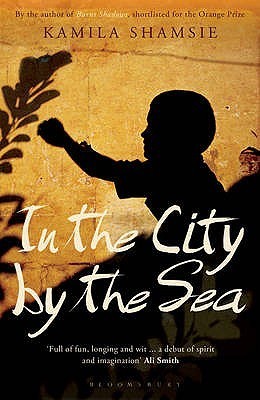
Hasan is eleven years old. He loves cricket, pomegranates, the night sky, his clever, vibrant artistic mother and his etymologically obsessed lawyer father, and he adores his next-door neighbour Zehra. One early summer morning, while lazing happily on the roof, Hasan watches a young boy flying a yellow kite fall to his death. Soon after, Hasan's idyllic, sheltered family life is shattered when his beloved uncle Salman, a dissenting politician, is arrested and charged with treason. Set in a land ruled by an oppresive military regime, this eloquent, charming and quietly political novel vividly recreates the confusing world of a young boy on the edge of adulthood, and beautifully illustrates the transformative power of the imagination.
Kamila Shamsie was born in 1973 in Karachi, where she grew up. She has a BA in Creative Writing from Hamilton College in Clinton, NY and an MFA from the University of Massachusetts, Amherst. While at the University of Massachusetts she wrote In The City By The Sea, published by Granta Books UK in 1998. This first novel was shortlisted for the John Llewelyn Rhys Award in the UK, and Shamsie received the Prime Minister’s Award for Literature in Pakistan in 1999. Her 2000 novel Salt and Saffron led to Shamsie’s selection as one of Orange’s “21 Writers of the 21st Century.” With her third novel, Kartography, Shamsie was again shortlisted for the John Llewelyn Rhys award in the UK. Both Kartography and her next novel, Broken Verses, won the Patras Bokhari Award from the Academy of Letters in Pakistan. Burnt Shadows, Shamsie’s fifth novel, has been longlisted for the Orange Prize for Fiction. Her books have been translated into a number of languages.
Shamsie is the daughter of literary critic and writer Muneeza Shamsie, the niece of celebrated Indian novelist Attia Hosain, and the granddaughter of the memoirist Begum Jahanara Habibullah. A reviewer and columnist, primarily for the Guardian, Shamsie has been a judge for several literary awards including The Orange Award for New Writing and The Guardian First Book Award. She also sits on the advisory board of the Index on Censorship.
For years Shamsie spent equal amounts of time in London and Karachi, while also occasionally teaching creative writing at Hamilton College in New York State. She now lives primarily in London.
This was twenty five year old Kamila Shamsie's debut novel.Possibly her worst book,but it still made it to shortlists for literary prizes.
I was very surprised to know that this less than mediocre offering was prescribed reading in some schools.
The city by the sea is not named,but it's Karachi,of course.It appears again and again in Shamsie's books.It is not the easiest place to live,given its endless violence.
Some people love Shamsie's prose,it feels very artificial and off-putting to me. This book never really got going.Made me yawn and try to speed read,but it didn't work.It was snail paced.
Shamsie takes aim at the military regime of General Zia ul Haq,which imprisons a dissident politician.Zia was a dictator,but the politicians were not that great either.Hard for me to care about the politician.
An eleven year old boy is the nephew of the politician,who witnesses this trauma and the death of a neighbourhood kid in a kite flying accident.Those are the principal events,around which hundreds of pages are written.
But it was hard for me to feel involved,given the general lack of plot and coherence.It is a first book,and it shows.
Quite a slog,dull,slow and plodding.It's all over the place,a book for die hard Shamsie fans only.
I’m almost tempted to leave this book unrated, because I’m so confused about how I feel for it. It’s neither a particularly good book, nor a really bad one. I didn’t hate reading it, but nor did I enjoy it all that much. There were some moments of plot stupidity, but they were balanced by sudden, smart writing. Basically, if you asked, I would have no idea whether to recommend this book to you or not.
The one coherent thought I had while reading this was that a lot of people might not really like this, and that’s because this isn’t really a plot-driven novel. This is more of a character study, a detailed look at how people act when facing such and such odds. And in this book, the odds are the imprisonment of a loved uncle.
“They’ve taken him away. They’ve taken Salman to prison.”
The weird thing about the story is that it tries to connect two very separate events in our protagonist’s life and make them have parallel meanings. 11-year-old Hasan accidentally witnesses a neighbouring kid’s death – a fall from the roof during a kite flying session – and the rest of the book is about Hasan’s politician uncle being put under house arrest by the President of the country for attempting a coup. But it’s hard to understand what these two disparate events have to do with relation to each other, or what point Kamila Shamsie is trying to make in comparing these disconnected happenings.
“Maybe he was doing it, getting so involved in making the kite fly, because he knew I was watching.”
Hasan’s guilt and confusion about the boy’s death are barely mentioned in the whole novel, which makes it hard to tell whether the story is not properly balanced, or whether this is a stroke of genius in showing how valiantly Hasan tries to suppress the memories of being an eye witness to the accidental death. Most of the story is instead dominated by the story of Salman Mamoo, a politician who is initially under house arrest and promptly ends up in jail, throwing Hasan’s life into a tail spin.
Hasan had never before known the need for presidential approval in order to reschedule a lunch with one’s uncle.
Salman’s arrest means riots in the City (constantly capitalized to show Karachi’s status as more than just a place to live; another thing Shamsie does well, grounding her characters into an area until it has a personality of its own) and schools being shut down and Hasan wandering around from one place to another, trying to deal with his uncle’s absence. I guess the best way to describe our protagonist’s journey, and in retrospect this book’s plot, is the word meandering. The author tries to create conflict and tension in the deadline being put on Salman’s upcoming military trial, which will decide whether he lives or dies, but it’s hard to really feel invested in the story.
“I would rather live under a dictator and have Salman safe at home, than achieve democracy through his imprisonment.”
The one good thing in this book is that the adults are quite interesting. Which is weird because this makes Hasan, an eleven year old, come across clearly as the product of an adult author trying to write through a child’s perspective. Even though the idea was good – a young child trying to understand the political machinations of the real world through an uncle’s arrest – Shamsie’s attempts at creating Hasan’s imaginary inner world, full of knights and unicorns and magical beings, comes across as contrived and unrealistic. The contrast between his childlike imagination and the mature, worldly conversations he has with his parents makes it hard to fix Hasan into his age group. Sometimes Hasan stops talking like an 11-year-old boy completely, and merges into adult conversation so readily that it’s hard to separate his tween mind from the story.
Hasan had a fleeting notion of raiding all the neighbourhood kitchens for onions, which he would unravel and stitch together into giant wings, but then he recalled that he couldn’t stitch. Plus, there was the smell factor to take into account.
Hasan’s parents and the other adults surrounding him are funny and smart, with a constant exchange of witty banter and shared understanding and an ability to emote. They’re not wholly religious, but that is a thread that runs through all of Kamila Shamsie’s stories, and I can’t tell whether it is a failing on the author’s part if she is incapable of imagining a Muslim character who is funny and selfish and complex in a number of ways, and actually seems to follow the religion? Apparently Kamila Shamsie knows none of those kinds of Muslims in real life.
“It’s the smell of rebelling just so that I could escape the category of Justagirl, though in the process I had to become Whatkindofgirl.”
Shamsie also tackles sexism and misogyny in sudden, subtle ways, slipping it into the story here and there in ways that are so refreshing to read. Given that this book was published in 1998, it’s hard to know whether it’s comforting or alarming that the issues women faced then, they continue to face now. So basically, even though there is comfort in our share experiences, we clearly are progressing nowhere fast.
“The girl you saw on the road yesterday. I would have envied her for being able to leave home and walk through the streets. You have to be male or poor to do that.”
And I loved the background story of the Widow, a character whose random, constantly changing group of bodyguards and dramatic love story as well as the desire to fight for the rights of widows everywhere makes her one of the most interesting characters in this novel. Unfortunately, while the Widow, Hasan’s parents, even Uncle Latif, the neighbouring father of Hasan’s best friend Zehra, are all fascinating in complex ways, it is Hasan and Zehra whose personalities created the least interest. I found Zehra so boring I’ve barely managed to mention her only once in this whole review, and that’s only to point out how little I cared about her relationship with Hasan. Even Hasan’s jealousy over Zehra’s blooming romance with Hasan’s cousin doesn’t manage to create enough drama within the story.
“Look, I love Uncle Salman too, okay?” “Then why are you whistling?” “I’m coping.”
You can tell this is one of Kamila Shamsie’s earlier works because the writing isn’t that controlled, the similes and metaphors used with less tact, the dramatic made just a touch more so. Her later books, like the brilliant 2009 novel Burnt Shadows, show her restraint, her expertise. But even though this is one of her weaker works, it still retains a certain charm, and most of this is due to the fact that Shamsie knows how to write really well.
“So what if there are no historical precedents for a completely happy ending? So what if the happiest ending that comes to mind is one which requires erstwhile good-guys to use the tools of a tyrant? So what?”
That’s not to say that weird descriptions don’t pop up here and there. Even though her writing remains far above that of any other Pakistani writing, and the quality of her prose lend the story strength, it is still not remarkable enough to give the book the spark of brilliance visible in Shamsie’s later books.
The clouds were a dragon breathing out a red sun.
You will also find here what authors like Omar Shahid Hamid do so liberally in novels: namely, the usage of regular Urdu words amongst the English without regularly providing context for the language. Shamsie also, however, engages in what I accused Kanza Javed’s Ashes, Wine and Dust of doing: the italicization of the Urdu word. Unfortunately, it was only while reading this novel that I realized it was a trend that all Pakistani authors seem to be following. Is it a deliberate attempt to pander to a western audience or is it because their publishers are always international, non-Pakistani organizations? It’s hard to tell.
Recommendation
This book was nice, sure, but I won’t be reading it again anytime soon, or ever. I’d say if you had to, skip this one and read her later novels. They’re more clearly reflective of Shamsie’s status as one of Pakistan’s best English-language authors.
***
I review Pakistani Fiction, and talk about Pakistani fiction, and want to talk to people who like to talk about fiction (Pakistani and otherwise, take your pick.) To read more reviews or just contact me so you can talk about books, check out my Blog or follow me on Twitter!
***
ORIGINAL UPDATE:
So it wasn't as bad as I remembered. But it also wasn't as good as I wanted it to be. Review to come.
Before starting this book I had read multiple discouraging reviews about a lack of plot in the novel. However, halfway through the book I decided that the purpose of this novel isn't to tell a story with an introduction and conclusion, as much as relate a very palpable experience of what Shamsie refers to as "pendular time." The fictional Pakistani city that Shamsie describes over a decade back is still the same Karachi that is present today, from domestic/familial relationships to strikes, politicians and parties whose names and acronyms are easily substituted with present-day ones. This also explains why Shamsie is intentionally vague with the time and setting. Nevertheless, I'm glad that most readers were able to appreciate how beautifully Shamsie writes, even with the occasional superfluous wit.
The story was a little too all over the place, and the neither the plot nor the characters really drew me into the book. The characters are too witty, always making clever remarks and word jokes, and the whole book just didn't come together for me.
Political genre books are of color grey, there's no black or white in them. But if you mix it up with the imagination of an 11-year-old, it becomes colorful and a peripatetic view. In The City By The Sea by Kamila Shamsie is one such book that revolves around Pakistani politics but under huge influence of an 11-year-old's imagination. Can this mixture become a good read? Read more to find out.
The story of In The City By The Sea revolves around eleven years old Hasan, who is living in a country which is under the dictatorial military rule. The reader gets an idea of the city in question through Hassan's life, whose maternal uncle is Salman Haq, a famous politician kept under house arrest. Son of an artist mother who owns a gallery and a father who is obsessed with etymology, Hassan's life is depicted in a very colorful way in the book.
One early summer morning, while lazing happily on the roof, Hasan watches a young boy flying a yellow kite fall to his death. And soon after, Hasan's idyllic and sheltered family life is shattered when his beloved Uncle Salman is thrown behind bars, awaiting a military trial for treason against the dictator. Hasan wants to rescue his uncle and is willing to go any length for that yet he also understands his incapacity to actually put any of his plans into action. The dilemmas and frustrations of sudden changes in his life lead to a tragic climax of In The City By The Sea.
I have read Kamila Shamsie's books before, but this was the first time I was reading a book more related to character sketches. Before this, I have only read books with a plot, and In The City by The Sea is a book that has no plot. It's like reading a character sketch of Hasan and a few members of his family, leading to a tragic end that could have been modified into something better.
The weird thing about In The City By The Sea is that Kamila is trying to connect two very sperate events that are happening in Hasan's life so that it can turn into something meaningful. Hasan witnessing a neighboring kid's death during a kite flying session comes as prologue of the book. And the rest of the book revolves around Hasan's politician uncle being put under house arrest and then behind bars for treason. The problem is that while reading, both the events jump back and forth, which may leave a reader confused and frustrated at times. I for one wanted to give up on the book in between. But as soon as I turned the page, something meaningful would come up that would make me stick to it.
Also, Hasan's feelings regarding neighboring boy's death are hardly mentioned anywhere in the book, which made me think that was it really necessary to put the event in the book? Maybe Kamila wanted to show how bravely Hasan can suppress his feeling of being a witness to such tragic event?
Another thing which made me restless while reading the book was Hasan's age group that has been defined in the story. Initially, an impression is given that Hasan is an imaginative boy, which many 11-year-old kids are. But then, he also has the talent to shut off his imaginary world and speak to adults in their language and poise. The contrast between his childlike imagination and mature conversations makes it hard to place Hasan down into his age group.
The only thing I admired in the story of In The City By The Sea were the unique characters of the Widow, bodyguards, and Zehra, who Hasan admires deeply. But sadly, even his jealousy when Zehra starts getting closer to Hasan's cousin didn't create any dramatic ripples in the story, which was very sad for someone like me who has deeply enjoyed Kamila Shamsie's work.
Honestly, In The City By The Sea has left me confused. I enjoyed the book through a magical and deep meaning perspective, but I was annoyed as well when there was no plot and unfinished things in the story. If I look at it overall, this character sketch was magical, but it's not everybody's cup of tea.
With sophisticated, poetic prose, Shamsie crafts a community of privileged characters somewhere on the coast of Pakistan. She paints with a fine brush, causing the narrative to gently but vividly unfold. Her characters have a believable depth; the affection between Hasan, the 11-year-old protagonist, and the adults is quite palpable.
Hasan’s unspoiled world begins to decay when his beloved uncle is arrested for treason. In forty days, a trial will commence, which may result in a death sentence.
The emotions captured during Hasan’s audition to represent his school at the National Oratory Competition and the events immediately following are particularly piercing.
There are moments when Hasan and 13-year-old Zehra emerge a little too mature for their age, and the motivation for their relationship is unclear. I also feel there are too many italicised, unfamiliar words.
Pitted with judicious wit, ‘In the City by the Sea’ is a charming novel well worth the effort afforded to read it.
Favourite quotation: ‘On those days, Hasan understood what Ami had meant when she said that there are memories that cannot be spoken of, because to speak of them imperfectly is to rob them of something vital, though to leave them intact, inside, is to leave no space for anything else in your life.’
When trying a new author, I try not to read his/her best book first, because you can't help and compare it with other books by the author and feel disappointed for not being as good as the first book that you read. I've seen people do that with Room by Emma Donoghue. They read that book first, and then feel disappointed with other books for not being as good and moving as Room. Each book has to be treated separately.
Earlier this year, I ended up reading Burnt Shadows by Shamsie which is said to be her best book till date. I absolutely loved it and wanted to read more of her. So I picked up In the City by the Sea. First of all, this book was published when she was 25, and wrote while being in college, and covering a political theme affecting a family is commendable. At this age, when aspiring authors often go for page-turner plot Shamsie went to talk about the political nature of her country.
Taking place in a fictional city titled "City", which is by the sea called "Sea", the book captures the events happening "In the City by the Sea", hence the name. But reading about Shamsie and themes of her other books, it's evident that she loves her hometown Karachi (a city by the sea) where most of the Shamsie's stories take place. She loves her city to no length, but the politics of the country disturb her greatly too. Another thing to notice in Shamsie's novels (In the City by The Sea and Burnt Shadows) is that she doesn't discuss the exact politics, and politicians trying to win, but how the current political situation is affecting the local people, that aren't related to politics in any way and only want to live a happy life.
In the City by the Sea follows an eleven-year-old boy Hasan. The book starts with him watching his neighbour "The boy" (later named Azeem) falling off of roof leading to his death. An incident that haunts him throughout the book. It borders the story of his life where his maternal Uncle, Salman Mammoo, is under house arrest for the act of treason. Political nature of the country is tyrannical and everyone hates the President. It isn't revealed what the act of treason was that Salman Mamoo committed - just that he is the head of a political party ACE (Anti-Corruption Enterprise) whose aim is to bring democracy in the country- but seeing someone so close to Hasan under house arrest, where the house is bugged, then taken to jail affects him. The story, to be honest, is a bit all over the place and got a bit chunky, but the book has that same poetic prose that Shamsie is known for, and it's both beautiful and painful. If I compare Burnt Shadows with this one, the growth chart is off the roof, and then to see that she started as such a good writer and then her skills honed even more, I adore for the love she has for writing.
I wanted to give it 4 stars, 1 can be taken away for chunky writing, but I'm cutting another one because of the characterisation. Only the protagonist is properly developed. To other characters she gave just one trait and played with them in different ways. Like Shehryar (father) is a lawyer who is a Shakespeare fan, so is often found making those references, Saira (mother) is a painter, but a bit protective about family and very understanding, so is Shehryar, so there isn't much difference in them. Uncle Latif is the fun guy always found making fun of Shehreyar and Shakespeare. Zehra, the 13-year-old neighbour (daughter of Uncle Latif) who acts as a guiding hand whenever Hasan is troubled.
But even with these single-traited characters, she tried to explore them in different ways which were beautiful; they were single-traited, but not one-dimensional. There are parts in the book which I found really annoying and unrealistic, but I think I'll forgive Shamsie for that because it's her first book, but that doesn't mean they're not annoying. These occurred two-three times in the book where Shehryar (father) while talking to Hasan got into the philosophical mode, trying to explain the situation to his son, which ended up Hasan asking his father to tone it down because he was talking to an eleven-year-old child and he understood none of them. So those parts, although beautiful, I think Shamsie wrote them with the intention of explaining the situation to the reader and not Hasan (Because the reader is more mature than an eleven-year-old child). So just to be come out as poetic and show the ethereal prose that she is known for, she forgot the message was being conveyed to an eleven-year-old, which ended up Hasan reminding his farther, "Aba. I'm eleven!"
The beauty of Shamsie books is the prose. She's witty, and she can talk about an idea without using the name of the idea and pull you into her writing. She has that magic of just holding your hand emerging into the story. Reading, I've found, is something you do your own, it's not like a movie which you can go for with friends. Although you and your friend can read the same book, but you cannot read it together. And this is the second time I read Shamsie and I felt I had someone holding my hand as I read the book. It didn't matter if I was sitting in my bed alone reading, or commuting to work fully immersed in the book not caring about who was around me. But I honestly felt I had someone by my side, holding my hand, and we read the book together. I don't know who it was, but I know someone was. This is the feeling that only Shamsie books have evoked in me. So when something in the story happened and I cried, I didn't cry alone, I had a shoulder to cry on. Whenever there was a joke, I laughed with someone. I shared those moments and experience.
At this stage, I know I may not like every book that Shamsie writes (3 stars isn't a very good rating), but I love the way she writes, and her prose is simply beautiful. I think if I ever meet her I'll just cry and hug her for making me go through so many emotions.
Kamila seems very confused. I was trying to find out where the location of the book was, what she was trying to portray, which time period, which country???? The English was bizarre, very old fashioned, difficult to understand. I finished the book since I thought I will find out the ending but it was a sheer waste of time. I will not recommend this book to anyone. Waste of time. Good luck Kamila.
In a mad scramble to read as much Shamsie as I could before reviewing her latest novel I managed to inhale one of her earliest novels. I have to admit, I didn't love it - the writing felt a little whimsical for the subject - a young boy in Karachi witnesses the death of a neighbor shortly before his uncle is put under house arrest. Still, it has many elements that Shamsie continued to use in her novels - smart, verbally sophisticated characters, a solid sense of place, an understanding of history, the bonds of family life and the way politics can infiltrate everything. I am very glad I read this.
Monumentally bad. Has all the hallmarks of a traditional Shamsie novel but none of them work. The clunky prose and the disjointed narrative don't help either.
Kamila Shamsie, Granta’s “Best Young British Novelist 2013”, has amazing novels to her credit (“Kartography’, “Broken Verses”, “Burnt Shadows” and “Salt and Saffron”); reading her first book, “In the City by the Sea”, was a very different and welcome experience.
Viewing the world through 11 year old Hasan’s eyes, Shamsie brings to life many of the wonderful, strange and frightening things that only children can see and feel. Perpetually living in his own sphere of fantasy, Hasan’s life turns topsy-turvy – after he witnesses a neighbor (Azeem, about his age) fall to his death from a rooftop. “Salman Mamoo’, his beloved uncle, friend, hero, is put under house arrest for treason, then taken away to jail, to a grim uncertain future.
Hasan’s life changes from a carefree, happy, normal, family-oriented one to a frightened, suffocating, abnormal one. All this is happening under an oppressive rule, where the President (Our glorious leader), is an unpopular army General. The political situation is one in which “you are always watching your mouth so that you don’t trip over your tongue”.
Hasan is tormented by apprehensions of what his uncle may have to go through and by disturbing images of Azeem falling, and by his own inability to do anything to save him. His next-door neighbor is Zehra (whom he is infatuated with and who is about 3 years older than him). The two share a strong bond; she understands his moods very well.
Through these characters, we get to appreciate how children sometimes seem wiser than adults. Their thoughts and conjuring here are interspersed with grave and grievous issues. We also see their capacity to observe minor details, especially absurdities, and to love – unconditionally.
This story probably makes children identify with the young characters, and grown-ups pause and reflect. It is sensitive, it is moving and it is masterfully narrated. The warm and easy relationships Hasan has with his parents, friends and neighbors, causes us to be lulled into thinking that only good can prevail. But in today’s complex world, this is wishful thinking.
Shamsie’s skill at creating interesting characters is evident in this book, too. Hasan’s mother (an artist), father (a lawyer), the widow, and of course the politician, Salman Haq, to mention a few of the characters, inhabit Hasan’s realm. Some of the other characters are eccentric but credible. While giving us a lucid picture of politics in Pakistan, this book offers a story we are not likely to forget soon. The ending is startling, perhaps even shocking, but seems like a logical conclusion to the series of events leading up to it.
One can seldom call a political novel "lovely," but I think that word is appropriate for The City by the Sea. An eleven-year-old boy, Hasan, lives in Karachi in a highly intelligent family that sometimes dips into wordplay. His uncle, Salman, is under house arrest by Pakistan's military dictator (a fictitious one, but Pakistan has had more than its share of them).
The novel is a moving depiction of an imaginative child trying to understand the brutalities of politics. The adults around him are sympathetic.
I enjoyed this book. I enjoy everything Kamila Shamsie has written.
Love letter to Karachi, and captures the politics of the city and country exceedingly well. This was one of my most favourite books growing up.
Edit: I see quite a few reviews which talk about the narrative being disjointed and all over the place. I agree that this is the case, but I'd argue that Karachi is a lot like that. Kamila grew from strength to strength after her debut in terms of plotline, but this novel really does capture the pulse of one of the most intriguing places on earth.
This is my first introduction to Shamsie's work, which is highly acclaimed in England where she resides, and elsewhere. When I give a new author a spin around my brain, I like to start with an early work, which this one is. It's a charming coming-of-age type of book where a young boy wrestles with the death of a friend, political conflicts in his native India, and his talented sometimes quirky family. I enjoy books where the protagonist has learned something valuable along the way and there's no better genre for watching this type of evolution than a coming-of-age book. It's like watching a flower begin to blossom in a rapid progression of still shots taken through time.
I'll definitely be moving on to another Shamsie novel. Her newest one, [i]Home Fire[/i] was long listed for the Booker. The Guardian nutshells it with this blurb: [i]The story of Antigone plays out in the modern world, in this Man Booker-longlisted exploration of the clash between society, family and religious faith [/i]. Sounds interesting.
In the City by the Sea is a heart-rending tale of the main protagonist Hasan, who at a very young age (11) must learn to deal with many issues in his native country of Pakistan. It is never revealed where the “City by the Sea” is. Hasan’s life changes when he witnesses a neighbour fall to his death while flying a kite and this moment changes his life. The themes of sadness, loss and vulnerability are clear in this tale. It is a tale of political instability in Pakistan and how it affects those living in such a country. Hasan hails from a very rich family, his father a hotshot lawyer with an obsession with etymology and his mother a very creative artist but despite this they are powerless as his uncle (Salman) is placed under house arrest. His uncle, a democratic leader who is loved by many, must now find a way out of this situation and for many Pakistani’s the tale will feel very realistic as this is a country that has been through real political turmoil and has never really had a democratic government for a full term. Amidst all this Hasan must work through his thoughts and feelings and deal with this injustice at such a tender age. My only problem was that certain characters were not given enough room to develop- such as the neighbour and Hasan’s confidante Zehra and her father Latif. All in all though it is a good read. Highly recommended.
I have read and enjoyed other books by this author. This one is her debut, but is just as good. The story is mainly that of a young boy growing up in Pakistan, within his family, his country and his imagination. It opens with him witnessing the accidental death of another boy. Sudden, apparently random death and violence also happens later. This is a theme which runs through the book. It is a gentle and poetic book, for the most part, despite those sudden violent intrusions. Everything is seen through the eyes of the eleven year old Hasan, who does not fully understand the politics and violence. Pakistan has had three military coups and even its democratic governments have had protests, allegations of corruption, political assassinations and arrests, and internal strife. This innocently told story is not the most obvious way to respond to all that, but it works very well.
Enjoyable, with a likeable protagonist, not as plot driven as the books I usually enjoy. The novel is set in Karachi, Pakistan and centres around Hasan, an 11 year old boy growing up in a privileged household. One day he sees a boy flying a kite fall to his death from the roof of a house. His beloved uncle, an opposition politiican, is arrested for treason and Hasan's life is turned upside down. I loved the sensory detail in this book and it made me feel like I could visualise Karachi, despite having never been there. The plot line was a bit gentle for my taste, but it's a very accomplished book and an enjoyable read.
Despite the fact I started off thinning I was reading a different book but Kamila Shamsie and being very confused... I really loved this. Its not a fast paced story but there are some wonderful pieces that describe a young boys imagination and the places they go. A very touching account of how the world can be interpreted by children, the things they see and hear but do not understand and how they find ways to cope.
In her debut novel, Kamila Shamsie gives the reader a glimpse into politics in Pakistan through the eyes of a child as eleven-year-old Hasan's world is turned upside down when his uncle, a dissenting politician, is arrested and faces a trial for treason.
It took me a while to get into the story, perhaps because the older I get, the harder I find to connect with a child protagonist, but the writing style eventually pulled me in.
I found I was unable to engage with the characters and story of this novel as well as I had with the other Shamsie novels I have read. It seems to be viewing big policitcal events fron a child's perspective. Some clever word play. I believe it's a powerful and clever novel but for me not one of the author's best
Lovedddd this book; the plot, the analogies, the profound comical phrases. This is my third book my Shamsie and I had decided to abdicate ever reading her and this was just the redemption that was requisite for me to come around and give her another try. So glad I bought this because of my capricious whims. Will definitely read more by her.
I would go with 2 1/2 star probably. While there are interesting bits in the novel, overall its too much of philosophy that's too coming from a child makes very little sense. Its almost that story was just their to fill in the gaps. Title gives you feel that it will be something about the city and people in it which as not the case.
"angels must be envious of humans if they cannot lie spine to spine..." I think that's how the sentence reads, apologies if I butchered it but that about says it all...how can you resist such prose...
I heard a lot about Kamila Shamsie, but read her first time. I enjoyed her first novel. It is very playful, lively and funny. Very creative and imaginative. It gave me great pleasure reading daily for few days after a hard day at work. now going to get her other books.
Although, there's was a lack of page turning plot in the story, nevertheless I believe that Shamsie writes beautifully! With her writing, she compels the readers to visualise the tiniest bit of details and make use of their imagination.
I like Kamila's style of writing.This story is from a 11 year old boy's perspective and the backdrop is in Pakistan.I felt the story and plot could have come together better,was left with a feeling that something was missing.