


 Meet Maggie, PCMag's
Casual PC gamers and Excel jockeys, turn back now. AMD designs its Threadripper processors to generate truly awesome levels of multi-threaded computational power, which is immediately evident with its new Ryzen Threadripper 9980X ($4,999). AMD's new mega-chip tops a new Ryzen Threadripper 9000 line and ships with 64 "Zen 5"-based CPU cores—the same as you would find in four AMD Ryzen 9 9950X chips, but all on a single package. The result, unsurprisingly, is a lightning-fast processor with astonishing performance in tasks that can take advantage of all these threads.
You'll pay dearly for this level of performance, with the Ryzen Threadripper 9980X costing that cool five grand, but it may well be worth it for professional content creation and other workstation-grade tasks that can leverage the core and thread count to the max. For considerably boosting its speeds over its predecessor, the Threadripper 7980X, with the same core count, we give the AMD Ryzen Threadripper 9980X our Editors' Choice award among extreme-performance, high-end desktop (HEDT) CPUs.
AMD's new 9000-series Ryzen Threadripper processors work in concert with the company's established TRX50 chipset and platform, and they fit into the existing sTR5 socket. The Ryzen Threadripper 9000 series directly replaces the Threadripper 7000 series. The respective flagships, the Ryzen Threadripper 9980X and the Ryzen Threadripper 7980X, each have 64 CPU cores, which drive incredible performance in multi-threaded tasks. (AMD also offers a Threadripper Pro line, the 9000WX, featuring enhanced security and stability features. It tops out at a 96-core 9995WX.)

Of course, the Ryzen Threadripper 9980X has a few clear advantages over the Threadripper 7980X. The most crucial difference is that the 9980X's CPU cores use the new Zen 5 microarchitecture. Zen 5 is more efficient and can process more instructions per clock (IPC), enabling it to complete more work, clock for clock, compared with the 7980X. This alone would lift the 9980X's performance over its predecessor's, but the 9980X also comes rated for a faster peak boost clock: 5.4GHz, compared with the 7980X's 5.1GHz, nearly a 6% performance bump.
Similar Products


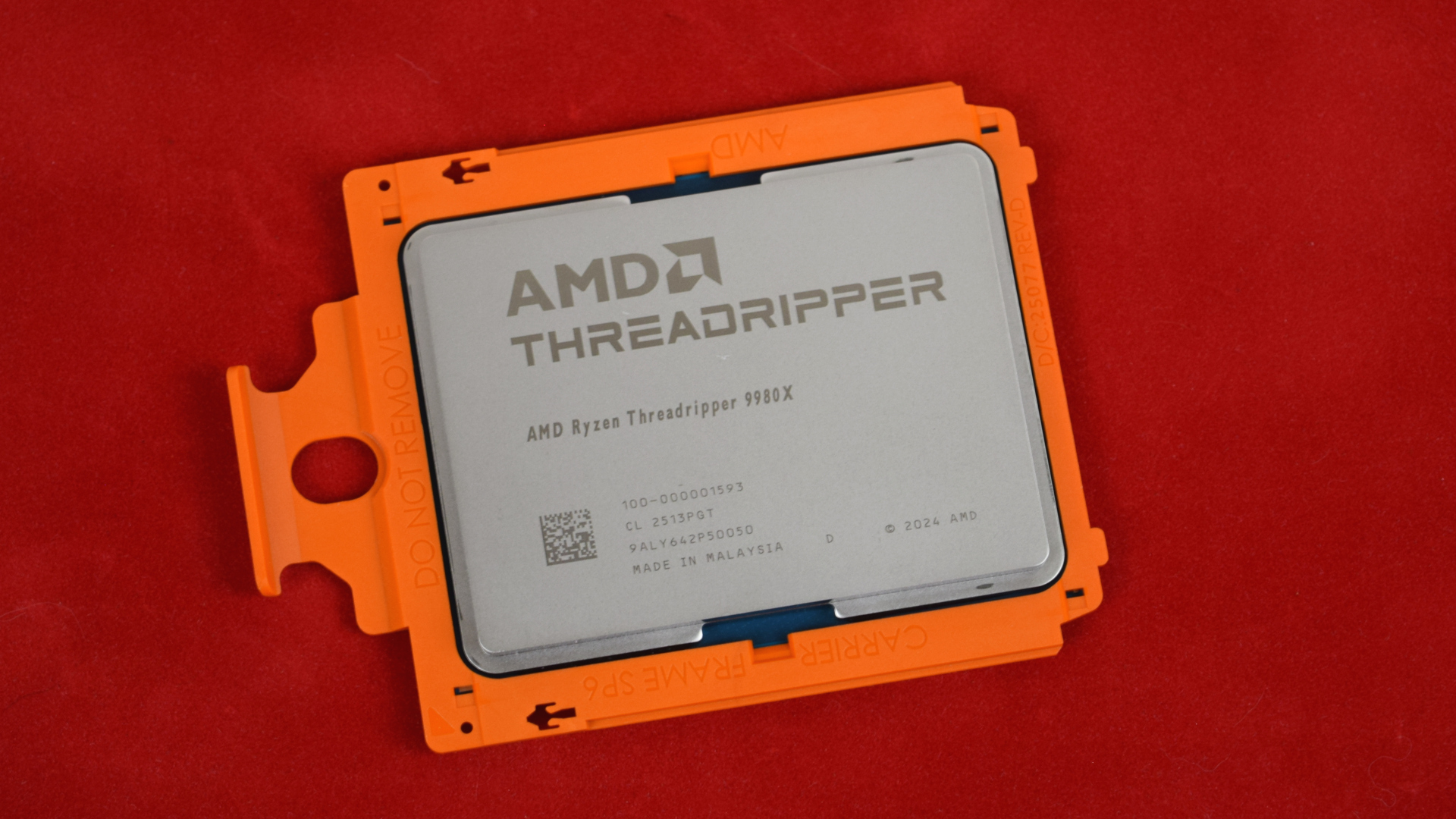
With the move to Zen 5, AMD adopted a 4-nanometer (nm) process for the CPU cores inside the Threadripper 9000 series. AMD used a 5nm process for the Threadripper 7000 series, and the 4nm move likely helped AMD achieve the higher clock speeds it has set on the 9000 series. The 4nm process is used for the core complex dies (CCDs) that hold the CPU cores, but the I/O die, which houses silicon that's less performance-demanding, is based on a 6nm process instead.
AMD also sped up the memory controller on the new 9980X, contributing to a further performance advantage for the chip. It can officially support DDR5 memory clocked at 6,400MHz, while the 7980X stops at 5,200MHz memory support. Technically, you could push the 7980X to run with DDR5 memory clocked at 6,400MHz if you used memory that can handle this speed, but this overclocks the memory controller and can lead to stability issues. Having official support for RAM at this speed should make running RAM this fast easier and more stable with a 9980X than with a 7980X.
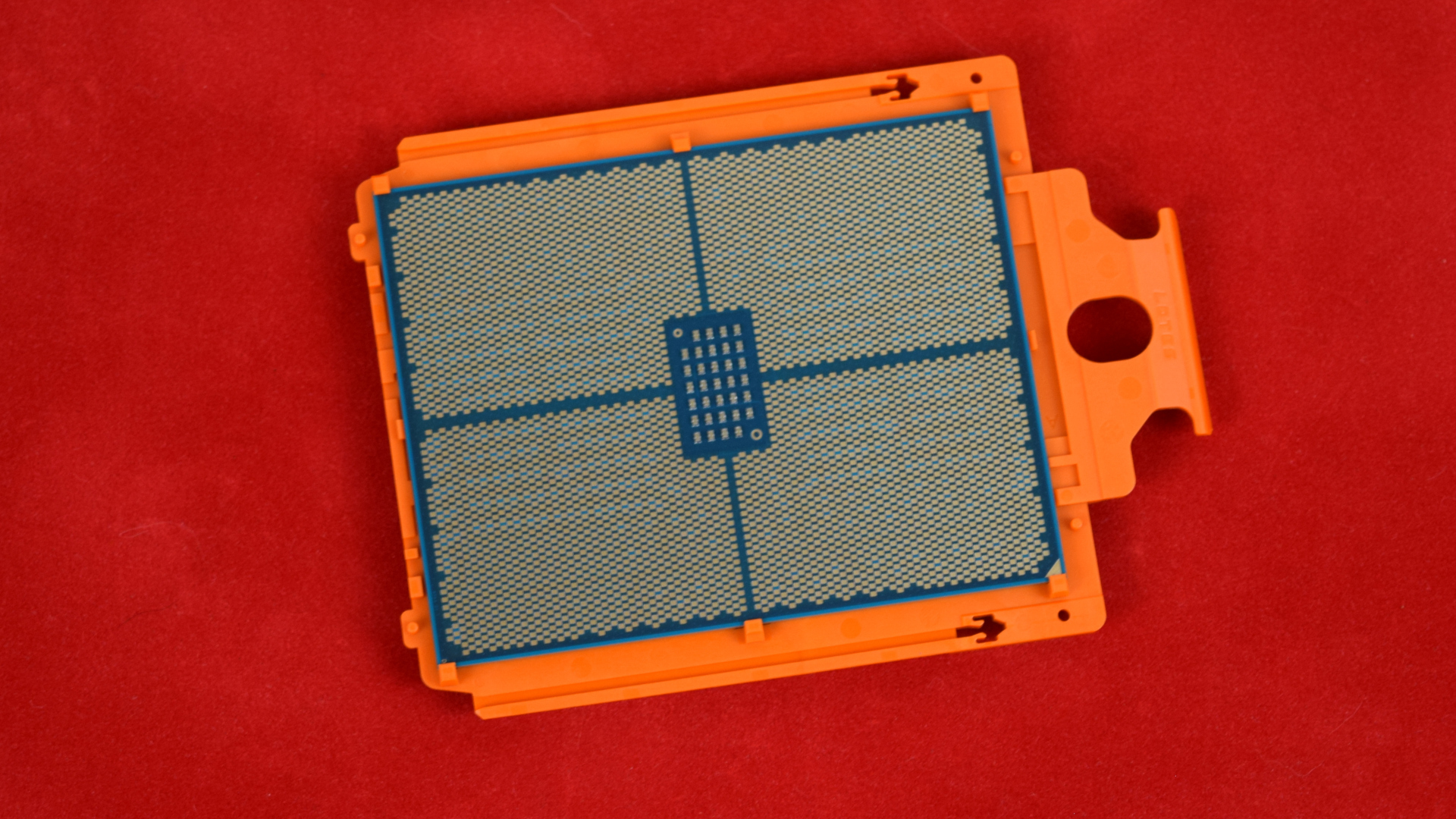
Besides those peak-boost and memory-speed upticks, you won't find much difference between the Threadripper 9980X and the 7980X. Both have a large 256MB pool of L3 cache, both support simultaneous multithreading (SMT) to operate two threads per CPU core for a total of 128 threads, and neither comes equipped with an integrated graphics processor (IGP). Also, both CPUs have a 350-watt (350W) thermal design power rating, a common aspect of most Threadrippers, so you'll need a robust thermal solution to keep any of AMD's Threadrippers from overheating. The chip die is a big rectangle, as ever, and your liquid cooler (and you'll want a liquid cooler) needs to support sTR5.
I tested the AMD Ryzen Threadripper 9980X (and all other Threadripper CPUs mentioned in this review) with an Asus Pro WS TRX50-Sage Wi-Fi motherboard. This test system sits on a Praxis Wetbench PC case, equipped with a SilverStone XE360-TR5 360mm water cooler and four 32GB sticks of registered DDR5 RAM that add up to 128GB of total memory.
I set the RAM to the max officially supported clock speed for each processor, and the system has a 1TB NVMe PCIe 4.0 SSD for storage. I have a SilverStone Hela 1650R Platinum 1,650W power supply for power delivery. Finally, I added an Nvidia GeForce RTX 5090 Founders Edition graphics card to this system I used throughout the testing process. I performed all tests using the latest version of Windows 11 Pro at the time of testing.
With its enormous core and thread count, it should be no surprise that the Threadripper 9980X dominates the competition in certain tests. The places where the Threadripper 9980X doesn’t hold a commanding lead are of greater interest. Cinebench 2024 illustrates this point quite easily by showing the 9980X with a significant lead in the multi-threaded test and a little behind the competition in the single-threaded version.
You might wonder why this is important. Computers are constantly juggling hundreds of tasks at any given time. Surely, multi-threaded performance is more important, right? In general, yes, but if you have a demanding application that only runs on a single thread, you can still notice a significant difference in single-threaded performance.
Blender is clearly well adapted to using as many threads as possible. The Threadripper 9980X was considerably faster than the competition, with AMD's own Threadripper 7980X being its closest rival in every Blender subtest. This result differs substantially from what the HandBrake test results showed. In that benchmark, the Threadripper 9980X performed reasonably well, but the Intel Core Ultra 9 285K and the AMD Ryzen 9 9950X3D both performed a little better and cost a fraction of the price.
The POV-Ray 3.7 test results all but mirror the Cinebench 2024 results, reiterating the same point regarding single-threaded versus multi-threaded performance. As for Adobe, Photoshop is a fitting example of a popular modern application that is still heavily dependent on single-thread performance. The Threadripper 9980X didn't perform badly here, by any means, but it lagged several other CPUs, including the Ryzen 9 9950X3D and the Threadripper 9970X. Either of those would probably be better options if Adobe Photoshop performance is of key interest to you, saving you a lot of money.
Unfortunately, I couldn’t test the Ryzen Threadripper 9980X’s Adobe Premiere Pro 24 performance. I tried to run this test multiple times, with the test utility (PugetBench for Creators) either refusing to run or crashing partway through the test. The whole system didn’t crash, just Premiere Pro. This distinction suggests some sort of compatibility issue. The program may be unable to support so many threads at once. The Threadripper 7980X had the same problem, but neither the Ryzen Threadripper 9970X nor the Ryzen Threadripper 7970X ran into issues running the test. These 32-core Threadrippers also performed well in this test, again suggesting they might be the better choice for Adobe software, at least until such time as a patch might address the issue.
The gaming benchmark results for AMD’s Threadripper processors look interesting. (Recall, we are testing here with a GeForce RTX 5090 card installed.) You might think the test scores in the 3DMark Time Spy chart weren’t all put in correctly, but no, they are correct. The 9000-series Threadrippers' CPU performance was far ahead of the competition, as this test's CPU subscores show, but their overall gaming performance lags far behind the competition.
The test scores from Cyberpunk 2077 also revealed the Threadrippers as lackluster gaming options. With the demanding Ray-Tracing: Ultra graphics preset, the Threadripper 9980X lagged the competition at 1080p and 1440p, but was about on par with them at 4K. With the graphics settings dialed down to the low preset, the Threadripper 9980X fell behind, and it was even the slowest of the Threadrippers here. Indeed, all the Threadrippers bottlenecked the RTX 5090, as you can see in the bar charts.
A few contributing factors make Threadripper CPUs poor for gaming. First, AMD configures most Ryzen processors so that they attempt to isolate games to a single CCD to avoid the performance penalty that comes from moving data between CCDs. Games can still use more than one CCD if they can use more than eight CPU cores, but not all games do.
AMD does not apply this logic to Threadripper processors. This missing feature, along with the larger number of CCDs, is part of what pulls down Threadripper’s performance while gaming. Threadripper’s high core count also contributes to excess heat, negatively impacting sustained CPU performance in tasks like gaming.
If you have a Threadripper CPU, disabling some CPU cores can actually improve gaming performance. But if you really want to run games, a Threadripper's not the answer. It would be better to just buy or build a PC with a different, consumer-grade processor, like one of the AMD Ryzen 7 or 9, or Intel Core i9 or Ultra 9, chips mentioned here.
To test each processor's power consumption, I use a Kill-A-Watt wall meter to measure the test bed's power draw from the wall. This method inevitably has some variation, as the motherboards used differ between the major platforms. Still, you, too, will have to deal with platform changes when you buy one of these CPUs. Regardless, this method gives us a general idea of how much power each system needs, and it shows the variances among the Threadrippers themselves on the same motherboard, with the rest of the components identical.
The Ryzen Threadripper 9980X is the most power-hungry CPU I have tested. This "milestone" is understandable due to the chip's dense core count. Interestingly, the 9980X's power consumption was just slightly higher than that of the Threadripper 7980X in Blender, and the two used about the same amount of power in Cinebench 2024. Overall, this comparison is good news for the Threadripper 9980X, as its significant uplifts in performance while maintaining similar power consumption suggest that it is more efficient than prior products.
You might notice that the Ryzen Threadripper 9980X also ran cooler than other CPUs I tested. The SilverStone XE360-TR5 CPU cooler we used to cool the Threadripper processors was explicitly designed for them and the sTR5 socket these processors fit into. The water block on this cooler is heavier than most, and the cooler likely does a better job of cooling the processors than the more conventional Corsair AIO cooler we use for other processors.
All the other Threadrippers in our table used this same thermal solution and ran at higher temps than the 9980X. For the last-generation 7970X and 7980X, this is likely down to them using a less advanced manufacturing process; they are based on the less efficient "Zen 4" architecture, instead of the Zen 5 of the 9980X and the 9970X.
As for why the 9970X also hit higher temps than the 9980X? This is likely because the temps I report here are the max peak temperatures, not the average. With fewer CPU cores and the same amount of power available, the 9970X likely pushed more power to its CPU cores to help maintain higher clock speeds for longer during the testing process. The heat would have been more concentrated in a smaller area, too—as again, there are 32 cores on the 9970X versus the 9980X's 64.
Final Thoughts
 (Credit: Michael Justin Allen Sexton)
AMD Ryzen Threadripper 9980X
- 5.0 - Exemplary: Near perfection, ground-breaking
- 4.5 - Outstanding: Best in class, acts as a benchmark for measuring competitors
- 4.0 - Excellent: A performance, feature, or value leader in its class, with few shortfalls
- 3.5 - Good: Does what the product should do, and does so better than many competitors
- 3.0 - Average: Does what the product should do, and sits in the middle of the pack
- 2.5 - Fair: We have some reservations, buy with caution
- 2.0 - Subpar: We do not recommend, buy with extreme caution
- 1.5 - Poor: Do not buy this product
- 1.0 - Dismal: Don't even think about buying this product
Read Our Editorial Mission Statement and Testing Methodologies.
AMD’s Ryzen Threadripper 9980X drives phenomenal performance, but whether you can harness it all depends on the programs you use. The 9980X isn’t designed for consumers but for contractors or businesses that don't want to pay for the even more costly Threadripper Pro line of processors. It’s also a potent option for high-end content creation, workstation, big-data, or similar tasks that would benefit from this processor's huge core count. (Photoshop wouldn't be a sole justification.)
If you use software that can benefit from the Threadripper 9980X’s dense core count, it’s well worth buying for the time it will save you. Likewise, this chip could financially benefit certain businesses due to the increased throughput, leading to faster final renders or projects completed. However, if you're an average or even an enthusiast home computer user, you would do best to buy something else. AMD’s 16-core/32-thread Ryzen 9 9950X also produces excellent performance for a far lower price, and Intel’s Core Ultra 9 285K also performs very well outside of games. Power-monger gamers, meanwhile, would benefit a lot more from the AMD Ryzen 9 9950X3D. Still, for the extreme-performance CPU category, we give the AMD Ryzen Threadripper 9980X our Editors' Choice award.
SHOULD I UPGRADE?
If every sliver of your time is money in the professional applications that you use, and you know you're leveraging all the cores and threads from your existing Ryzen Threadripper 7000-class processor, the Threadripper 9980X is well worth a look. It works on the same TRX50 chipset platform and sTR5 CPU socket as the 7000 series, so swapping one in might be as easy as a BIOS upgrade. It's a solid performance uptick over even the former flagship Threadripper 7980X.
STILL ON THE FENCE?
About Our Expert
I have been interested in science and technology for as long as I can remember, spurred on by a fondness for video games. I learned to work in Windows and manipulate files to get buggy games to work, and I learned to build and upgrade PCs for better performance.
In my role at PCMag for the past four years, I’ve deeply enjoyed the opportunity to share my knowledge and expertise. Before PCMag, I wrote for Tom's Hardware for three years, where I covered tech news, deals, and wrote some hands-on reviews. After working as a PCMag contributor for a time reviewing desktops, PC cases, budget processors, and motherboards, I now focus on testing and reviewing processors and graphics cards and sharing my insights on the industry.
- Geekom A9 Max 2026 Edition Review: An Outpaced and Out-Priced Mini PC
- Asus NUC 16 Pro Mini Review: A Powerhouse Mini PC for Work and Play
- I Tested Nvidia's DLSS 5 in NBA 2K27. AI Slop It Is Not
- Asus ProArt GeForce RTX 5090 32GB GDDR7 OC Edition Review: The Ultimate Creator Card
- AMD Ryzen 9 9950X3D2 Dual Edition Review: The Ultimate 3D V-Cache Chip for Creators, Not Gamers
- More from Michael Justin Allen Sexton


