
 Meet Maggie, PCMag's
OLED TVs keep getting brighter, and Samsung’s S95F ($3,299.99 for 65 inches) continues the trend. It puts out much more light and color than its predecessor, the S95D, making an already excellent picture look even better. That said, the LG Evo G5 ($3,399.99 for 65 inches) is still brighter, adds Dolby Vision support, and has a more intuitive user interface, making it our Editors’ Choice winner for premium OLED TVs. The LG doesn't come with a table stand, though, so you might prefer the Samsung S95F if you aren't planning to wall-mount your TV.
The S95F's panel is almost completely bezel-less, framed by the edge of a metal band along the sides and top, and only a narrow brushed metal strip along the bottom edge. Most of the TV’s ports and electronics are located in a separate One Connect Box, making for a very thin panel.
It's not quite paper-thin, however, as the TV itself houses a 70W, 4.2.2-channel sound system. That’s more advanced than the stereo sound most TVs offer and even bests the LG Evo G5’s 4.2-channel system, which lacks height channels.
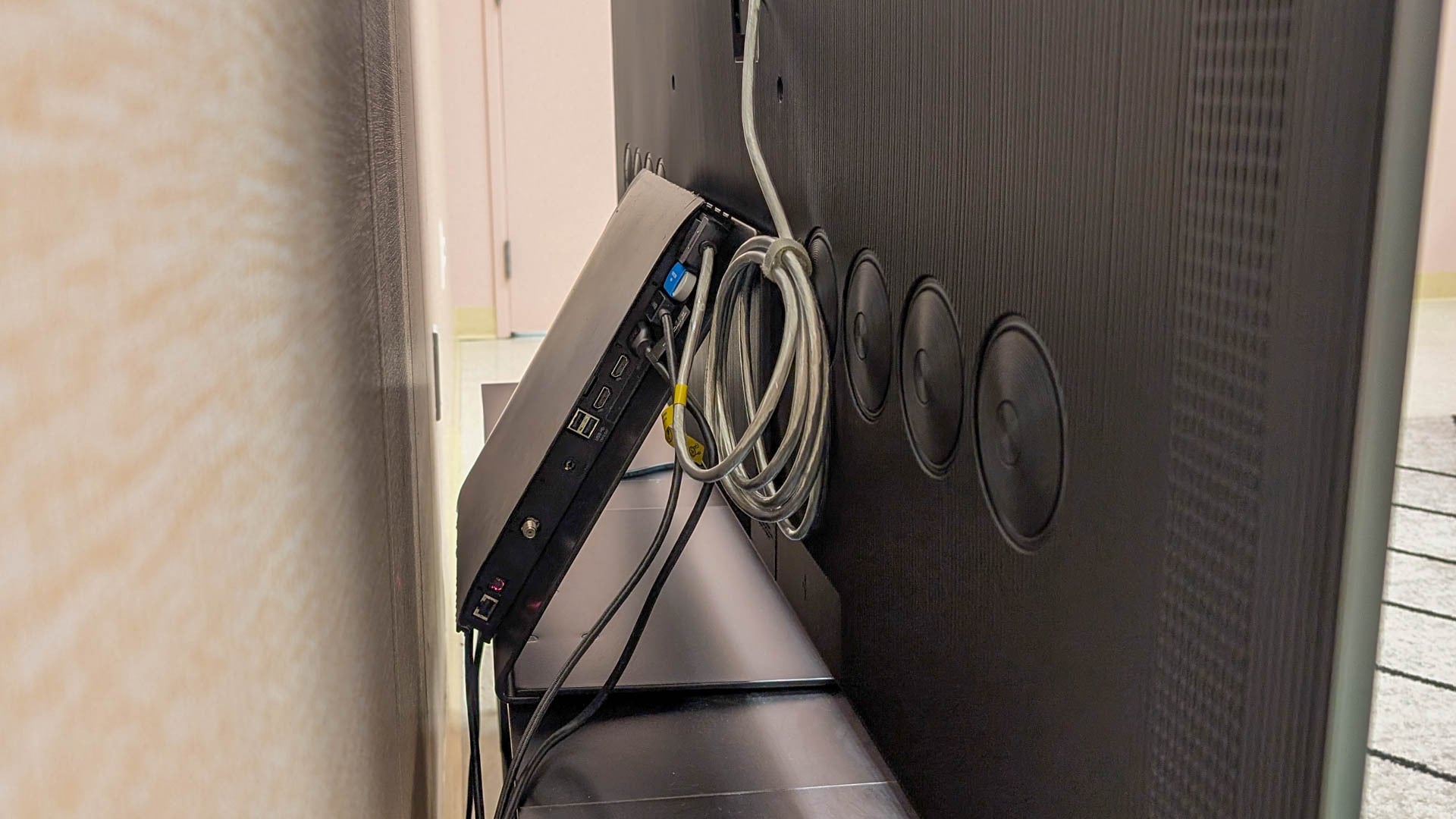
The One Connect Box drives the S95F by sending all of its power and signal information through a single five-foot cable (if you need a longer reach, Samsung offers 16- and 48-foot cables for $220 and $300, respectively). This lets you place the box some distance from the screen and connect all your devices to it, leaving the screen itself almost completely free of wires. The box can also be mounted behind the TV on the included metal table stand if you prefer. The plain black plastic slab measures 13.0 by 14.2 by 1.3 inches (HWD), and has four HDMI ports (one eARC), three USB-A ports, a 3.5mm RS-232C port, an optical audio output, an Ethernet port, and an antenna/cable connector.
Similar Products


Vizio Mini LED Quantum 4K Smart TV


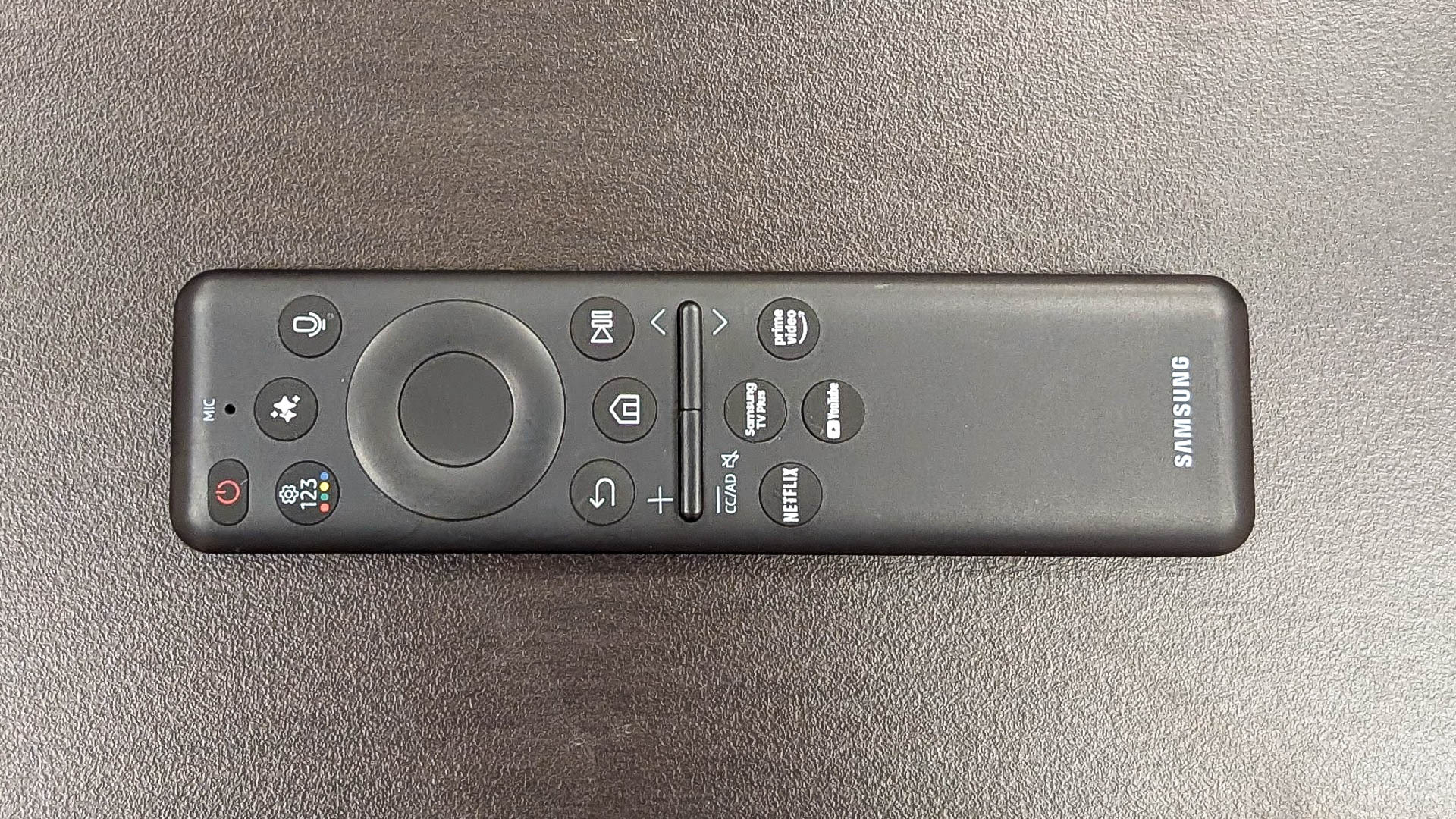
Samsung includes the same SolarCell Remote that comes with its other flagship TVs. It’s a slim, rectangular, matte black wand with a large circular navigation pad near the top, a pinhole microphone, volume and channel rockers, and dedicated service buttons for Amazon Prime Video, Netflix, Samsung TV Plus, and YouTube. Frustratingly, there are no input buttons for quickly switching sources. It has a solar cell on the back and a USB-C port on the bottom for charging its built-in rechargeable battery, so you don’t have to deal with AAs.
As always, Samsung’s Tizen OS smart TV platform is loaded with features but slightly frustrating due to its overbearing tendency to over-automate certain tasks and bury menus a layer or two deeper than most other interfaces. It’s inching forward a little, though, and now lets you easily access settings by just pressing the gear button on the remote instead of having to press the gear button and then manually navigate through a long list to get to that menu.

All major streaming services, including Amazon Prime Video, Apple TV, Crunchyroll, Disney+, Netflix, Twitch, and YouTube, are available on Tizen OS. Apple AirPlay and Miracast/WiDi are also supported, so you can stream directly from your iPhone, iPad, Mac, or PC. Amazon’s Alexa voice assistant is also built into the TV, and you can access it hands-free via the S95F’s far-field microphone.
The S95F is a 4K OLED TV with a 120Hz refresh rate. It supports high dynamic range (HDR) content in HDR10, HDR10+, and hybrid log gamma (HLG), but Samsung continues to leave Dolby Vision out of its TVs. It has an ATSC 1.0 tuner for over-the-air broadcasts, but not ATSC 3.0. It uses Wi-Fi 5 for wireless connectivity, putting it a few steps behind the LG G5's Wi-Fi 6E, which supports the 6GHz band and can provide faster and more stable connections with a compatible router.
I test TVs with a Klein K-10A colorimeter, a Murideo SIX-G signal generator, and Portrait Displays’ Calman software, and I was impressed by the S95F’s performance. The biggest weakness of OLED TVs (besides the high price) is brightness; they are almost universally less bright than high-end LED models, with some looking outright dim. Well, the S95F might not put out a ton of light when the entire screen is lit up, but it can still get blazing.
In HDR Movie mode, the S95F shows a modest peak brightness of 397 nits with a full-screen white field but a much brighter 1,451 nits with an 18% white field. Moving to a 10% field, that number increases to an incredibly high 2,138 nits. I compare 18% white field measurements between TVs to be consistent across different types, but that 10% field brightness is excellent, especially with perfect black levels and no light bloom whatsoever, thanks to the pixel-level dimming OLED technology enables.
It’s far brighter than the S95D (1,060 nits 18%, 1,613 nits 10%), though it's not quite the brightest OLED I’ve tested. That designation belongs to the LG Evo G5, which is downright stunning at 1,608 nits with an 18% white field and 2,386 nits with a 10% white field.
Mini-LED TVs are still far brighter than OLEDs, and the Hisense U8QG has a peak brightness of 3,200 nits with an 18% field and technically perfect black levels, but light bloom is a factor.

Color is almost always a strong suit of OLEDs, and the S95F is definitely proof of that. The above charts show the TV’s color levels in Movie mode with an SDR signal compared against Rec.709 broadcast standards and with an HDR signal compared against DCI-P3 digital cinema standards, and in both cases, colors are largely accurate and free of any tinting. Whites lean just a little bit toward magenta but are still fairly close, and with an HDR signal, colors actually manage to exceed the DCI-P3 color space. The performance is very similar to the LG Evo G5, though the S95F's magentas are a little more balanced and its greens reach a bit further.
The Great Gatsby demonstrates the strong contrast the S95F can achieve. The black suits in the party scenes show plenty of detail, like cuts, contours, and textures, while staying very dark. The whites of shirts and balloons look bright, while skin tones appear natural.
Demonstration footage on the Spears & Munsil Ultra HD benchmark disc really lets the S95F show off its excellent picture quality. A time-lapse scene of a landscape from before dawn to midday transitions smoothly, starting very dark and brightening considerably. Snowy shots retain lots of highlight details, making wisps of clouds and falling snowflakes visible against white skies and snow-covered ground. Colorful objects against completely black backgrounds are bright and vivid. The backgrounds remain perfectly black without any light bloom.
Gamers will be pleased by the S95F, which has a 120Hz panel that supports up to 165Hz variable refresh rate (VRR) and AMD FreeSync Premium Pro. It’s very responsive, too. Using a Leo Bodnar 4K Video Signal Tester, I measured an input lag of 13 milliseconds with a 4K60 signal and 4.8 milliseconds with a 1080p120 signal on the S95F. That’s below the one-frame threshold (16.6ms for 60Hz, 8.3ms for 120Hz) we consider best for gaming.
Final Thoughts
 (Credit: Will Greenwald)
Samsung 65-Inch S95F OLED TV
- 5.0 - Exemplary: Near perfection, ground-breaking
- 4.5 - Outstanding: Best in class, acts as a benchmark for measuring competitors
- 4.0 - Excellent: A performance, feature, or value leader in its class, with few shortfalls
- 3.5 - Good: Does what the product should do, and does so better than many competitors
- 3.0 - Average: Does what the product should do, and sits in the middle of the pack
- 2.5 - Fair: We have some reservations, buy with caution
- 2.0 - Subpar: We do not recommend, buy with extreme caution
- 1.5 - Poor: Do not buy this product
- 1.0 - Dismal: Don't even think about buying this product
Read Our Editorial Mission Statement and Testing Methodologies.
The Samsung S95F is a fantastic OLED TV that looks great and puts out far more light than its predecessor. I also appreciate its advanced speaker system, fast gaming performance, and streamlined design with the One Connect box for minimal cable clutter. While its picture is stellar, the S95F still isn't quite as bright as the LG Evo G5, and it lacks Dolby Vision, so the G5 remains our Editors' Choice for OLED TVs. That said, the S95F has an even better speaker system and comes with a table stand, making it a worthy alternative depending on your needs.
About Our Expert
I’m PCMag’s home theater and AR/VR expert, and your go-to source of information and recommendations for game consoles and accessories, smart displays, smart glasses, smart speakers, soundbars, TVs, and VR headsets. I’m an ISF-certified TV calibrator and THX-certified home theater technician, I've served as a CES Innovation Awards judge, and while Bandai hasn’t officially certified me, I’m also proficient at building Gundam plastic models up to MG-class. I also enjoy genre fiction writing, and my urban fantasy novel, Alex Norton, Paranormal Technical Support, is currently available on Amazon.
- The Best Ereaders for 2026
- Up Close With Amazon's New Kindles: Sleek Aluminum, Flat Bezels, and Page-Turn Buttons Are Back
- Meta VR Glasses vs. Apple Vision Pro: Can $1,300 Glasses Dethrone a $3,700 Headset?
- The Best Smart Glasses for 2026
- I Test TVs for a Living. Here's Why I Bought Last Year's Model
- More from Will Greenwald


