Showing posts with label landscape. Show all posts

Saturday, 13 December 2014

The view from Richmond Hill

One of the most famous views in the history of landscape painting is "The View from Richmond Hill". In the last it was liked so much that it's now the only view in the UK which is specifically protected by an Act of Parliament.

I've created a small website about it - The View from Richmond Hill - for those who want to know exactly where it is and what the view looks like - and some more about the artists associated with painting the view from the hill e.g.
  • Sir Joshua Reynolds whose home (Wick House on Richmond Hill) has this view, or 
  • JMW Turner who painted it several time or 
  • Jasper Francis Cropsey, the American landscape painter (Hudson River School) whose painting of the View of Richmond Hill recently sold at Bonhams in New York. Cropsey later produced a massive painting of the same view - some eight feet wide - based on this study (and presumably others he made at the same time).  This study is principally focused on the features of the landscape and doesn't have the figures seen in the later painting.
View of Richmond Hill - Jasper Francis Cropsey (1823-1900)
previously exhibited as Study for Richmond Hill in the Summer of 1862
oil on canvas 12 1/2 x 20 1/2in
sold 21st May 2014 for $50,000 at Bonhams
Back in 2010 I visited to see what all the fuss was about. Like many such views I've visited in the past - the trees have grown!

I found it very tricky to get a place where you got a decent view of the bend in the river without running into other problems - like trees obscuring the view.

This is my "failed" photographic view. It's a classic one - with the horizon bisecting the image! You can at least see the river and the fact it has a curve and an island and some boats on it - plus some water meadows next to it!

The view from Richmond Hill - in 2010
This local photographer has had a go at showing us what is the magic of this place in this video


I'm thinking maybe a visit in winter when there are no leaves might prove more fruitful - although it would appear this brings different challenges


Tuesday, 14 October 2014

Fine Canadian Landscape Art - Auction and Previews

There's an auction of "Fine Canadian Art" being held in Toronto, Canada by Heffel Fine Art Auction House on 27th November 2014. The majority of the works in the catalogue are landscapes.

Heffel Fine Canadian Art Catalogue Cover
The Trapper's Return by Clarence Gagnon
oil on canvas, circa 1909 ~ 1913
signed and on verso signed and titled and titled
21 x 28 3/4 in, 53.3 x 73 cm
$500,000 ~ $700,000 CAD

View the catalogue

You can the works in the auction as follows:


The Artists


Artists who are new to me who impressed 


These included:
DavidMilne1909
David Brown Milne in 1909
  • David Brown Milne (1882-1953) - I liked his watercolours. You can see more of his work on Wikimedia - these include some very fine paintings of the First World War eg Montreal Crater, Vimy Ridge and there is more information on the National Gallery of Canada website
  • Clarence Alphonse Gagnon (1881 - 1942) - whose painting is on the cover of the catalogue. A woodcut of the same scene is also included in the sale together with a number of other paintings. He was apparently renowned as a painter of the Canadian winter - with snow being pink in the morning and blue at the end of the day. His landscapes were more 'dreamed about' than painted on the spot - with some being completed in his studio in Paris.  Paysage de Charlvoix is simply stunning!
He invented a new type of landscape - a winter world composed of valleys and mountains, of sharp contrasts of light and shadow, of vivid colours, and of sinuous lines. He ground his own paints, and from 1916 his palette consisted of pure white, reds, blues and yellows.   
National Gallery of Canada profile

Artists familiar to me


  • Lawren Stewart Harris - I was surprised to find out that Harris is Canada's top artist in terms of auction sales. I'd never before seen any of Harris's urban landscapes - his painting of Houses on Gerrard Street is very fine and is on the back cover of the catalogue
Gerrard Street Houses by Lawren Harris
Back cover of catalogue: Gerrard Street Houses by Lawren Harris(Estimate $350,000-400,000)
Harris’s depictions of Toronto streets are like portraits. Sometimes poignant, sometimes regal, sometimes sad, each of his buildings can be seen as a sitter whose character, carriage and personality are depicted with exacting skill under Harris’s brush Catalogue

Information about the auction


The evening auction is being held at the Park Hyatt Hotel, Queen’s Park Ballroom, 4 Avenue Road, Toronto. 

Works can be seen in previews as follows
  • Preview At Heffel Gallery, Vancouver: 2247 Granville Street Saturday, November 1 Through Tuesday, November 4, 11 Am To 6 pm
  • Preview At Galerie Heffel, Montreal: 1840 Rue Sherbrooke Ouest Thursday, November 13 Through Saturday, November 15, 11 Am To 6 pm
  • Preview At University Of Toronto Art Centre 15 King’s College Circle Entrance Off Hart House Circle Saturday, November 22 Through Wednesday, November 26, 10 Am To pm Thursday, November 27, 10 Am To 12 pm
  • Heffel Gallery, Toronto 13 Hazelton Avenue, Toronto Ontario, Canada M5r 2e1 Telephone 416 961~6505, www.Heffel.Com


Wednesday, 30 April 2014

American Paradise: The World of the Hudson River School

Cover of the exhibition catalogue re. American Paradise: The World of the Hudson River School

American Paradise: The World of the Hudson River School


You can download this catalogue of the exhibition American Paradise: The World of the Hudson River School at the Metropolitan Museum of Art. The exhibition was held between 4th October 1987 and 3rd January 1999.

The reproduction qualities of the pdf copy available for download on the Metropolitan Museum of Art website is very good.

You won't find it by including the title in the websites' search facilty. Instead you need to know to go to their MetPublications website

The title is out of print hence why the Met is making it available online.  You can also:

About the exhibition


Prior to 1987, the Metropolitan Museum of Art has focused on individual artists when mounting major retrospectives and had highlighted prominent American artists in doing so.

This exhibition was the first time a major retrospective had been undertaken of an important school of art unique to the USA. The book and the exhibition represented a summary of the (then) current scholarship relating to the Hudson River School.

The exhibition - and the catalogue - brought together some of the finest and most historically important of the paintings associated with the School.  It also provided a survey of the work of the various artists involved with the School.

Prior to this exhibition, there had been three initiatives by museums in the USA to highlight the art, scope and role of the Hudson River School

  • 1917 - the Museum had held a much smaller exhibition - Paintings of the Hudson River School;
  • 1945 - the Art Institute of Chicago mounted the The Hudson River School and the Early American Landscape Tradition exhibition
  • 1949 - The Museum of Fine Arts in Boston published a book about M. and M. Karolik Collection of American Paintings, 1815–1865 


The Hudson River School


The Hudson River School was America's first true artistic fraternity. Its name was coined to identify a group of New York City-based landscape painters that emerged about 1850 under the influence of the English émigré Thomas Cole (1801–1848) and flourished until about the time of the Centennial.

This is the webpage for the Hudson River School in the Heilbrunn Timeline of Art History on the Met's website


Monday, 24 February 2014

Pete "The Street" Brown paints plein air

This is a video of a very hard-working plein air artist - Peter Brown NEAC ROI RSPP PS aka "Pete the Street".  You can see his artwork in the Annual Exhibitions of various national art societies at the Mall Galleries including:
He's based in Bath and can often be seen painting on the streets of Bath.  To my mind he paints with what I'd call a "very English palette" - lots of muted coloured greys.

There's an article about him in the February 2014 edition of Artists & Illustrators Magazine - available in print and digital versions.

Click the link in his name to visit his website.

Saturday, 1 February 2014

Landscape Pictures - Notes #1

"Landscape Pictures" is a new type of post for this blog. The aim is to have a periodic round-up about recommended blog posts and articles about landscape art - with an emphasis on those with decent images and places you can see landscape paintings. It will also allow me to highlight blog posts by artists just because I like the painting!

LANDSCAPE ART - ANNUAL REVIEWS


Prolific plein air painter Haidee-Jo Summers artist reviewed her plein air painting year and exhibitions in four posts which include lots and lots and LOTS of plein air landscape paintings
Michael Chesley Johnson (A Plein Air Painter's Blog)has a post which lacks visual interest but reflects on which of his blogs posts in 2013 have been of most interest to Plein Air Painters - see Top 10 Posts for A Plein Air Painter's Blog
Galley Hill Allotments in the snow by Haidee-Jo Summers 
Winner of The Best Picture (Landscape) 2013

In my Making A Mark Art Blog Awards - on Making A Mark
He regularly includes lots of very useful tips relating to plein air painting and painting generally - and very obviously thoroughly enjoys his plein air painting. This particular post A Plein Air Set Up For Watercolor  (posted last month) almost deserves an award all to itself! 
  • The 2013 winner of The Travels with a Sketchbook Trophy was Pete Scully (Pete Scully)
He draws the routine and the mundane in the area where he lives and the places he visits and makes most places look interesting. He opens my eyes and remind me again and again about how sketching starts with learning how to see.

LANDSCAPE ART COMPETITIONS


The 2013 Fleurieu Art Prize claims to be the world's richest landscape painting Prize (AU$60,000) and attracts both Australian and International Artists. Do you know different?  To see the list of 2013 finalists go to the Finalist Page.

Two competitions/exhibitions for landscape photographers:


LANDSCAPE ART HISTORY


America’s Forgotten Landscape Painter: Robert S. Duncanson is a blog post by the Smithsonianmag.com site.  Robert Seldon Duncanson is a 19th century African American artist I'd never heard of before who trained in painting in Glasgow, Scotland.  You can see more of his work on Wikimedia Commons.

Robert Duncanson - Land of the Lotos Eaters
Robert Duncanson - Land of the Lotus Eaters
Two paintings by Claude Monet of the cliffs at Etretat
One of the enduring motifs of landscape painting on the coast of Normandy are the famous chalk cliffs and stacks of Étretat. Charley Parker (Lines and Colors) has done a very interesting post which displays paintings by various different Painters of the cliffs of Étretat

The Standard Examiner has a fascinating piece - sadly with no images - about Top of Utah Voices: Landscape painting in the round.  However the word pictures are stunning!
Painters who utilized the art form and travelled with their depictions faced a daunting task of transporting these large works of sometimes dozens of paintings attached to each other and unrolled scene by scene. Some were advertised as being three miles long and taking over an hour to view. Usually 12 feet in height and rolled up on poles which, when unrolled by an assistant, gave the viewers a tour of the chosen scenes the painter portrayed while the artist (standing on a platform) described them.


LANDSCAPE PAINTING - EXHIBITIONS


Art In Liverpool's post 'Turner: Travels, Light and Landscape’ at the Lady Lever highlights an exhibition which runs from 14 February to 1 June 2014 at the Lady Lever Art Gallery in Port Sunlight Village, Lower Rd, Wirral CH62 5EQ.  Turner: Travels, Light and Landscape comprises some 30 watercolours, paintings and prints, drawn from the National Museums Liverpool’s own Turner collection.
Paintings such as 'Margate Harbour' (1837) and 'Linlithgow Palace' (about 1807), will be shown alongside prints and watercolours that are rarely displayed due to their light-sensitivity. This will include the watercolours 'Dudley' (about 1830-33), 'Off Dover' (between 1820-1827), 'Wells Cathedral' (1795-96) and 'View of the Mole' (about 1818).
New Turner exhibition at the Lady Lever Art Gallery in Port Sunlight - opens 14th February 2014

Recording Britain is a touring exhibition organised by the Victoria & Albert Museum, London. It can be seen in the Sir William Harpur Gallery at The Higgins in Bedford until March 20th 2014.
At the outbreak of the Second World War an ambitious scheme was set up to employ artists on the home front. The result was a collection of more than 1500 watercolours and drawings that make up a fascinating record of British lives and landscapes at a time of imminent change.
I've already bought the catalogue for the exhibition and it's absolutely fascinating.  I think this is one exhibition I'll definitely be going to see.  I'll be writing more about the project on this blog.

A National Art: Watercolour & the British Landscape Tradition can be viewed at the Wixamtree Gallery at The Higgins Bedford until Sunday 27th April 2014
The exhibition, drawn entirely from the Cecil Higgins Art Gallery collection of works on paper, explores the landscapes of the late 18th century and early 19th century watercolourists and how they influenced their 20th century counterparts. The work of Cotman, Girtin and Turner will be shown alongside that of Nash, Ravilious and Piper in a celebration of the British landscape and its ideal medium, watercolour. It is part of a season of exhibitions exploring the idea of landscape, which includes Recording Britain and Bawden's Britain.

This one takes some beating when it comes to exhibitions of landscape art. Culture 24 introduces The best art exhibitions to see in Wales in 2014 and starts with a new exhibition in Cardiff thus 

How about this for a new take on landscape painting? National Museum Cardiff’s Wales: A Visitation. Poetry, Romanticism and Myth in Art, (February 22 - September 7) takes the neo-Romantic work of David Jones, Graham Sutherland, Richard Long and contemporary abstract landscape painter Clare Woods and wraps it around an LSD-infused trip to Wales made by beat poet Allen Ginsberg in 1967.

PLEIN AIR PAINTING


Katherine van Schoonhoven (Art and Music) has an interesting review post of a trip to the coast of California when she painted the same place at different times of the day. The timescale panorama in learning from the plein air line up
is fascinating.

"View of Pescadero" Mexico, plein air, landscape painting by Robin Weiss on the In Plein Air blog is a great visual report of a landscape painting

Thursday, 22 August 2013

The Corn Harvest by Pieter Bruegel the Elder

Corn is harvested in August - however what's in the landscape painting of a corn harvest varies according to where the artist painted (see explanation at the end).  In Europe corn means grain.

Pieter Bruegel the Elder- The Corn Harvest (August)
 Die Kornernte  (1564) by Pieter Breugel the Elder (1526 - 1569)
(a.k.a. The Harvesters / The corn harvest / The grain harvest)
Oil on wood,
Overall, including added strips at top, bottom, and right, 46 7/8 x 63 3/4 in. (119 x 162 cm);
original painted surface 45 7/8 x 62 7/8 in. (116.5 x 159.5 cm)
Location: Metropolitan Museum of Art

Paintings of the Corn Harvest in August


The most famous  painting of a corn harvest is that shown at the top of this post.

What do we know about 'The Corn Harvest'?

  • This painting was painting by  Pieter Bruegel the Elder in 1564, when he was nearly 40 years old - some 4 years before he died in 1569.
  • It's one panel in a famous series of six paintings by Bruegel called "The Months". These paintings each different times of the year. This is the fourth panel in the series and represents late summer (July/August).  See also other paintings in the series which have featured on this blog.:
  • The "Months" series were commissioned by Niclaes Jongelinck and were used as a frieze for a room in his home.  Jongelinck was a merchant, tax collector and art collector who lived in Antwerp
  • The painting is a view of "what is" in terms of real life.  There's no sense of a need for a religious story or pretext for painting the landscape.  The emphasis is on realism rather than the religious. This is the case with all the paintings in the series - which is why Bruegel's landscape paintings are said to represent a watershed in the history of Western Art.   
  • The landscape is a dominant theme within the painting - but it's animated by the people who populate the picture plane.  The painting focuses on the harvest - the harvesters are in the foreground, their community, their church and nature in general are in the background.  The workers in the field are depicted in a naturalistic way - they are shown working, exhausted, lying or sitting, eating or sleeping.  As with all other paintings in this series there is a dominant colour - in this instance it's the yellow of the grain crop being harvested.  
  • This painting now resides in the Metorpolitan Museum of Art in New York (Other paintings in the Months series are located in the Kunsthistorisches Museum, Vienna, and Lobkowicz Collection, Prague)

The meaning of corn

"Corn" means different things in different countries.

  • In the USA the term refers to maize (i.e. sweet corn)
  • however in Europe, the older use of the word "corn" relates to grain and cereal crops - such wheat, oats and barley (ie maize is called maize and corn on the cob is called corn on the cob!).  That's because Europeans didn't have a name for the maize crop when they first encountered it in the New World.  So it acquired the generic name for all grain crops!

Here's the definition of corn from Cambridge Dictionaries online

B1 [U] UK (the seeds of) plants, such as wheatmaizeoats, and barley, that can be used to produce flour:sheaf of corngrains of corn [U] US the seeds of the maize plant, or the plant itself


Monday, 18 March 2013

The Wynne Prize - Finalists 2013 + their websites

The Wynne Prize ($35,000) for Best Landscape Painting of Australian scenery, or figure sculpture by Australian artists had 773 entries this year - which is marginally down on last year (2012: 783 entries; 2011: 712 entries)
The Wynne Prize is awarded annually for 'the best landscape painting of Australian scenery in oils or watercolours or for the best example of figure sculpture by Australian artists’.
Richard Wynne left a bequest which established the prize.  It's run and judged on an annual basis by the Trustees of the Art Gallery of New South Wales in Sydney.  The prize was first awarded in 1897 when the present Gallery opened in its current home next to the Botanical Gardens and Sydney Harbour  (I know - I've been!).

Those whose artwork will be in the exhibition were announced last week.

You can find the Wynne Finalists 2013 listed below.  You can also explore past winners and finalists on the prize webpage on the AGNSW website
  • GW Bot - Glyphs and Moon GW Bot is the the exhibiting name of Chrissie Grishin, who was born in Quetta, Pakistan of Australian parents
  • Linda Bowden - The others  Linda Bowden is a sculptor
  • Jun Chen - North Queensland  Born in China in 1960, Chen migrated to Australlia in 1990 and now lives in Queensland. He graduated from the Guangzhou Academy of Fine Arts in China in 1986 and converted from being a brush and ink painter in China to using oil paint thickly applied with a palette knife in Australia!
  • Xiuying ChenCentral Railway Station, Sydney  
  • He is a member of the Australian Chinese Painting Society
  • David Collins - Hawkesbury crossing
  • Dale Cox - Tract 17 - He paints the geomorphology of the land - above and below the ground.  I'm thinking this one might be in with a chance./li>
Tract paintings in acrylic by Dale Cox
Tract 17 (burning) is bottom right
I'm hoping they will produce the online display of the individual works as they did last year

See my post The Wynne Prize 2012 - Selected artists and winner (which was published a little later than planned)

Wednesday, 9 January 2013

Mapping landscape paintings on Google Maps

I'm in two minds about a website I came across today.  MyReadingMapped maps places to historic events - or in the case of artists - landscape paintings to places on maps

The thing is that they're mapping the place in the picture - not the place from where the picture was seen and/or painted - and it's often the latter which artists are interested to see.  Not least because some of us are rather fond of trying to see what we make of the same view! (see my "Places to Paint" series)

The Google Map view of the world as seen in landscape paintings
Here's the link - The Works of Artists, Architects and Photographers in Google Map - and you can see for yourself.
Click on the map title below to go to the blog page with an embedded map, photos and background and source information about each subject.
I think the problem for me is that this has the potential for being a good idea - however it needs more content and the pins in the map need to be rather more accurate - preferably being placed "where the easel stood" literally or metaphorically!

Monday, 26 November 2012

Places to Paint: Agawa Canyon, (Algoma)

I'm very grateful to Jeff McColl for a comment he left on my post about Canada's Group of Seven at Algoma.  This alerted me to the fact that he's been putting an awful lot of effort into pulling together a portfolio of photographs on Google+ of the locations where the Group of Seven painted in the Agawa Canyon in Algoma.

Places to Paint: Agawa Canyon, Algoma, Canada
Some of Jeff McColl's portfolio of photographs matched to paintings by the Group of Seven
© Jeff McColl
Between 1918 and 1923 several members of the Canada's Group of Seven painted in the Algoma region including Lawren Harris, A. Y. Jackson, Frank Johnston, J. E. H. MacDonald, and Arthur Lismer. To gain access to this remote area they rented a boxcar from The Algoma Central Railway, which had been outfitted like a cabin and was shunted to sidings near choice painting locations. From these locations they set out on foot or canoe to capture this untamed area on canvas. Their paintings brought this vast, rugged, and beautiful part of the country to fellow Canadians and the world.Wikipedia - Agawa Canyon
Below are links to Jeff's photos and the paintings by G7 artists at various locations.  Do read his comments as to location as it's obvious that not all the original locations are now accessible due to changes in growth of vegetation or changes in the course of rivers made as a result of floods.  He also provides photographs of what the locations look like in winter.

The links in the name of the artist are to the biography of the artist on the National Gallery of Canada website.
You can also read an article by Jeff - Paddling/Hiking/Photographing in the footsteps of Legends by Jeff McColl - in the Spring Newsletter of the Group of Twelve - Fine Arts Society of Milton 
Mention the Group of Seven to any artist or photographer and there are instantly visions of great Canadian Landscapes. I have known for years that the Group of Seven had visited the Agawa Canyon and when asked to describe the area I have said it was like paddling into one of their paintings. I have also known that fellow canoeists Sue and Jim Waddington of Burlington have a hobby that include working with the McMicheal Gallery in finding locations where they painted. They have been very successful in finding locations in Georgian Bay, Killarney and Algonquin Prov. Parks. They know that I frequent the Agawa area every year and they asked me if I could identify a few areas
All photos are copyright Jeff McColl. You can see more of Jeff's wonderful photographs of the Canadian countryside on Panoramio
Seems to me that the logical extension of all this work by these canoeists is a book - complete with maps and details of how to get to these places to paint!

Group of Seven fans may also like:

Sunday, 28 October 2012

Breugal "The Return of the Herd" (Autumn Landscape #12)

Pieter Breughal the Elder (1525-1569) is one of the great painters of landscapes in different seasons that are also located within the timeline of annual tasks of the ordinary man.  This is his painting of an autumn landscape - and the return of the herd.

The Return of the Herd (Autumn) / De Terugkeer van de kudde (najaar) (1565) 
by Pieter Bruegel the Elder 
oil on panel, 117 x 159 cm
Gallery: Kunsthistorisches Museum, Vienna, Austria

What's fascinating about this landscape scene is that it involve mountains. Those who know the Low Countries will appreciate that mountains are not the normal subject matter of a Flemish painter working at home!  The museum where now owns this painting has an explanation.
Bruegel introduced to the art of painting the autumn motif of the returning herd, a subject untypical for the Netherlands. To achieve this, he would have been able to draw on impressions gained during his travels through Switzerland. Driving the cattle down from the Alpine pastures, a key event in every peasant's year, is made into the title scene. Yet the main subject is the landscape which the artist has raised to the sublime in its tonal colouring and mood.
The Return of the Herd (Autumn) / De Terugkeer van de kudde (najaar)
Kunsthistorisches Museum, Vienna, Austria
The name for the return of the cattle from upland pastures to the valleys is the transhumance. (see Transhumance and Transhumance in the Alps).  The same word is used for the migration in the other direction in the springtime.

This painting is also a very good example of why you should NOT always believe everything you read on Wikipedia (note the comment about the direction of the cattle which is complete twaddle!)

About one third of Bruegel's surviving paintings are located in the Kunsthistorisches Museum, Vienna, Austria.

The painting is classified as being part of the Northern Renaissance.

Links: Winter Landscape - Adoration of the Magi by Pieter Bruegel

Monday, 4 June 2012

Painting the Thames: Jan Siberechts

This week, in honour of the River Pageant which took place on Sunday, I'm doing posts about artists who have painted views of the River Thames.

Landscape with Rainbow, Henley-on-Thames c.1690 by Jan Siberechts
Oil on canvas, 82,5 x 103 cm
Tate Gallery, London
The first artist is Jan Siberechts and I chose him because he painted the Thames near Henley on Thames - which is an area less well know to those who only think of Thames in relation to London.  It's also a town which is associated with the Henley Royal Regatta which is held each year in July.

Siberechts was a Flemish landscape painter who was born in Antwerp in 1627.  In 1672, in his 40s, he emigrated to England and died in London in 1703.

His earlier landscape paintings tend to depict a small detailed aspect of a landscape.  His later paintings are typically more topographical in nature with sweeping views.

This particular riverscape painting of the Thames has been done from an elevated slope above the flood plain of the River Thames.  It purports to be a realistic painting of the scene and is one of the most important landscape paintings in the collection on Tate Britain.

  • the painting appears to present a realistic portrayal of the profile of the natural landscape of this place.  However the true reality is that the view has been embellished and the perspective has been distorted.  (I did my usual Streetview search for the view - and it's not one which is at all easy to spot.  That might because of the growth of vegetation and development of buildings)
  • on the right is the village of Henley on Thames (the church and bridge are still there, although the bridge has been replaced - the current five arched Henley Bridge across the river was built in 1786 -and the steep slopes in the background of the painting have disappeared!)
  • the background portrays a steep slope up from the river - which exists - but not quite so close as indicated in the painting
  • the foreground has cows and sheep eating the pasture of the lush grass meadows next to the river
  • on the left there is a cargo boat.  There is another on the main river next to Henley.  These both  reflect the importance of the river's role in carrying goods between different centres of population and the countryside.  The boat on the left looks like it's on another river but judging by the map it seems very likely it's parked up.
  • the shadow of storm clouds cover parts of the landscape while bright sunlight bathes Henley in a golden glow
  • One of the unique aspects of this painting is that it's one of the few ever painted which appears to depict a convincing rainbow - although I'm not sure it's in the right place relative to the sunlight and rain.  I think it should be further to the left.  What do you think?
It's possible that the painting was commissioned by a landowner of one of the large houses built between Remenham Wood and the River, situated off White Hill above the town.  It's unlikely that any of the current houses were the one in question but it appears it may have become established as a a vantage point for the wealthy in the seventeenth century.

In contrast to the Flemish landscape painting of his homeland, England offers hills and slopes to a much greater degree and consequently, more components within a landscape to illustrate depth.  It possible explains why Flemish landscapes tend to focus on one aspect of the landscape while Flemish painters who move away to other countries start to depict larger views of the landscape.

This is a link to another painting by Siberechts - Henley-on-Thames from the Wargrave Road, Oxfordshire which you can see at the River & Rowing Museum on the banks of the Thames at Henley.

Links:

Monday, 30 April 2012

Thames Diamond Jubilee Pageant and Canaletto's Thames Pageants #1

The River Thames with St. Paul's Cathedral on Lord Mayor's Day (1746)
Canaletto
oil on canvas, 26.8 x 37.6 cm
The Lobkowicz Collections, Prague Castle, Czech Republic
There's going to be a Pageant on the River Thames to mark the Queen's Diamond Jubilee of her accession to the Throne.

1,000 boats are going to make their way down the Thames on Sunday 3rd June - mustering between Hammersmith and Battersea and dispersing from Tower Bridge to West India Docks.

The Thames Diamond Jubilee Pageant has its very own website.  The BBC is also going to be out filming people painting from a bridge - although my own feeling is that the only way to capture the view - as Canaletto did - is to get up much higher than a bridge.  I've got a couple of spots in mind!

There are a couple of famous Canaletto paintings of pageants on the Thames.  The one featured above is currently being portrayed as a mural on a temporary wall at the entrance to London Bridge station.

The painting is currently on loan to the The National Maritime Museum (one of the Royal Museums at Greenwich) for Royal River: Power, Pageantry and the Thames the exhibition to mark the Queen's Diamond Jubilee.

If you want to find out more about Canaletto and his verdute or "view paintings" try my resource About Canaletto - Italian Painter
A veduta (Italian for "view"; plural vedute) is a highly detailed, usually large-scale painting or, actually more often print, of a cityscape or some other vista.

Sunday, 22 April 2012

Paradises and Landscapes

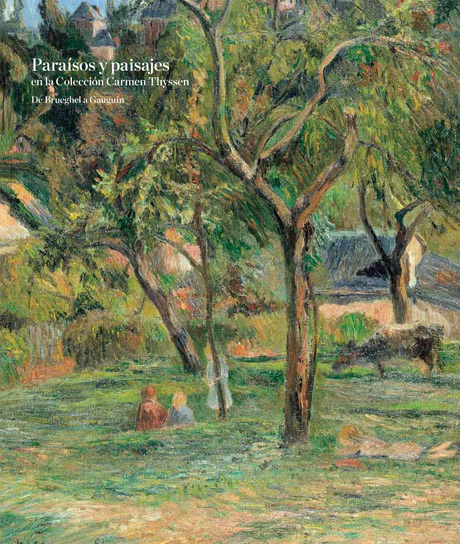
A new exhibition Paradises and Landscapes in the Carmen Thyssen Collection From Brueghel to Gauguin has opened at the Museum Carmen Thyssen in Malaga, Spain.

Paradises and Landscapes Exhibition Catalogue 
Cover: An Orchard under the Church of Bihorel, 1884 (detail) by Paul Gauguin
The exhibition runs until 7 October 2012. You can pay a virtual visit via this link

Rooms in the exhibition covers the following topics.  Click the links to see the images of the paintings in the exhibition.
This is a video of the works in the exhibition - the commentary is in Spanish.


Exposición 'Paraísos y paisajes en la Colección Carmen Thyssen. De Brueghel a Gauguin' from Museo Carmen Thyssen Málaga on Vimeo.

This for me is the sort of standard all museums should set for the online dissemination of their exhibitions.

Sunday, 8 April 2012

Talking about Hockney's Landscape Painting

Tomorrow is the last day of the Royal Academy exhibition David Hockney RA - A Bigger Picture.  I'm going to see it for the fourth time at 8pm tomorrow evening.  The exhibition closes at 10pm.

Here are the podcast recordings which the Royal Academy have made from the various events held during the course of the exhibition

The second room in the exhibition reviews his earlier landscapes - which includes his California landscapes.
Constance Glenn delves into David Hockney’s California works, from his signature landscapes of the 1960s to his panoramas of the 1980s that introduce a new perspective and capture Mulholland Drive’s vertiginous curves, which swerve across LA’s hilltops toward his Montcalm studio and home. 
David Hockney - Nichols Canyon, 1980
Acrylic on canvas, 213.4 x 152.4 cm
Private collection
Copyright David Hockney
She describes this painting as his first mature painting of California.  It bears no relationship to the work he had been doing previously (swimming pools and palm trees).  Hockney had brought a house at the top of the Hollywood Hills on a street called Montcalm.

The image is to convey the sense of careening down the hill in a car to his studio very quickly - it has a visceral feeling of descent.  The houses are situated at their natural place, have perspective and are quite realistic.  But the painting also includes patterns of the landscape either side - mark-making and images that represent trees and grass.

Mulholland Drive runs across the hills - but "drive" in this painting is a verb - it's what he's doing.  The mark-making has almost become the subject of the picture.  It has a pattern of complementary colours red/orange and blue-green and yet it's not easy to look at a painting of complementary colours.

The Pearblossom Highway picture is a composite of photographs.  She (and Marco Livingstone below) describes how is was created.  The photo collage precedes his multiple canvas paintings.

David Hockney - Pearblossom Highway, 11-18 April 1986 #1
Photographic collage, 119.4 x 163.8 cm
The J. Paul Getty Museum, Los Angeles. Gift of David Hockney
Copyright David Hockney
I like listening to descriptions of the drives with Google Maps in front of me!
Marco Livingstone describes how the exhibition was put together and how Hockney tackled the way he painted for the exhibition.  Prior to this he comments on paintings in the exhibition from the Californian era.  He comments on the importance of looking at the images from different distances.

David Hockney - The Road Across the Wolds, 1997
Oil on canvas, 121 x 152 cm
Private Collection
Copyright David Hockney
Photo credit: Steve Oliver

This is the view of the drive he took on a regular basis to see his friend Jonathan Silver who was dying from pancreatic cancer.  Silver was a major collector of Hockney's work and established a museum at Saltaire of Hockney's art - owned by either the Silver family or the Hockney family.  The road is the one between the Yorkshire Wolds and Bradford.  It repeats the process of Nichols Canyon - he painted in the studio of accumulated memories.  He didn't work from direct observation and spent a lot of time on each painting.

By way of contrast the more recent Yorkshire landscapes are produced by a man who is more comfortable painting landscapes.  His landscapes are much spontaneous and immediate.

He liked painting in watercolours because of the disdain it was treated by the royal Academy.  He knew many of the great landscape painters were masters of watercolour painting - and he spent three years just painting in watercolours.  He was also aware that no major British artist had ever painted East Yorkshire.

Latterly he has been painting plein air by the side of very quiet roads.  He's not doing any preliminary drawings, not drawing on the canvas - just getting on and transferring his observations into paint.  He intensifies the colours which he sees in the landscape.

He's made more work in terms of the number of paintings in the last few years than ever before.  The numbers rival a whole lifetime of painting by other artists.

In Yorkshire he really revelled in the changing seasons - in the different look of the place - and the light from the early morning and the end of the day when you have the best light for painting a landscape

He also comments on what a fantastic tool the iPad has been for Hockney in creating drawings of the landscape and there are now hundreds.  They are visually very rich.

He also describes the process for producing the films of moving through the landscape in what has turned out to be a very popular room in the exhibition

David Hockney - Winter Tunnel with Snow, March, 2006
Oil on canvas, 91.4 x 121.9 cm
Courtesy of the artist | Copyright David Hockney
Photo credit: Richard Schmidt
David Hockney - Under the Trees, Bigger 2010-11
Oil on twenty canvases (each 91.4 x 121.9 cm) , 365.8 x 609.6 cm
Courtesy of the artist | Copyright David Hockney
Photo credit: Richard Schmidt
She tells the story of the exhibition and explains the paintings room by room.  She has a tendency to gabble in long sentences which makes her talk a bit more difficult to follow.  However she does focus on Hockney's ways of working and how is work is all based on observation and the memories of looking.

Many of the stories in the recordings can be read in Hockney's biography David Hockney: The Biography by Christopher Simon Sykes and True to Life: Twenty-Five Years of Conversations with David Hockney by: Lawrence Weschler.

Note: Exhibition organised by the Royal Academy of Arts, London in collaboration with the Guggenheim Museum, Bilbao and the Museum Ludwig, Cologne

Links: About David Hockney - British artist