Showing posts with label landscape painter. Show all posts

Monday, 6 April 2015

Wildcard entries - Sky Arts Landscape Artist of the Year 2015

You too can be a Wild Card entry to the new Sky Arts Landscape Artist of the Year competition! Each of the heats are going to have places for 50 Wild Card entries.


All you have to do is:

  • enter a heat as a Wild Card
  • bring your own easel, canvas and materials
  • come to one of the heats at National Trust properties around the country
  • paint one of the landscapes in front of the judges

It's first come, first served - click on one of the below links to enter as a Wild Card for your preferred Heat: You never know - you might impress the judges and win the opportunity to go through to the semi-final!

If you did you could win the prize of a £10,000 commission for the National Trust's permanent collection and become Sky Art Landscape Artist of the Year 2015.

The Wild Card is open to artists who previously applied and were unsuccessful as well as artists who didn't apply.

For full terms and conditions and to apply to become a Wild Card, pick your heat and enter via www.sky.com/tv/show/landscape/article/wild-card

Thursday, 26 February 2015

Art Competition: £10,000 prize for Landscape Artists

Read my blog post about the Call for Entries for the Sky Arts Landscape Artist of the Year 2015 If you're interested in:
  • winning a £10,000 landscape art commission from the National Trust
  • participating in an art competition which has a number of knockout rounds prior to the final; and
  • creating landscape art on television - while Sky Arts film you for a television programme about their brand new competition to find the Sky Arts Landscape Artist of the Year 2015!
Image for the Landscape Artist of the Year 2015 competition on Sky Arts

In summary you need to:
  • be aged 16+
  • resident in the UK, Republic of Ireland, Isle of Man or Channel Islands for one year or longer on 2nd February 2015
  • be a competent landscape artist in any of the following media Watercolour, Oil Paints, Pencil, Charcoal, Pastel, Acrylic, Alkyds, Mixed Media (including collage) and "Other". Note sculpture or any form of digital media is NOT allowed
  • complete and submit and online application form by 12pm (midday) on Friday 20th March 2015 together with images of landscape art completed in the last five years
  • not mind being filmed for television while you paint!


Wednesday, 30 April 2014

American Paradise: The World of the Hudson River School

Cover of the exhibition catalogue re. American Paradise: The World of the Hudson River School

American Paradise: The World of the Hudson River School


You can download this catalogue of the exhibition American Paradise: The World of the Hudson River School at the Metropolitan Museum of Art. The exhibition was held between 4th October 1987 and 3rd January 1999.

The reproduction qualities of the pdf copy available for download on the Metropolitan Museum of Art website is very good.

You won't find it by including the title in the websites' search facilty. Instead you need to know to go to their MetPublications website

The title is out of print hence why the Met is making it available online.  You can also:

About the exhibition


Prior to 1987, the Metropolitan Museum of Art has focused on individual artists when mounting major retrospectives and had highlighted prominent American artists in doing so.

This exhibition was the first time a major retrospective had been undertaken of an important school of art unique to the USA. The book and the exhibition represented a summary of the (then) current scholarship relating to the Hudson River School.

The exhibition - and the catalogue - brought together some of the finest and most historically important of the paintings associated with the School.  It also provided a survey of the work of the various artists involved with the School.

Prior to this exhibition, there had been three initiatives by museums in the USA to highlight the art, scope and role of the Hudson River School

  • 1917 - the Museum had held a much smaller exhibition - Paintings of the Hudson River School;
  • 1945 - the Art Institute of Chicago mounted the The Hudson River School and the Early American Landscape Tradition exhibition
  • 1949 - The Museum of Fine Arts in Boston published a book about M. and M. Karolik Collection of American Paintings, 1815–1865 


The Hudson River School


The Hudson River School was America's first true artistic fraternity. Its name was coined to identify a group of New York City-based landscape painters that emerged about 1850 under the influence of the English émigré Thomas Cole (1801–1848) and flourished until about the time of the Centennial.

This is the webpage for the Hudson River School in the Heilbrunn Timeline of Art History on the Met's website


Monday, 24 February 2014

Pete "The Street" Brown paints plein air

This is a video of a very hard-working plein air artist - Peter Brown NEAC ROI RSPP PS aka "Pete the Street".  You can see his artwork in the Annual Exhibitions of various national art societies at the Mall Galleries including:
He's based in Bath and can often be seen painting on the streets of Bath.  To my mind he paints with what I'd call a "very English palette" - lots of muted coloured greys.

There's an article about him in the February 2014 edition of Artists & Illustrators Magazine - available in print and digital versions.

Click the link in his name to visit his website.

Thursday, 22 August 2013

The Corn Harvest by Pieter Bruegel the Elder

Corn is harvested in August - however what's in the landscape painting of a corn harvest varies according to where the artist painted (see explanation at the end).  In Europe corn means grain.

Pieter Bruegel the Elder- The Corn Harvest (August)
 Die Kornernte  (1564) by Pieter Breugel the Elder (1526 - 1569)
(a.k.a. The Harvesters / The corn harvest / The grain harvest)
Oil on wood,
Overall, including added strips at top, bottom, and right, 46 7/8 x 63 3/4 in. (119 x 162 cm);
original painted surface 45 7/8 x 62 7/8 in. (116.5 x 159.5 cm)
Location: Metropolitan Museum of Art

Paintings of the Corn Harvest in August


The most famous  painting of a corn harvest is that shown at the top of this post.

What do we know about 'The Corn Harvest'?

  • This painting was painting by  Pieter Bruegel the Elder in 1564, when he was nearly 40 years old - some 4 years before he died in 1569.
  • It's one panel in a famous series of six paintings by Bruegel called "The Months". These paintings each different times of the year. This is the fourth panel in the series and represents late summer (July/August).  See also other paintings in the series which have featured on this blog.:
  • The "Months" series were commissioned by Niclaes Jongelinck and were used as a frieze for a room in his home.  Jongelinck was a merchant, tax collector and art collector who lived in Antwerp
  • The painting is a view of "what is" in terms of real life.  There's no sense of a need for a religious story or pretext for painting the landscape.  The emphasis is on realism rather than the religious. This is the case with all the paintings in the series - which is why Bruegel's landscape paintings are said to represent a watershed in the history of Western Art.   
  • The landscape is a dominant theme within the painting - but it's animated by the people who populate the picture plane.  The painting focuses on the harvest - the harvesters are in the foreground, their community, their church and nature in general are in the background.  The workers in the field are depicted in a naturalistic way - they are shown working, exhausted, lying or sitting, eating or sleeping.  As with all other paintings in this series there is a dominant colour - in this instance it's the yellow of the grain crop being harvested.  
  • This painting now resides in the Metorpolitan Museum of Art in New York (Other paintings in the Months series are located in the Kunsthistorisches Museum, Vienna, and Lobkowicz Collection, Prague)

The meaning of corn

"Corn" means different things in different countries.

  • In the USA the term refers to maize (i.e. sweet corn)
  • however in Europe, the older use of the word "corn" relates to grain and cereal crops - such wheat, oats and barley (ie maize is called maize and corn on the cob is called corn on the cob!).  That's because Europeans didn't have a name for the maize crop when they first encountered it in the New World.  So it acquired the generic name for all grain crops!

Here's the definition of corn from Cambridge Dictionaries online

B1 [U] UK (the seeds of) plants, such as wheatmaizeoats, and barley, that can be used to produce flour:sheaf of corngrains of corn [U] US the seeds of the maize plant, or the plant itself


Wednesday, 27 February 2013

George Rowlett painting the River Thames and Uist

Today I saw a work by George Rowlett which had won a £1,500 Runner Up Prize in the art competition for the Lynn Painter Stainer Prize.

Advancing blue, yellow barges, Thames Barrier, early afternoon
by George Rowlett
Rinner Up, Lynn Painter Stainer Prize 2013
George's work is not so much impasto as huge slabs of paint which are trowelled onto and moved around the support - with a trowel. This is Mark Glazebrook writing about George Rowlett and the Art of Landscape
It was therefore fascinating to find out that there are a couple of videos on YouTube about how he paints plein air.  You will be amazed at the way he transports huge paintings covered in massive amounts of paint....

Here are two films:

George Rowlett painting the River Thames (and I know some of those locations!)


and

George Rowlett painting on Uist March 2011


and this is how he gets them back to his studio

Sunday, 28 October 2012

Breugal "The Return of the Herd" (Autumn Landscape #12)

Pieter Breughal the Elder (1525-1569) is one of the great painters of landscapes in different seasons that are also located within the timeline of annual tasks of the ordinary man.  This is his painting of an autumn landscape - and the return of the herd.

The Return of the Herd (Autumn) / De Terugkeer van de kudde (najaar) (1565) 
by Pieter Bruegel the Elder 
oil on panel, 117 x 159 cm
Gallery: Kunsthistorisches Museum, Vienna, Austria

What's fascinating about this landscape scene is that it involve mountains. Those who know the Low Countries will appreciate that mountains are not the normal subject matter of a Flemish painter working at home!  The museum where now owns this painting has an explanation.
Bruegel introduced to the art of painting the autumn motif of the returning herd, a subject untypical for the Netherlands. To achieve this, he would have been able to draw on impressions gained during his travels through Switzerland. Driving the cattle down from the Alpine pastures, a key event in every peasant's year, is made into the title scene. Yet the main subject is the landscape which the artist has raised to the sublime in its tonal colouring and mood.
The Return of the Herd (Autumn) / De Terugkeer van de kudde (najaar)
Kunsthistorisches Museum, Vienna, Austria
The name for the return of the cattle from upland pastures to the valleys is the transhumance. (see Transhumance and Transhumance in the Alps).  The same word is used for the migration in the other direction in the springtime.

This painting is also a very good example of why you should NOT always believe everything you read on Wikipedia (note the comment about the direction of the cattle which is complete twaddle!)

About one third of Bruegel's surviving paintings are located in the Kunsthistorisches Museum, Vienna, Austria.

The painting is classified as being part of the Northern Renaissance.

Links: Winter Landscape - Adoration of the Magi by Pieter Bruegel

Friday, 19 October 2012

'Dieppe from the East' by John Sell Cotman and JMW Turner

This post is about two paintings of Dieppe painted by JMW Turner and John Sell Cotman at more or less the same time - give or take a year!  It also covers the concept of staffage and how to access Turner's sketchbooks

You can see both paintings - hung next to one another in  Cotman in Normandy - the new exhibition of watercolour paintings, drawings and etchings by John Sell Cotman at Dulwich Picture Gallery.

The Cotman painting was definitely produced in his studio and the Turner was either painted on a loose leaf of watercolour paper while in Dieppe or was worked up as a colour study from his sketchbook.  They neatly contrast the different approaches and styles of the two artists when faced with the identical view.  (See my Review: Cotman in Normandy - at Dulwich Picture Gallery on Making A Mark for the explanation of why all Cotman landscapes were done in his studio.)

Dieppe from the heights to the East of the port (1823) by John Sell Cotman
Graphite and watercolour with pen and ink and scratching out of the paper
Victoria and Albert Museum
Dieppe from the East (?) (1826-7) by JMW Turner
Graphite and watercolour on paper
Turner Bequest
Turner's 1826 French tour began at Dieppe towards the end of August. His first sketchbook (no.5) includes only a general view of the town of the kind he had already noted two years earlier. But it seems that he also made some sketches on loose sheets of paper. On these he again recorded the quaysides, which had formed the subject of his large oil painting of 1825 (Frick Collection, New York)
Interestingly the description of the work in the exhibition indicates that this watercolour was probably developed from the 1821 sketchbook and produced as part of an unrealised sceheme to represent both sides of the Channel.

Tuesday, 18 September 2012

The Limbourg Brothers - and "September"

Très Riches Heures du duc de Berry
Folio 8, verso: September
by the Limbourg Brothers
I always think it's a pity that we don't see more present day painters painting the months of the year.  Recording the changes in the landscape - particularly where farming is involved - generates a real understanding of the land and a much better sense of place.

You can find out more about the Limbourg Brothers in this fascinating video - which is some 53 minutes in length.  [NOW DISAPPEARED - SEE SUBSTITUTE AT END] So grab a hot drink and find a compfy chair.....
  • It shows how the Très Riches Heures du duc de Berry came to public attention.

    In 1948 the American photo journal Life published the twelve calender miniatures from the manuscript, which roused an enormous public interest.
  • It displays the actual book which contains these incredibly important miniature paintings of the medieval times
  • Authoritative experts explain the importance of the paintings and the way in which the Limbourg Brothers worked and created innovation in painting
Watch and enjoy!


UPDATE: This is a video which features the months within the book


This video is about the exhibition at the Metropolitan Museum of Art in 2010 (which is 11 minutes long)


Friday, 3 August 2012

A review of Thomas Moran

An art blog - Poul Webb Art Blog - has recently posted a series of five posts about the great landscape painter Thomas Moran (1837-1926).  These highlight his watercolour sketches and oil paintings of the American West.

Born in Bolton in Lancashire, Moran became one of the renowned painters of the Hudson River School.  He's best known for his panoramic paintings of the American West and the Rocky Mountains.  He's also known as: "Father of the National Parks" and "the Dean of American Painters".

Moran, Thomas - Grand Canyon of the Yellowstone, 1904
Grand Canyon of the Yellowstone (1904) by Thomas Moran
30 x 60 1/2 in. (76.2 x 153.7 cm), oil on canvas painting
Collection: Honolulu Museum of Art
Thomas Moran [Public domain], via Wikimedia Commons
He's been on my list of painters to find out more about for some time.

So here's an introduction for me as well as any of you who haven't studied his work before.  I'm not quite sure where the images come from - but there's an excellent selection of images of Moran's paintings in the following posts.  If you click them and open in a new tab you can see larger versions.

I'm particularly impressed with his plein air watercolour sketches done on the spot.

Here are the links to
  • Thomas Moran - part 1 - an introduction and overview of Moran's life and important works
  • Thomas Moran - part 2 - Watercolour and gouache paintings on paper made during the Yellowstone Expedition and subsequently (early 1870s)
  • Thomas Moran - part 3 - Oil paintings on canvas, board and paper plus watercolours of Yellowstone and Yosemite - plus Nevada, Florida and other parts of Wyoming -- and Lower Manhattan
  • Thomas Moran - part 4 - Watercolour and oil paintings of landscapes in : USA: New Jersey, Florida, Colorado, Wyoming, Utah, Denver, Yellowstone Plus Scotland and Venice
  • Thomas Moran - part 5 - Oil paintings of New Mexico, Arizona, Utah, Yellowstone, Grand Canyon, Tetons.  Plus waterfalls and geysers everywhere
If you want to get a mental fix on Moran, note that his dates are virtually identifical to those of Claude Monet (1840-1926) - although their painting styles were very different over time.

I've set up a "resources for art lovers" website on Squidoo - About Thomas Moran - American Landscape Painter.  It's got the basics in it - but I'll be continuing to develop it over time.  If you know of any excellent online references re Moran I'd be glad to hear about them

You can see more of my "resources for art lovers" websites about individual artists in About Artists

Saturday, 9 June 2012

John Constable - Somerset House Terrace from Waterloo Bridge

I've been looking at views of the Thames by different artists this week and came across one which was attributed to John Constable but which just looked wrong to me.  I first found it on wikipaintings - and then noticed that they'd sourced it from one of those "we can paint you any painting you want" sites.

Finally, it dawned on me why it was wrong - the image had been reversed!  Maybe you have to have walked along this terrace to know these things?

So here is a small Constable oil sketch of Somerset House Terrace from Waterloo Bridge - the proper way round!  The real thing forms part of the Paul Mellon Collection in the Yale Center for British Art At Yale University in downtown New Haven.

Somerset House Terrace from Waterloo Bridge (c 1819) by John Constable (1776-1837)
Oil on panel, 6 1/8 x 7 3/8 inches (15.6 x 18.7 cm)
Yale Center for British Art, Paul Mellon Collection

What's also interesting about this painting is:
  • it's definitely a sketch/study - given the size and the quality of the finish.  Constable simply did not paint like this for his studio paintings but he did when painting studies for studio paintings.  It would be interesting to know whether he did anything with it.
  • the sketch dates from before the Embankment was built along the edge of the Thames.  In those days Somerset House was on the banks of the Thames and didn't have a couple of roads and pavements and a wall between the terrace and the river.

The other names for this painting are:
  • Somerset House Terrace and the Thames: a View from the North end of Waterloo Bridge with St. Paul's and Blackfriar's Bridge
  • Somerset House, A View from Waterloo Bridge looking towards St. Paul's and the City

Whatever it's called it suggests that a good place to paint the Thames and the City of London is the north end of Waterloo Bridge.

The end of the terrace at Somerset House is not such a good spot for painting - you can see how much trees now interfere with the view in my post Sunday Papers at Somerset House on my Travels with a Sketchbook blog

Friday, 8 June 2012

Richard Wilson - View of Syon House across the Thames

View of Syon House across the Thames near Kew Gardens (c. 1760) by Richard Wilson
Oil on canvas, 104 x 139 cm
Neue Pinakothek, Munich
Continuing the notion of a yellow sky and water (see View of the Thames by Childe Hassam), here's another view of the Thames - this time at Kew.

The painter of this scene is Richard Wilson - the man regarded as the father of British Landscape Painting and the finest painter Wales has ever produced.  He painted this scene shortly after his return from Italy where he developed his skills as a landscape painter.

The hazy warm yellow glow is very much redolent of the style of the artist who had profoundly influenced his landscape painting - Claude Lorrain.  It's almost as if the Roman campagna has arrived in southwest London!

That said the sun does set in the west behind Syon House and this indicates that this is an early evening painting in summer.

The important point about this painting is that has been painted the year after Kew Gardens became established as a botanical garden - in 1759.
In 1759, Princess Augusta and Lord Bute established the first botanic garden at Kew, employing William Aiton as the gardener. The Physic or Exotic Garden is the direct ancestor of today's establishment and this date is now accepted as the foundation of the Royal Botanic Gardens, Kew.Kew, History and Heritage - Kew's first botanic garden
The place

The scene is one of my own personal "places to paint" (or rather sketch - see The Thames at Kew - in March sunshine).

Wilson's perspective is from a mound - which nowadays has a very convenient seat - at the end of the walk known as Syon Vista and next to the path at the far end of Kew Gardens.  This gives an excellent view of the River Thames and Syon House.

The Artist

Richard Wilson RA was a pioneer of landscape painting in the UK.  Both Turner and Constable admired his paintings.

He was born on 1 August 1713 in Penegoes, Montgomeryshire in Wales.  He died on 11 May 1782 age 68 at Colomendy Hall, near Llanferres, Denbighshire and is buried in St Mary's Churchyard in Mold.  He never married.

His family was well connected and a relative sent him to London to train to become a painter and he initially trained as a portrait painter.  It appears he was successful gaining commissions and setting up his own studio.

He begins to demonstrate an interest in landscape painting from the mid 40s onwards.  However it's unclear why he subsequently became more interested in landscape painting. However it is known that he went to study in Italy between 1750 - visiting Venice first and then Rome - and there became very much influenced by the paintings of Claude Lorrain. 

Wilson is sometimes called 'The English Claude'.

His approach to landscape painting

While in Italy, he earned a living and had modest success by selling picturesque paintings of Italian scenes to English aristocrats who were doing the "Grand Tour".  He devoted himself to painting idealised landscapes in the manner of Claud Lorrain.  The main contrast being that Richard Wilson was typically painting a real scene rather than an idealised picture.

As a landscape painter, Wilson was obsessed with light and the quality of light reflected from the sky - and he loved a good sunset!  His tendency to bathe a scene in golden light was well known.

However Richard Wilson was also very sensitive to colour and demonstrated in his paintings his appreciation of the very many hues found in nature.  John Ruskin wrote that Wilson "paints in a manly way, and occasionally reaches exquisite tones of colour".

Kew Gardens: The Pagoda and Bridge (1762) by Richard Wilson (1713-1782)
Oil on canvas,
Yale Center for British Art, Paul Mellon Collection
When painting figures in a landscape, they play a minor role and do not intrude upon the overall impact of the landscape.

The website of records the following as being the way he approached the painting of landscapes
His landscape paintings were produced by first applying an underdrawing of brown paint, followed by ‘dead-colouring', a task which was given to the studio apprentices. Thin washes of colour were applied at this stage; Prussian blue and grey-brown for the sky, and a mixture of red and blue pigments for the landscape. The colour was applied to a thickness depending on the depth of tone required, allowing the light tone of the ground to show through more towards the horizon. Once the dead-colouring was dry it was oiled out before the second painting.

For the foreground Joseph Farington records that Wilson 'went over it a second time, heightening every part with colour and deepening the shadows, but still, brown, loose and flat, and left in a state for finishing: the half-tints laid in, without highlights.' In the third and final painting of the foreground Wilson altered the tints, adding the necessary sharpness to the different objects, before glazing them with rich warm tints, and finally adding further solid tints over this.

The sky and distant landscape, on the other hand, were worked wet-in wet after the initial dead-colouring, rather than in two separate stages. This allowed Wilson to achieve easier blending of the clouds with the blue of the sky, apparently using ultramarine rather than Prussian blue for this stage of painting. Last of all the horizon was adjusted and the distance softened with grey-brown again as necessary.
This is a complete catalogue of Richard Wilson's paintings - which has obviously been a labour of love for its creator.

The Yale Centre of British Art in America has an excellent collection of paintings by Richard Wilson.

Richard Wilson - art communities and art societies

On his return to England, Wilson took on a grand studio and was initially successful and held many exhibitions, gained a reputation and sold his landscapes to a number of different clients.

He was active in founding first the Society of Artists and then in 1768, age 55, he became a founder member of the Royal Academy of Art.  He became the Director of what became ‎(in 1765)‎ the Royal Society of Artists of Great Britain.

The prices for his paintings went up and up - along with Wilson's arrogance - until on one famous occasion he offered to let the King have a painting on an instalment plan!  After that the commissions began to dry up and at the end of his life he lived in poverty and had to rely on his family.

Wilson subsequently became an alcoholic and stared the slide into poverty and ill-health. At the end he was taken back to the family home in Wales. He died there on 11 May 1782.

Links:


Monday, 30 April 2012

Thames Diamond Jubilee Pageant and Canaletto's Thames Pageants #1

The River Thames with St. Paul's Cathedral on Lord Mayor's Day (1746)
Canaletto
oil on canvas, 26.8 x 37.6 cm
The Lobkowicz Collections, Prague Castle, Czech Republic
There's going to be a Pageant on the River Thames to mark the Queen's Diamond Jubilee of her accession to the Throne.

1,000 boats are going to make their way down the Thames on Sunday 3rd June - mustering between Hammersmith and Battersea and dispersing from Tower Bridge to West India Docks.

The Thames Diamond Jubilee Pageant has its very own website.  The BBC is also going to be out filming people painting from a bridge - although my own feeling is that the only way to capture the view - as Canaletto did - is to get up much higher than a bridge.  I've got a couple of spots in mind!

There are a couple of famous Canaletto paintings of pageants on the Thames.  The one featured above is currently being portrayed as a mural on a temporary wall at the entrance to London Bridge station.

The painting is currently on loan to the The National Maritime Museum (one of the Royal Museums at Greenwich) for Royal River: Power, Pageantry and the Thames the exhibition to mark the Queen's Diamond Jubilee.

If you want to find out more about Canaletto and his verdute or "view paintings" try my resource About Canaletto - Italian Painter
A veduta (Italian for "view"; plural vedute) is a highly detailed, usually large-scale painting or, actually more often print, of a cityscape or some other vista.

Sunday, 22 April 2012

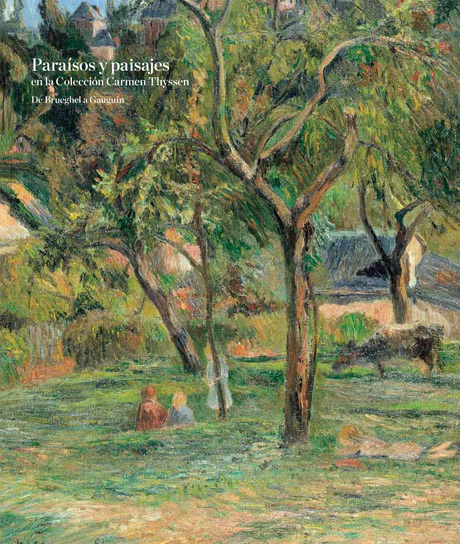
Paradises and Landscapes

A new exhibition Paradises and Landscapes in the Carmen Thyssen Collection From Brueghel to Gauguin has opened at the Museum Carmen Thyssen in Malaga, Spain.

Paradises and Landscapes Exhibition Catalogue 
Cover: An Orchard under the Church of Bihorel, 1884 (detail) by Paul Gauguin
The exhibition runs until 7 October 2012. You can pay a virtual visit via this link

Rooms in the exhibition covers the following topics.  Click the links to see the images of the paintings in the exhibition.
This is a video of the works in the exhibition - the commentary is in Spanish.


Exposición 'Paraísos y paisajes en la Colección Carmen Thyssen. De Brueghel a Gauguin' from Museo Carmen Thyssen Málaga on Vimeo.

This for me is the sort of standard all museums should set for the online dissemination of their exhibitions.

Sunday, 8 April 2012

Talking about Hockney's Landscape Painting

Tomorrow is the last day of the Royal Academy exhibition David Hockney RA - A Bigger Picture.  I'm going to see it for the fourth time at 8pm tomorrow evening.  The exhibition closes at 10pm.

Here are the podcast recordings which the Royal Academy have made from the various events held during the course of the exhibition

The second room in the exhibition reviews his earlier landscapes - which includes his California landscapes.
Constance Glenn delves into David Hockney’s California works, from his signature landscapes of the 1960s to his panoramas of the 1980s that introduce a new perspective and capture Mulholland Drive’s vertiginous curves, which swerve across LA’s hilltops toward his Montcalm studio and home. 
David Hockney - Nichols Canyon, 1980
Acrylic on canvas, 213.4 x 152.4 cm
Private collection
Copyright David Hockney
She describes this painting as his first mature painting of California.  It bears no relationship to the work he had been doing previously (swimming pools and palm trees).  Hockney had brought a house at the top of the Hollywood Hills on a street called Montcalm.

The image is to convey the sense of careening down the hill in a car to his studio very quickly - it has a visceral feeling of descent.  The houses are situated at their natural place, have perspective and are quite realistic.  But the painting also includes patterns of the landscape either side - mark-making and images that represent trees and grass.

Mulholland Drive runs across the hills - but "drive" in this painting is a verb - it's what he's doing.  The mark-making has almost become the subject of the picture.  It has a pattern of complementary colours red/orange and blue-green and yet it's not easy to look at a painting of complementary colours.

The Pearblossom Highway picture is a composite of photographs.  She (and Marco Livingstone below) describes how is was created.  The photo collage precedes his multiple canvas paintings.

David Hockney - Pearblossom Highway, 11-18 April 1986 #1
Photographic collage, 119.4 x 163.8 cm
The J. Paul Getty Museum, Los Angeles. Gift of David Hockney
Copyright David Hockney
I like listening to descriptions of the drives with Google Maps in front of me!
Marco Livingstone describes how the exhibition was put together and how Hockney tackled the way he painted for the exhibition.  Prior to this he comments on paintings in the exhibition from the Californian era.  He comments on the importance of looking at the images from different distances.

David Hockney - The Road Across the Wolds, 1997
Oil on canvas, 121 x 152 cm
Private Collection
Copyright David Hockney
Photo credit: Steve Oliver

This is the view of the drive he took on a regular basis to see his friend Jonathan Silver who was dying from pancreatic cancer.  Silver was a major collector of Hockney's work and established a museum at Saltaire of Hockney's art - owned by either the Silver family or the Hockney family.  The road is the one between the Yorkshire Wolds and Bradford.  It repeats the process of Nichols Canyon - he painted in the studio of accumulated memories.  He didn't work from direct observation and spent a lot of time on each painting.

By way of contrast the more recent Yorkshire landscapes are produced by a man who is more comfortable painting landscapes.  His landscapes are much spontaneous and immediate.

He liked painting in watercolours because of the disdain it was treated by the royal Academy.  He knew many of the great landscape painters were masters of watercolour painting - and he spent three years just painting in watercolours.  He was also aware that no major British artist had ever painted East Yorkshire.

Latterly he has been painting plein air by the side of very quiet roads.  He's not doing any preliminary drawings, not drawing on the canvas - just getting on and transferring his observations into paint.  He intensifies the colours which he sees in the landscape.

He's made more work in terms of the number of paintings in the last few years than ever before.  The numbers rival a whole lifetime of painting by other artists.

In Yorkshire he really revelled in the changing seasons - in the different look of the place - and the light from the early morning and the end of the day when you have the best light for painting a landscape

He also comments on what a fantastic tool the iPad has been for Hockney in creating drawings of the landscape and there are now hundreds.  They are visually very rich.

He also describes the process for producing the films of moving through the landscape in what has turned out to be a very popular room in the exhibition

David Hockney - Winter Tunnel with Snow, March, 2006
Oil on canvas, 91.4 x 121.9 cm
Courtesy of the artist | Copyright David Hockney
Photo credit: Richard Schmidt
David Hockney - Under the Trees, Bigger 2010-11
Oil on twenty canvases (each 91.4 x 121.9 cm) , 365.8 x 609.6 cm
Courtesy of the artist | Copyright David Hockney
Photo credit: Richard Schmidt
She tells the story of the exhibition and explains the paintings room by room.  She has a tendency to gabble in long sentences which makes her talk a bit more difficult to follow.  However she does focus on Hockney's ways of working and how is work is all based on observation and the memories of looking.

Many of the stories in the recordings can be read in Hockney's biography David Hockney: The Biography by Christopher Simon Sykes and True to Life: Twenty-Five Years of Conversations with David Hockney by: Lawrence Weschler.

Note: Exhibition organised by the Royal Academy of Arts, London in collaboration with the Guggenheim Museum, Bilbao and the Museum Ludwig, Cologne

Links: About David Hockney - British artist

Saturday, 31 March 2012

Paintings of water in March by Willard Metcalf

I've not come across Willard Metcalf (1858-1925) before.  He's an American artist who became renowned as a landscape painter.  Here are two landscapes by Metcalf for the Spring Landscape series.  They both include water and neatly demonstrate the contrasts in landscape scenes which occur in March in the USA.

The Frozen Pool, March (1909) by Willard Metcalf
66.04 x 73.66 cm
Brook in March (1923) by Willard Metcalf

Facts about Willard Metcalf
The Spring Landscape series will continue next week with paintings of April.  Do send your recommendations to me by leaving a comment on this blog.

Wednesday, 28 March 2012

'March' by Isaac Levitan (Spring Landscape #4)

March by Isaac Levitan
March (1895) by Isaac Levitan
oil, 60 x 75cm
The Tretyakov Gallery, Moscow, Russia

We tend to think of Spring as being new shoots, fresh green buds - maybe a bit of blustery weather.  But for a lot of people Spring is "the thaw" and underfoot can get a bit messy.....

Isn't the painting of the light absolutely remarkable in this painting?  Every time I see a painting by Levitan I find myself staring at the colour and the light and the atmosphere.

Isaac Levitan - founder of the 'mood landscape'


This is a painting by Isaac Ilyich Levitan (1860-1900) who is always described as a famous Russian landscape painter painting in the nineteenth century - round about the same time as the French Impressionists.  he's regarded as the founder of the “mood landscape” genre.

The reality is that he was was born on August 30, 1860 in the shtetl (Jewish town) of Wirballen in the Province of Kowno in Lithuania - which at the time was occupied by Russia. It's now known as Kybartai and is situated extremely close to the border with Russia.  Which means strictly speaking he's a very famous Lithuanian landscape painter!

This is a biographical essay about Levitan.  He was part of the Peredvizhniki (Society for Traveling Art Exhibitions).

This is an article about the exhibition Russian Landscape in the Age of Tolstoy at the The National Gallery, London (23 June-12 September 2004).  It sets the context for landscape painting
As the National Gallery's curator of 19th-century paintings, Christopher Riopelle has pointed out, 'Landscape plays a central role in the Russian imagination. The emptiness of the country's vast reaches, the rigours of its climate, the difficulties of transportation, and the intense isolation that long winter months impose, all contribute to a specifically Russian sense of nature, different from - perhaps more fatalistic than - that of elsewhere. In the age of Tolstoy the landscape simply dominated the lives of most Russians.'

Tuesday, 17 January 2012

David Hockney RA talks about landscape painting

David Hockney RA - A Bigger Picture - Gallery Guide
opening at the Royal Academy of Arts on 21 January 2012

I'm currently writing a review of the new exhibition by David Hockney at the Royal Academy of Arts - David Hockney RA - A Bigger Picture - which I saw today.  It opens to the public on Saturday 21st January.

The exhibition focuses on his recent landscape painting and the majority of the artwork on display in the complete suite of Main Galleries are paintings of the Wolds in East Yorkshire.  This is the area inland from Bridlington where he now lives.

I've rapidly arrived at the conclusion that I need to deal with various specific aspects of the exhibition in posts on this blog - which is what I'll be doing.

This particular post provides an index of opportunities to hear David Hockney talking about his landscape painting and why he's been painting the Easy Yorkshire Wolds in particular for the last few years.

One of the interesting aspects of David Hockney is that he is very articulate and not at all bashful about airing his views on art, painting and anything else he's interested in.

Below you can find links to:

  • a ten minute Channel 4 News interview with David Hockney (posted today) in which he talks about the attractions of the East Yorkshire countryside, his use of the iPad for sketching


  • HIGHLY RECOMMENDED: Sunday Feature - New Ways of Seeing with David Hockney - an hour long Radio 3 programme  in which Rachel Campbell-Johnston interviews David Hockney at his Bridlington home and his studio ahead of the major exhibition at the Royal Academy.  The link is to where you can access it via iPlayer Catchup. 
  • HIGHLY RECOMMENDED: Bruno Wollheim's film (available on DVD) - made over the course of 3 years and first aired on the BBC in 2009 - is one of the best films I've ever seen of the contemporary practice of a painter painting plein air.  There's a lot of film of Hockney painting.  You also get to see how he works with his team of studio assistants.  Read my review of the film when originally shown on the BBC - Review: David Hockney - A Bigger Picture

Wednesday, 4 January 2012

The MAM Award for Best Picture (Place) on an Art Blog 2011

Pacific Passage
© Robin Purcell (Robin Purcell - Watercolours in the Plein Air Tradition)
14" x 14", watercolour
I'm pleased to announce that Robin Purcell (Robin Purcell - Watercolours in the Plein Air Traditionwon The Making A Mark Award for Best Picture of a Place - on an Art Blog in 2011.  This prize aims to celebrate and highlight excellence in creating pictures about places in our environment

I nominated her for the award as part of my Annual Making A Mark Awards - and was very pleased to see that she won.  I think her watercolour paintings are fantastic.   Do take a look at her blog post about her Point Lobos series

Also take a look at the other artists who made the short list in VOTE for the Best Artwork on an Art Blog in 2011

Links:

Friday, 16 December 2011

Film of Claude Monet painting waterlilies at Giverny

Below you can see a short film of the Impressionist painter Claude Monet at work on one of the paintings in his series of paintings of the nympheas (waterlilies) in the water garden at his home in Giverny in Normandy.


All plein air painters will wish to note:
  • the white suit he is wearing - which has no marks from paint!  Monet is always wearing a suit when photographed while working.  We can only assume this is summer!
  • the very large palette he is using
  • the fact that the canvas is absolutely rock steady despite what is obviously a very blustery day.
Claude Monet (on right) in his garden in Giverny 
with an unidentified visitor in 1922
Source: Wikipedia
It's preceded by a very short film of him talking with a man in the Clos Normand (the flower garden) at Giverny.  If you study the background we can see that Monet was a cat person!

The general consensus is that Monet was probably filmed in the early twentieth century.  The colour of his beard suggests he's older than he was in the famous photograph of Monet by Nadar in 1899.  He looks more like the figure photographed in the water garden in 1922 (see photo on right).

Monet was an inveterate painter of gardens and always painted the gardens of the houses he lived in (see Making A Mark - Gardens in Art by Claude Monet for previous posts I've written on this topic).

The garden at Giverny is an example of Monet creating his very own place to paint - with a separate flower garden and water garden.

I came across the film (which was uploaded to YouTube by nickwallacesmith) on the Painting Perceptions blog.  This has a post with some useful observations about Monet's habits as a plein air painter.