Inside FCC — Understanding the Seeded Members

Anyone who has worked with Oracle Financial Consolidation and Close Cloud (FCC) would have noticed a large number of members beginning with the prefix “FCCS_”. These members are not just default metadata — they are seeded system members that form the very foundation of flexible application configuration in FCC.
Understanding the role of these seeded members can provide valuable insights into how FCC actually performs consolidation behind the scenes.
This article explores what seeded members are, why they exist, and the role they play in driving the consolidation engine within FCC.
What Are Seeded Members?
Oracle provisions a standardized set of pre-configured members across multiple dimensions — Account, Consolidation, Data Source, Entity, Intercompany, Movement, and Multi-GAAP (if enabled) — at the time of FCC application creation. These members serve as the foundation for the application’s native financial intelligence and consolidation functionality.
Unlike user-created members, seeded members cannot be removed, renamed, or structurally modified — they are tightly integrated with the system’s calculation logic.
For seeded members, users have the ability to modify the Parent member and member alias attribute across any dimension. Additionally, the Account Type, Consolidation Operator, Variance Reporting, and Exchange Rate type attributes can be modified for seeded members within the Account dimension specifically.
A Data Storage property of Dynamic Calc indicates the seeded member is a parent member, and child members can be added beneath it. A property of Store or Never Share identifies the member as a base member, which does not support the addition of children.
Why FCC Uses Seeded Members?
Financial consolidation follows a structured accounting process where calculations must execute in a precise, sequential order. FCC provides this foundation natively — covering consolidation concepts such as intercompany eliminations, currency translation, and ownership calculations — through seeded members that are tightly coupled with the application’s built-in calculation logic. This ready-to-use framework eliminates the need for customers to build these foundations from scratch, significantly reducing implementation time.
Get Aparna’s stories in your inbox
Join Medium for free to get updates from this writer.
Let us examine the key seeded members available across FCC dimensions.
Seeded Members in Account Dimension
FCC includes a seeded Balance Sheet and Income Statement structure with approximately 60 accounts out of the box. It is important to preserve this seeded account hierarchy — bypassing or ignoring it will cause several system and seeded calculations to break, as the built-in calculations rely directly on this account structure.


FCC structures the Income Statement hierarchy under Retained Earnings Current by design — this mirrors a fundamental accounting principle where net income flows into Retained Earnings at period end, allowing FCC to achieve an automatically balanced Balance Sheet without the need for additional calculations or manual closing entries.
Seeded Members in Consolidation Dimension

Retrieving data across the Consolidation dimension is often the fastest path to diagnose unexpected consolidation results — the seeded members tell the full story of how numbers were calculated.
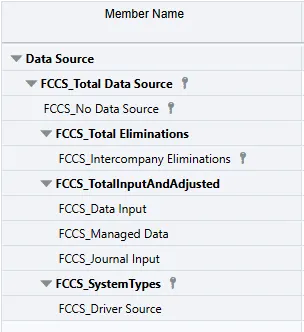
Seeded Members in Data Source Dimension

Seeded Members in Entity/Intercompany Dimensions


Seeded Members in Movement Dimension

The Movement dimension follows a distinct naming convention for its seeded members. Movement members within the FCCS_Movements hierarchy are prefixed with “FCCS_Mvmts_”, while members within the FCCS_CashFlow hierarchy are prefixed with “FCCS_CashFlow_”. As with all seeded members, the alias can be modified, but all other attributes remain unchanged.
Why Understanding Seeded Members is Useful
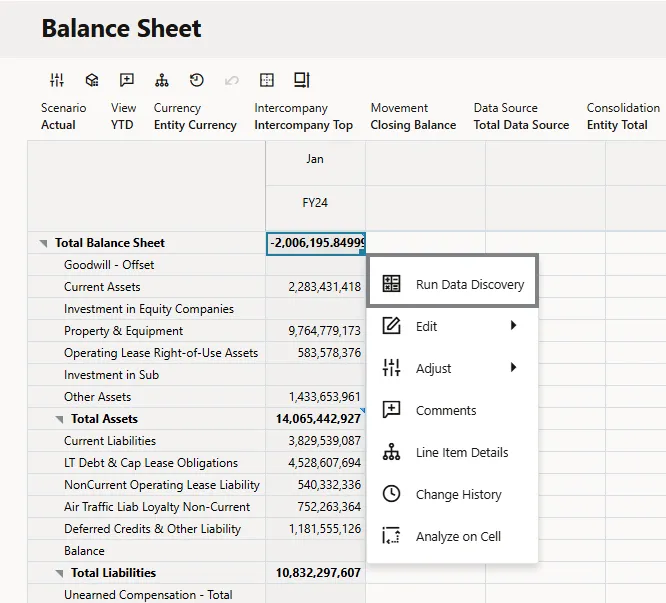
From an implementation perspective, seeded members are extremely helpful when troubleshooting consolidation results. A Smart View retrieval including the following members can reveal the full calculation path:

This makes it easier to determine whether a variance originates from ownership adjustments, elimination entries, or other consolidation calculations.
Seeded members in FCC are an integral part of the consolidation engine — and a clear understanding of their interactions is what elevates analysis from a basic review of numbers to an accurate and confident interpretation of consolidation results.